


News
Plans to boost mobile coverage in Carmarthenshire’s worst served areas


PEMBROKESHIRE residents who travel regularly into neighbouring Carmarthenshire will be pleased to learn that The Shared Rural Network is set to improve 4G coverage. Customers from all mobile networks benefit, the local authority said this week.
The council explained that demand for faster Internet speeds and better connectivity shows no signs of slowing, with Carmarthenshire becoming a county that is increasingly reliant on digital infrastructure for both work and everyday life. Despite the requirement for mobile connectivity as a daily necessity, the urban-rural digital divide still poses a challenge locally, however this is now being firmly addressed.
The Shared Rural Network (SRN) is a collaboration of Mobile Network Operators and UK Government initiatives, working together to improve 4G mobile coverage for communities in poorly served rural areas across the region. The SRN is one of the many projects being delivered across Carmarthenshire as well as Pembrokeshire, Swansea and Neath Port Talbot as part of the Swansea Bay City Deal’s Digital Infrastructure Programme.
The combined initiative is set to bring an improved infrastructure that will deliver reliable 4G coverage, allowing rural businesses to prosper, providing a lifeline to emergency services as well as the many social benefits that are often lacking in harder to reach areas.
Of the 26 sites planned for Carmarthenshire, 14 new sites have now received planning permission and will be built in the first half of 2024. This includes two sites in areas which currently have no coverage at all, bringing an additional estimated £7million inward investment. This will overhaul the ‘not spots’ in Carmarthenshire, opening more online health services, more reliable access to emergency services, along with boosting the tourism and agriculture industries.

Commenting on the site plans, Cllr Hazel Evans, Carmarthenshire County Council’s Cabinet Member for Regeneration, Leisure, Culture and Tourism said, “This is a welcomed step for Carmarthenshire, at a time when becoming digitally equipped has never been so important.
“As a society, our use of the internet is continuously increasing, so having the right infrastructure in place to allow rural communities to thrive both economically and socially is a must. I am confident that these plans will safeguard the future connectivity of the county and strengthen our position across our key industry sectors.”
The environmental impact has also been carefully considered, with mobile operators sharing masts for the first time, meaning a move away from singular masts for individual services providers. This is a positive step that aims to keep the footprint on our local environment to a minimum, whilst allowing customers from all networks to benefit. Added to this, all implemented infrastructure complies with the International Commission on Non-Ionising Radiation Protection (ICNIRP), ensuring that all welfare and safety standards are adhered to.
Many more existing sites will be upgraded to allow this shared hosting and in addition to the fourteen new planned sites, a further seven more will be put forward to enter the planning process in 2024. This means a substantial levelling up of the digital divide in Carmarthenshire, allowing a larger proportion of local communities to connect to superfast broadband where fibre broadband is not yet available.
Carmarthenshire has significantly larger rural areas than other counties in the Swansea Bay City Deal region but adding to that, the topology of the land means that adding new infrastructure can add numerous complexities to what are already difficult projects. Considering those factors, the SRN investment is a substantial gain for the county, with an expected uplift to 99% mobile coverage on completion.
Cornerstone, who are acquiring planning permission and building the telecommunication sites on behalf of the Shared Rural Network, have worked closely with Carmarthenshire Couy Council.
Cornerstone’s Director of Property and Estates and General Counsel Belinda Fawcett noted, “As part of the UK Government’s multi-million-pound Shared Rural Network project we continue to develop our network of base stations to ensure the infrastructure needed by the mobile operators to improve connectivity in rural areas is available.

“Carmarthenshire Council has worked closely with us and provided essential feedback that has allowed us to understand local concerns and address these in the initial stages of our proposals.”
The positive impacts of these plans not only provide the social benefits often lacking in rural environments, but vastly improve the promotion of inward investment to the area. Through the creation of jobs, skilled, young people will be incentivised to remain in the county with better prospects and opportunities, ensuring that we have an inclusive digital landscape across Carmarthenshire, that meets everyone’s needs.
For more information, please contact: [email protected]



A PENDINE man has been jailed after admitting abducting a teenage girl, supplying her with drugs and keeping more than a thousand indecent images of children.
Richard Knight, aged 73, from Pendine, Carmarthenshire, was sentenced to three years and nine months in prison at Swansea Crown Court following what police described as a lengthy and complex investigation.
Officers from Dyfed-Powys Police were alerted in the early hours of Monday, April 11, 2022 after a distressed 15-year-old girl phoned her mother asking to be collected, saying she had taken drugs at Knight’s home.
Police forced entry to the address after receiving no answer and finding concerns for the girl’s safety. Inside, officers discovered a small cannabis grow but no occupants. It later emerged Knight had driven the girl home himself.
He was arrested shortly afterwards on suspicion of drink driving and drug offences. A further search of the property uncovered several types of controlled drugs and a number of digital devices.

During interview, the teenager told officers she had agreed to meet Knight but believed he knew her age and that she had not told her mother where she was going. She described being given various drugs, including substances hidden inside fruit pastels. CCTV later showed Knight buying the sweets before collecting her.
Digital forensic analysis revealed 1,101 unlawful images of children stored on his devices, including 122 Category A images – the most serious classification.
Drug experts valued the cannabis grow at between £6,000 and £20,000. Officers also seized six different types of Class A drugs from the address.
Guilty pleas before trial
Knight was charged with 12 offences including child abduction, possession and making of indecent images of children, and being concerned in the supply of controlled drugs.
He admitted the drug offences in April last year and later pleaded guilty to three counts of making indecent images. Although he initially denied child abduction, he changed his plea immediately before a trial was due to begin at court in January.
‘Very serious case’
Detective Constable Jon Gouldson said: “This was a very serious case involving a man who groomed a young and vulnerable girl for his own satisfaction.
“There is no doubt he knew that taking this 15-year-old into his home without parental permission was wrong.

“Taking or keeping a child under 16 without consent is a crime. There are no grey areas.
“We welcome today’s sentence and remain committed to bringing offenders like this before the courts.”
Support available
Anyone concerned about their own behaviour or thoughts towards children can seek confidential help from the Lucy Faithfull Foundation, which runs the Stop It Now service aimed at preventing abuse before it happens.

THIRTEEN volunteer crew members at Royal National Lifeboat Institution’s Angle Lifeboat Station have successfully completed a demanding week of assessments, marking the culmination of months of training and preparation.
The pass-outs strengthen the station’s operational capability and ensure the all-weather lifeboat remains fully crewed and ready to respond to emergencies across the Milford Haven Waterway and the wider Pembrokeshire coast.
Three crew members – Anthony Thomas, Gareth Thomas and Nathen Houston – qualified as All-weather Lifeboat (ALB) Navigators after completing a four-hour practical and theory assessment.

Their test covered a range of search and rescue scenarios, including simulated taskings, radar work, position fixing and traditional paper chart navigation – all skills vital during poor visibility and challenging sea conditions.
A further ten volunteers – Phil Jones, Tom Meehan, Nick Gale, Rob Davies, Finn Frost, James Findlay, Allen Price, Seymore Phillips, Graham Booth and Matt Nicholas – passed their Tier 2 ALB Crew assessments.
The qualification tests every aspect of lifeboat operations, from man overboard recovery and towing to mooring, berthing, helming and anchoring. Candidates were put through their paces by an RNLI assessor in realistic scenarios designed to mirror live shouts.
Station representatives said the results reflect the commitment and professionalism of the volunteer crew, many of whom balance training with full-time jobs and family life.
The latest qualifications come as the Angle crew continue to play a crucial role in rescues around Milford Haven and the south Pembrokeshire coastline, one of the busiest and most complex maritime areas in Wales.
A spokesperson said the achievements “demonstrate the dedication of our volunteers and the continued strength of lifeboat operations from the town of Milford Haven.”

With 13 newly qualified crew now ready to serve, the station is better equipped than ever to respond when the pager sounds.

A NEW tax on long-vacant plots of land could be introduced in Wales in a bid to force stalled housing sites back into use and speed up housebuilding, ministers have confirmed.
The Welsh Government and the UK government are preparing a joint consultation on devolving powers that would allow Wales to create a vacant land tax targeting sites that have planning permission but remain undeveloped.
Ministers say the move is aimed squarely at discouraging “land banking” — where land is bought and held in the hope its value will rise, rather than being built on — a practice they argue is worsening the housing shortage.
Research commissioned by the Welsh Government previously identified 456 “stalled” sites across Wales, including 376 earmarked for homes, that have failed to progress.
Finance secretary Mark Drakeford said the proposals were about behaviour, not revenue.
“This is not about raising money but changing behaviour and getting more houses built,” he said. “A tax on land that has been designated for development but has not yet been developed could encourage building within expected timescales.”
The powers would first need to be transferred from Westminster before any levy could be introduced by the Senedd Cymru.
Consultation expected
At Westminster, Welsh Secretary Jo Stevens told MPs the change would have a “positive and tangible” impact.
She said: “There are pockets of land being held for ever and ever and we need to bring them back into use.”

Officials have indicated the consultation will be launched soon, though it is not expected before the next Senedd election.
Any new tax would require approval from both Houses of Parliament and the Senedd before coming into force.
Political divide
The plans come as housing supply remains a major political battleground ahead of the election, with Plaid Cymru and other opposition parties pressing Labour to go further on devolution and regeneration powers.

First Minister Eluned Morgan has previously called for additional powers and funding from Prime Minister Keir Starmer, saying Wales needs more tools to tackle housing and infrastructure challenges.
Plaid Cymru has welcomed the consultation, though it argues Wales should also gain control over areas such as rail and the Crown Estate.
Stevens rejected calls to devolve the Crown Estate, warning it could disrupt investment and delay offshore energy projects.
Opposition scepticism
Welsh Conservatives questioned whether the proposals would deliver real change.
Shadow finance spokesman Sam Rowlands said ministers must provide clear data and timescales.
“If this is truly about building more homes rather than raising revenue, ministers should be upfront with the Welsh public about the impact,” he said. “Warm words are not enough.”
Ministers insist the aim is to encourage regeneration, prevent dereliction and unlock brownfield land for affordable homes — particularly in towns where unused plots have remained empty for years.
If approved, Wales would join a growing number of governments looking at fiscal measures to push developers to build sooner rather than later.
The proposal is not new. The Welsh Government first identified a vacant land tax as a priority back in 2018, when ministers began formally requesting powers from Westminster to introduce it. Research published by Senedd Cymru shows those discussions dragged on for years, with talks repeatedly stalling as the UK Treasury sought further evidence and clarification, leaving the plans effectively at an impasse. At one stage ministers said six years had passed with little progress. The latest joint consultation therefore marks the first real movement in nearly a decade — and could finally unlock a policy long promised as a way to bring derelict and unused sites back into productive use across Wales.



Crime1 day ago
Publican admits supplying cocaine and cannabis at Crown Court
Admits cocaine and cannabis supply but denies intent and cash allegations A MILFORD HAVEN pub landlord has admitted supplying cocaine...


Local Government1 day ago
Plaid win in Fishguard North East by-election
PLAID CYMRU has taken the Fishguard North East seat on Pembrokeshire County Council following this week’s by-election. Billy Shaw was...


News2 days ago
Man to return to court over alleged harbour collision
Three charges relate to navigation of vessel in Milford Haven A NEWPORT man is due to return to court later...


Business3 days ago
Computer Solutions Wales under fire from customers
Claims of unreturned devices, unpaid refunds and small claims court cases as company blames landlord dispute CUSTOMERS across west Wales...


News3 days ago
Starmer under fire as aides quit and Scottish Labour leader calls on him to resign
Two senior Downing Street exits in 24 hours as Anas Sarwar breaks ranks, but ministers insist the Prime Minister is...


News3 days ago
Fresh concerns over £60m A40 scheme after resurfacing works just months after opening
QUESTIONS are being asked about the condition of the newly-opened A40 Llanddewi Velfrey to Redstone Cross carriageway after sections of...

Charity3 days ago
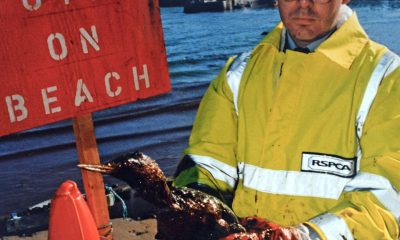
RSPCA looks back at the Sea Empress oil tanker disaster 30 years on
Charity reflects on one of the biggest environmental disasters to hit UK IN just a few days time it will...


Crime4 days ago
Pembroke Dock man admits threatening to hack woman’s head off with sword
Court imposes strict bail conditions and bans contact with named individuals ahead of sentencing A PEMBROKE DOCK man has admitted...


Crime5 days ago
Teenager remanded after teacher injured in knife incident at Milford Haven school
Fifteen-year-old charged with Section 18 grievous bodily harm and possession of a bladed article appears before Swansea magistrates A FIFTEEN-YEAR-OLD...


Crime5 days ago
Police confirm teacher was stabbed at school as teenager appears in court
15-year-old charged with Section 18 GBH with intent and possession of a bladed article on education premises POLICE have confirmed...
-

 Health7 days ago
Health board targets rise in steroid and gym drug use across west Wales
-

 Health22 hours ago
Health Board to decide future of nine key services at two-day meeting
-

 Crime7 days ago
Teacher injured and teenager arrested for attempted murder at Milford Haven School
-
Business3 days ago
Computer Solutions Wales under fire from customers
-

 Business6 days ago
Six-figure negligence victory leaves retired builder trapped in divorce limbo
-

 News7 days ago
Reform appoints Dan Thomas to lead party in Wales
-

 Sport7 days ago
Wales name squad for Six Nations opener against England
-

 Business5 days ago
Minimum alcohol price to rise by 30 per cent as retailers warn of border impact