


Business
Philanthropy support to ‘generous generation’ could unlock money for society


PRO BONO Economics research estimates that there are around 230,000 people under 35 in the UK with net financial assets exceeding £100,000
Nearly all wealthy young people surveyed express a strong desire to have a positive societal impact with their money, with 88% already donating to charity
However, around 110,000 wealthy people under 35 may not have a relationship with a financial or wealth adviser at present.
New research reveals that, while a significant percentage of young people in the UK are keen to contribute to good causes, many are not receiving advice on how best to invest their money.
The research, by Pro Bono Economics (PBE)1, found that while there are around 230,000 people under 35 with net assets exceeding £100,000, roughly 110,000 of those may not be in contact with a financial or wealth adviser.2
As well as unlocking large charitable donations, providing philanthropy support for young wealthy clients would be a significant growth opportunity for financial advisers given their ability to understand and cater to the philanthropic inclinations of what PBE has coined the ’generous generation’ and build long-term relationships with the high-net-worth individuals of the future.
To address this issue PBE brought together the Financial Conduct Authority, the Treasury, and the Department of Culture Media and Sport, as well as an alliance of accredited bodies, government entities, and philanthropy experts, to enhance philanthropy training for advisers.3

An estimated £5.5 trillion is expected to be passed down to younger generations over the next 20 to 30 years – the so-called ‘Great Wealth Transfer’. Financial advisers and firms seeking to attract the business of the 230,000 under-35s who already possess net financial assets exceeding £100,000 will need to adapt.
Encouragingly, 88 per cent of wealthy young people already donate to charity and PBE found that 90 per cent of those surveyed expressed a strong desire to have a positive societal impact with their money. With this generation giving more to charity – and in greater numbers – than ever before, financial advisers will need to tap into their philanthropic instincts.4 Last year 38% donated more than £2,000 to charity last year, compared to 5% of over-55s. This makes them eight times more likely to have made a substantial gift to charity or charities. Despite straitened times, 63% of those surveyed said they would consider increasing their charitable donations, compared to 13% of over-55s.
While this generation is also more likely to seek financial advice – 78% compared to 61% of those over 55 – more than half of wealthy under-35s also indicated they would be more likely to choose a financial adviser who offers philanthropy advice.
One compelling route to engaging with younger clients and potential clients on their giving is through Donor Advised Funds, a convenient charitable giving vehicles which can be funded through cash, shares or third-party entities. Encouragingly, 65% of under 35s5 said they would be interested in investing in a DAF in the future.

Sisters Lauren Gupta and Becky Holmes founded the Helvellyn Foundation, which provides philanthropic grants to individuals and organisations involved in biodiversity and the education of young people. When they first started they found almost no philanthropic advice from financial advisers.
Becky said:
“I found that most advisers focused on just growing your money, with philanthropy always being a secondary consideration. That immediately lost me because that’s not the go-to motivation for everyone. It’s a big deal to push against the status quo – it’s very difficult to get out of that box. A lot of wealth advisers will also not talk about the impact of how money is invested for fear of offending clients, such as whether it will be to the detriment of a habitat or a community.

“My advice to people wanting to give philanthropically is to speak to foundations in the UK and other people who have had that experience before speaking to advisers.”
Lauren said:
“We all live in a society affected by global issues, and advisors need to talk about how wealth management can impact, positively or negatively, these issues. But they don’t seem to offer that, it’s presumed that you are looking to preserve and grow the wealth regardless of the impact – there’s such a protective mindset on it.
“I have also been speaking to advisers about how they engage the next generation of wealth holders, because we were not engaged by the advisers around our family. My caveat is that advice should be more holistic and impact-focused; we are probably more progressive because we didn’t get that engagement and ended up seeking more forward-thinking advice elsewhere! One thing that helped us early on was a wealth coach who talked us through the emotional as well as the planning side of wealth, which we had not seen anywhere else. To anyone thinking about giving money away, you don’t have to start big. Initially a large sum seemed scary, but now we feel more secure and are braver in what we are doing.”
David Clarke set up a project called Wealth Shared which saw 12 people decide how to spend his £100,000 inheritance.
David said:
“My mum died in 2014 and I inherited this amount of money and I had this feeling of not being comfortable with inherited wealth – I don’t think it’s how the world should work so I decided to give it away.
“I went through a thought process of wondering what to do with it, and sent out 600 letters in my local area. The task was they could do anything with the money – and they had to give it away rather than having any lasting relationship with that money – but it could go to any individual or organisation in the world. In the end the money went to organisations in the L8 postcode – an area where there’s a lot of deprivation.
“A lot more people are in a position like me and the amount of wealth inherited is going to massively increase over the coming decades. We’re also in a time where people are more socially aware. “If you’re ever in a position about what to do with the money there’s power in democratising that decision and dispersing the pressure so it’s not all on the individual.”
Nicole Sykes, Director of Policy and Communications at Pro Bono Economics and co-author of the report, said:
“This is an opportune moment for financial advisers with the Great Wealth Transfer, and the time to act is now. By championing philanthropy, advisers can ensure they remain relevant and tap into the significant good will of the generous generation.
“Firms and advisers that do not currently offer philanthropy services or limit their philanthropy offerings to the ultra-wealthy risk being left behind by demographics, demand, and by governmental action. But by evolving and embracing this challenge they can attract the next generation of clients in a competitive market and contribute to a more giving, socially-conscious society.”


PUBGOERS are being urged to leave their pint glasses behind this summer amid warnings that thefts are adding pressure to already struggling pubs.
The call comes after Jeremy Clarkson revealed that his Oxfordshire pub, The Farmer’s Dog, is losing up to 400 pint glasses a week.
Small business comparison site Bionic said the issue is not confined to one venue, with millions of adults admitting they have taken tableware from pubs, bars or restaurants.
Laura Court-Jones, Small Business Editor at Bionic, said: “Many people see taking a pint glass home as a harmless act, but the costs can quickly add up for pubs, bars and restaurants already facing rising expenses and tight margins.
“If you want to support UK hospitality and help your favourite venues thrive this summer, leave all pint glasses behind.”
Bionic said glass theft can also have consequences for customers.
Ms Court-Jones added: “Stealing glassware from a pub might seem like a minor offence, but it is still theft. Licensed premises have the right to refuse service and may bar individuals caught stealing.
“In some cases, the police may be called. While a prison sentence is unlikely for a minor offence, individuals may face a formal warning, a fine, or a criminal record.”
The company said pubs and bars can reduce losses by using CCTV, setting clear house rules, switching to unbranded glassware, and checking whether their insurance covers stolen or damaged stock.
Hospitality businesses across the UK have faced rising costs in recent years, including energy, staffing, food, drink and supplies, with many warning that even small losses can have a serious impact on margins.
Caption: Jeremy Clarkson at The Farmer’s Dog pub, where glass theft has reportedly become a major problem.


A CALL to keep a building which would partly be used a distillery at a Pembrokeshire farm which produces award-winning sheep milk-infused gin has been turned down by county planners.
In an application to Pembrokeshire County Council, Steven and Julie Ayers of Fifth Flock Spirits Ltd through agent Johnston Planning Ltd sought permission for the retention of a replacement building for farm diversification purposes incorporating a gin distillery with associated function/tasting room, reception area for farm businesses, including the distillery, a kennels and caravan site, along with offices and associated storage facilities at Nash Mountain Farm, Sardis.
Two previous similar 2024 and 2025 applications have been refused, the latest scheme removing some previous elements.
A supporting statement said the building would be used for farm diversification purposes for a number of established rural enterprises on the holding “but primarily in connection with Fifth Flock Spirits Ltd, a family run drinks company specializing in gin infused with milk derived from the resident flock at Nash Mountain”.

It said the 2023-erected building had replaced an earlier long-standing dilapidated farm building on the site, and is intended to play host to the three established farm enterprises which are run in conjunction with the main agricultural operation: Nash Mountain Kennels, Nash Mountain Caravan and Camping Site and primarily Fifth Flock Ltd.
It said internal works had yet to be completed, and, in addition to the retention of the building, the application also seeks permission for some external works which have not yet been carried out.
The statement said the Ayers family has farmed at 26ha Nash Mountain, which has a flock of 168 East Friesian sheep, for some five generations, the limited acreage meaning “the agricultural mainstay is not sufficient to sustain a viable business,” leading to the farm diversifications, with Fifth Flock the latest.
It said, in addition to the main farming operation, Nash Mountain also gains income from an on-site wind turbine, a caravan site, a boarding kennels with cattery, and Fifth Flock Ltd.
On the gin side, the statement says: “Fifth Flock Spirits Ltd Fifth Flock has operated from Nash Mountain since August 2025. It is at core currently a drinks enterprise based on the production of gin and rum infused with sheep’s milk, however, as set out in the accompanying business plan, the intention is to expand the offer into other sheep-based products to capitalise on the home flock.
“Since launching the enterprise has exceeded expectations with strong demand and accolades including A Taste of Pembrokeshire Award at the Pembrokeshire Food and Farming Awards in December 2025.
“Firth Flock currently source their gin from an independent distillery in Gorgeddan, Ceredigion however the intention, as reflected in this submission, is to develop the distilling element on-site and include it as part of an immersive visitor experience focussing on the home flock.
“Firth Flock has rapidly become a cornerstone of the enterprise at Nash Mountain and whilst the building at the centre of this proposal may have been premature there is a strong case for its retention as part of the overall rural enterprise on the holding.”

It adds that the Ayers are actively exploring diversification into other wool and sheep-based products.
The application was refused on the grounds including it was not demonstrated a countyside location was needed and there was not “sufficient evidence of a genuine and established rural enterprise necessitating the development,” adding: “In particular, the primary distilling process does not currently take place at the site and instead relies on off-site production, with only a future aspiration to relocate such activities.
“As a result, the proposal represents a speculative form of development that lacks a clear and direct functional link to the agricultural holding.”
It went on to say the scale of the proposals “introduces a level of intensity and built form more akin to a standalone commercial or tourism enterprise, rather than a modest farm diversification scheme”.
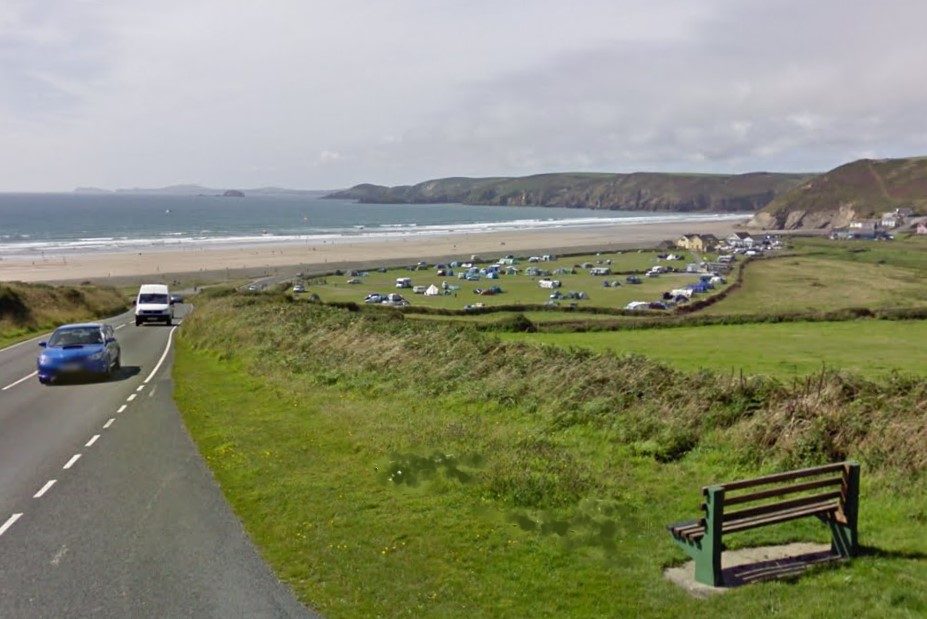
PLANS by a Vodafone phone company subsidiary to bring fibreoptic cables across the sea from Ireland to a Pembrokeshire seaside beach village in order to improve broadband coverage have been lodged.
In an application to Pembrokeshire Coast National Park, Apollo Submarine Cable Systems limited, through agent APEM Group, seeks permission for the construction of four underground telecom chambers and interconnecting ducts, along with Horizontal Directional Drilling (HDD) underneath Brandy Brook, Newgale, and the construction of one HDD bore-to-sea outfall.
A supporting statement accompanying the application says the scheme would form the onshore part of a project to bring a fibreoptic cable onshore from Kilmore Quay, Wexford, Ireland to a site at Newsurf Shop car park, Sands Café Car Park and Duke of Edinburgh Inn, Newgale.
It says the majority of the project is subterranean, with very minor above ground works are proposed, which comprise the installation of a manhole cover.
It adds: “To facilitate improved internet connectivity, the applicant is proposing the installation of a fibreoptic telecoms cable (the Beaufort cable) from Kilmore Quay, Wexford, Ireland to Newgale.
“The project is to facilitate the installation of the Beaufort cable, as it comes ashore in Wales and to link it into the wider network, which will be operated by Vodafone’s wholly-owned subsidiary Apollo Cable System Limited in the UK.”
It says the project would see three underground telecom chambers and a 120-metre interconnecting duct, the 87-metre HDD underneath Brandy Brook, launching from the receiver pit located within the Site, along with the construction of one HDD bore-to-sea outfall, in a subtidal area of Newgale bay, of approximately 920 metres, and one underground telecom chamber and interconnecting duct.
Citing a report on digital connectivity, it says 5G geographic coverage has seen improvements but is still relatively low at 57 per cent of Wales’ landmass, with 4G the primary service.
That report says there is a difference in full fibre coverage between urban and rural areas (83 per cent versus 59 per cent) and highlighting a need for further coverage.
On the scheme itself, the statement says short-term noise and disruption to local residents “is anticipated during the construction phase however this will be limited to 57 days,” adding: “The proposed drilling operations are not to be continuous and will be limited to approximately 20 minutes in each hour,” the works in total expected to last 91 days after which land will return to its former use without restrictions.
It goes on to say: “The HDD is specifically designed to mitigate the risk of any shoreward movement of the shingle bank and beach level changes. The use of HDD reduces the likelihood of potential environmental impact on the landscape and seascape.
“The project is not anticipated to interact with Brandy Brook. All drilling works will take place within excavated launch pits and all construction works will be confined to the hardstanding of the car park.”

The application will be considered by Park planners at a later date.



Crime14 hours ago
Farmers fined in bovine TB scandal face fresh court action
Hartt family members listed at Haverfordwest Magistrates’ Court over unpaid penalties linked to major cattle prosecution TWO PEMBROKESHIRE farmers convicted...


Crime18 hours ago
Pembrokeshire child killer stabbed to death in prison cell, murder trial hears
Kyle Bevan, jailed for the murder of Haverfordwest toddler Lola James, was allegedly stabbed 25 times and left ‘as if...


News1 day ago
Pendine cliff fall victim recovering after major emergency response
A 22-YEAR-OLD man who suffered serious injuries after falling from cliffs overlooking Pendine Beach is recovering well following emergency surgery....


Community1 day ago
Commissioner launches free course to help tackle ageism in Wales
A NEW free learning course has been launched to help people across Wales recognise and challenge ageism. The Older People’s...


News2 days ago
First Minister challenged over jobs for student nurses
REFORM WALES has accused the First Minister of failing to guarantee jobs for student nurses in Wales, despite continuing pressure...

Crime2 days ago
Knife blankets call as school staff face rising violence fears
GMB says protective equipment should be considered where risk assessments show staff could face blades SCHOOL staff should be given...


News2 days ago
Claire Archibald secures review of Milford Haven train times
RURAL TRANSPORT CONCERNS RAISED WITH TFW CLAIRE ARCHIBALD MS has secured a review of train times between Milford Haven and...


Crime2 days ago
PCC review calls for stronger youth crime prevention work
REPORT MAKES 13 RECOMMENDATIONS A REVIEW into crime and anti-social behaviour services for young adults has called for stronger prevention...


Crime2 days ago
Families condemn failed appeal by paddleboard boss jailed over Haverfordwest tragedy
RELATIVES SAY LATEST COURT BID HAS REOPENED PAIN AFTER FOUR DEATHS ON WESTERN CLEDDAU THE FAMILIES of victims of the...


Crime2 days ago
MPs warn overcrowded Welsh prisons are undermining safety and rehabilitation
A DAMNING report by MPs has warned that overcrowding, staff shortages and rising pressure across Welsh prisons are undermining safety,...
-
Crime6 days ago
Paddleboard company owner loses bid to cut sentence over Haverfordwest tragedy
-

 Crime5 days ago
Milford Haven man admits harassment and assault
-

 News5 days ago
Community appeal for privacy after serious emergency in Pendine
-

 Community3 days ago
Forgotten wartime archive found in Pembroke Dock attic after 80 years
-

 Crime3 days ago
Sex offender in senior role at Tenby family hotel
-
Crime2 days ago
Families condemn failed appeal by paddleboard boss jailed over Haverfordwest tragedy
-

 Business5 days ago
Call for gym and Padel courts at Kiln Park Farm unanimously backed
-

 Community5 days ago
Founders Day hailed a success despite rising costs and extra security