


Climate
Climate activists heading to Windsor with a message for the King

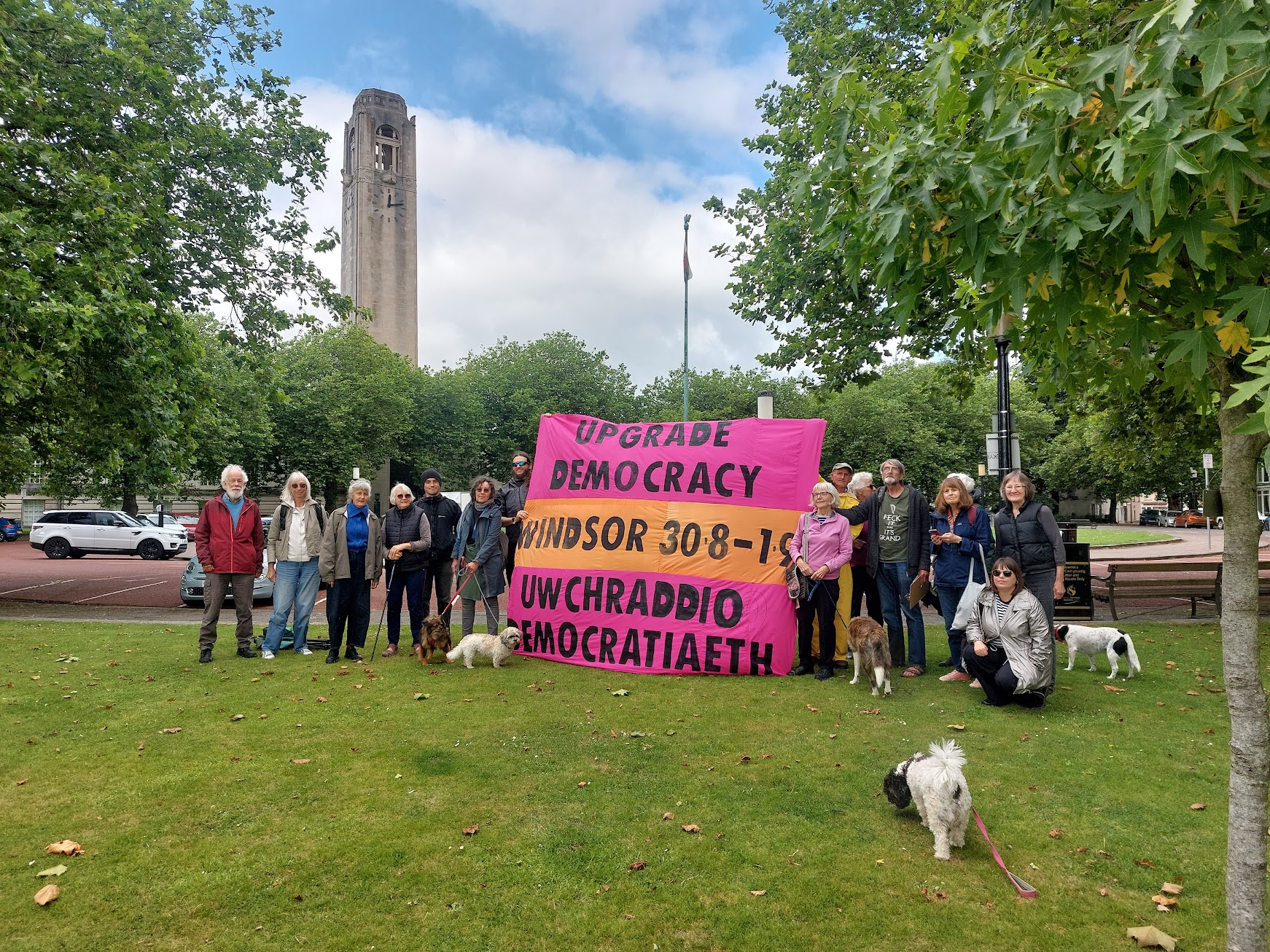
PEOPLE from West Wales will be going to Windsor at the end of August with messages for the King.
Climate activists from the area will be camping in Windsor for a fun and family friendly weekend with a very serious purpose. The weekend camp is all about ‘Upgrading Democracy’. While most people see voting and our democratic system as fundamental to good government, many also see that there are some issues which can be ‘too hot to handle’. This means it can be difficult for governments to make good decisions about them – because the politicians always have an eye on the next election, and powerful lobbyists and those with vested interests may have too much influence.
The West Wales climate campaigners will unite with thousands at Windsor in a peaceful, creative protest demanding urgent climate action and democratic reform through a Citizens’ Assembly on Climate and Ecological Justice.

One of those going to Windsor is Jane Mansfield from Pentrecagal, a grandmother, retired nurse and member of Cadernid Emlyn Resilience. She explained: “Many places in the world, including parts of Wales, Scotland, Ireland, and Great Britain as a whole, have turned to Citizens’ Assemblies as an effective way of dealing with difficult issues such as how to tackle the climate crisis.”
She added, “Our camp at Windsor (which has police and council approval) won’t be targeting a person, it will target the system. A system where money and power is concentrated in the hands of a few. Powerful business interests have corrupted our politics and media, causing denial and delay on this urgent problem. And as the planet burns, the massive profits of oil and gas companies keep on rolling in.”

The group has been taking a giant banner around various iconic sites recently to advertise the weekend in Windsor. “The banner was last seen winging its way to St. Davids, but it could turn up anywhere!” said Graham Wilson, another local climate campaigner. “We just want to get the word out so that people can come and join us, and so that more people become aware of how effective Citizens’ Assemblies can be. Look up the term through Google and you’ll see them explained and examples of how they’ve been used. They’re like juries, with people chosen at random but in a way that ensures all parts of society are represented. They don’t need to worry about getting elected and they aren’t influenced by the rich and powerful, and that means that people trust them. Through careful discussion they can come to very wise and creative solutions.”
A coach has been booked to take people to Windsor from West and South Wales on Friday 30th August and return on Sunday afternoon 1st September.
Those travelling to Windsor will be taking a bag full of messages to deliver to the King. These have been written by local members of the public in recent weeks, all expressing their hopes and fears about the climate crisis, and urging a change in the system, so that effective action can be taken.
Philippa Gibson, a volunteer at the Oxfam shop in Cardigan, who also backs the call to upgrade democracy, said, “King Charles clearly understands the plight of the planet and the urgent need for society to change course. As Prince of Wales he actively spoke out about climate change and environmental destruction. Now that he is King, he is expected to keep fairly quiet about the emergency as it is seen as too ‘political’ even though he spoke frankly at COP28 about the peril of our own survival due to climate and ecological collapse. Many people have been keen to send him their messages calling for change.“

Anyone wanting to find to find out more about the weekend and to book on the coach can contact [email protected] or 07787 197630.

Sector partnership targets 100% renewable electricity by 2035
A NEW deal has been launched to help Wales meet its renewable energy targets while ensuring greater benefits for local communities.
The Renewable Energy Sector Deal will see the Welsh Government and industry work in strategic partnership to unlock the full economic potential of Wales’ renewable energy future.
The announcement coincides with the publication of the latest Energy Generation and Energy Use in Wales report, which shows renewable electricity generation in 2024 was equivalent to 54% of Wales’ electricity consumption.
The Welsh Government has set a target for renewable electricity to meet 70% of demand by 2030 and 100% by 2035. It also aims to deliver at least 1.5 gigawatts of locally owned renewable energy capacity by 2035.
The Sector Deal is intended to accelerate deployment across onshore and offshore wind, solar, marine and hydro projects. It will also focus on strengthening supply chains, developing skills, and ensuring communities across Wales benefit directly from renewable energy developments.

Cabinet Secretary for Economy, Energy and Planning, Rebecca Evans, is launching the deal during a visit to the Morlais tidal energy project on Anglesey.
The Morlais scheme, owned and managed by social enterprise Menter Môn, is set to become the largest consented tidal energy project in Europe. The Welsh Government holds an £8 million equity stake in the project.
Rebecca Evans said: “Our ambition is to become a world leader in renewable energy, creating jobs and green growth to make families in Wales more prosperous and help with the cost of living.
“The current conflict in the Middle East has further highlighted the importance of energy independence. Our Renewable Energy Sector Deal will provide a strong foundation for future delivery, benefiting our economy, environment and energy security.
“The Morlais project shows how sustained partnership can unlock Wales’ natural energy resources and turn them into lasting economic opportunities for local communities and businesses.
“The latest energy report shows we are making progress towards our targets. Combined with the record 20 major renewable projects, totalling 1,400MW, backed in the most recent UK Government Contracts for Difference auction, it is clear we are building a more resilient, renewable-powered future.”
Dafydd Gruffydd, Managing Director of Menter Môn, added: “The Renewable Energy Sector Deal is an important step in accelerating growth in Wales and across the UK.

“It recognises the role marine energy schemes like Morlais can play in strengthening energy security, creating high-quality jobs and delivering long-term economic benefits for communities such as Anglesey.”
The Sector Deal was co-produced by a task and finish group made up of developers and community organisations.
Responding to the Welsh Government’s Renewable Energy Sector Deal, Welsh Liberal Democrat Leader Jane Dodds MS said: “This so-called ‘sector deal’ raises more questions than it answers.
“There is no clear plan for how we build the workforce needed, with no detail on training, skills or apprenticeships to deliver the green jobs Wales needs.
“Ministers also promise benefits for communities, but without minimum standards or enforcement, there is no guarantee local people will see the rewards.
“Most concerning is the lack of focus on energy bills. Families are struggling, yet there is no clear explanation of how this will bring down costs. Renewable energy should mean cheaper bills, but as long as electricity prices are tied to gas, households won’t feel the benefit, something Labour in Westminster has failed to fix.”

Bangor University scientists join £2.1m project investigating the impact of bottom trawling on carbon stored beneath the seabed
A STATE OF THE ART research vessel has set sail from Liverpool to investigate how bottom trawling may affect carbon stored in the seabed of the Irish Sea.
The scientific expedition is part of a £2.1 million research project funded by the Natural Environment Research Council and led by Professor Jan Geert Hiddink of Bangor University.
A team of eighteen scientists has embarked on the RRS Discovery, one of the world’s most advanced research vessels, for a three-and-a-half-week voyage studying the impact of fishing activity on carbon held in seabed sediments.
Before the ship departed, a number of local dignitaries were invited aboard for a tour of the vessel, including Liverpool City Region Mayor Steve Rotheram and National Oceanography Centre Operations Director Natalie Campbell.
Professor Jan Geert Hiddink, from Bangor University’s School of Ocean Sciences, said bottom-trawl fishing is both vital to global food supply and a major disturbance to seabed environments.
“Bottom-trawl fishing provides around a quarter of global seafood but is also the most extensive physical disturbance caused by human activities to stocks of carbon locked in seabed sediments,” he said.
“This is important because recent evidence suggests that disturbing the seabed could lead to the release of significant amounts of greenhouse gases from the seabed into the atmosphere.
“There are still major uncertainties about how this disturbance affects carbon stored beneath the seabed. As a result, the impact of these disturbances is largely unquantified and currently unregulated.
“The aim of this project is to gain a much clearer understanding of what is happening so that scientists, policymakers and regulators can make informed decisions in the future.”

Seven research organisations are collaborating on the project: Bangor University, the Centre for Environment, Fisheries and Aquaculture Science (CEFAS), Heriot-Watt University, the University of Leeds, Plymouth Marine Laboratory, the University of St Andrews, and Imperial College London.
Caption: Scientists prepare to begin their research aboard the RRS Discovery, one of the world’s most advanced research vessels.

Major investment expected to boost low-carbon industry and create skilled jobs in West Wales
A MAJOR green hydrogen project planned for the Milford Haven Freeport tax site has taken a significant step forward after developers approved the final investment decision.
Energy company MorGen Energy has confirmed it will proceed with the West Wales Hydrogen project, one of the first schemes backed through the UK Government’s Hydrogen Allocation Round (HAR1) to reach this stage.
The facility will be built within the Milford Haven Tax Site, part of the Celtic Freeport zone covering Pembrokeshire and Neath Port Talbot.
Construction is expected to begin in 2026, with the plant scheduled to become operational in early 2028.
Once completed, the site is expected to produce around 2,000 tonnes of low-carbon hydrogen each year, meeting the UK’s Low Carbon Hydrogen Standard.

The hydrogen produced will support a range of industries, including port operations, manufacturing and industrial heating, as well as use as a chemical feedstock.
Supporters say the development will help reduce carbon emissions while strengthening Milford Haven’s role in the UK’s emerging hydrogen economy.
The project is also expected to create skilled jobs and provide work for local contractors during the construction phase.
Further expansion may be possible in future phases as demand for hydrogen grows, potentially helping establish Milford Haven as a major hub for low-carbon energy production serving South Wales and beyond.

Luciana Ciubotariu, Chief Executive of Celtic Freeport, said the decision marked another milestone for the region.
She said: “MorGen Energy’s decision is another major step forward for the hydrogen economy in South West Wales.
“Projects like this within the Milford Haven Tax Site show how the Celtic Freeport is accelerating decarbonisation while creating high-value jobs.”

The UK Government’s Hydrogen Allocation Round scheme provides revenue support to help scale up the country’s low-carbon hydrogen sector and bring early projects to market.



Education10 hours ago
Milford Haven school plans unveiled but funding not yet secured
PLANS for a new £100 million school in Milford Haven have been unveiled, but the project has not yet secured...


News11 hours ago
Council unveils plans for new state-of-the-art secondary school in Milford Haven
PEMBROKESHIRE COUNTY COUNCIL has revealed plans for a new state-of-the-art school in Milford Haven, promising modern, inspiring learning spaces for...


Health14 hours ago
NHS waiting list falls — but cancer delays and diagnostic backlog worsen
Record progress claimed by Welsh Government as critics warn key targets are still being missed THE NHS in Wales has...


Crime2 days ago
Rapist jailed after ‘abhorrent’ attacks on woman and children
Haverfordwest man told police “women won’t have sex without force” A HAVERFORDWEST man who raped a woman and a young...


News2 days ago
Reform secures first Pembrokeshire councillor in Hakin by-election win
Late Reform candidate takes seat as independent surge and Labour withdrawal shape contest REFORM UK candidate Scott Thorley has won...


News2 days ago
Scott Thorley elected as Pembrokeshire’s first Reform councillor
REFORM UK candidate Scott Thorley has won the Hakin by-election after securing 179 votes. The full result is as follows:...


News2 days ago
Police confirm man has died after being recovered from River Cleddau
Major emergency response in town centre after concerns raised for man in water A MAN has died after being recovered...


Community2 days ago
Davies and Kurtz urge groups to seek employability funding
Community organisations in Pembrokeshire encouraged to apply for new grants supporting skills and job access LOCAL Senedd Members Samuel Kurtz...


News2 days ago
Emergency services flood Haverfordwest after reports of person in river
Town centre sealed off as multi-agency response continues A MAJOR emergency response is underway in the centre of Haverfordwest after...


News2 days ago
Detectives receive surge of new information in bid to identify man found at Powys reservoir
Public response follows release of facial image as officers pursue fresh lines of enquiry DETECTIVES investigating the identity of a...
-

 Health7 days ago
Welsh Ambulance Service to host bi-monthly Board meeting
-

 News6 days ago
Rayner and Lammy visit Wales to discuss justice and community safety
-

 News5 days ago
Fishguard linked to allegations in Many Tears Animal Rescue investigation
-
News2 days ago
Emergency services flood Haverfordwest after reports of person in river
-

 Local Government6 days ago
Investigation confirmed after inspectors visit Many Tears Animal Rescue
-

 Community7 days ago
Local charity hosts cancer awareness event in Cardigan
-
 Business7 days ago
Work set to begin on £50m hydrogen plant in Milford Haven
-

 Farming7 days ago
Plea to remove decades old ‘unviable’ planning conditions from property