


Community
The life of a crime scene cleaner: Ben Giles shares his harrowing experiences


SOME of the images that Ben Giles has confronted over the past three decades have been stomach-churning.
He’s seen the brutality of murders, corpses left to rot for weeks on end, young children who have been mauled to death by dogs, victims of fatal car crashes, and an ever-increasing number of tragic suicides.

As he tackled each new scene as founder and director of Ultima Cleaning, Ben’s sole focus was on ensuring that the job was executed professionally. But it was only when he began working on his recently published book The Life of a Crime Scene Cleaner, that the true extent of those harrowing experiences began to hit home.
“Arriving at a crime scene, my main drive was to get the job done properly, but this meant not really thinking about what had happened,” Ben told The Pembrokeshire Herald.
“It was only when I began working on the book and started going over some of the scenes I’d confronted that I began to realise what some of those families had gone through.

“Yes, some of the things I’ve seen have been horrific.”
One image that will never leave Ben is that of a middle-aged woman who had been bludgeoned to death by her husband at their home in Birmingham.
“It made me realise that people sometimes die in ways that we don’t think possible,” he said. “I’d recently got married, and I just couldn’t accept how anything like this could happen between a husband and his wife.”
The woman had survived for three days on the kitchen floor but sadly died as she was being taken to hospital by ambulance. The entire room in which she’d been murdered was covered by a fine mist of blood, and bloody handprints and fingerprints were all over the kitchen units. The drawers had blood inside them and their runners, while the washing machine had so much blood on it that it had seeped into the door and into the seal.

“In a few hours, we’d completely cleaned the room and were travelling back home to our own wives and families. But the emotion that we were all feeling as a team will never leave me.”
Dealing with the unimaginable
On another occasion, Ben and his team were asked to attend a property in Penrhiwllan, near Newcastle Emlyn, where a man had lain dead for eight weeks.
“The smell was horrendous,” recalls Ben. “His face and legs had been eaten by his dog, and the man had begun decomposing through the carpet. His body fat had gone into the concrete. There were swarms of bluebottles everywhere.

“This was one of the very first biohazard cleaning jobs I’d ever done, so obviously the expectations were considerable. And in those days, we didn’t have Google to refer to, so it was a question of using our own knowledge and initiative to ensure the job was done well.”
Building a business from scratch
In many ways, this strong sense of self-belief has been the undercurrent of Ben’s life journey.
He left school at the age of 16 with a handful of GCSEs and no inclination to pursue further education.
“I knew I wanted to carry on living here in west Wales but I also knew that the qualifications I had weren’t going to get me the job or the salary I wanted,” explains Ben.
And so he set up his own window cleaning business.
“I managed to make a success of it,” he explains. “By the time I was 17, I was earning more money than my schoolteachers, and when I was 18, I was able to buy my first house and car.”
That same year, Ben decided to diversify into different methods of cleaning, focusing on offices and schools. By the time he was 23, he had a workforce of 20 people.
His first job came courtesy of a client who worked with the Aberystwyth branch of Age Concern.
“She told me that a warden-assisted flat hadn’t been cleaned for ten years. The bath was full to the brim with human faeces, as was the toilet, and the place was crawling with flies. Both the flats on either side were empty because of the smell.
“We cleaned the property that same day for a fee of £2,000, and I knew that by deodorising it and doing everything possible to clean it, we’d created an opportunity for the other flats to be let out too.”
A business built on expertise
Under Ben’s directorship, Ultima has been split into three categories:
- Ultima Cleaning, specialising in crime scene and biohazard cleaning;
- Ultima Academy, which offers specialist biohazard training to organisations such as police and prison officers, British Aerospace, and immigration officers;
- Ultima’s Environmental Network, facilitated by some 400 operatives throughout the UK.
The company has also worked closely with leading pharmaceutical companies to develop pioneering cleaning materials for severe cleanup operations, while a mental health specialist is always on hand to support any staff members affected by their work.
Ultima remains the sole British company that can offer a two-hour call-out, operating from its centre in Newport, Gwent.
Selling Ultima Cleaning
In 2022, Ben made the difficult decision to sell Ultima Cleaning.
“When COVID hit, I was going to bed at 3am and waking up at 6, when there’d be 20 jobs already in, waiting to be sanitised. We were absolutely everywhere, and it nearly exhausted me and the team.
“So I suppose it was this that made me take stock of where I am today.
“Over the years, it’s become obvious that people love hearing about the work we do as loads of people love crime, and the most popular question I get asked has to be ‘What’s the worst thing you’ve ever had to clean up?’
“But people are also interested in my own personal journey.
“And this is why I decided to write the book. OK, so I’m a much better cleaner than I am a writer, but I’ve always kept a diary of my jobs, and this has helped me to select between 30 and 40 of the most interesting ones for the book.
“At the end of the day, I’m a normal guy from Cardigan who’s worked hard, who’s had a firm belief in everything I’ve done, and who’s succeeded.
“But the business has made me appreciate my life, my family, the wonderful people around me, and my home near Cardigan.
“Ultima has taught me a great deal about life, but perhaps the greatest thing is to forget the word ‘no’. If I’d said no to so many of those jobs over the years, there’s no way I’d be where I am today.”
The Life of a Crime Scene Cleaner is available from Amazon on Kindle (£7.99) and paperback (£15.99).



Giant puppet begins historic journey marking 850 years since the first Eisteddfod
MIST swirled around St Davids Cathedral on Friday evening as a giant Lord Rhys puppet emerged from the fog to begin a journey celebrating 850 years since the first recorded Eisteddfod.
Accompanied by traditional musicians and followed by crowds of spectators, the towering figure cut an imposing sight against the backdrop of the ancient cathedral.
The procession marked the start of Taith yr Arglwydd Rhys (The Journey of Lord Rhys), a cultural pilgrimage retracing the legacy of the Welsh prince whose gathering of poets and musicians at Cardigan Castle in 1176 is widely regarded as the first recorded Eisteddfod.
As fog drifted across the city and church towers faded into the background, the scene felt more like a chapter from Welsh folklore than a modern-day celebration.
The giant puppet, accompanied by fellow performers and musicians, travelled from St Davids Cathedral to Oriel y Parc before beginning a wider journey through west Wales.
The travelling celebration will visit communities across Pembrokeshire and Ceredigion before culminating in Cardigan, where Lord Rhys originally staged his famous cultural gathering eight and a half centuries ago.
Video and photographs shared by DrifterStDavids captured the remarkable atmosphere, with many describing the spectacle as one of the most memorable cultural events seen in St Davids for years.
Photo caption: Lord Rhys emerges from the mist outside St Davids Cathedral as celebrations begin to mark the 850th anniversary of the first recorded Eisteddfod
(Pic: SmallWorld – Video: Drifter St Davids)

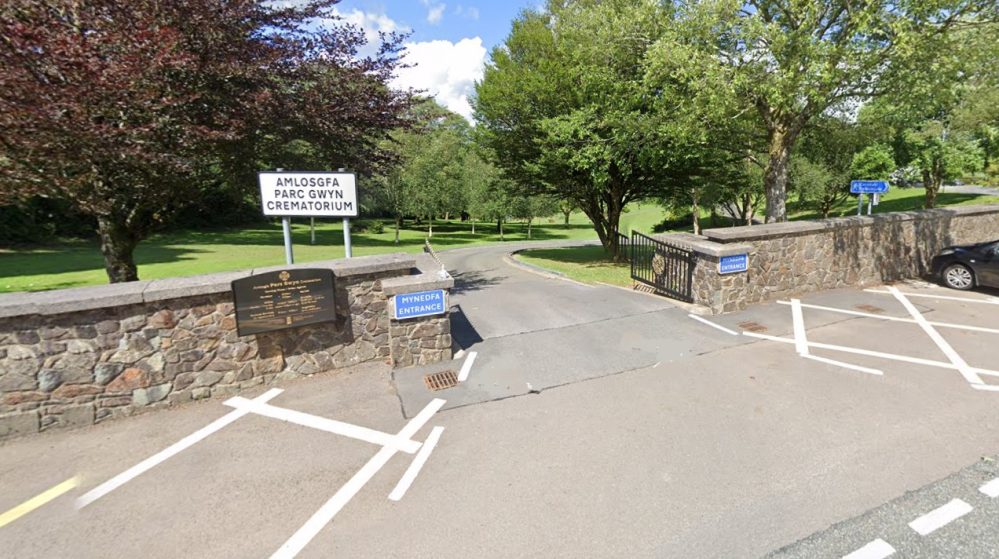
A RECENT decision by senior Pembrokeshire councillors on a review in the way crematorium services in the county will be delivered is to be revisited following a ‘call-in’ by members of the Conservative group.
At a special meeting of Pembrokeshire County Council’s Cabinet to be held on June 22, members will consider a May Cabinet decision on crematorium services in the county.
A report for members says at the March meeting of the council’s Services Overview and Scrutiny Committee it was resolved to recommend that Cabinet undertake a review of fees and charges at Parc Gwyn Crematorium, with particular regard to the cost of direct cremation, and that Cabinet commission a comprehensive review of the crematorium’s future operational model, with the findings to be reported to the committee for consideration and scrutiny prior to any final Cabinet decision.
At the May meeting of Cabinet, members agreed to review fees and charges at Parc Gwyn along with a review of service delivery, efficiency and value for money, excluding alternative operating models, the report says.
An extraordinary meeting of Services Overview and Scrutiny Committee was held in response to a call-in from 11 councillors, all member of the council’s Conservative group, saying the Cabinet report materially altered the original scrutiny recommendation, the decision was not supported by sufficient evidence or benchmarking, financial considerations relating to “surplus” and “profit” were improperly weighted, alternative operational models were prematurely excluded, and that further scrutiny is required.
That committee agreed the matter be referred back to Cabinet for reconsideration.
The report for Cabinet members says: “Members who requested the call-in were dissatisfied with the way the issue was presented to Cabinet in regards to the second recommendation, which although was presented in full in the Cabinet paper, the officer recommendation removed the element relating to the review of the operating model.
“Members queried if Cabinet were given a fair opportunity to consider the merits of a full operational review. It was suggested that the officer report led Cabinet towards their conclusion by recommending against the operating model review.
“Whilst referral was made to the call-in not being in relation to privatisation, members in the previous services overview and scrutiny committee meeting had discussed this as a potential future option which resulted in the recommendation to review the operating model.”
The report says there “are well-established and unavoidable cost factors associated with any change in delivery model,” adding: “Should Cabinet now agree to include this aspect of the recommendation, Members should be aware that this will require the commissioning of an external consultant to carry out the review, expected to cost an estimated £30,000, financed from existing crematorium reserves.”
Members are recommended to review the previous decision.
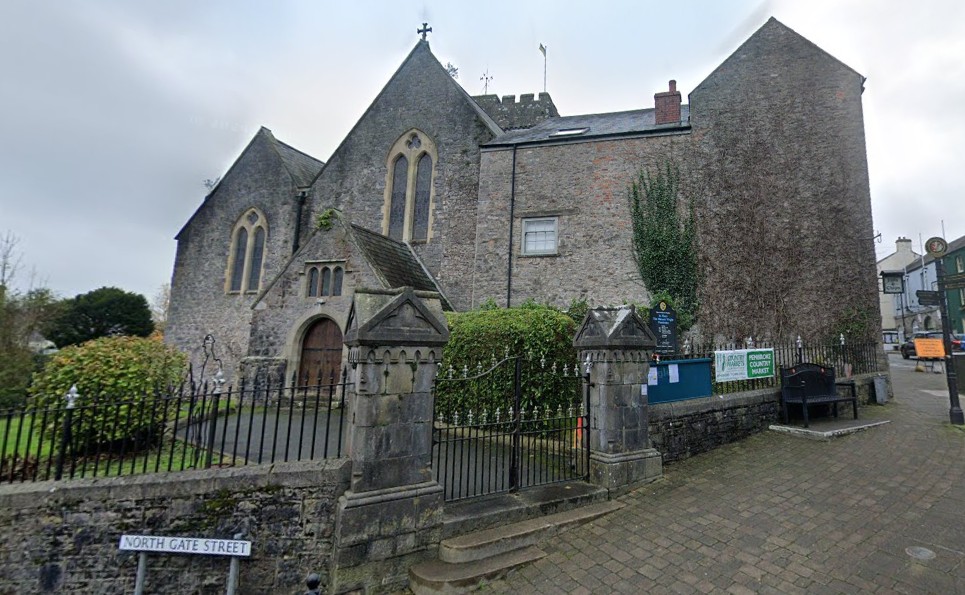
A CALL for works at a historic Pembrokeshire town centre church to make it more accessible has been submitted to county planners.
In an application to Pembrokeshire County Council, The Parochial Church Council of St Mary’s Church, Pembroke, through agent Arnold Bartosch Ltd, is applying for the removal of existing steps with replacement steps and a ramp at the grade-I-listed church.
A supporting statement says the church, heavily restored in the 19th century, “is thought to have been built for Gilbert de Clare, first Earl 1138-48 or his son Richard Strongbow, 1148-76, but is likely to be contemporary with the major building at the castle by William Marshal, first in Pembroke between 1204, and 1219”.
Of the proposed scheme it says: “The current access consists of a sloping pathway and three steps up. The steps deny access to the church for wheelchair users and those with impaired mobility. The proposed arrangement will provide a level platform allowing access for all into the church and churchyard.”
It adds: “The existing access from the churchyard into the West Porch also consists of steps. The proposals will include for the installations of a new landing at the west doorway which will provide access for all into the church.”
The west entranceway was itself listed back in 2005, as grade-II.
The supporting statement adds: “The access should be altered as it currently restricts access for all. The alterations will improve public access of the church whilst retaining the grade-II-listed piers and gates. The alterations will be carried out to a high standard befitting a grade I Listed Church setting and grade-II-listed gates and railings.
“The relocation will involve minimum disruption and no loss of historic fabric. We believe this proposal is acceptable and a reasonable part of the site’s evolution concurrent with modern requirements and can be justified as minimal harm.”
The application will be considered by county planners at a later date.
A successful fundraising campaign was held at St Mary’s for the restoration of three church bells and associated works, with a blessing of the bells service and dedication taking place back in May attended by the Rt Revd Dorrien Davies, Lord Bishop of St Davids, new mayor of Pembroke Cllr Jonathan Grimes and Mayoress Cllr Deborah Willcocks.
The three new bells dedicated were the Lingard Family Bell, the Rogers Family Bell, and the Morgan Bell.



Community2 hours ago
Lord Rhys emerges from the mist in St Davids
Giant puppet begins historic journey marking 850 years since the first Eisteddfod MIST swirled around St Davids Cathedral on Friday...

News1 day ago
Tragic tribute paid to Haverfordwest man after A4075 collision
FAMILY REMEMBERS “KIND AND LOVING” CALLUM HANSON THE FAMILY of a 22-year-old man from Haverfordwest who died following a road...

News2 days ago
Motorcyclist, 22, dies in A4075 crash in Pembrokeshire
A 22-year-old woman remains in hospital after two-vehicle collision A MOTORCYCLIST has died following a serious two-vehicle crash on the...

Community2 days ago
Why police will be visiting every home in Pembrokeshire
New operation aims to knock on more than 257,000 doors across Dyfed-Powys over the next three years DYFED-POWYS POLICE has...


Crime2 days ago
Prisons at breaking point: MPs warn Wales is paying the price of a failing system
Frozen healthcare budgets, overcrowded jails, homelessness on release and mounting pressure on staff are undermining rehabilitation across Wales, according to...


News3 days ago
Brexit at 10: How Britain was sold a dream that cost us dearly
A decade after the referendum, the promised benefits remain hard to find while the economic costs are increasingly difficult to...


Crime3 days ago
Worcestershire man jailed after violent attack on woman in Tenby
Defendant was already serving a suspended sentence when serious assault took place A WORCESTERSHIRE man has been jailed for more...


Climate3 days ago
Offshore wind ‘could bring new generation of jobs to Milford Haven’
Pembrokeshire ports and Celtic Sea projects placed at centre of Wales’ green energy ambitions MILFORD HAVEN and Pembroke Dock could...


Community4 days ago
Police officer hailed hero after midnight sea rescue in Milford Haven
PC swam 100 metres offshore to save distressed woman heard calling for help in darkness A DYFED-POWYS POLICE officer has...


Local Government4 days ago
Security privately arranged by Mayor at Beating of the Bounds
HAVERFORDWEST TOWN COUNCIL has confirmed that security personnel seen at this year’s Beating of the Bounds were privately arranged and...
-

 Community6 days ago
Pembrokeshire Chess Club crowned Welsh champions
-

 Crime2 days ago
Milford Haven man jailed for breaching domestic violence protection order
-
Local Government4 days ago
Security privately arranged by Mayor at Beating of the Bounds
-

 News2 days ago
Crash on Freeman’s Way causes school-run chaos across Haverfordwest
-

 Crime4 days ago
Man wanted by court after failing to attend hearing over alleged shop thefts
-
 Crime4 days ago
Man banned from roads after drink-driving offence
-

 Crime4 days ago
Man jailed after admitting strangulation and assaults
-
 Crime4 days ago
Man sentenced over stalking campaign and lock knife offence