


News
Fury as ex-MP Simon Hart handed peerage


Tell-all book and Nazi graffiti scandal reignite calls for answers
FORMER South Pembrokeshire MP Simon Hart is facing mounting criticism over his appointment to the House of Lords—amid fresh outrage over his decision to publish a revealing political memoir and lingering questions about the “swastika saga” involving defaced campaign material once in his own possession.
Hart, who was MP for Carmarthen West and South Pembrokeshire from 2010 until he stood down last year, appeared on Rishi Sunak’s resignation honours list and is now set to take a seat in the Lords. But his peerage has sparked anger from senior Conservatives, who say Hart breached trust by publishing ‘Ungovernable: The Political Diaries of a Chief Whip’, which contains personal and salacious anecdotes about MPs who confided in him while he held one of the most sensitive roles in government.
The Herald understands that at least one sitting Tory MP wrote to the House of Lords Appointments Commission (HOLAC) in an attempt to block the nomination, arguing Hart had violated the Nolan Principles—guidelines designed to maintain integrity in public life.

In the book, Hart recounts incidents involving MPs caught in compromising situations, including one who allegedly called the whips’ office for help after becoming stranded in a brothel. Critics say the publication undermines the confidential nature of the whips’ office, which exists partly to offer pastoral support to MPs during times of personal crisis.
Former defence minister Sir Alec Shelbrooke branded the book “appalling” and said it risked breaking the trust that Parliament depends on: “If MPs can’t trust the whips, the system will break down,” he said.

But questions about Hart’s judgement don’t stop there.
Back in 2019, The Pembrokeshire Herald revealed that Hart had shared an image of a defaced campaign poster—infamously bearing the phrase “WILL STARVE YOUR NAN AND STEAL HER HOUSE!”—which had been further altered with Nazi swastikas at some point between its original appearance in 2017 and its reappearance two years later during Hart’s re-election campaign.

Mr Hart had kept the already-defaced poster in his personal possession during that time, and critics pointed out that the two swastikas—absent from the original image—were added while the sign was no longer in public display. Hart refused to explain the additions, dismissing questions from the Herald as “totally outrageous” and claiming it was political mischief by opponents.
Local campaigner Jim Scott, who spotted the differences between the 2017 and 2019 images, asked: “Who had access to the sign in those two years? And why were the swastikas added later?”
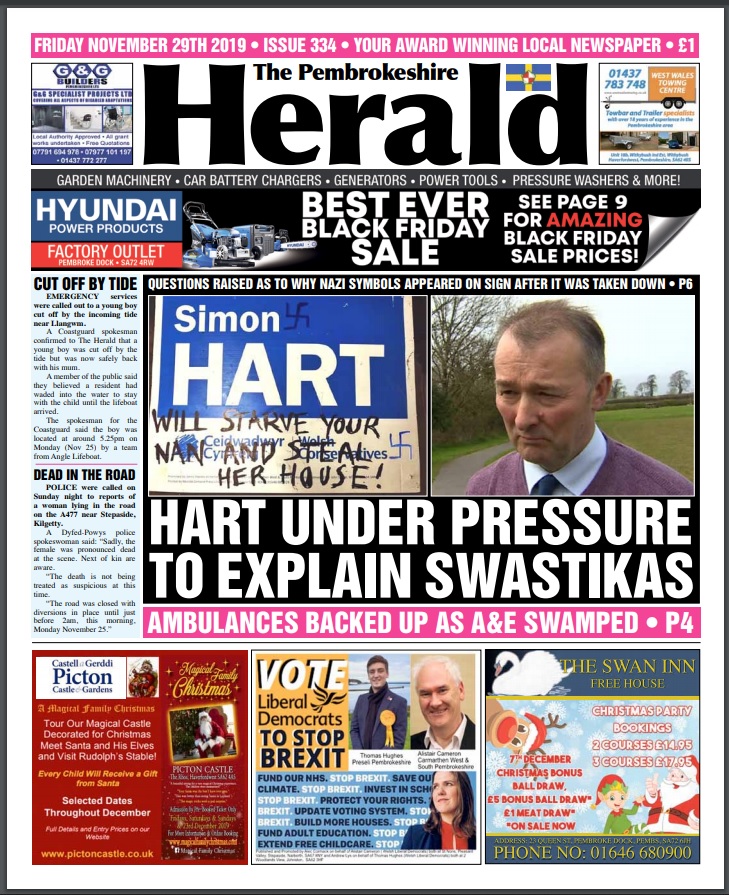
The incident caused national embarrassment and raised eyebrows in Westminster, especially as Hart leveraged the graffiti controversy to campaign for civility in politics and even secured a seat on the parliamentary Standards in Public Life Committee on the back of it.
Despite these controversies—and his refusal to address them publicly—Hart has now been rewarded with a life peerage.
One former Tory MP told the BBC: “You’d expect a chief whip to get a peerage, but doing so after publishing a book like that? It’s very odd.”

Hart has not responded to requests for comment from The Pembrokeshire Herald this week. His publisher, Pan Macmillan, also declined to issue a statement.
Campaigner Jim Scott said: “As if it wasn’t a bad enough indictment on our ‘so called’ democracy in the UK that we still have an unelected second chamber in Westminster which wields huge legislative power.
“What does it say about the British establishment and our political systems as a whole that a former MP who drew Swastikas on his own election boards purely to get attention is then rewarded with a peerage to this archaic institution.”
“The House of Lords should be scrapped and replaced with a democratic and representative alternative.
“As should the corrupt process of awarding positions solely based on the favours they have earned to their respective political Parties.
“Hart may well know ‘where the bodies are buried’ within the Tory party but this is arguably a terrible reason to give this morally reprehensible person more power within any British institutions.”
“To date, Hart has never offered a rational explanation as to how the Swastikas appeared on his own election boards, surely this matter should be satisfactorily resolved before any such position was granted”
Meanwhile, former immigration minister Kevin Foster labelled Sunak’s honours list “a reward for failure,” describing it as “a list of Sunak’s mates.”
The Herald stands by its original reporting on the swastika poster and continues to invite Mr Hart to offer a full and credible public explanation.












Estyn report highlights strengths in classrooms but says too many pupils face gaps in learning
A NEW report by Wales’ education watchdog has found examples of excellent science teaching across the country but warns that inconsistent provision is preventing many pupils from developing the scientific knowledge and skills they need.
Inspectors from Estyn found strong practice in both primary and secondary schools, with some pupils benefiting from engaging practical experiments, real-world learning opportunities and well-planned lessons that build understanding over time.
However, the report concludes that the quality of science education remains “too variable” across Wales, with weaknesses in curriculum planning, teaching and assessment continuing to affect pupils’ progress.
Inspectors said problems were particularly evident when pupils moved from primary to secondary school, where poor coordination often led to repetition of work, gaps in learning and uneven levels of challenge.
His Majesty’s Chief Inspector, Owen Evans, said science education plays a crucial role in preparing young people for future careers.
“Science plays a vital role in helping young people understand the world around them and preparing them for future study and employment,” he said.
“While we saw encouraging examples of effective practice in schools across Wales, too many pupils experience an inconsistent science curriculum that does not build their knowledge and understanding systematically enough over time.”
The report also highlights ongoing difficulties recruiting and retaining specialist science teachers, particularly in Welsh-medium education.
Growing importance
The findings come at a time when demand for science, technology and engineering skills is increasing across west Wales.
Projects linked to renewable energy, environmental monitoring, advanced manufacturing and the Celtic Freeport are expected to create new opportunities requiring strong STEM (Science, Technology, Engineering and Mathematics) skills over the coming years.
Estyn said schools need to strengthen teachers’ subject knowledge, improve curriculum planning and work more closely together to ensure pupils progress smoothly through their education.
The watchdog also called on local authorities, school improvement services and the Welsh Government to invest further in science-specific professional development and tackle shortages of specialist teachers.

The report was commissioned by the Welsh Government and examined science teaching in primary, secondary and all-age schools across Wales.

Michelle John founded PEGS in 2020 and has helped thousands of parents across the UK while driving national awareness of a little-understood issue
A PEMBROKESHIRE-born campaigner who has dedicated her career to supporting families affected by child-to-parent abuse has been recognised in the King’s Birthday Honours List.
Michelle John, who grew up in Pembrokeshire and now lives in Shropshire, has been awarded an MBE for services to family support and advocacy.
Michelle is the founder of PEGS, a social enterprise established in 2020 to help parents and carers experiencing abusive behaviour from their children. The organisation also works with professionals, policymakers and employers to improve understanding of Child to Parent Abuse (CPA), an issue believed to affect up to one in ten households across the UK.
Since launching PEGS, Michelle has built a specialist team that has trained police officers, teachers, social workers and other frontline professionals to recognise the signs of CPA and provide effective support to affected families.
The organisation has also developed a range of services for parents, including daily practitioner-led support sessions, peer support networks and one-to-one assistance for those considered most at risk.
Michelle’s work has gained national recognition, with PEGS helping to shape policy discussions and working alongside government departments to raise awareness of the issue. The organisation also launched a Child to Parent Abuse Covenant for employers in partnership with the Department for Work and Pensions.
In addition, Michelle has advised organisations including the Home Office, the BBC and Channel 4, helping inform storylines and coverage designed to increase public understanding of child-to-parent abuse.
Responding to the honour, Michelle said: “This honour is also shared with the parents who have trusted me along the way: they drive me, inspire me and I will always stand with them.
“I feel proud, privileged and very grateful – and I’d like to thank everyone who has supported me and PEGS along the way.
“There is much more to come for PEGS, and we will continue to work every day for the parents and carers who have been or continue to be affected by CPA.”
Reflecting on receiving the award, she added: “Being told I’d received an MBE will always remain a truly incredible moment that I’ll remember forever.”
The award recognises more than six years of campaigning, support work and advocacy aimed at bringing greater awareness to a problem that often remains hidden behind closed doors.

Child-to-parent abuse can include physical violence, verbal abuse, coercive control, intimidation, property damage and financial abuse directed towards parents or carers by their children.
Michelle’s work has helped shine a light on the issue nationally, ensuring that more families receive the support they need while encouraging professionals to better understand the challenges faced by those affected.
For many in Pembrokeshire, the honour will be a source of pride as one of the county’s own receives national recognition for helping vulnerable families across the UK.

Giant puppet procession marks 850 years since the first recorded Eisteddfod
LORD RHYS continued his journey through west Wales today, Sunday (Jun 21), as communities in Cenarth and Newcastle Emlyn welcomed the giant puppet procession marking 850 years since the first recorded Eisteddfod.

The striking figure of Lord Rhys was seen crossing the historic bridge at Cenarth, surrounded by woodland, banners and crowds of onlookers.
Later, the procession continued into Newcastle Emlyn, where music and performance formed part of the travelling celebration.

The event is part of Taith yr Arglwydd Rhys, a cultural journey commemorating the legacy of Rhys ap Gruffydd, the Welsh prince who held a gathering of poets and musicians at Cardigan Castle in 1176.
That gathering is widely regarded as the first recorded Eisteddfod and remains one of the most important moments in Welsh cultural history.

Photographs from today show the giant puppet towering above the streets and bridges of west Wales, creating another memorable scene after Friday’s misty launch in St Davids.
The journey will continue towards Cardigan, where the anniversary celebrations will reach their finale.



Community3 hours ago
The gentle giant behind the tattoos
Pembrokeshire security worker Josh Davies praised for professionalism, kindness and proving first impressions can be wrong JOSH Davies is hard...


Charity1 day ago
Toy Story fans fill charity toy box at Haverfordwest cinema
Donations pour in for SNAP Specialist Play as families embrace Toy Story 5 launch A TOY STORY-themed charity appeal at...


Community1 day ago
Lord Rhys emerges from the mist in St Davids
Giant puppet begins historic journey marking 850 years since the first Eisteddfod MIST swirled around St Davids Cathedral on Friday...


News2 days ago
Tragic tribute paid to Haverfordwest man after A4075 collision
FAMILY REMEMBERS “KIND AND LOVING” CALLUM HANSON THE FAMILY of a 22-year-old man from Haverfordwest who died following a road...


News3 days ago
Motorcyclist, 22, dies in A4075 crash in Pembrokeshire
A 22-year-old woman remains in hospital after two-vehicle collision A MOTORCYCLIST has died following a serious two-vehicle crash on the...


Community3 days ago
Why police will be visiting every home in Pembrokeshire
New operation aims to knock on more than 257,000 doors across Dyfed-Powys over the next three years DYFED-POWYS POLICE has...


Crime3 days ago
Prisons at breaking point: MPs warn Wales is paying the price of a failing system
Frozen healthcare budgets, overcrowded jails, homelessness on release and mounting pressure on staff are undermining rehabilitation across Wales, according to...


News4 days ago
Brexit at 10: How Britain was sold a dream that cost us dearly
A decade after the referendum, the promised benefits remain hard to find while the economic costs are increasingly difficult to...


Crime4 days ago
Worcestershire man jailed after violent attack on woman in Tenby
Defendant was already serving a suspended sentence when serious assault took place A WORCESTERSHIRE man has been jailed for more...


Climate4 days ago
Offshore wind ‘could bring new generation of jobs to Milford Haven’
Pembrokeshire ports and Celtic Sea projects placed at centre of Wales’ green energy ambitions MILFORD HAVEN and Pembroke Dock could...
-
 Community7 days ago
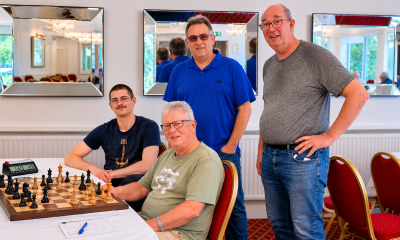
Pembrokeshire Chess Club crowned Welsh champions
-

 Crime3 days ago
Milford Haven man jailed for breaching domestic violence protection order
-

 Local Government5 days ago
Security privately arranged by Mayor at Beating of the Bounds
-

 News3 days ago
Crash on Freeman’s Way causes school-run chaos across Haverfordwest
-

 Crime5 days ago
Man wanted by court after failing to attend hearing over alleged shop thefts
-
 Crime5 days ago
Man banned from roads after drink-driving offence
-

 Crime5 days ago
Man jailed after admitting strangulation and assaults
-

 Crime5 days ago
Drug trafficker must repay £33,000 after court rules he made nearly £500,000