


News
Coastguard and lifeboat teams in cliffside dog rescue drama

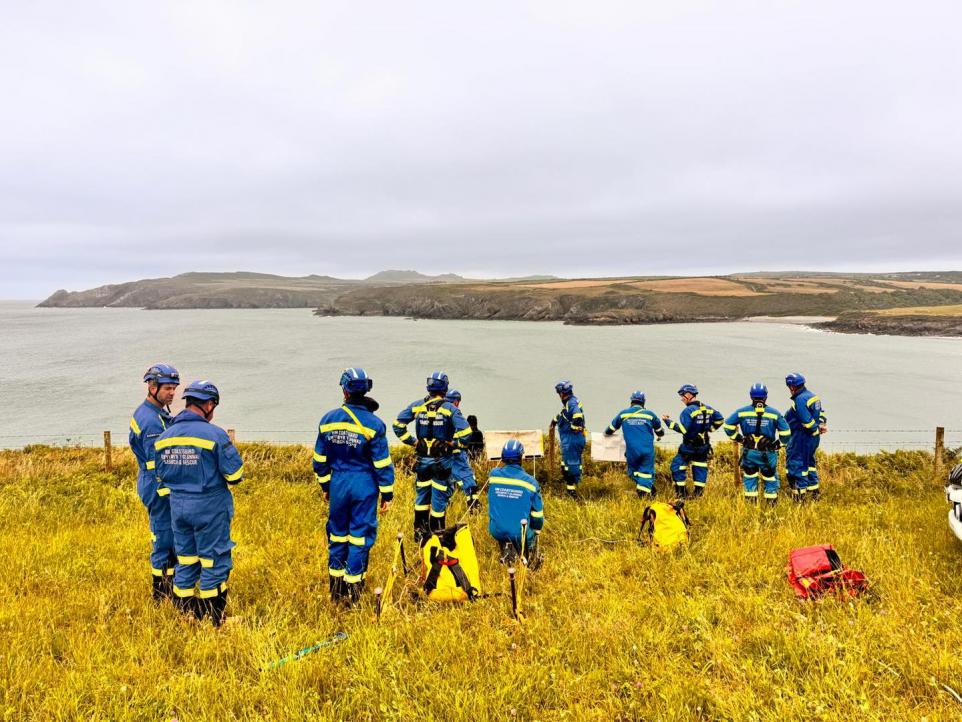
Pet walks back to owner after full rope rescue prepared
COASTGUARD and RNLI crews were called to the Pembrokeshire coast on Friday (June 27) after reports that a dog had gone over a cliff near Abermawr.
Emergency teams from HM Coastguard Fishguard and St Davids attended the scene shortly before 1:00pm. The distressed owners, found on the coastal path, were able to point out the approximate location where the dog had fallen.
Fishguard RNLI lifeboat also launched to assist from the water, while coastguard crews began preparing a rope rescue operation.
A coastguard officer managed to reach the cliff edge through thick undergrowth and located the dog below, but was unable to safely access it. Two full rope systems were then rigged—one to lower a cliff technician to the animal and another to prevent the dog from running away once reached.
However, just as the rescue was about to begin, the dog took matters into its own paws.

“As this was almost complete, the dog decided that he’d had enough and just walked back up to its owners on the path,” said a spokesperson for HM Coastguard Fishguard.
“A great outcome for all involved.”
Members of the public are reminded that in any coastal, sea, or cliff emergency, they should call 999 and ask for the Coastguard. Coastguard rescue teams respond to a range of incidents including cliff rescues, water emergencies, missing persons, vessels in distress, and potentially suspicious objects.
Photo: Coastguard teams launch a rescue after the dog went over the cliff near Abermawr (Pic: HM Coastguard Fishguard).



Visit Pembrokeshire says the county-wide survey will help decide future priorities for the visitor economy
PEMBROKESHIRE residents, businesses, community groups and visitors are being invited to have their say on the future of tourism in the county.
Visit Pembrokeshire has launched a new community engagement survey called Pembrokeshire, Our Future, Our Opportunity, aimed at helping shape a ten-year vision for the county’s visitor economy.
The survey, which launched during the week commencing Monday (June 8), is open to residents, businesses, organisations, students, partners and visitors.
It comes as Pembrokeshire continues to balance the benefits of tourism with wider concerns around housing, infrastructure, seasonal pressure, jobs, transport, the environment and the future of local communities.
Visit Pembrokeshire says the results will help inform long-term priorities and build on its existing Destination Management Plan for 2024-2028.
The survey takes around ten minutes to complete and is available in both English and Welsh.
Emma Thornton, Chief Executive Officer of Visit Pembrokeshire, said: “This is much more than a survey. It is an opportunity for the people of Pembrokeshire to help shape the future of the place they know, value and care deeply about.”
She said tourism supports jobs and businesses, while also helping sustain communities, culture and the environment.
Neil Kedward, Chair of Visit Pembrokeshire, said the county’s future was something “we all have a stake in”.
He added that the engagement exercise was about understanding what success looks like from the perspective of communities and businesses.
The survey will close on Friday, August 21.
It can be completed at: https://forms.office.com/e/WpwPtgwDDW

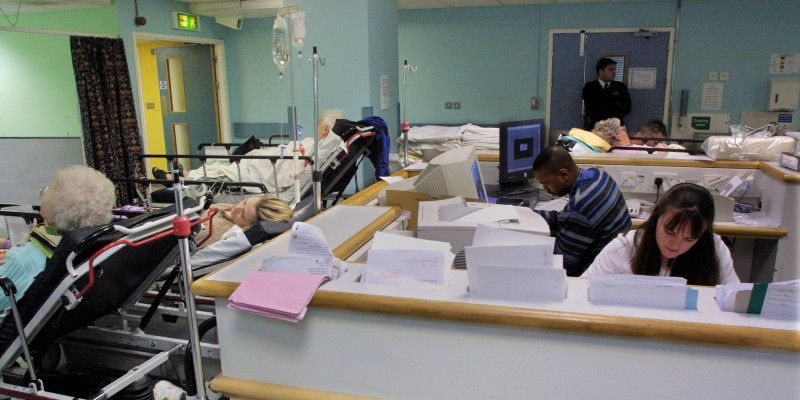
RCN Wales says patients are being left in chairs and hospital corridors for hours as England begins releasing national figures
WALES is being urged to begin publishing hospital corridor care data after England released its first national figures exposing the scale of patients being treated in inappropriate spaces.
RCN Wales said the Welsh Government cannot properly tackle unsafe care if it is not routinely measured or publicly reported.
The call follows the publication of corridor care data by NHS England, which RCN Wales said provides a clearer picture of the scale of the issue in English hospitals for the first time.
The union is calling for the Welsh Government to publish monthly corridor care data by health board, agree a national data set, and release the first figures as soon as possible.
‘Unsafe and unacceptable’
Nicola Williams, Executive Director of RCN Wales, said: “Today’s publication of corridor care data in England demonstrates why transparency matters. We cannot tackle a problem we do not fully understand and are not measuring.
“Corridor care is unsafe, undignified and unacceptable. Nurses across Wales have repeatedly raised concerns about patients being treated in inappropriate spaces because of pressures on the health and care system.”
Ms Williams said she had recently visited a number of hospitals in Wales where she saw patients in chairs, on trolleys in corridors, and squeezed into overcrowded areas not designed for patient care.
She said some patients had been there for well over 12 hours.
She added: “There was one consistent feature which was the look of fear in patients’ eyes as they watched the continual movement and activity going on loudly in very close proximity to them.
“These patients were mainly in gowns with no privacy, no dignity, no space and no confidentiality.”
‘Now normalised’
RCN Wales said nurses had reported that corridor care had become normalised in some hospital settings.

Ms Williams said staff were going home after shifts knowing they had not been able to give patients the care they deserved.
She said: “Nurses told me this is now normalised, happens every day and staff cannot care adequately for patients, which is causing harm and distress to patients, and significantly affecting nurses’ morale.”
In the Senedd on Tuesday (June 2), Health and Care Cabinet Secretary Mabon ap Gwynfor described corridor care as an unsafe practice and said tackling it was a priority.
RCN Wales said it welcomed that recognition but said the next step must be proper measurement and public reporting.
Ms Williams said: “Without consistent national and organisation-wide data, it is impossible to establish the true scale of the problem, identify trends, target resources effectively or measure progress over time.”
Call for national reviews
RCN Wales is also calling for the publication of two national reviews into healthcare capacity, alongside policy recommendations for action.
The union said understanding the relationship between capacity pressures and corridor care would be essential if the practice was to be eliminated.
Ms Williams added: “This is not about collecting statistics for their own sake. It is about establishing a baseline against which improvement can be measured and ensuring accountability for delivering safer care for patients.
“Nursing staff have been warning about the dangers of corridor care for years. Patients deserve care delivered in safe and appropriate clinical environments, and staff deserve the resources and capacity needed to provide it.
“The publication of data in England is an important step. Wales must now follow suit and ensure we have the evidence needed to eradicate corridor care for good.”

VISITORS to this year’s Royal Welsh Show are being encouraged to use public transport as organisers look to ease congestion and promote more sustainable travel.
The show takes place at the Royal Welsh Showground in Llanelwedd, Builth Wells, from July 20 to 23, and is expected to attract thousands of people from across Wales and beyond.
The Royal Welsh Agricultural Society said rail and bus services would provide convenient options for showgoers, with free shuttle buses running from Builth Road railway station to the showground, which is just over a mile away.
Discounted admission
Visitors travelling on the Heart of Wales Line with a valid rail ticket will be able to buy discounted show admission tickets from conductors and ticket offices along the route.
The discounted prices are £35 for adults and £11 for children. Children under 16 can travel free by train when accompanied by a fare-paying adult.
Transport for Wales said rail services would connect visitors from across Wales and the borders, including routes from Cardiff through some of Wales’ most scenic countryside. TrawsCymru bus services will also provide another option for those travelling to the event.
Family activities
Transport for Wales and Network Rail will also have an interactive stand at the show, offering family-friendly rail safety activities and entertainment.
Activities will include VR headset experiences, story time sessions, badge-making classes and rail safety performances. Builth Wells Male Voice Choir is also due to visit the stand on the first day of the show.
Children under 16 travelling to the show by train on the Heart of Wales Line will be able to collect a free activity sheet on board and hand in their completed artwork at the Transport for Wales stand for a chance to win a prize.
Visitors are being urged to plan their journeys in advance through the Transport for Wales website and journey planner.
Travel encouraged:
Visitors to the Royal Welsh Show are being urged to consider rail and bus services this year (Pic: RWAS).



News1 hour ago
Childcare row erupts as Plaid faces questions over costs and delivery
Opposition parties clash over flagship pledge as Senedd debate exposes growing divisions PLAID CYMRU’S flagship promise to create what it...


Crime16 hours ago
Farmers fined in bovine TB scandal face fresh court action
Hartt family members listed at Haverfordwest Magistrates’ Court over unpaid penalties linked to major cattle prosecution TWO PEMBROKESHIRE farmers convicted...


Crime20 hours ago
Pembrokeshire child killer stabbed to death in prison cell, murder trial hears
Kyle Bevan, jailed for the murder of Haverfordwest toddler Lola James, was allegedly stabbed 25 times and left ‘as if...


News1 day ago
Pendine cliff fall victim recovering after major emergency response
A 22-YEAR-OLD man who suffered serious injuries after falling from cliffs overlooking Pendine Beach is recovering well following emergency surgery....


Community1 day ago
Commissioner launches free course to help tackle ageism in Wales
A NEW free learning course has been launched to help people across Wales recognise and challenge ageism. The Older People’s...


News2 days ago
First Minister challenged over jobs for student nurses
REFORM WALES has accused the First Minister of failing to guarantee jobs for student nurses in Wales, despite continuing pressure...

Crime2 days ago
Knife blankets call as school staff face rising violence fears
GMB says protective equipment should be considered where risk assessments show staff could face blades SCHOOL staff should be given...


News2 days ago
Claire Archibald secures review of Milford Haven train times
RURAL TRANSPORT CONCERNS RAISED WITH TFW CLAIRE ARCHIBALD MS has secured a review of train times between Milford Haven and...


Crime2 days ago
PCC review calls for stronger youth crime prevention work
REPORT MAKES 13 RECOMMENDATIONS A REVIEW into crime and anti-social behaviour services for young adults has called for stronger prevention...


Crime2 days ago
Families condemn failed appeal by paddleboard boss jailed over Haverfordwest tragedy
RELATIVES SAY LATEST COURT BID HAS REOPENED PAIN AFTER FOUR DEATHS ON WESTERN CLEDDAU THE FAMILIES of victims of the...
-
Crime6 days ago
Paddleboard company owner loses bid to cut sentence over Haverfordwest tragedy
-

 Crime5 days ago
Milford Haven man admits harassment and assault
-

 News5 days ago
Community appeal for privacy after serious emergency in Pendine
-

 Crime3 days ago
Sex offender in senior role at Tenby family hotel
-

 Community3 days ago
Forgotten wartime archive found in Pembroke Dock attic after 80 years
-
Crime2 days ago
Families condemn failed appeal by paddleboard boss jailed over Haverfordwest tragedy
-

 Business5 days ago
Call for gym and Padel courts at Kiln Park Farm unanimously backed
-

 Community5 days ago
Founders Day hailed a success despite rising costs and extra security