


Health
Whistleblower says capacity test was used to silence him after media exposure

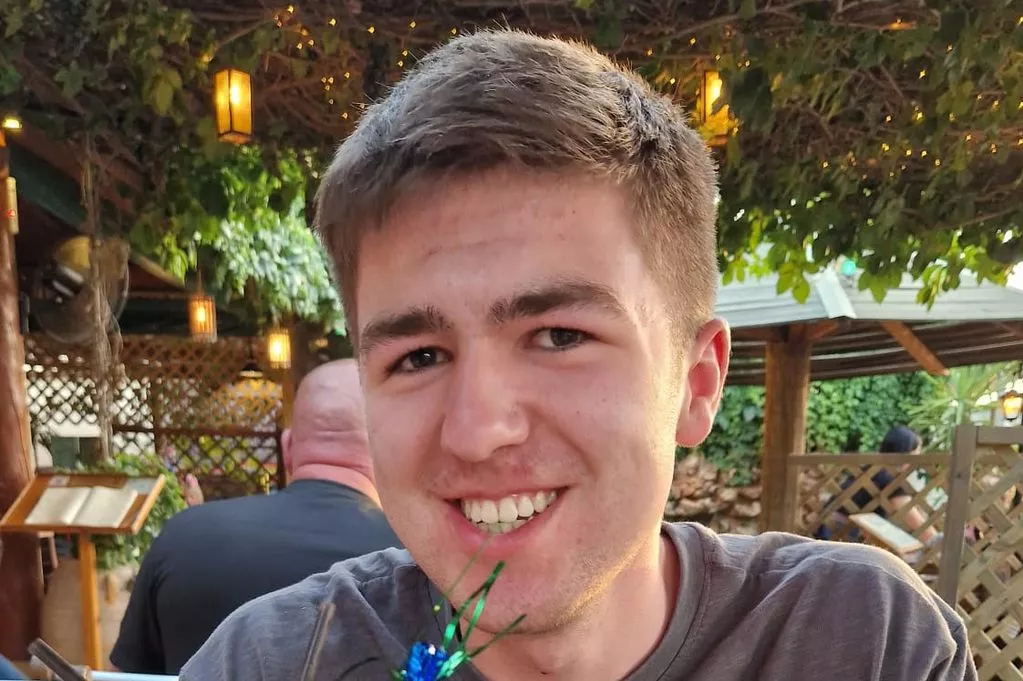
Jacob Robertson claims Swansea Bay Health Board ordered unlawful mental health assessment the day after his story appeared online
A YOUNG patient receiving care under Swansea Bay University Health Board says he was subjected to a sudden and unlawful mental capacity assessment as retaliation for going public with concerns about his treatment.
Jacob Robertson, 19, has accused the Health Board of attempting to silence him using what he describes as “a misuse of clinical tools for non-clinical purposes” following the publication of his story by Wales Online in May.
The following day, he says he was unexpectedly summoned into a room at Cefn Coed Hospital where two doctors and a nurse were waiting — with a capacity assessment form already prepared.
“There was no warning, no advocate, no explanation,” said Mr Robertson. “The doctor literally said, ‘Don’t know why to be honest… I was just told to do it.’ That’s not how lawful assessments work. It was clearly ordered from above — an abuse of power to intimidate me.”
Mr Robertson was ultimately found to have capacity, but says the process itself breached guidance under the Mental Capacity Act 2005, and occurred without proper notice, consent, or justification. He has submitted a formal complaint and says he intends to escalate the matter to the Public Services Ombudsman for Wales.

He alleges this is part of a wider pattern of harmful decision-making within the Health Board, including failures in risk management, denial of access to NICE-recommended therapies, and what he describes as “institutional attempts to discredit or silence whistleblowers.”
Mr Robertson is diagnosed with Emotionally Unstable Personality Disorder (EUPD). Despite multiple consultant psychiatrists and AMHP social workers recommending Dialectical Behaviour Therapy (DBT), he says the service refused to offer the therapy on age-related grounds — a reason he claims breaches national guidance.
In addition, he has raised safety concerns after being hospitalised following an anaphylactic reaction to Brazil nuts, despite his known allergy being recorded. He says no follow-up was undertaken, and that nurses had dismissed his earlier complaints as “attention seeking.”
In correspondence seen by The Herald, Mr Robertson also challenges inaccurate medical records, including a diagnosis of autism spectrum disorder (ASD) that he says was ruled out by internal assessments but continued to appear in his clinical notes.
His online petition calling for a public investigation into Swansea Bay mental health services has now gathered over 3,000 signatures. In the petition, he draws attention to multiple deaths associated with Ward F at Cefn Coed Hospital, including those of Andrew Davies, Jean Pike, and Nicolas Harrison — each the subject of a coroner’s Prevention of Future Deaths report.
“The truth is I wouldn’t still be here if I hadn’t fought this hard,” he told The Herald. “But I shouldn’t have to. The way I’ve been treated for raising genuine, fact-based concerns has been nothing short of hostile.”
HEALTH BOARD DECLINES TO COMMENT ON INDIVIDUAL CASE

When approached for comment, Swansea Bay University Health Board issued the following statement: “Strict confidentiality rules mean we are unable to comment on individual patients in our care and therefore cannot comment on the claims being made. However, we can confirm we are aware of the patient’s concerns, and we are working to better understand and hopefully resolve them. We actively encourage patients to always let us know if they have any concerns.”
COMPLAINTS ESCALATING
The capacity assessment complaint is now one of several issues Mr Robertson is pursuing. He has submitted three formal complaints, and has pledged to bring matters to the ombudsman if the Health Board does not take meaningful action.
A video recorded by Mr Robertson outlining the capacity assessment incident is available on YouTube and includes audio excerpts he says prove the process was conducted improperly.
The Herald understands Mr Robertson has the backing of both his mental health advocate and legal support in asserting that the capacity assessment lacked lawful basis.
CALLS FOR TRANSPARENCY AND REFORM
Jacob Robertson’s case is now one of the most high-profile patient-led campaigns to emerge from Swansea Bay’s mental health system in recent years. His detailed documentation, willingness to speak publicly, and insistence on accountability reflect growing frustration among service users across Wales.
While the Health Board says it is “working to better understand” the issues raised, campaigners argue that deeper cultural change is required.
“The problem isn’t that they don’t know,” said Mr Robertson. “It’s that they don’t want to admit what they already know. And until they do, people will continue to be harmed — or worse.”
His fight for answers — and for access to safe, appropriate care — continues.
If you or someone you know has been affected by mental health care failings at Swansea Bay University Health Board, contact us in confidence at [email protected]


AMBULANCE handover delays, long waits in emergency departments and delays discharging patients from hospital are continuing to put people at risk across Wales, Audit Wales has warned.
The public spending watchdog said urgent and emergency care remains under “constant pressure” despite extra funding and new policies aimed at improving joined-up working between the NHS, ambulance service, councils and social care providers.
In an article published today, Monday (Jun 22), Audit Wales said its work since 2024 had examined how health boards and the Welsh Ambulance Services NHS Trust manage demand for urgent and emergency care, as well as how health boards and local authorities support timely discharge from hospital.
It found that pressures across the system are increasing patient safety risks and driving up costs.
Key problems identified include ambulance handover delays, lengthy waits in emergency departments, underused new services despite extra funding, and delayed hospital discharges which continue to result in hundreds of thousands of lost bed days each year.
Audit Wales also said workforce problems across health and social care remain a major factor in delayed discharges.
The watchdog warned that data is still not being shared effectively across the system, making it harder for public bodies to make informed decisions and manage pressure.
The findings will add to growing concern about the state of urgent and emergency care in Wales, with patients, families and frontline staff repeatedly warning that delays in A&E and problems arranging social care packages are leaving people waiting too long for treatment or stuck in hospital after they are medically fit to leave.
Audit Wales said staff and leaders across the system had made clear that “something must change”.
It has set out six questions for the Welsh Government, NHS Wales and local authorities to consider as they look at how urgent and emergency care can be improved.
The Auditor General for Wales is the independent statutory external auditor of the devolved Welsh public sector and is responsible for auditing most public money spent in Wales.
The Herald has asked the Welsh Government and Hywel Dda University Health Board for comment.


MORE people in Wales recognise alcohol as addictive than anywhere else in Britain, new research has found, but health experts are warning that awareness alone may not be enough to prevent harmful drinking habits.
The findings come ahead of the busy summer period, when pubs, beer gardens, festivals, barbecues and outdoor events often lead to increased alcohol consumption.
According to YouGov data, 86% of people in Wales describe alcohol as addictive — the highest figure recorded across Britain and above the national average of 78%.
Only 14% of Welsh respondents said alcohol was either “not very addictive” or “not addictive at all”.
By comparison, London recorded the lowest level of awareness, with 69% of respondents recognising alcohol as addictive.
Health professionals say the results show that while many people understand the risks, regular drinking can still become habitual, particularly during periods of increased socialising.
Official figures suggest adults consume an average of 10.7 litres of pure alcohol per person each year, equivalent to around 21 UK units per week. That is around nine pints of beer or seven large glasses of wine, and is significantly above the recommended maximum of 14 units a week.
Nearly one in five adults are also said to drink at hazardous levels or above, with men more than twice as likely as women to fall into that category.
Dr Karen Faulkner, Associate Medical Director at Panthera Clinic, said alcohol occupied a “unique place” in British culture because it was both legal and socially encouraged.
She said: “What’s particularly interesting is that most people understand alcohol can be addictive, yet many still underestimate how easily regular drinking can become habitual. Dependence often develops gradually and doesn’t always fit the stereotypes people associate with addiction.
“During the summer months, drinking can become even more normalised through holidays, beer gardens, barbecues, festivals and sporting events.
“The challenge isn’t necessarily a lack of awareness about alcohol’s risks. It’s recognising when a socially accepted habit has crossed the line into something that’s beginning to have a negative impact on your health, wellbeing or daily life.”

Dr Faulkner said people wanting to cut back should consider planning alcohol-free days, alternating alcoholic drinks with water or soft drinks, setting limits before social events, and keeping track of their weekly intake.
She also urged people to watch for signs that alcohol may be becoming more important than intended, including finding it difficult to relax, socialise or enjoy an event without drinking.
Panthera Clinic has launched a free online Alcohol Health Calculator to help people assess how their drinking habits may be affecting their health and wellbeing.
Dr Faulkner added that low and no-alcohol alternatives had become more widely available, making it easier for people to reduce their intake while still taking part in social occasions.

Health Minister tells Paul Davies MS that decisions remain a matter for Hywel Dda University Health Board
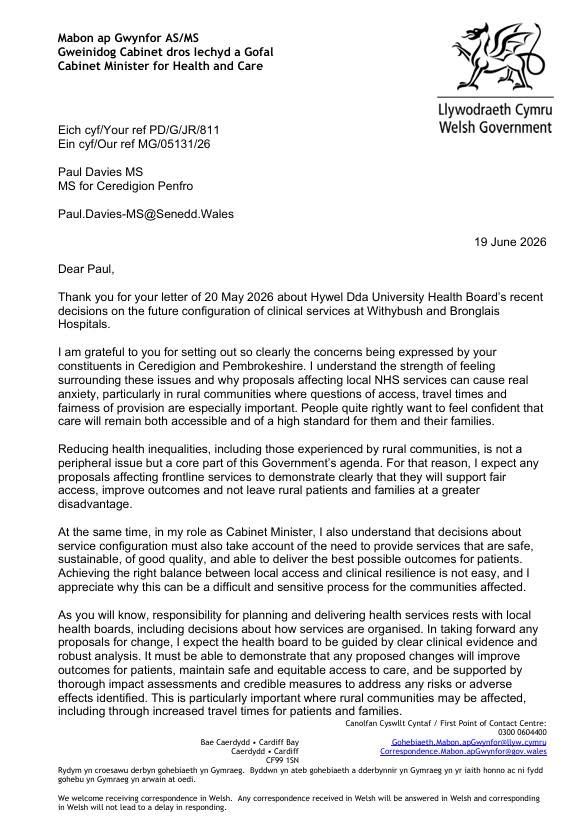
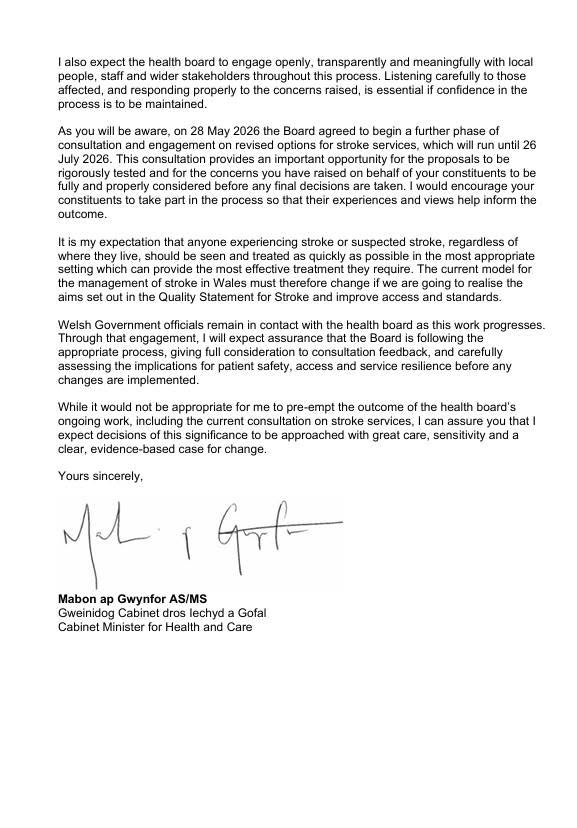
THE WELSH GOVERNMENT has declined to intervene in controversial plans affecting services at Withybush and Bronglais hospitals, prompting fresh criticism from local Senedd Member Paul Davies.
In a letter dated June 19, Health and Care Cabinet Secretary Mabon ap Gwynfor said responsibility for planning and delivering NHS services rests with local health boards and confirmed that Hywel Dda University Health Board should continue its consultation process on proposed service changes.
The response follows concerns raised by Mr Davies on behalf of constituents in Pembrokeshire and Ceredigion over the future configuration of clinical services, including stroke care.
While acknowledging strong public concern about access to healthcare in rural communities, the Minister stopped short of offering any commitment to block or reverse the Health Board’s proposals.
Instead, he stressed that any changes must be supported by robust evidence, maintain patient safety and demonstrate improved outcomes.
The Minister wrote: “Responsibility for planning and delivering health services rests with local health boards, including decisions about how services are organised.”
He added that proposals must improve outcomes for patients, maintain safe and equitable access to care and be supported by thorough impact assessments.
Paul Davies MS described the response as disappointing.
Posting the letter on social media, he said: “This letter tells me that the Welsh Government is not going to stand in the way of the Health Board’s plans.”
He added that he would raise the issue in the Senedd chamber next week and continue pressing ministers to intervene.
The exchange comes as Hywel Dda University Health Board continues a public consultation on proposed changes to stroke services across west Wales.
The consultation, which opened on May 28, is due to run until July 26.

In his response, the Minister stated that anyone suffering a stroke should receive treatment “as quickly as possible in the most appropriate setting” and said the current model of stroke care in Wales must evolve if national standards are to be achieved.
The comments are likely to fuel concern among campaigners opposed to the proposed changes, who fear services could become increasingly centralised and further away from rural communities in Pembrokeshire and Ceredigion.



News56 minutes ago
Bus overturns in major incident near Kidwelly
All passengers rescued as emergency services remain at scene A BUS overturned on the A484 between Kidwelly and Ferryside on...


News3 hours ago
Major incident declared after bus crash in Carmarthenshire
Emergency services at scene as A484 closed near Parc y Bocs A MAJOR incident has been declared in Kidwelly following...


Community22 hours ago
Tenby Summer Spectacular cancelled amid council row over harbour access
Organisers say popular charity events cannot safely go ahead without clear powers to control crowds TENBY ROUND TABLE has announced...


News1 day ago
Motorcyclist dies after four-vehicle crash on A40 in Carmarthenshire
A MOTORCYCLIST has died following a four-vehicle collision on the A40 between St Clears and Whitland. Dyfed-Powys Police said the...


News1 day ago
Rhun ap Iorwerth urges new deal for Wales after Starmer quits
First Minister says next Prime Minister must focus on greater powers, fair funding and respect for Wales’ democratic mandate FIRST...


News1 day ago
How Labour’s landslide victory unravelled in just two years
Prime Minister announces resignation after losing support within his own party as Andy Burnham emerges as overwhelming favourite to take...


News2 days ago
Long Course Weekend set to bring thousands to Pembrokeshire
Three days of swimming, cycling and running will once again transform Tenby into one of the UK’s biggest endurance sporting...


Community2 days ago
The gentle giant behind the tattoos
Pembrokeshire security worker Josh Davies praised for professionalism, kindness and proving first impressions can be wrong JOSH Davies is hard...


Charity3 days ago
Toy Story fans fill charity toy box at Haverfordwest cinema
Donations pour in for SNAP Specialist Play as families embrace Toy Story 5 launch A TOY STORY-themed charity appeal at...


Community3 days ago
Lord Rhys emerges from the mist in St Davids
Giant puppet begins historic journey marking 850 years since the first Eisteddfod MIST swirled around St Davids Cathedral on Friday...
-

 Crime5 days ago
Milford Haven man jailed for breaching domestic violence protection order
-

 News5 days ago
Crash on Freeman’s Way causes school-run chaos across Haverfordwest
-

 Crime7 days ago
Man wanted by court after failing to attend hearing over alleged shop thefts
-
 Crime7 days ago
Man banned from roads after drink-driving offence
-

 Crime7 days ago
Man jailed after admitting strangulation and assaults
-
 Crime7 days ago
Drug trafficker must repay £33,000 after court rules he made nearly £500,000
-

 Crime7 days ago
Man sentenced over stalking campaign and lock knife offence
-

 Crime7 days ago
Woman admits assaults on police officers during incident in Haverfordwest