


News
Attorney General under pressure as ‘terror’ arrests spark Wales-wide concern

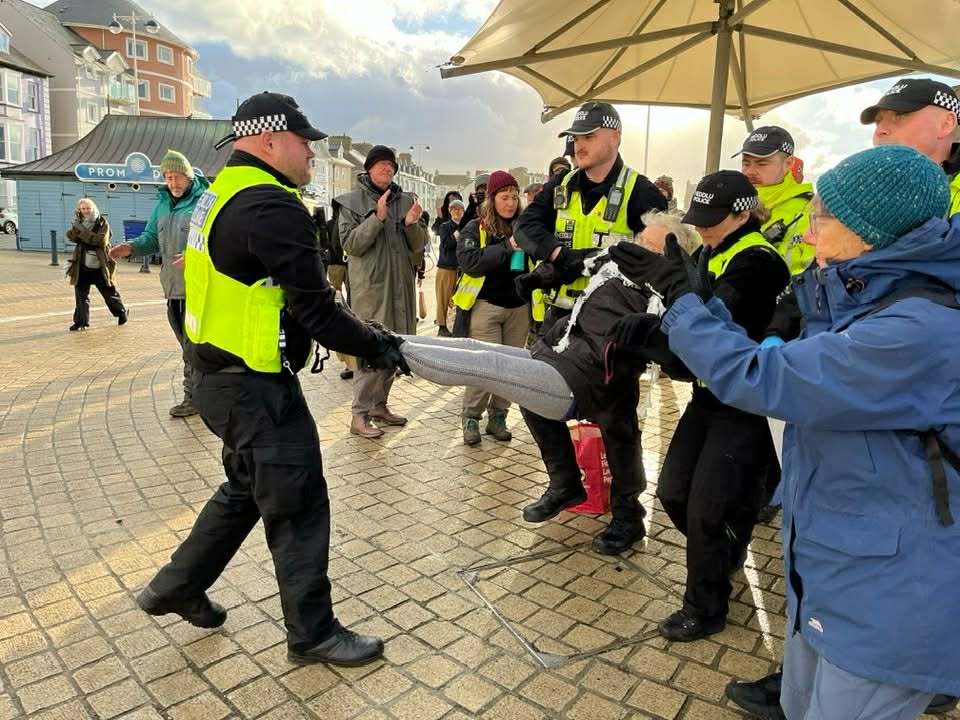
Campaigners say peaceful sign-holders face disproportionate charges
ACTION at the Ministry of Justice in London yesterday has triggered fresh scrutiny of the UK Government’s decision to pursue terrorism-related charges against supporters of the Lift The Ban campaign, with activists and civil liberties groups warning that the policy is creating uncertainty across Wales.
From 1:00pm on Thursday, around 50 people were arrested outside the Ministry of Justice while sitting quietly with cardboard signs reading “I oppose genocide. I support Palestine Action.” The action took place in near-freezing temperatures and forms part of a coordinated wave of protests across twenty towns and cities ahead of a Judicial Review set for 25–27 November.
Campaigners say the focus on the Ministry of Justice is deliberate, as the Attorney General, Lord Hermer, has authorised prosecutions of almost 200 peaceful demonstrators under section 13 of the Terrorism Act 2000. Six people linked to the movement are also reported to be on hunger strike in UK prisons, with supporters claiming they have been held on remand beyond normal time limits.
Lord Hermer, a former human rights barrister who previously worked alongside Keir Starmer at Doughty Street Chambers, has faced questions about how the prosecutions align with his earlier warnings about the dangers of undermining international law. The Ministry of Justice oversees the court system, where—if the Judicial Review fails—thousands of defendants could face rapid, short hearings for holding signs.
A spokesperson for Defend Our Juries said those taking action “pose no threat to the public” and accused the government of “using terror legislation in cases where peaceful protest is being targeted.”

Mixed response from police forces
The latest round of arrests has highlighted inconsistencies in how different UK police forces are responding. All nine Lift The Ban protests in England and Wales on Tuesday saw arrests, including in Aberystwyth, where local police intervened after several hours.
However, Police Scotland made no arrests at the corresponding action in Edinburgh, and officers in Derry, Totnes, Truro and Kendal have previously allowed sign-holders to continue without intervention. Campaigners say this disparity demonstrates that the proscription of Palestine Action is “unenforceable,” noting that 95 people who took part in Tuesday’s actions were not arrested.
Concerns were also raised after Devon and Cornwall Police—who had not made arrests at earlier actions—detained participants this week. Activists described a “coordinated response,” though police forces maintain operational independence from central government.
One protest on Thursday even saw officers detain a mannequin displaying one of the prohibited signs.
What’s happening here in Wales?
In Wales, the action in Aberystwyth is one of several protests held this month, with another planned for Cardiff on Saturday 29 November. Campaigners in Wales say the arrests have caused “significant public concern” and have called for greater clarity from the Home Office and Ministry of Justice about how terrorism legislation is being applied.
Civil liberties groups note that Wales has seen an increase in political demonstrations connected to the conflict in Gaza, with local organisations emphasising the importance of maintaining the right to peaceful protest.
Further protests are scheduled in the run-up to the Judicial Review:

More than 2,200 people have been arrested under terrorism legislation during Lift The Ban actions, which involve participants holding handwritten signs. Around 170 have been charged so far. The campaign is calling for the government to lift the proscription of Palestine Action and to formally recognise the situation in Gaza as genocide.
The government’s decision to proscribe the group has recently been criticised by UN experts, security specialists and members of an official advisory panel, who warned it could inflame community tensions and risk appearing politically motivated.
A number of activists held on remand are now engaged in a rolling hunger strike in prisons in England, including individuals connected to the so-called Filton 24 and Brize Norton Five cases. Supporters say they are being detained under extended pre-trial conditions despite not being charged with terror offences.
The Ministry of Justice and Home Office have insisted that all decisions relating to arrest, charging and proscription are taken in accordance with UK law and national security assessments. Ministers say terror legislation remains necessary to prevent serious harm and protect public safety.
The Attorney General’s office has been approached for comment.


From young recruit to respected veteran, Phil Lees-Griffiths leaves lasting legacy
A TENBY firefighter whose career has spanned almost four decades has been honoured on his retirement after 37 years of service with Mid and West Wales Fire and Rescue Service.
Photographs shared to mark the occasion show Phil Lees-Griffiths’ remarkable journey from a young firefighter at the beginning of his career to a respected and experienced member of Tenby’s fire crew, reflecting nearly four decades of commitment to protecting local communities.
Tenby Town Council has paid tribute to Phil’s dedication, courage and professionalism, describing his retirement as the end of an era for the town’s emergency services.
Mayor of Tenby, Cllr Dai Morgan, said: “Today, we celebrate not just the retirement of a firefighter, but the remarkable career of a man who has devoted 37 years to protecting the people of Tenby and our surrounding communities.”

OFFICERS investigating an alleged sexual assault in Carmarthen are appealing for the public’s help to identify a person who may have information.
Dyfed-Powys Police said the incident happened in front of F.Hinds jewellers on Lammas Street at around 4pm on Tuesday, May 12.
Investigating officers have carried out a number of enquiries and are now asking for assistance in identifying the person pictured.
Police stressed that the person may have information that could help the investigation.
Anyone who is the person pictured, or who knows who they are, is asked to contact Dyfed-Powys Police online at https://bit.ly/DPPContactOnline, by emailing [email protected], or by calling 101.
Alternatively, information can be passed anonymously to Crimestoppers on 0800 555111 or via crimestoppers-uk.org.
Quote reference: 26000377639

FAMILIES are being invited to the Torch Theatre this July for a lively bilingual production that uses music, storytelling and interactive performance to explore the importance of bees and other pollinators.
We Need Bees, an original production from Theatr na nÓg, has been created by award-winning Welsh playwright Katherine Chandler and introduces important environmental themes to young audiences in an engaging and accessible way.
The show will visit the Torch Theatre in Milford Haven on Saturday, July 11, with performances in both Welsh and English, thanks to support from the ScottishPower Foundation’s Art for Climate Fund.
Fun, energetic and thought-provoking, We Need Bees explores biodiversity loss, climate displacement and environmental responsibility through the fascinating world of insects. By focusing on the lives of bees and other pollinators, the production encourages children to think about empathy, resilience and the real-world impact of climate change.
Featuring striking oversized bee costumes and original songs, the show promises a memorable experience for school and community audiences alike.
Director Phylip Harries said: “It’s a privilege to be part of a production that shares such important messages with young audiences. Theatre is a brilliant way to entertain children while encouraging them to think about the world around them, and We Need Bees does exactly that.
“At Theatr na nÓg, we create productions that leave audiences smiling but also talking and thinking afterwards. Morgan, Catrin and Aled are fantastic storytellers who bring so much energy to the show. We’re delighted that the school tour has sold out, and I’d encourage families to come along to one of the public performances and enjoy it together.”
The production features original music by Barnaby Southgate and will be performed in both English and Welsh at selected venues.
We Need Bees first toured schools in 2012 before later being adapted as an online podcast during the Covid pandemic. It returned as an outdoor theatre production at Theatr Brycheiniog in 2021 as part of a Welsh Government pilot scheme encouraging audiences back to theatres.
Thanks to ScottishPower’s Art for Climate Fund, the show will tour schools across Wales, reaching more than 1,200 children, ahead of the arrival of its brand-new companion production, Bug Hotel, in 2027.
Melanie Hill, Executive Officer and Trustee of the ScottishPower Foundation, said: “The climate crisis is the defining challenge of our time, and we know the arts have a unique power to make complex ideas accessible, emotional and impossible to ignore.
“Through our new Art for Climate Fund, we’re backing bold, imaginative projects that give young people hope, confidence and a real sense of agency. Theatr na nÓg, a worthy beneficiary of this new fund, shows how creativity can spark climate action in classrooms and communities across the UK, and we’re incredibly proud to support them as one of the first recipients of this new fund.”

The cast includes Morgan Llewelyn-Jones, whose theatre credits include The Trial of Elgan Jones for Theatr na nÓg and The Snow Queen at Sherman Theatre; recent musical theatre graduate Catrin Lewis; and Aled Herbert, who returns for his twelfth production with Theatr na nÓg. On screen, Aled was most recently seen in the popular television series Rownd a Rownd.
We Need Bees is suitable for families and children aged four and over.
The show can be seen at the Torch Theatre on Saturday, July 11, at 11:00am in Welsh and 2:00pm in English. Tickets are £10 and can be booked at torchtheatre.co.uk or through the Box Office on 01646 695267.



Crime22 hours ago
Judge calls pensioner a ‘dirty old man’ as he avoids jail for exposing himself to women
Judge says 75-year-old Stewart Laugharne behaved ‘disgracefully’ as he avoids jail but is ordered to sign sex offenders register A...


Health23 hours ago
Stroke services consultation reaches halfway point as public urged to have say
HYWEL DDA University Health Board is urging people to take part in its consultation on the future of stroke services,...


Business23 hours ago
Welsh firms eye share of £5bn defence drone boom
WELSH defence and aerospace firms could be in line for a share of billions of pounds in new military spending...


Community3 days ago
Thousands line Cardigan streets for Lord Rhys homecoming parade
THOUSANDS of people lined the streets and quayside in Cardigan on Saturday as the town marked 850 years since Lord...

Crime4 days ago
Dyfed-Powys Police rated only ‘Adequate’ in organised crime inspection
A WATCHDOG has rated Dyfed-Powys Police only “Adequate” in its response to serious and organised crime, despite praise for the...


News4 days ago
Two taken to hospital after aircraft ditches in Cardigan Bay
Coastguard helicopter spotted two casualties after light aircraft came down off west Wales coast TWO people were taken to hospital...


Sport5 days ago
Long Course Weekend gets underway in Tenby as thousands head for county
Three days of swimming, cycling and running begin with The Wales Swim at North Beach THOUSANDS of athletes and supporters...


Climate5 days ago
Welsh waters, Westminster profits: Crown Estate row reignited in Wales
PLAID CYMRU has renewed calls for the Crown Estate to be devolved to Wales after figures showed income linked to...

News5 days ago
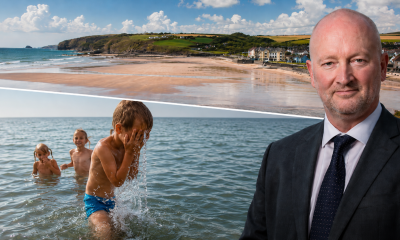
Reform MS: ‘I felt like shouting get out of the water’
Paul Marr says children playing in streams at Pembrokeshire beaches deserve better protection from pollution risks REFORM UK MS Paul...
Health6 days ago
Senedd backs call to rule out hospital downgrades after heated NHS debate
Reform UK amendment passes as West Wales hospital fears remain central political issue THE SENEDD has backed a call for...
-
 Crime7 days ago
Milford man threatened to smash parents’ windows, court hears
-

 Crime7 days ago
Haverfordwest father stole groceries amid cost-of-living struggle
-

 Crime7 days ago
Woman sentenced over neglect of child at Haverfordwest property
-

 Crime6 days ago
Police appeal after reported rape at Young Farmers rally
-

 Crime7 days ago
Dock woman given mental health treatment order after supermarket thefts
-

 Crime7 days ago
Hakin man stole Tesco goods to fund drink and gambling addictions
-

 Crime7 days ago
Grandmother banned after cocaine drug-drive offence
-
Crime4 days ago
Dyfed-Powys Police rated only ‘Adequate’ in organised crime inspection