



Local Government
Pembrokeshire and Ceredigion to receive lower than average funding from Welsh Government


PEMBROKESHIRE and Ceredigion are set to receive a lower-than-average funding settlement from the Welsh Government, placing them both at 13th out of the 22 local authorities.
While council tax makes up a proportion of the council’s annual revenue, a crucial area of funding is the Aggregate External Finance (AEF) rate from Welsh Government.
Welsh Government Cabinet Secretary for Housing and Local Government, Jayne Bryant, has announced that local authorities will next year receive £6.4bn from the Welsh Government to spend on delivering key services.
The investment, which comes from the Revenue Support Grant and non-domestic rates, means that Welsh councils will receive an average 2.7 per cent funding increase, with a fully funded floor will ensure that no council receives less than a 2.3 per cent increase.
In addition to the core settlement, there will also be grants for local government amounting to over £1.3bn for revenue purposes and over £1.08bn for capital investment.

Pembrokeshire is to receive a 2.3 per cent increase on its settlement, a total of £244,318,000, amounting to an extra £5,493,000, placing it at 13th of the 22 local authorities in Wales.
Neighbouring Ceredigion, also jointly on 13th place, receives a 2.3 per cent increase, some £3,388,000 for a total of £150,670,000.
2024 saw Pembrokeshire receive a higher-than-expected settlement increase of 3.6 per cent from Welsh Government – amounting to just over £8.1m – against a predicted two per cent.
Of the 22 authorities in Wales, in 2024 Pembrokeshire ranked 15th in its rate of settlement, neighbouring Ceredigion also receiving 3.6 per cent, to rank 17th, and Carmarthenshire receiving 4.1 per cent, ranking 12th.
Of the latest settlement, Jayne Bryant said: “We have been listening to local government, and we fully recognise the challenges that they face.
“This provisional settlement is the beginning of the budget process, our priority has been to provide councils with the stability they need to set budgets which protect and deliver core frontline services.
“We will continue to work closely with the Welsh Local Government Association and council leaders to see where we can provide additional flexibility when managing their budgets.

“We are committed to working with all parties to develop a budget which ensures our public services can continue to operate effectively and which can be passed by the Senedd in the final months of this term.”
The final budget will be published in January following consultation with local authorities and stakeholders.
Pembrokeshire Cabinet Member for Corporate Finance Efficiencies Cllr Alistair Cameron said: “This is very disappointing for Pembrokeshire as it is well below the current UK inflation rate of 3.6 percent.
“It also fails to take account of the needs of providing services in a rural authority and the need to provide social services for an ageing population in the county. I will be appealing against this provisional settlement.
“I see that some of the urban councils such as Newport and Swansea have had a more generous provisional settlement. We therefore need to appeal for a better and more realistic settlement which takes account of our demographics and geography.”
Ceredigion council has also been contacted for its reaction to the announcement.



Mayor’s charities named as civic leaders gather at St Katharine and St Peter’s Church
THE CIVIC SERVICE of the Mayor of Milford Haven, Cllr Mark Woodward, took place at St Katharine and St Peter’s Church on Saturday (June 20).
The service marked Cllr Woodward’s election as Mayor and First Citizen of Milford Haven.
It was conducted by Rev Dr Adrian Furse and Canon John Cecil, with music from church organist Richard Stephens, Gelliswick Community Choir and Milford Haven Town Band.
Guides and Brownies, Milford Haven Sea Cadets and Royal Marines Cadets were also among those taking part, with councillors Colin Sharp and Yvonne Southwell acting as ushers.
Refreshments followed at Milford Haven Bowling Club.
Local MS Paul Davies was among those attending the service and wished the new mayor all the best for his term in office.
Cllr Woodward’s chosen charities for the year are Patch Charity and Greenacres Rescue.
Photo caption:
Civic guests attended the Mayor of Milford Haven’s service at St Katharine and St Peter’s Church on Saturday (Pic: Supplied)

Campaigners say Carmarthenshire must properly consider alternatives after judge’s ruling and last-minute amendment to statutory notice.
A HIGH COURT judge has warned Carmarthenshire County Council that alternative proposals to closing Ysgol Meidrim must be given proper and conscientious consideration before any final decision is made.
The ruling follows a judicial review challenge brought by parent Leia Perry over the council’s decision to consult on the future of the Welsh-medium rural primary school.
Although the High Court did not halt the closure process, campaigners say the judgment raises serious questions about the way the council has handled the matter.
Ysgol Meidrim, near St Clears, currently has around 30 pupils and has been earmarked for closure, with children expected to transfer to other schools from January 2027.
But the school community has mounted a determined campaign to keep it open, arguing that the school remains central to the future of the village, the Welsh language and rural life in the area.
The judgment, handed down by His Honour Judge Jarman KC, found that the challenge should be allowed to proceed, but ultimately dismissed it on the basis that the council still has an opportunity to properly consider alternatives during the ongoing process.
However, the judge made clear that those alternatives must now be considered conscientiously.
Campaigners say this is a significant warning to the council.
Ffred Ffransis, speaking on behalf of Cymdeithas yr Iaith in Carmarthenshire, said the organisation was not a party to the legal action, but understood why a parent of a child with severe medical needs had taken the case.
He said: “The judge criticised the lack of clear communication from the council and that governors had the impression that the council had not yet seriously considered alternatives to closure of Ysgol Meidrim, but found that the evidence did not yet reach the high threshold for legal intervention.
“He has warned the council that they must give conscientious consideration to the alternative proposals drawn up by governors.”
The governors’ proposals include developing the school as part of a wider community hub and exploring federation options rather than closure.

Cymdeithas yr Iaith said the council now had two choices: to press ahead regardless, or to withdraw the closure notice and enter into genuine discussions with governors over their plans.
Mr Ffransis added: “The council must at least demonstrate a new open attitude during the objections period to discussing the alternative proposals.”
The row has deepened after Carmarthenshire County Council was forced to withdraw and reissue its closure notice just three days after it was first published.
According to Cymdeithas yr Iaith, the original notice, issued on June 16, listed nearby Ysgol Bancyfelin as one of three receiving schools. The notice was then withdrawn after it emerged that Ysgol Bancyfelin was already over capacity.
A revised closure notice has now been issued, with the objection period extended until July 17.
The campaign group said this raised further concerns about the way the process was being handled.
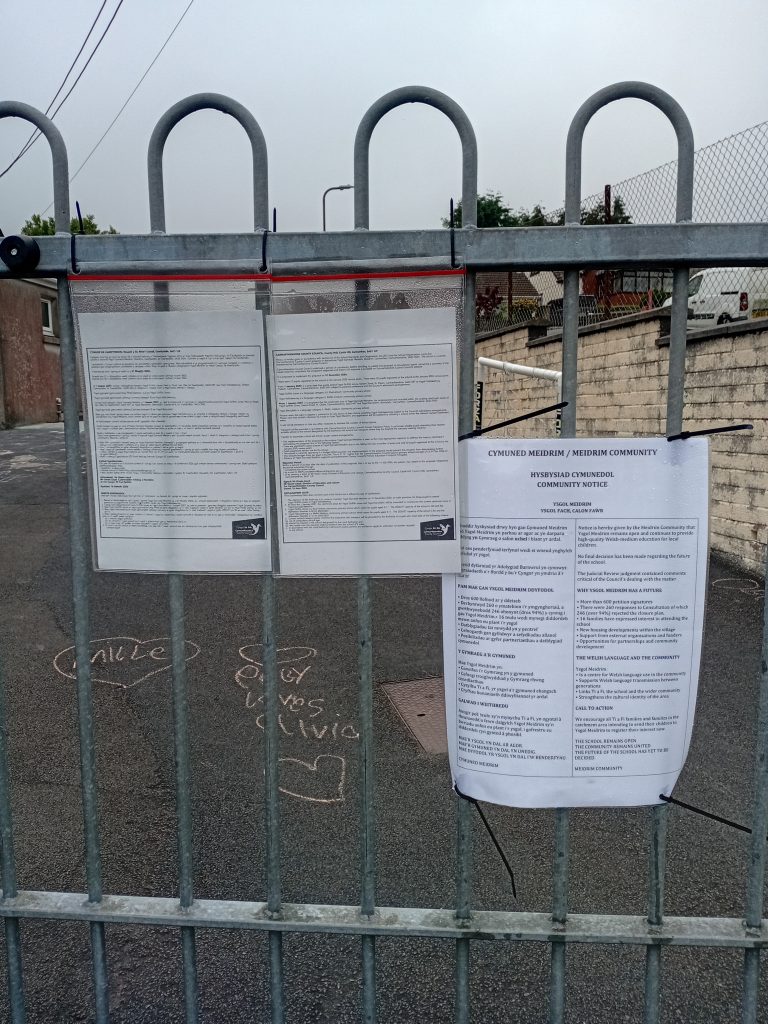
Notices have also been placed at the school gates by supporters, making clear that Ysgol Meidrim remains open and encouraging parents to register children there.
One notice states that the judicial review judgment was critical of the council’s handling of the matter and that the future of the school has not yet been decided.
The campaign has attracted wider attention because of the Welsh Government’s presumption against closing rural schools.
Under the School Organisation Code, councils must carefully consider all reasonable alternatives before deciding to close a rural school, including federation and wider community use.
Campaigners argue that Ysgol Meidrim is not simply an education issue, but a question about the survival of Welsh-speaking rural communities.
The council has previously cited low pupil numbers, surplus places, budget pressures and curriculum challenges as reasons for proposing closure.
But opponents say the financial savings are small compared with the impact on the village and its Welsh-medium provision.
Local Government
Minister questioned on local government funding, rent protections, and asylum seekers
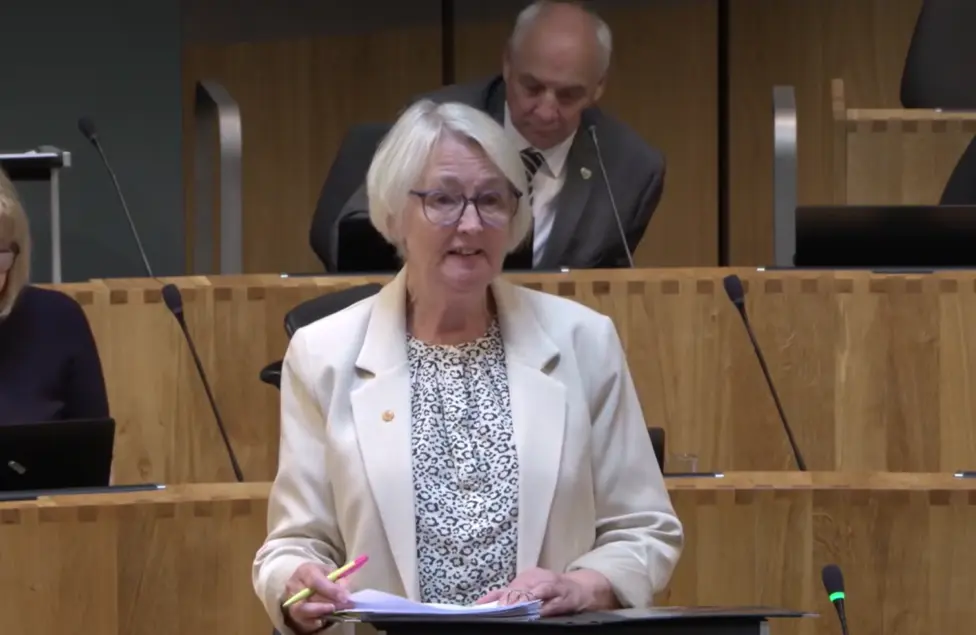
LOCAL government funding, protection for renters, and asylum seekers were all discussed as Wales’ housing minister took questions from Senedd colleagues on Wednesday June 17.
Siân Gwenllian, whose ministerial role includes local government, housing and planning, took her first question from Reform’s Paul Marr.
Pressing the minister on houses in multiple occupation (HMOs) and asylum seekers, Mr Marr asked Ms Gwenllian if she knew the total number of HMOs in Wales, and what proportion are occupied by current and former asylum seekers.
The Ceredigion Penfro MS spoke of meeting a 70-year-old veteran in his constituency who had spent several years living in an abandoned camper van because he was unable to secure accommodation.
Mr Marr called on Ms Gwenllian to provide “assurances” that Welsh people facing homelessness will not be “treated less favourably” in the allocation of housing or housing support than those that have been granted asylum status.

Warning the Reform MS to avoid creating divisions by “trying to point the finger at one specific group in our society”, Ms Gwenllian confirmed that 14,954 homes in Wales were HMOs as of March 31, 2025.
She added that data is not collected on residents, and as such there is no data on what percentage are occupied by asylum seekers.
“Our ambition is that everyone in Wales should have a quality home, for an affordable price and in the area that is right for them, including veterans, and including refugees too”, she said.
Ms Gwenllian referred to the First Minister’s statement on immigration and housing on Tuesday June 16, adding that “it’s not immigration that is causing the housing crisis, [and] it’s not asylum seekers that are causing the housing crisis.”
Fellow Reform MS Steven Rodaway also quizzed the minister on the housing shortage and asylum seekers.
Mr Rodaway asked Ms Gwenllian about the “housing demand arising from the Nation of Sanctuary programme”.

Responding, she clarified accommodation for asylum seekers is not a devolved matter, noting that it is the UK Government making those decisions.
Ms Gwenllian also stressed that social housing is not available to asylum seekers who are awaiting decisions.
She also shared the figure for the number of asylum seekers in Wales, as collected by the Home Office, noting that it is around 3,400 people.
Responding to Mr Rodaway, Ms Gwenllian said: “These are people who are fleeing atrocities and war, things that we in this chamber can only imagine in terms of the kinds of lives and the kinds of trauma that these people have experienced and are fleeing.
“So, please don’t try and create divisions by discussing housing problems in the same breath as asylum seekers.
“The housing crisis has nothing to do with asylum seekers. I hope that that message is being heard by those who need to hear that message.
“The housing crisis in Wales has nothing to do with asylum seekers, it has nothing to do with refugees.”

Labour’s spokesperson for local government, Mike Hedges, told the Siambr the Welsh Local Government Association (WLGA) estimated £1.6 billion of additional funding would be needed to meet budget pressures for local authorities over the next three years.
Mr Hedges added that the auditor general for Wales had said some councils in Wales were at the very edge of financial stability.
He said: “Education and social services account for the majority of local government spending. The WLGA estimates schools and social services alone make up around 60% of financial pressures this year.
“Local authorities have a statutory duty to provide these services and, with ever-increasing demand in these areas, there’s little flexibility in other budgets.”
Mr Hedges questioned if Ms Gwenllian would argue for the supplementary budget to have additional money included for local government.
Describing the current financial situation as an “extremely challenging period”, Ms Gwenllian said her government understands the pressures of schools and local authorities, including the pressures on families and supporting ALN learners.
She said: “The education system and the budgetary arrangements aren’t the same in Wales as they are in England, of course, and it’s clear that there are significant financial pressures in local education authorities in this country as well as in England – and I know that they’ve had to make very difficult decisions to manage this situation.
“We must now progress in working with our partners to develop a long-term, clear transformation plan for ALN – one that is specific, clear and timely – to ensure that the sector can support the needs of learners as well as being operationally sustainable.”
Peter Fox, Conservative spokesperson for finance, local government, and communities, called on Ms Gwenllian to clarify if the government will be looking to restructure local authorities, noting a manifesto pledge to keep the structures of government in Wales, including town and community councils, under “continuous review”.
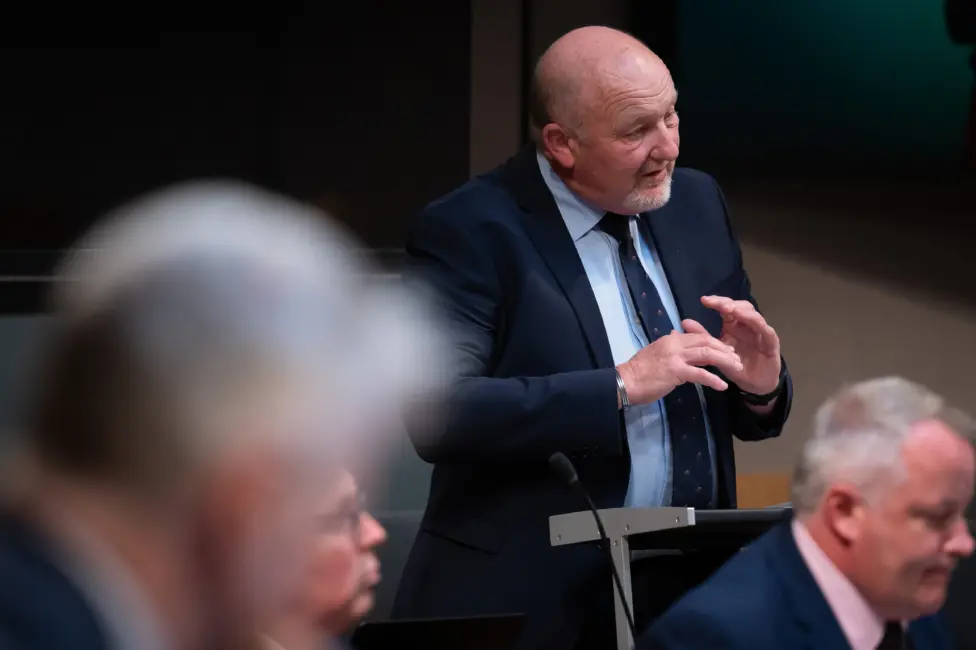
Mr Fox said this has caused “quite a lot of confusion and concern” amongst local authorities.
In response, Ms Gwenllian confirmed restructuring local government is “not a priority for this government”.
However, she added: “There are a number of things that we could be working on collaboratively with local government to reduce bureaucracy and processes and focus on delivery.
“That’s where the partnership agreement that the Welsh Government has with local government is extremely valuable, so that we can discuss jointly our priorities and look to the future.”

Plaid Cymru’s Leticia Gonzalez asked the minister for an update on work to make renting fairer for tenants.
Ms Gonzalez, who represents the Caerdydd Penarth constituency, said: “Rents in Wales are rising well ahead of wages, with private rents increasing by 8.7% across the country, and even higher in Cardiff, leaving many households vulnerable to debt and poverty.
“At the same time, UK Government policies, such as the Warm Homes programme, include the mandatory move towards energy performance certificate C requirements for all private rented homes by 2030.
“This will inevitably add further cost pressures on landlords, costs that tenants are already worried will simply be passed on through higher rents.
“This is compounded by the reduction in the cost cap available to landlords to carry out necessary upgrades, raising serious questions about how deliverable these standards are in practice within the Welsh private rented sector.”
Ms Gonzalez asked how the Welsh Government would work with the UK Government to seek clarity on how landlords can be expected to fund these improvements without driving up rents.
Ms Gwenllian noted the importance of improving energy efficiency of privately rented accommodation but said she recognises the concern about costs for landlords and for tenants.
Ms Gwenllian, who met with UK Government ministers to discuss the issue, said she made it clear that a number of landlords in Wales are not professional landlords, and the importance of supporting them to understand their obligations under the new standard.
Discussing fair rents, the minister described the situation as “deteriorating”.
She said: “There is a need for us to tackle this issue, and I will be bringing more information forward about how exactly we intend to look at managing rents, and we’ll be looking at work in different countries around the world that have succeeded in doing this successfully.”



Charity22 hours ago
Toy Story fans fill charity toy box at Haverfordwest cinema
Donations pour in for SNAP Specialist Play as families embrace Toy Story 5 launch A TOY STORY-themed charity appeal at...


Community1 day ago
Lord Rhys emerges from the mist in St Davids
Giant puppet begins historic journey marking 850 years since the first Eisteddfod MIST swirled around St Davids Cathedral on Friday...


News2 days ago
Tragic tribute paid to Haverfordwest man after A4075 collision
FAMILY REMEMBERS “KIND AND LOVING” CALLUM HANSON THE FAMILY of a 22-year-old man from Haverfordwest who died following a road...


News3 days ago
Motorcyclist, 22, dies in A4075 crash in Pembrokeshire
A 22-year-old woman remains in hospital after two-vehicle collision A MOTORCYCLIST has died following a serious two-vehicle crash on the...


Community3 days ago
Why police will be visiting every home in Pembrokeshire
New operation aims to knock on more than 257,000 doors across Dyfed-Powys over the next three years DYFED-POWYS POLICE has...


Crime3 days ago
Prisons at breaking point: MPs warn Wales is paying the price of a failing system
Frozen healthcare budgets, overcrowded jails, homelessness on release and mounting pressure on staff are undermining rehabilitation across Wales, according to...


News4 days ago
Brexit at 10: How Britain was sold a dream that cost us dearly
A decade after the referendum, the promised benefits remain hard to find while the economic costs are increasingly difficult to...


Crime4 days ago
Worcestershire man jailed after violent attack on woman in Tenby
Defendant was already serving a suspended sentence when serious assault took place A WORCESTERSHIRE man has been jailed for more...


Climate4 days ago
Offshore wind ‘could bring new generation of jobs to Milford Haven’
Pembrokeshire ports and Celtic Sea projects placed at centre of Wales’ green energy ambitions MILFORD HAVEN and Pembroke Dock could...


Community5 days ago
Police officer hailed hero after midnight sea rescue in Milford Haven
PC swam 100 metres offshore to save distressed woman heard calling for help in darkness A DYFED-POWYS POLICE officer has...
-

 Community7 days ago
Pembrokeshire Chess Club crowned Welsh champions
-

 Crime3 days ago
Milford Haven man jailed for breaching domestic violence protection order
-

 Local Government5 days ago
Security privately arranged by Mayor at Beating of the Bounds
-

 News3 days ago
Crash on Freeman’s Way causes school-run chaos across Haverfordwest
-

 Crime5 days ago
Man wanted by court after failing to attend hearing over alleged shop thefts
-
 Crime5 days ago
Man banned from roads after drink-driving offence
-

 Crime5 days ago
Man jailed after admitting strangulation and assaults
-

 Crime5 days ago
Man sentenced over stalking campaign and lock knife offence