


Crime
Man denies murdering brother as jury hears of ‘ferocious attack’ at Morriston flat


Brother found dead after neighbours raised alarm over distressed dog, Swansea Crown Court told
A MAN accused of murdering his brother is standing trial at Swansea Crown Court, where jurors heard harrowing evidence about the final hours of a 48-year-old man found dead at his home in Morriston.
Darren Steel, aged 41, from Morriston, Swansea, denies murdering his brother Martin Steel on May 20, 2023. He also faces an alternative charge of manslaughter.
Opening the prosecution case on Tuesday morning (Jan 27), prosecutor Andrew Jones told the jury that Martin Steel was discovered dead inside his flat at Hill View Crescent after neighbours became concerned when his dog was found whining alone in the garden at around 8.30am.
The court heard that neighbours attempted to alert Mr Steel but received no response. They took the dog into their home and noticed its fur was matted with a red-brown substance and that the animal appeared distressed.
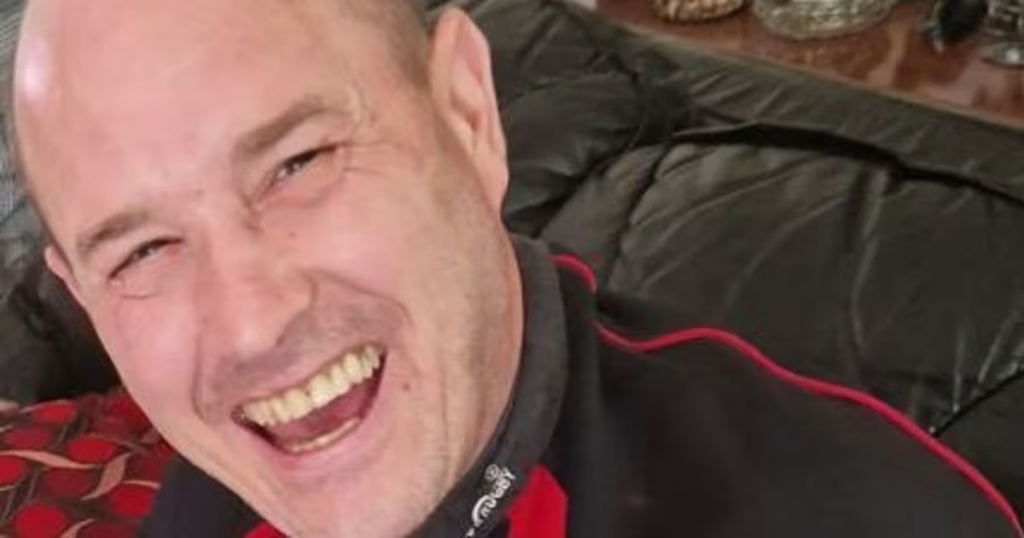
Further attempts were made to get an answer at the flat before another neighbour suggested contacting Mr Steel’s mother, who had been due to go shopping with him that morning.

She arrived shortly afterwards but was unable to enter through the front door, which was deadlocked, or the back door, which had been chained shut. From inside the property, she heard a voice she recognised as belonging to her son Darren ask: “Who’s that?”
After identifying herself, she was asked: “Have you brought the police with you?”
She replied that she had not, and the door was then opened.
Upon entering the flat, she found Martin Steel slumped in a chair, his face covered in blood and his eyes and face severely swollen. Mr Jones told the court the injuries were consistent with what he described as an “aggressive, ferocious attack”.
The court heard that Martin Steel’s mother placed her hand on his forehead and checked for a pulse and heartbeat, but found none. His body was cold. She called 999 and, following instructions from the emergency call handler, moved him onto the floor.
Mr Jones told the jury that the defendant then fled the scene.
While tending to her son, she heard Darren Steel say: “He’s not dead,” after she said she could not find a pulse. She also described his eyes as looking “like a shark’s eyes”.

Emergency services arrived and attempted CPR, but Martin Steel was pronounced dead at 11.06am.
The court heard that Martin Steel suffered extensive injuries, including cuts, abrasions and bruising to his face and head, internal bruising, a fractured voice box and larynx horn, collapse of his airway, and a lower lip detached from his jaw. The injuries were consistent with blunt force trauma.
The prosecution say Darren Steel killed his brother during what was described as a “fit of extreme rage”. The defendant claims he acted in self-defence after being punched twice during an argument, saying he struck his brother four to five times lawfully.
Mr Jones told the jury that body-worn camera footage captured at the scene showed what he described as an “extreme violent attack” and “starkly exposes the lie” that Martin Steel was the aggressor.
After fleeing the flat, the defendant went to a friend’s address, where he arrived intoxicated and sobbing. He told the friend that an argument with his brother had “gone too far”. He was advised to hand himself in.
When a police van arrived nearby, officers asked the defendant to identify himself. He gave the name “Andrew Jones”. The friend mouthed his real name to officers, and Darren Steel was arrested and taken to Swansea Police Station.
At the police station, the court heard that the defendant said he had smoked heroin with his brother and his girlfriend. He claimed his brother had been “coming on to” his girlfriend and had punched him several times. He said he had stayed in the flat all night, placing pillows behind his brother’s head and neck, adding: “If he’s gone, it’s manslaughter.”
A post-mortem examination concluded that Martin Steel died from blunt impact trauma to the left side of his head and face and the front of his neck, together with airway impairment caused by the deliberate application of force to a vulnerable area of the body, consistent with an intention to kill.
A microscopic examination showed that Martin Steel survived for between three and six hours after the assault, during which time the defendant was present but did nothing to help him.
Mr Jones told the court: “This demonstrates he must have been in terrible pain and suffering for several hours. The defendant did not raise a finger to help him and did nothing to give his brother any chance of survival.
“The defendant’s only concern was purely for himself.”
Jurors were shown photographs and blood-spatter analysis which, the prosecution say, contradict the defendant’s claim that his brother was standing during the assault. Instead, the evidence was said to be consistent with a man being punched while seated in a chair.
Analysis of the defendant’s clothing suggested blood transfer occurred as the victim’s blood was beginning to clot, indicating what the prosecution described as prolonged violence.
The court also heard evidence about events in the days leading up to the death. Mr Jones told jurors that on May 18 and 19, 2023, the defendant was involved in what he described as escalating violence towards others.
The prosecution said Darren Steel had since been convicted of unlawful wounding after assaulting Julian Samuels by punching him, strapping him to a chair with parcel tape, continuing to strike him to the face and throat, pressing fingers into his eyes, and threatening to cut his throat.
The jury also heard that the defendant had been convicted of assaulting his girlfriend, Dawn Begley, at Martin Steel’s flat the night before the killing. CCTV footage was shown of him chasing her with a hammer and later grabbing her by the hair in the road.
Ms Begley told the court she believed she would have been killed had she been forced back into the flat.
Mr Jones said the earlier incidents demonstrated an escalating pattern of violence that culminated in Martin Steel’s death.
He told the jury: “Darren Steel was in a fit of rage and he took it out on his brother. Martin Steel was incapable of defending himself. He stood idly by as his brother’s life ebbed away.”
The trial continues at 10.30am on Wednesday (Jan 28).



Former Powys clergyman claimed he had “nothing else to do” when police discovered prohibited material during unannounced visit
A RETIRED vicar has been jailed after police discovered prohibited images of children on his laptop during an unannounced visit to his home.
Andrew Robinson, 77, of Talybont-on-Usk near Brecon, was already subject to strict monitoring after admitting child image offences in 2025.
The former clergyman had previously received a suspended prison sentence, was placed on the Sex Offenders Register and made subject to a Sexual Harm Prevention Order following his conviction for possessing indecent images of children.
Officers from Dyfed-Powys Police’s offender management unit carried out a surprise compliance visit to Robinson’s home on June 9, 2026, as part of routine checks on registered sex offenders.
During the visit, officers found an open laptop displaying animated sexual images involving children.
When challenged by officers, Robinson claimed he did not believe the material was illegal. Following his arrest, he reportedly told officers he had been viewing the images because he had “nothing else to do”.
Robinson was charged with possessing a prohibited image of a child and with breaching the terms of his Sexual Harm Prevention Order.
Appearing before the courts the following day, he admitted both offences.
The breach activated the suspended prison sentence previously imposed on him. Robinson was jailed for a total of 12 months and 12 weeks and ordered to pay £187.
Detective Sergeant Paula Rutherford said the case demonstrated the importance of monitoring convicted sex offenders in the community.
She said: “The law is clear. Possessing this type of material is illegal, deeply concerning and contributes to the wider harm caused by child sexual exploitation.
“Some people wrongly believe there are no victims when animated images are involved, but viewing such material helps sustain demand for abusive content and can form part of a pathway towards more serious offending.

“The safeguarding of children and the protection of the public remain at the heart of our work. This sentence reflects the seriousness of Robinson’s actions and the effectiveness of proactive offender management.”
Robinson remains subject to notification requirements under sex offender legislation following his release from custody.
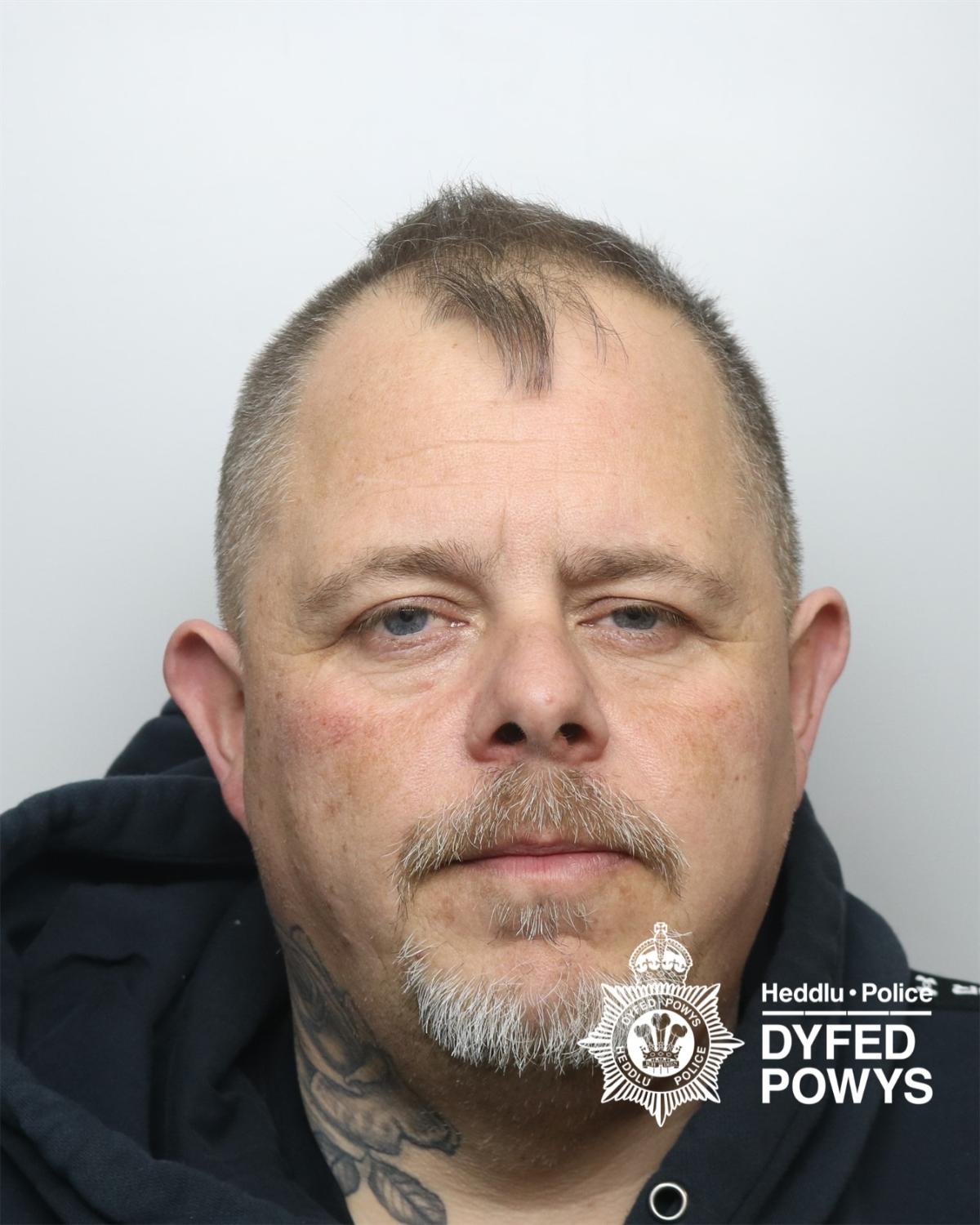
A PEMBROKESHIRE drug trafficker jailed after a major cocaine and cannabis seizure has been ordered to repay more than £33,000.
Dean Evans, 44, returned to Swansea Crown Court for a Proceeds of Crime Act hearing after prosecutors sought to recover money made through his offending.
The court heard it had been agreed that Evans benefited from criminal conduct by £496,533.94. However, his available assets were calculated at £33,337.37.
Judge Catherine Richards made a confiscation order for that amount and gave Evans three months to pay. If he fails to do so, he faces a further year in prison.
Evans, of St Clements Park, Freystrop, is already serving an eight-year sentence after admitting possession with intent to supply cocaine and cannabis.
He was caught after Dyfed-Powys Police’s Roads Policing Unit stopped his Seat Ateca on Holyland Road, Pembroke, at around 10:25am on January 2.
Officers searched the vehicle after Evans admitted they would find “stuff” inside.
They discovered around one kilogram of cocaine in a cardboard box in the boot, together with 5.4 kilograms of cannabis in a black bin bag. The cannabis had been split into ten vacuum-sealed bags.
Swansea Crown Court was previously told the drugs had a combined potential street value of up to £185,000, made up of around £125,000 of cocaine and cannabis worth up to £60,000.
A mobile phone seized from Evans revealed what prosecutors described as a “dealer’s list”, with dozens of names and sums believed to be owed. Messages also showed Evans directing dealers below him in the supply chain.
At the original sentencing hearing, the court was told Evans had 23 previous convictions for 62 offences, including rape and robbery. His previous drug matters had related only to possession.
Sarah John, mitigating, said he had pleaded guilty at the earliest opportunity and had stayed out of trouble for a “fairly lengthy period”, with his last conviction in 2016.

Jailing Evans for eight years, Judge Paul Thomas KC said: “You are clearly a man with few criminal boundaries.
“You ensnared users and low-level drug dealers into debt, dragging them into a vicious circle of criminality.”
After sentencing, DC Phill Jones, of Pembrokeshire’s Serious Organised Crime Unit, said illegal drugs brought misery to local communities and would not be tolerated.
He said: “This sentence should serve as a stark warning to any others who are tempted into the illegal drugs trade. You will get caught and you will go to prison.”
Photo caption: Drugs seized:
Dean Evans was caught with cocaine and cannabis worth up to £185,000 in his car (Pic: Dyfed-Powys Police).
A MAN is wanted by the courts after failing to attend a hearing relating to a series of alleged shop thefts in Pembrokeshire.
Jack Morgan, of Pembroke, was due to appear before Haverfordwest Magistrates’ Court on Tuesday (Jun 16) but failed to attend.
The court heard that Morgan faces several allegations of shop theft from businesses in Pembrokeshire.
The charges include the alleged theft of vodka from the Co-op in Pembroke Dock, along with food and drink items including sausages, crisps and Dragon Soop from The Green Garage.
The alleged offences are said to have taken place on various dates earlier this year.
After Morgan failed to attend court, magistrates issued a warrant for his arrest without bail.
He will now be brought before the court once located by police.
Court officials heard that the matters remain before the court and no pleas have yet been entered.


Community18 hours ago
Police officer hailed hero after midnight sea rescue in Milford Haven
PC swam 100 metres offshore to save distressed woman heard calling for help in darkness A DYFED-POWYS POLICE officer has...


Local Government24 hours ago
Security privately arranged by Mayor at Beating of the Bounds
HAVERFORDWEST TOWN COUNCIL has confirmed that security personnel seen at this year’s Beating of the Bounds were privately arranged and...


Business2 days ago
Celtic Freeport five-year plan puts Milford Haven at centre of green energy future
Strategy promises investment, skilled jobs and new supply chains, but major barriers remain over grid connections, planning and delivery THE...


Education2 days ago
Closure of Ysgol Clydau approved after emotional council debate
COUNCILLORS WARNED RURAL COMMUNITIES WILL REMEMBER DECISION PEMBROKESHIRE councillors have voted to close Ysgol Clydau following an emotional debate over...


Education2 days ago
Manorbier school closure process to continue after narrow council vote
Questions remain over insurance, rebuilding costs and possible legal action by Diocese PEMBROKESHIRE councillors have voted to press ahead with...

Community2 days ago
The father, son and daughter lifeguard trio saving lives in Pembrokeshire
A FATHER, son and daughter are preparing to help keep beachgoers safe on the Pembrokeshire coast this summer as part...


Community3 days ago
Beating of the Bounds brings music, boats and tradition to Haverfordwest
CENTURIES-OLD CEREMONY DRAWS FAMILIES TO THE RIVERSIDE HAVERFORDWEST’S historic Beating of the Bounds returned on Sunday (Jun 14), with boats,...


Community3 days ago
Milford Haven School pupil praised after stepping in during real-life emergency
A YEAR 11 pupil at Milford Haven School has been praised after putting his first aid training into action to...


Community3 days ago
River festival brings crowds to Haverfordwest
A CELEBRATION of the River Cleddau brought crowds into Haverfordwest on Saturday (June 13) as the town’s River Festival returned...


Charity3 days ago
Voices at the Castle hailed as unforgettable night after weather setback
Russell Watson headlines spectacular charity concert at Pembroke Castle A SPECTACULAR evening of live music at Pembroke Castle has been...
-

 Community3 days ago
Pembrokeshire Chess Club crowned Welsh champions
-
Local Government24 hours ago
Security privately arranged by Mayor at Beating of the Bounds
-

 Crime6 days ago
Pembroke Dock teenager sentenced over train strangulation attack
-

 Education5 days ago
Diocese threatens legal action as Manorbier school closure battle intensifies
-

 Crime6 days ago
Man accused of six rapes including alleged Haverfordwest offence
-

 Local Government5 days ago
Taxi suspended after county-wide licensing checks
-

 Crime6 days ago
Brothers found guilty of causing death of Welsh dad in ‘reckless’ race
-

 Crime5 days ago
Currys worker denies stealing £2,500 of store stock