


Community
MPs should be ‘a bloody nuisance’


A nuisance: Simon Hart
SIMON HART arrives for his interview with the air of a man eager to get cracking with business. That does not, however, stop him from taking time to chat about his experiences as a surveyor in and around Tenby and the deep connection he feels to his home locality. With a message sent on his mobile phone to explain he would be late for his next stop on a journey that had seen him visit a trampoline factory in Pembroke Dock before heading to The Herald offices and then off to visit Llawhaden, he gives the impression of being a man constantly active and on the move.
The same habits permeate his speech: he is, by turn, measured and bubbling with infectious enthusiasm as he warms to a subject. We start off with a subject featured in last Friday’s edition of The Herald. A couple of weeks ago, our columnist Badger offered an assessment of how the local seats in the coming election would pan out. In that column he described Mr Hart, whose chances he did not fancy, “a humane and committed constituency MP of a type becoming increasingly rare at Westminster”.
Badger’s words were met with correspondence from those who wished to draw attention to their contention that Mr Hart’s past as Chief Executive of the Countryside Alliance made the word “humane”, at best, moot. That correspondence was featured, as was Badger’s somewhat pithy response. Mr Hart said: “I am interested that those who are opposed to hunting are those who appear to be obsessed about it and are constantly raising it.
“My priorities in my constituency are, I hope, basically the same as everyone else: jobs, housing, health, the future of Withybush. Of course, I have never made any secret about what I did before I was an MP.I am proud to have been associated with a 200 year old Pembrokeshire institution – the South Pembs Hunt. So, I have no problems. People must make their own judgements and if they found what I did before I was an MP too much to stomach, then I have to live with that.”
He continued: “The usual thing you hear about MP’s is that we are all the same and nobody knows what anyone stands for. I personally think that voters these days would prefer to vote for somebody who has beliefs and opinions and is prepared to stand by them. “It was not my party who spent 700 hours of parliamentary time debating hunting. In this Parliament not a single hour of debate has been devoted to the issue. I am not going to be accused of devoting time to a subject which, as I say, I never raised and which I never would have raised.”

We asked Mr Hart whether he was optimistic about the prospects for economic regeneration in his parliamentary constituency. He said: “I’m always somebody with a positive demeanour. Entering 2015, and trying to be realistic about the obstacles some families face, I am immensely proud of the fact that we have great businesses around here. Some of them are long-standing and some of them relatively new. This morning, I was at Atlantic trampolines in Pembroke Dock, who have sold 50,000 trampolines over the last few years and are selling their goods across the UK and worldwide.
“There is a lot to be positive about with small and medium-sized business opening up: the manufacture of the ZANO drone based at the BIC, in Pembroke Dock, puts us at the forefront of new and developing technologies. The lists of these new businesses is endless.” Simon Hart paused to take a sip of tea and continued: “It is fantastic we are seeing unemployment fall in the area. I hate it when people talk about jobs in tourism as “not proper jobs”.
If you are working on that caravan site or in that hotel, earning your own money and spending it in your community: that’s a proper job. I did that once and I think it is condescending of people to suggest that they are not proper jobs.” Looking at the loss of manufacturing jobs, at Murco and Cambrian Windows, Mr Hart acknowledged the challenges but remained upbeat: “There are career prospects in the County: I don’t want it to seem that I am looking at things through rose-tinted spectacles. There are a signifi cant number of new jobs being created and maintained. People are fi nding Pembrokeshire is a very good place to do business.”
In terms of what he has done for his constituents he replied: “My ambition is to provide a voice for people that they otherwise would not have. I like sticking up for the small guy. I think the role of an MP is become a bloody nuisance on behalf of people in need of help. “If that means knocking on the doors of the Welsh Government, the County Council and the Health Board, so be it. I know that there are times when the phone rings at County Hall when people go ‘oh no not him again’. Good!”

Moving on to discuss Withybush Hospital and the actions of the Health Board in respect of health services within Pembrokeshire, Simon Hart was very clear: “My frustration with Hywel Dda, and that should indicate how I feel about it, is that its communication is poor. It does not think it communicates either its intentions or its decisions effectively, either its staff or the public. This creates an information void which can be alarming.”
Visibly warming to a subject upon which he has campaigned vociferously, Mr Hart continued: “We need to know what the longterm is and whether the Board sees a future for Withybush. Without that we cannot plan for our families or our businesses. “One thing the Board says is an issue is recruitment, and it has blamed a lot of things for that being a problem for it, but the real issue affecting recruitment is the lack of certainty about Withybush’s future.
How does the Board think it will attract professionals to Pembrokeshire if nobody knows whether the jobs on offer are permanent? “The Board has created a selffulfi lling position for itself in recruitment. Until we have certainty about the future of the hospital for the next ten or fifteen years, we are still going to encounter that problem.”

Discussing the Welsh Government’s role in the NHS, Simon Hart expressed concerns that the Welsh NHS had not had its funding protected in the same way as the NHS in England. Speaking of a meeting he had the previous day with Mark Drakeford he said: “Mark Drakeford made some sensible points about the treatment of patients, but it worries me that the budget has been cut and that the public is losing confidence in the NHS.
“In relation to comparisons between the performance of the NHS in England and Wales, Mark Drakeford said that comparisons were unfair, and then proceeded to make some to illustrate his argument. “Whether it is true or not, people believe that the Welsh NHS is not as good and it has a signifi cant economic impact on Wales. We are trying to encourage people to come to Wales with their businesses and families, and the negative perception of the Welsh NHS is discouraging them.” The Herald will reveal part two of this interview next week.


BARCUD Housing Assistant, Amanda Evans, is a brave ‘sole’ as she has agreed to do a Firewalk to help raise funds for Wales Air Ambulance. The charity, which is celebrating its 25th anniversary, relies entirely on public donations to keep both the rapid response vehicles and helicopters running.
The firewalk is a sponsored walk with a difference! It might be the shortest and hottest walk, but it takes strength of mind to complete the challenge of walking five metres, barefoot, over hot coals which reach temperatures of up to 800°C!
Amanda has never done a Firewalk before but last year she changed her mindset and since then the word ‘no’ hasn’t been in her vocabulary. She said, “Doing a Firewalk sounds awesome. I decided it would be a giggle to sign up on behalf of Barcud to raise funds for Wales Air Ambulance. Why not? It would be great to have a crowd at the Firewalk in Aberaeron to show support and cheer me on.”
Day to day Amanda works at Barcud’s office in Glyn Padarn, Aberystwyth. She works as part of a team with housing officers to provide support for tenants.
Barcud is based in mid and west Wales with a 300 strong workforce and 4,500 tenants. This is the group’s first year of fundraising for a specific charity and at the annual colleague conference last winter the majority were in favour of supporting a charity, that, like Barcud, helped and supported those living rurally.
Gail Windley, Wales Air Ambulance’s Events and Partnership Fundraiser said, “We’re delighted to be launching our firewalks this year on our special 25th anniversary year. Fundraisers will take on the ultimate challenge of walking over hot coals to helps save lives across Wales. This is a wonderful challenge aimed at all physical abilities and one that needs some courage.
“Walkers don’t need any previous experience to take part in the firewalk, as all the training will be provided on the day. We want to reiterate that this is not an activity to be tried at home and should only be done during a professionally organised event.
“The Charity relies on donations to continue to keep our helicopters in the air and our rapid response vehicles on the road. Fundraising events, like the firewalks, will help to continue this lifesaving service for the people of Wales. It will be an unforgettable day for the participants and their supporters.”
Amanda will be doing her Firewalk at Moody Meadows in Aberaeron from 6pm on Friday, 10th July 2026. Any donations to support Amanda, and Barcud reach its fundraising target of £5,000 would be very gratefully received. Click here to support Amanda online: https://firewalks.walesairambulance.com/amanda-evans

New research suggests most children in Wales are still falling short of five-a-day
TESCO is expanding its Free Fruit & Veg for Schools programme across Wales after new research found that most children are not eating their recommended five portions a day.
The supermarket said only four out of 37 children in Wales, around 10.8%, eat their recommended five portions of fruit and vegetables on a typical school day.
The research also found that almost a third of Welsh parents said their child refuses fruit and vegetables altogether.
Tesco said it will double the number of schools supported by the programme from September, with an ambition to double it again the following year.
The scheme currently provides funding to more than 500 schools across the UK with higher-than-average free school meal eligibility, allowing them to provide pupils with fruit and vegetables during the school day.
Since launching in 2024, the programme has already reached more than 188,000 children across the UK, with pupils consuming more than 15 million portions of fruit and vegetables in its first year.
This year’s expansion is expected to support more than 388,000 children across the UK.
Tesco said the programme is designed to help children try a wider range of fruit and vegetables, build confidence with healthy food, and encourage better eating habits.
The company said pupils taking part have already sampled more than 100 different varieties of fruit and vegetables.
The research also suggested that choice and presentation can make a difference. More than three quarters of Welsh parents said their child is more likely to eat fruit and vegetables when they can choose them themselves, while many said making food fun or visually creative encouraged children to try more.
Ken Murphy, Tesco Group CEO, said: “We’ve set out an ambition to help one million children get free fruit and veg through our school and community programmes, supporting the development of healthy habits.
“Schools have told us what a positive impact the Tesco Free Fruit & Veg for Schools programme has already made, so we’re delighted to be able to double the number of schools receiving support from September.”

Elaine Hindal, Chief Executive of the British Nutrition Foundation, said: “A significant number of children in the UK are growing up with diets that don’t support their health.
“Early food experiences matter, as they can help to shape children’s confidence, habits and long-term health outcomes.
“By helping children enjoy and regularly eat fruit and vegetables from a young age, programmes like Tesco Free Fruit & Veg for Schools can help to make a lasting difference to diet and health now and in the future.”
Tesco is also inviting children to create fruit and vegetable-packed recipes as part of its Giant Fruit and Veg Challenge, with the winning dish to be served in more than 1,500 schools.
The supermarket has set a target of helping one million school children across the UK access free fruit and vegetables through its school and community programmes by July 2029.
Temporary facility set to offer face-to-face banking support as permanent home is sought
A NEW temporary banking hub is expected to open in Pembroke Dock within the next week, offering residents and businesses access to everyday banking services following the closure of traditional high street branches.
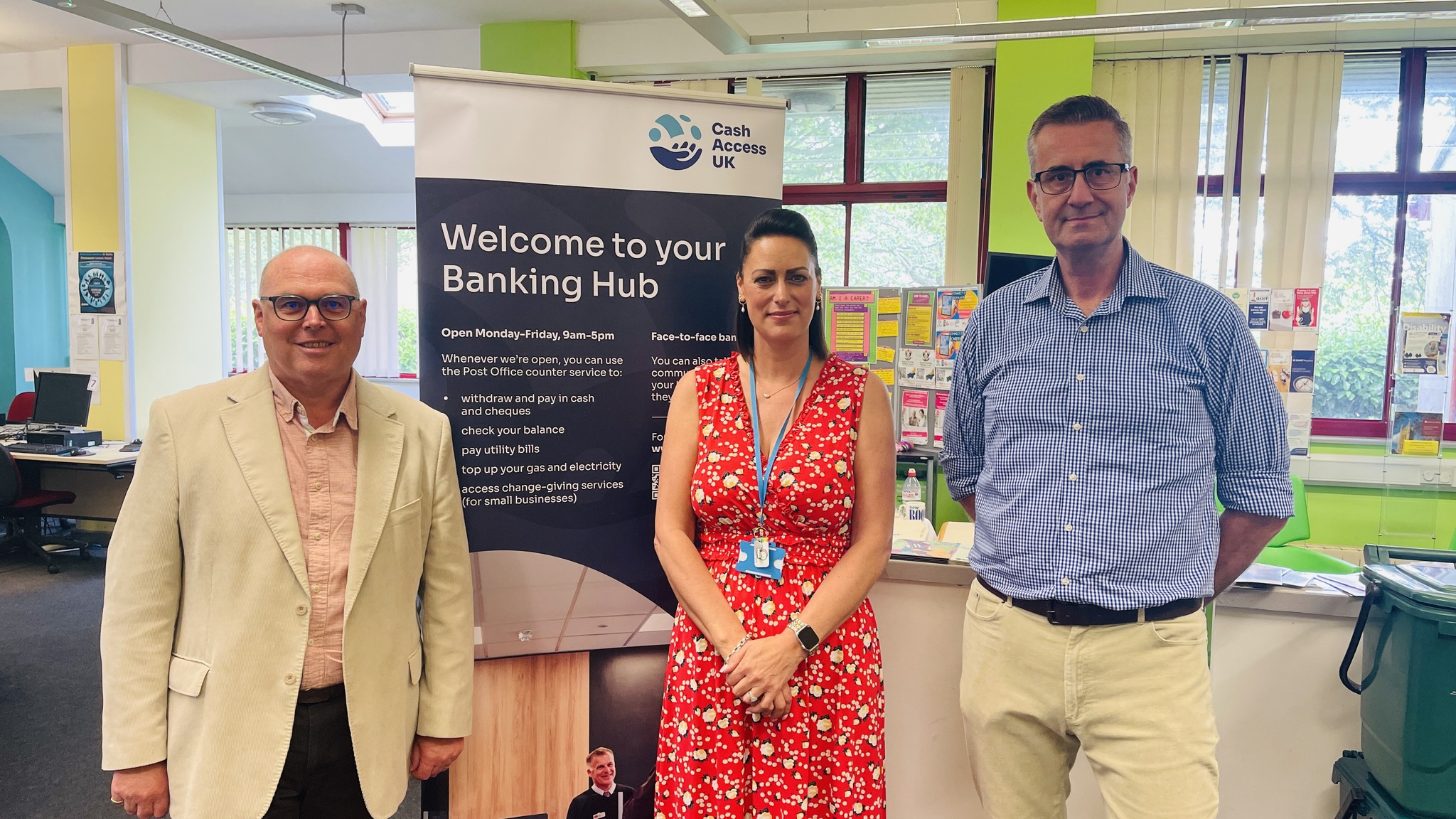
The facility, which is being established inside Pembroke Dock Library, was visited this week by county councillor Jonathan Grimes and Preseli Pembrokeshire MS Paul Davies, who received an update on progress from Debbie of Cash Access UK.

According to Cllr Grimes, the temporary hub is now nearing completion and will provide a valuable service to the local community, particularly for residents who still rely on face-to-face banking and cash services.
At present, it is understood that NatWest, Lloyds and Barclays will each have a dedicated day at the hub during the working week, with staff available to offer advice, support and assistance with account-related queries. Other banks are expected to be confirmed in due course.
Importantly, customers will not be restricted to using services only from their own bank. The hub will allow people from any banking provider to carry out routine transactions such as cash withdrawals, deposits and other day-to-day banking needs.
The temporary facility will operate Monday to Friday from 9:00am to 5:00pm and will be based inside the library while plans continue for a permanent banking hub in the town.
Jonathan Grimes, county councillor for Pembroke St Mary South and Monkton, said he was pleased with the progress being made.

He said the temporary hub “already looks fantastic” and would be a “really valuable addition for the community.”
The long-term location for the permanent Pembroke Dock Banking Hub is still being finalised by Cash Access UK, with the permanent site expected to open within the next 12 months.
The move comes amid growing concern over the loss of high street bank branches across Pembrokeshire and the impact this has had on elderly residents, cash-reliant businesses and people without easy access to online banking.
Banking hubs have been rolled out across the UK to plug the gap left by branch closures, offering shared facilities where customers from different banks can access essential services under one roof.
Photo caption: New banking hub: Jonathan Grimes and Paul Davies receive an update on the temporary Pembroke Dock Banking Hub at Pembroke Dock Library (Pic: Supplied).




News8 hours ago
Lifeboats and helicopter join search for missing person off Broad Haven
SEARCH teams carried out a major operation at Broad Haven after reports of a missing person. Little and Broad Haven...


News21 hours ago
Multi-agency rescue after child falls on rocks while coasteering
Child airlift requested after four-metre fall near Lydstep A CHILD was rescued from rocks near Lydstep after falling around four...


News1 day ago
Police investigate ‘arson’ after vehicle fire spreads to property in Pembroke
A VEHICLE is believed to have been deliberately set alight during an alleged arson in Pembroke in the early hours...


News1 day ago
Four rescued after dinghy deflates off Pendine
FOUR people were rescued off Pendine on Wednesday evening after Tenby’s all-weather lifeboat was launched to reports of an inflatable...


News1 day ago
Hundreds attend major Diocese of St Davids gathering
Churches across West Wales urged to take message of faith back into their communities HUNDREDS of people gathered at Carmarthenshire...


News1 day ago
Vehicle destroyed in early morning fire in Pembroke
POLICE are investigating after a vehicle was destroyed in an early morning fire in Pembroke. The incident happened in the...


Climate2 days ago
Pembrokeshire named among Wales’ green economy hotspots
New analysis says the county’s net zero sector supports 1,600 jobs and accounts for 5.3% of local economic output PEMBROKESHIRE...


Local Government3 days ago
Dennison code breach raises serious questions over common sense at County Hall
Standards Committee finds Milford Haven councillor breached code despite claims he only helped another councillor complete paperwork A PEMBROKESHIRE councillor...


Business5 days ago
Plaid energy policy challenged by Labour after Adam Price interview
LABOUR SAYS MINISTERS MUST EXPLAIN COST AND TIMETABLE FOR PYLON PLANS PLAID CYMRU’S approach to energy infrastructure has come under...


Community5 days ago
Pembroke Fair praised as well-organised community event
HORSES, STALLS AND FAMILY CROWDS RETURN TO MONKTON FAMILIES, horse owners and visitors turned out in force for Pembroke Fair...
-

 News7 days ago
Watchdog criticises health board over £10m GP contract checks
-

 Health1 day ago
Paul Davies warns health board over Withybush and Bronglais services
-
 Crime2 days ago
Police tip-off leads to drink-drive ban for Pembrokeshire pensioner
-

 Crime1 day ago
Carmarthenshire man sent to Crown accused of 33 historic sexual offences
-

 Crime2 days ago
Warrant issued for man accused of taking wild goldfinches
-
 Crime2 days ago
Dock man given suspended prison sentence for third drink-drive offence
-

 Crime2 days ago
Steynton motorist banned after drink-drive collision
-

 Crime2 days ago
Dock motorist fined £1,600 after four speeding offences
private jet charter The Bahamas
April 10, 2026 at 10:01 pm
Thanks for the comprehensive overview. Very helpful!