


Education
Holy Name pupils celebrate CK’s grant for breakfast club


PUPILS at Holy Name Catholic Primary School in Fishguard are celebrating after the school’s Breakfast Club received a generous grant from CK’s Supermarket.
The funding was awarded through CK’s Making a Difference initiative, following nominations from parents.
Staff said the children were delighted to hear the news and are now putting together a wish list for items that could benefit the club.
The school thanked CK’s and the parents who supported the nomination.
A spokesperson said: “Breakfast Club pupils at Holy Name School, Fishguard were delighted to hear the news that, thanks to parent nominations, we were awarded a very generous grant from CK Supermarket as part of their Making a Difference initiative.

“The pupils and staff would like to thank CK’s and the parents that nominated us, and are excitedly thinking about putting together a wish list.”



A FURTHER secular group has backed Pembrokeshire County Council’s plan to redesignate a north county faith primary school as a nonreligious community school.
Back in May, Pembrokeshire County Council voted to remove Voluntary Controlled (VC) status from Welsh-medium Ysgol Cilgerran’s Church in Wales school despite 97 per cent of the responses to a consultation having opposed a change which the church describes as ‘entirely unnecessary’.
That consultation followed a review which “considered the extent of surplus school places in the area, set against a significant decline in the pupil population,” the council has previously said.
Hundreds opposed the proposed changes, with a petition on the council’s own website gaining 391 signatures.
The Church in Wales has objected formally to the proposal and has warned it will take legal action on the grounds of “public misrepresentation and unqualified legal assertions made by Pembrokeshire County Council officers,” and “discrimination against faith schooling”.

At the council’s July meeting, Cilgerran parents, teachers, and students travelled to County Hall, Haverfordwest to protest.
Their colourful protest signs, made by students, carried messages such as “You can’t fix what isn’t broken”, “Leave our VC status alone”, and “Don’t take away our identity for a few £££”.
One of the protesters, an ex-pupil and governor, Sarah Moore, has said: “I’m here today because I’m horrified that the council are talking about taking the church status away from our school. The church gave that land for the school over 180 years ago.
“97 per cent have voted against this and yet they’re still trying to do it. If we want our children to stay in a church school, the nearest one is Letterston. So where will these children have that good education that they are getting now?”

The Church has said it has deep concern about what it sees as a pattern of the council’s recent actions regarding Church Schools.
In June, councillors voted to close Manorbier Church in Wales Voluntary Controlled School, which was damaged by a fire in 2022.
It has also expressed concerns about VC status being lost for Tenby Church in Wales VC school after councillors backed a consultation on penitential education changes in the Tenby area.

Wales Humanists recently supported the council plans, writing to Pembrokeshire County Council expressing its support for the proposal “on behalf of the area’s substantial non-religious community”.
It says, according to the 2021 Census, almost half of people in Pembrokeshire identified as having no religion.
Since then, another secular group, The National Secular Society (NSS), has expressed its support for the council.
The NSS campaigns for publicly funded faith schools to be phased out, and for religiously selective admissions to be abolished.
Welcoming the move, the NSS praised the council’s “secular approach to education” as the “best means of ensuring publicly funded schools are equally welcoming to all children, regardless of their backgrounds”.
The NSS added: “Inclusive schools which educate pupils together are one of our best means of promoting community cohesion, whilst faith schools which divide children on the basis of religion and are entirely out of step with the irreligious and religiously diverse Wales of today.
“Schools we all pay for should be managed in the best interests of everyone, not used as a vehicle for the agenda of religious institutions.”

Ysgol Preseli also represented Pembrokeshire among five finalists at an all-Wales green skills competition
A TEAM of Haverfordwest pupils has earned national recognition after developing a range of environmentally friendly cleaning products aimed at hotels and tourism businesses.
The Sustainables, from Haverfordwest High VC School, presented their idea to business leaders, Welsh Government representatives and sustainability experts at the Tomorrow’s Changemakers Hackathon 2026.
The pupils gave a live demonstration of their product and explained how it could be priced and marketed to businesses across the hospitality sector.

Their combination of environmental thinking and commercial awareness impressed the judging panel, which awarded the team a Highly Commended prize.
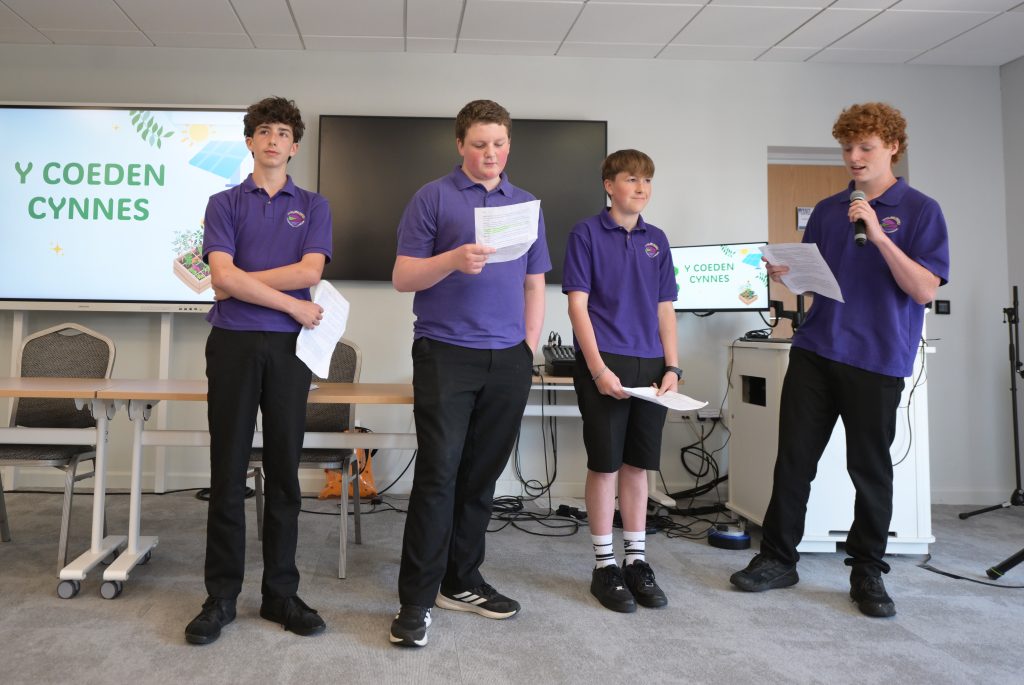
Pupils from Ysgol Preseli also reached the final, meaning Pembrokeshire was represented by two of the five teams selected from across south and west Wales.
The competition, held at the University of Wales Trinity Saint David in Carmarthen, challenged Year 8 pupils to find practical solutions to environmental problems affecting tourism, hospitality and the built environment.
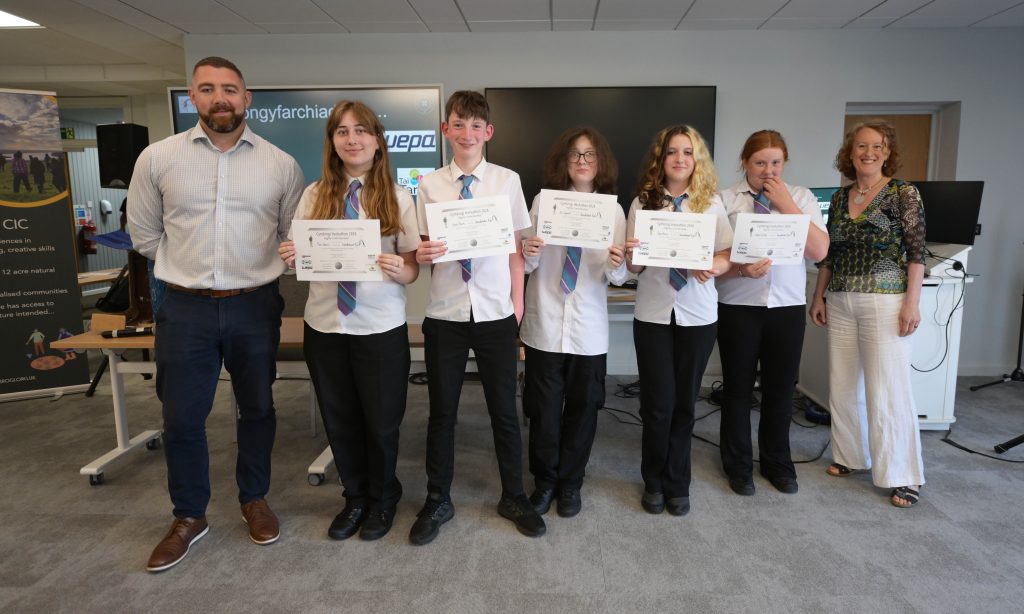
The overall winners were the Green Guardians from Llangatwg Community School in Neath Port Talbot.
Their design for a more sustainable school included an outdoor learning centre which could also operate as a pupil-run garden café.
The hackathon marked the end of a year-long programme in which pupils worked alongside teachers, employers and community organisations to research problems, develop ideas and present their solutions.
More than 1,000 Pembrokeshire pupils have taken part in the Tomorrow’s Changemakers programme since it was introduced in the county in 2023.
The Port of Milford Haven is the programme’s main partner in Pembrokeshire.




Anna Mullarkey, the Port’s stakeholder engagement and communications manager, said: “The creativity and innovation shown by these learners is truly inspiring.
“They transformed their ideas into practical solutions that could help build a more sustainable future.
“We’re proud to support young people in reaching their full potential and delighted to see schools across Pembrokeshire creating environments where ideas and talent can flourish.”
The programme has now worked with more than 3,000 young people across Pembrokeshire, Carmarthenshire and Neath Port Talbot.
It is due to expand further from September, with Ysgol Harri Tudor and Ysgol Caer Elen joining the Pembrokeshire programme alongside schools in Swansea, Powys and Bridgend.
Cymbrogi Futures founder and chief executive Liza Lort-Phillips said Pembrokeshire remained at the heart of the initiative.
She said: “The county has extraordinary young people with bold ideas about the future of their communities.
“Our job is to give them the space, the tools and the confidence to act on those ideas.”

Ysgol Caer Elen could receive more than £1,000 to help pupils perform as Pembrokeshire hosts Wales’ biggest cultural festival
PUPILS from Ysgol Caer Elen are preparing to perform on one of Wales’ biggest cultural stages after Haverfordwest Town Council backed financial support for their visit to this summer’s National Eisteddfod.
The council’s Personnel, Policy and Finance Committee has recommended awarding the Haverfordwest school £1,065 towards transport and participation costs.
The National Eisteddfod, known this year as Eisteddfod y Garreg Las, will be held at Llantood, near Crymych, from August 1 to 8.
Councillors said the event would provide pupils with an exceptional opportunity to perform at a major national festival while it is being hosted in their home county.
Members also praised the school’s enthusiasm and its efforts to support local fundraising, including a concert and disco held on behalf of the Haverfordwest Eisteddfod Appeals Committee.
The proposed grant was considered to support several of the town council’s priorities, including the promotion of the Welsh language, culture and the arts, as well as creating educational opportunities for young people.
Ysgol Caer Elen provides Welsh-medium education for pupils aged from three to 16 and has played a significant role in the growth of Welsh-language education in Pembrokeshire.
This year’s festival also carries added historical significance, marking 850 years since the first recorded Eisteddfod was held at Cardigan Castle in 1176.
Councillors said the chance for local pupils to participate in such an important event was unlikely to come around again in the foreseeable future.
However, the committee stressed that its recommendation had been made because of the exceptional circumstances surrounding the Eisteddfod’s return to Pembrokeshire.
Members said the award should not be treated as setting a precedent for future applications, which will continue to be considered under the council’s usual grant criteria.
The recommendation must now be approved by the full town council before the funding is formally awarded.
Thousands of visitors are expected to travel to Pembrokeshire during the week-long festival, which will feature music, literature, theatre, visual arts, competitions and activities for families.
The National Eisteddfod is regarded as Europe’s largest travelling festival celebrating the Welsh language and culture.



News20 hours ago
Princess Royal celebrates Pembrokeshire craftsmanship at family-run weaving mill
A Pembrokeshire business that began after a mother grew tired of waiting three weeks for her children’s name tapes has...


Local Government20 hours ago
Burger King could be coming to Haverfordwest as plans submitted
Plans have been lodged for a Burger King outlet at the Morrisons petrol station on Bridge Meadow Lane BURGER KING...


Crime2 days ago
Murder investigation launched into death of Pembrokeshire man in 1991
A 67-YEAR-OLD man has been arrested on suspicion of murder after new potential evidence emerged in connection with a death...


Community2 days ago
‘Paying £29 to reach a cashpoint is absurd’: Narberth’s urgent ATM appeal
Residents, businesses and visitors are being urged to provide evidence after two High Street cash machines were removed, leaving the...


Crime2 days ago
Haverfordwest man jailed for seven years for historic rape and sexual assault of girl
A HAVERFORDWEST man has been jailed for seven years after being convicted of raping and indecently assaulting a girl during...


News3 days ago
Burnham more willing to listen on Welsh devolution, says First Minister
Rhun ap Iorwerth says he will press the new Prime Minister for powers over policing, railways and Wales’ natural resources...


Crime3 days ago
Women jailed after man chased through Milford home and attacked with knives
Kelly Rees receives further 27-month sentence while already serving prison term for notorious taxi robbery TWO women have been jailed...


Crime3 days ago
Mother headbutted and clawed police officers after threatening social worker
Court shown body-worn footage of violent confrontation at Goodwick property A COURT has been shown police body-worn footage capturing the...


Crime4 days ago
Man, 37, found dead following major police response in Pembroke Dock
Death not being treated as suspicious as police make statutory referral to IOPC following active investigation A 37-YEAR-OLD man has...


Community4 days ago
Household Cavalry drum horse returns home to Pembrokeshire for final farewell
Dyfed Willa Rose, who became Major Juno and the first mare to serve as a Household Cavalry Drum Horse, was...
-
Crime2 days ago
Murder investigation launched into death of Pembrokeshire man in 1991
-

 News18 hours ago
Burnham’s first week – what it means for Wales
-
Community2 days ago
‘Paying £29 to reach a cashpoint is absurd’: Narberth’s urgent ATM appeal
-

 Business2 days ago
Port of Milford Haven named among UK’s best workplaces for women
-

 Health2 days ago
Record summer waits expose deepening crisis in Wales’ A&E departments
-

 Community2 days ago
Green Flag flies at Manorbier Community Garden for first time
-

 Community1 day ago
‘Warn and inform’ approach for breaches of dogs on beach restrictions to continue
-

 Business12 hours ago
Certificate of lawfulness granted for Whitesands overflow campsite