


News
Board asks charities to dig deeper



Handed a poisoned chalice? Steve Moore
CANCER charities and volunteers were left perplexed by the presentation of the Local Health Board’s plans for the future of cancer services in Pembrokeshire.
The meeting, held on Monday (Feb 23) morning at Withybush Hospital’s Postgraduate Centre, was intended by the Health Board to be a discussion of fundraising plans for the often-promised new Cancer Day Unit and new inpatient cancer unit. However, it developed into a thorough and critical examination of the board’s occasionally difficult relationship between charitable fundraisers and the board.
The sailing was not all through difficult waters. There was genuine and touching warmth between many of the people present directed towards those who had treated them.
The goodwill in the room extended to new Chief Executive, Steve Moore, whose efforts to meet with the public and listen to them had evidently been appreciated.
Sue Lewis, the County Director for the board, acknowledged past problems. With regard to the general medical admissions being made to Ward 10, she said that the pressures upon hospital beds over the winter months had meant that those admissions were unavoidable; however, she said that a new Ward 10 would definitely be a cancer ward. Sue Lewis was at pains to say that the discussions on Monday were for the provision of cancer services in Pembrokeshire only.

The good news given by the board was that enough money had been raised to build the new day unit in the location of the current Ward 10. Charities were told that the former Ward 14, as previously revealed by The Herald, would house paediatric care beds. However, the good news was tempered by the Health Board confirming that it had not secured any funding for the ‘new’ Ward 10 to be sited in the location of the present Ward 9.
Plans had been drawn for the new inpatient unit. But money to build it was there none.
And so the board asked the charities to help them.
The challenge put to the charities was stark. In terms, the board said: “You have raised so much money over the last eleven years. Please raise the same again, but in a very short period of time.”

Responding for Adam’s Bucketful of Hope, Chris Evans-Thomas told the meeting: “After all the fundraising charities have done, we need something tangible in return.” She sympathised with new Chief Executive Steve Moore, who had, she said been ‘handed a poisoned chalice’. Directing her fire at the Welsh Government in Cardiff Bay, she made it plain that she expected it to pay up.
Margaret Bond, Chair of the Board of Trustees of Withybush Hospital Cancer Day Unit Appeal, highlighted the reliance of the charities themselves on the goodwill of the public, while trying to turn pennies and pounds into the type of sums that can fund equipment purchases for patient care.
Sophie Thomas gave an overview of the work of The Paul Sartori Foundation in end of life care, while the representative of Shalom House Palliative Care Centre drew attention to the struggles faced by small charities in continuing to provide services complementary to those provided by the NHS.

Responding, Sue Lewis stated that while the board would look to the Welsh Government to pitch in, and ask for generous help from larger national charities, there would, nevertheless, be a significant demand upon the goodwill of local charities.
Paul Hawkins, the Operations Manager for the Board, was at pains to spell out that in order to begin work on phase two of the plans – reconstructing an inpatient unit to replace that removed – he would need ‘a clear sight’ that the £1m target for the new unit was on track.
Quite what that meant if the target was not in ‘clear sight’ after the completion of the Cancer Day Unit was not spelled out.
The issue of trust was raised by more than one representative of a charity. Mr Hawkins was told point blank that at least one of the charities represented did not trust the board to deliver. The Herald understands that, in light of the trust issues, charities are very likely to place significant strings on any other money they hand over to the board.
The charities also expressed grave concerns about the displacement of money from their central charitable activities towards the building of a new Ward 10. Sophie Thomas, from The Paul Sartori Foundation, expressed particular concerns about the finite amount of money available for charitable giving in Pembrokeshire and the way in which third party resources, on which patients depend, might be adversely affected.
Lyn Neville of Pembrokeshire Cancer Support was not at the meeting but he has repeatedly raised questions about where the extra money will come from. He told The Herald that he was worried about the path the board had taken: “The original plans were always to build the Day Unit last. I am very concerned that we might have a new Day Unit but no dedicated cancer ward. I am also concerned that – even if the money is found for a new ward – there will be difficulties in sustainably staffing it.”
One charity campaigner, who did not want to be identified, told us that they were concerned that the board turned to charities to raise money for this specific capital project but not others, saying: “Refurbishment should be part of a rolling programme for all areas of the hospital, paid for out of core funding.”
The Health Board was due to provide a press release following the meeting. At the time of going to press, the board has confirmed that a press release is now scheduled for next week.

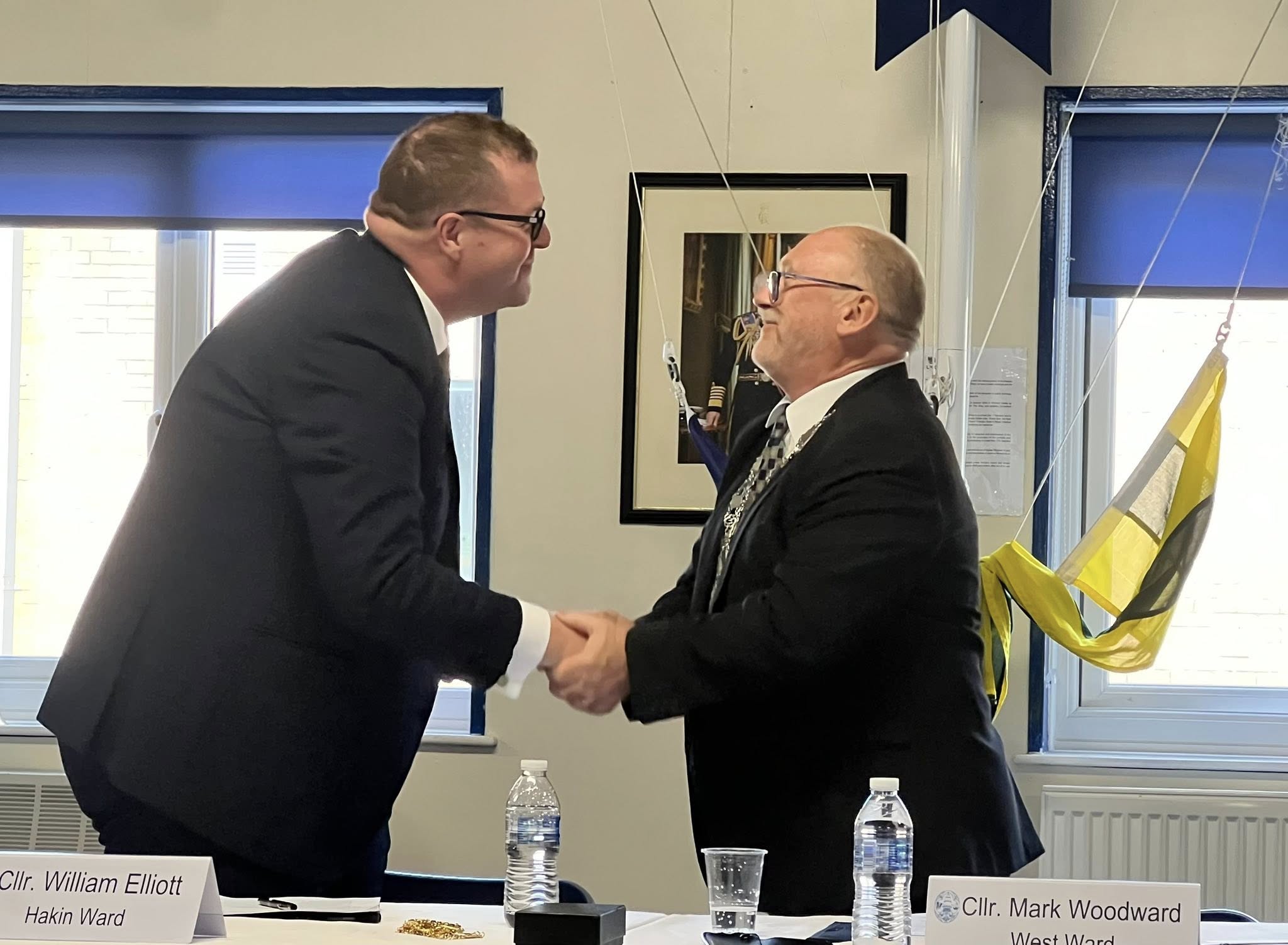
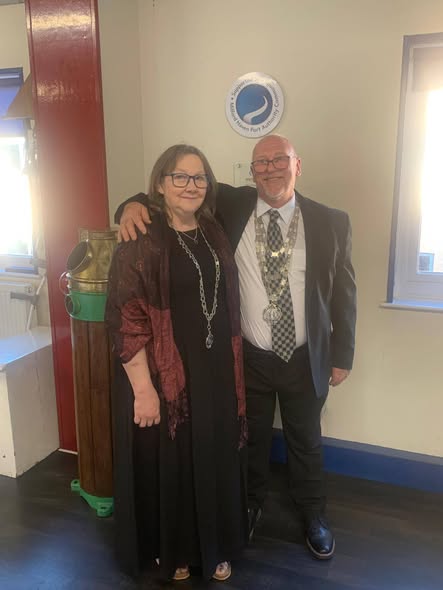
MILFORD HAVEN TOWN COUNCIL has congratulated Cllr Mark Woodward after he was inaugurated as the town’s new Mayor and First Citizen.
Cllr Woodward was formally appointed on Monday evening, with Cllr Kathy Gray confirmed as Deputy Mayor.
Following the ceremony, Cllr Woodward said it was a “true honour and privilege” to take on the role, adding that it was something he had “never in my wildest dreams imagined would happen to me.”
He thanked his fellow councillors for their trust, as well as residents who had sent messages of congratulations.
Cllr Woodward also paid tribute to his wife Eva, who now becomes Mayoress, saying her support had helped make the moment possible.
He said: “I promise I will do my absolute best and fight hard and passionately for my beloved adopted town.”
With Cllr Gray serving as Deputy Mayor, Cllr Woodward added that residents could “rest assured it will not be a quiet year.”
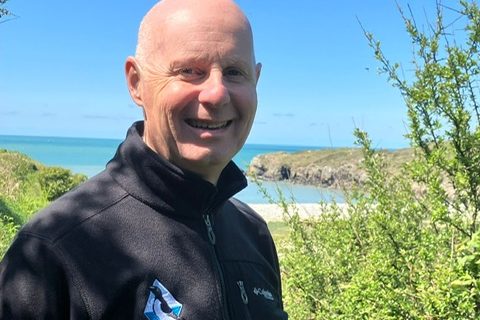
PARK CHIEF RECOGNISED
PEMBROKESHIRE Coast National Park Authority Chief Executive Tegryn Jones is to be honoured by Gorsedd Cymru at this year’s National Eisteddfod.
Mr Jones has been named among those who will be admitted to the Gorsedd in recognition of their achievements and contribution to Wales, the Welsh language and local communities.
He will be admitted in the Blue robes, which are awarded to people who have given distinguished service in areas including public life, local and national activity, journalism, media, sport, science and law.
Originally from Lampeter and a fluent Welsh speaker, Mr Jones has played a prominent role in Welsh public life through a career spanning environmental, educational and community leadership.
Before joining Pembrokeshire Coast National Park Authority, he served as Chief Executive of Keep Wales Tidy and also worked for the General Teaching Council for Wales.
He was nominated for his work in education, youth work and the environment, as well as for developing environmental initiatives at both local and national level.
In Pembrokeshire, he is also closely associated with the development of Welsh-medium education through his long-standing involvement with Ysgol Caer Elen in Haverfordwest, where he was the first Chair of Governors.
Mr Jones said: “It is a great honour to be recognised by Gorsedd Cymru, particularly in a year when the National Eisteddfod returns to Pembrokeshire for Eisteddfod y Garreg Las.
“The Welsh language belongs to all our communities, and I have been very fortunate to work with so many people who care deeply about its future, whether through education, culture, the environment or public service.
“The Pembrokeshire Coast National Park is one of the jewels of Wales and provides an outstanding landscape that contributes to the environmental, social and economic goals that are essential to Wales’ future.
“I am very fortunate to lead the National Park Authority and extremely proud that this work has been recognised by the Gorsedd.”
This year’s National Eisteddfod, Eisteddfod y Garreg Las, will be held in Llantwd, North Pembrokeshire, from August 1-8, 2026.

The event will be especially significant as it marks 850 years since the first recorded Eisteddfod was held in Cardigan in 1176, just across the river from this year’s Maes.

PUBLIC SUPPORT FOR CULLING ‘NOT THERE’, CHARITY SAYS
NEW polling from RSPCA Cymru suggests there is no clear public support in Wales for badger culling as a way of tackling bovine TB.
The charity says the new Welsh Government must “listen to people’s love of wildlife” after a survey found that just over a quarter of people in Wales actively support the culling of badgers.
The polling, released today (May 13), comes as 96 Members of the Senedd prepare to take their seats in the newly-expanded Welsh Parliament, with bovine TB expected to become one of the major animal welfare and farming issues facing the next administration.
RSPCA Cymru said only 27% of those surveyed supported badger culling, while 46% were opposed. A further 28% said they did not know.
The charity is calling on Plaid Cymru, which is seeking to form a minority government following the appointment of Rhun ap Iorwerth MS as First Minister, and on MSs from all parties, to reject culling and focus instead on what it describes as a science-led, cattle-focused approach.
The survey of 1,033 adults in Wales found that 63% of respondents were uncomfortable with badger culling being carried out using lethal methods approved by government authorities.
More than two-thirds, 68%, said they were uncomfortable with public money being used to fund the culling of badgers.
The polling also suggested that the issue could affect political support. More than half of those surveyed, 52%, said they would be less likely to support a political party that backed badger culling, while only 7% said they would be more likely to do so.
RSPCA Cymru said the figures showed that badger culling was “unsupported by a clear majority” of the Welsh public.
Billie-Jade Thomas, senior public affairs manager for RSPCA Cymru, said: “How the new Welsh Government approaches bovine TB will be one of the biggest talking points concerning animals in Wales in the coming years.
“This polling should remind all newly-elected Senedd Members that the Welsh public cares about how badgers are treated, and politicians must listen to people’s love of wildlife.
“There is a clear lack of public support for badger culling in Wales, and those supporting such action could see their support wane among their constituents.”
She added: “Wildlife control and badgers were featured in several parties’ Senedd manifestos, including Plaid Cymru, Wales’ new biggest party.
“We now hope MSs from all political groups recognise that badger culling is unsupported by a clear majority of the Welsh public, and they should instead prioritise a science-led, cattle-focused approach to combatting bovine TB.”
The polling also found that almost 98% of people in Wales consider protecting Welsh wildlife to be important, with 69% saying it is very important.
Badgers were among the most popular species named in the survey, with 73% of respondents choosing them as one of the species they were most concerned about when asked to select their top three.
RSPCA Cymru said badgers remain one of Britain’s most distinctive and misunderstood wild mammals.
Ms Thomas said: “Badgers are such wonderful creatures and, like all wildlife, deserve to be treated with kindness and respect.
“A growing body of evidence suggests that the majority of bovine TB infection occurs between cattle, with scientific evidence suggesting that badger culling is not an effective way to reduce the disease in cattle.
“The new administration must always tackle bTB in a way which does not needlessly pose a threat to one of our most distinctive, well-loved yet misunderstood species of wildlife.”
RSPCA Cymru’s manifesto for the seventh Senedd, Securing A Better Future For Animal Welfare in Wales, calls for badger culling to be rejected, describing it as ineffective and inhumane.
The poll was carried out online by Savanta between April 24 and May 12, 2026. Figures were weighted to be representative of adults in Wales.



News19 hours ago
State Opening overshadowed by Starmer leadership crisis
KING CHARLES has arrived at Parliament for the State Opening as Sir Keir Starmer faces the most serious crisis of...


News2 days ago
Rhun ap Iorwerth becomes Wales’ new First Minister
PLAID CYMRU TAKES POWER AFTER HISTORIC SENEDD VOTE PLAID CYMRU leader Rhun ap Iorwerth has become Wales’ new First Minister...

News2 days ago
Hotel was hit during a Luftwaffe bombing raid
THE COMMEMORATION, held on Tuesday (May 12), marked the anniversary of the wartime attack, with members of the community gathering...


News2 days ago
Starmer fights for survival as Labour civil war erupts
Cabinet split, ministers resign and MPs revolt as pressure mounts on Prime Minister after disastrous election losses KEIR STARMER is...


News3 days ago
Starmer accused of ignoring Wales in major ‘reset’ speech
Prime Minister pledges EU reset, British Steel nationalisation and youth jobs guarantee — but critics say Wales was left out...


Community3 days ago
Concern grows after child hospitalised following Tenby sea swim
PARENT SAYS BOY BECAME SERIOUSLY ILL AFTER SWIMMING DURING FAMILY VISIT CONCERN is growing in Pembrokeshire after a parent claimed...


News4 days ago
Rhun prepares for clash with Starmer as Plaid eyes power in Cardiff Bay
PLAID CYMRU leader Rhun ap Iorwerth has signalled he is ready for confrontation with Prime Minister Keir Starmer after the...


News5 days ago
Plaid Cymru celebrates historic victory as Rhun ap Iorwerth arrives at Cardiff Bay
CROWDS gathered outside the Senedd as Plaid Cymru leader Rhun ap Iorwerth arrived in Cardiff Bay following his party’s historic...


Crime5 days ago
Police standoff ends after four-hour incident in Pembroke Dock
ELIZABETH COURT SCENE STOOD DOWN AFTER DOMESTIC INCIDENT A FOUR-HOUR police standoff in Pembroke Dock has ended with a 21-year-old...


Crime5 days ago
Teen denies attempted murder of Milford Haven teacher
TEENAGER REMANDED AHEAD OF JULY TRIAL A 15-YEAR-old boy has denied attempting to murder a teacher during a stabbing incident...
-

 Crime17 hours ago
Teenager banned from roads after being caught six times over drug-drive limit
-

 Crime21 hours ago
Man threatens to torch Silverdale Lodge through ‘demon drink’, court hears
-

 Crime7 days ago
Racial abuse suspect barricaded himself inside Johnston lodge
-

 Local Government7 days ago
Tenant says botched wetroom repair left her fearing flooding
-

 Crime18 hours ago
Man sentenced for stalking women and threatening to torch home
-
 Crime7 days ago
Milford Haven woman denies causing suffering to cat
-
Crime5 days ago
Police standoff ends after four-hour incident in Pembroke Dock
-

 Crime18 hours ago
Violent man jailed after ‘Banksy’ claims and campaign of domestic abuse