


News
Council U-Turn on ‘Bedroom Tax’ policy


 The Herald has learnt that a high profile local and televised case has led to a change of heart in how Pembrokeshire County Council applies the Government’s policy on the Spare Room Subsidy, often referred to as the‘Bedroom Tax’.
The controversial policy was at the centre of Westminster politics this week when David Cameron was challenged, during Prime Minister’s Questions, in Parliament, by Labour MP Jim Cook to justify his position for what Mr Cook saw as ‘a policy that punishes the poor’. To which, The Prime Minister responded by stating that the policy is designed to apply the same rules to both the private and public sector housing markets alike. Mr Cameron also challenged Labour to state whether they would reverse the Coalition policy or not, to which he received no response.
The Spare Room Subsidy was introduced on April 1 of this year by the UK Government. principally, because they claim there are nearly one million spare bedrooms in the UK, with an estimated cost to the tax payer of up to half a billion pounds a year. Simon Hart, MP for Carmarthen West and South Pembrokeshire told The Herald that,
“To ensure we protect those affected, we have trebled the Discretionary Housing Payment (DHP). We have allocated £25 million to support disabled people living in heavily adapted accommodation”.
In the Welsh Assembly this week, Rebecca Evans AM, and member of the Health and Social Care Committee, commented on the policy, claiming that the Labour Welsh Government were ‘making efforts to mitigate the effects of the Bedroom Tax’. In a press release dated September 3, of the UK Government, she stated that,

“Amazingly, despite admitting that the Bedroom Tax could have a disproportionate effect on rural communities, the UK Government didn’t undertake a specific rural impact assessment to fully investigate the problems it may pose. It seems they are quite comfortable with pushing forward with metropolitan policies that have a harsh effect on rural communities”
Welsh Finance Minister, Jane Hutt, visited housing developments in both Haverfordwest and Pembroke Dock and said that,
“We are determined to do all that we can to help mitigate against the UK Government welfare reforms. That’s why we’ve allocated £20 million to provide much needed one and two bedroom homes across Wales.”
However, one Pembrokeshire resident directly affected by this policy, whose story was featured on Channel 4 news this past week, does not feel the application of this tax is being applied in a fair and even handed way. Paul Rutherford, of Haverfordwest, spoke directly with The Herald to explain his experience.
“Our bungalow was purpose built and allocated to my wife and her grandson due to the profound nature of his disabilities and care requirements. It was built with various adaptations. We first became unsure if we would, in fact, be affected or not after I read the legislation in January of this year. There, it states that an exemption will be made for any household in which the claimant or the claimant’s partner requires an extra bedroom for an overnight carer who does not normally reside at the address.”
In correspondence with The Herald, Simon Hart MP re-iterated this aspect of policy.
Mr Rutherford, continued to explain that the spare bedroom for which the tax would be liable was occupied at least two to three nights a week by a non resident carer. Initially, he said that the Council had advised him to put in a claim for a Discretionary Housing Payment. After many problems with form filling and financial assessment, he went on to say that the Council had advised him that he was not eligible for a DHP and could therefore afford to pay the additional 14% of his rent. Eventually, however, he said that the Council agreed to award the DHP but informed Pembrokeshire County Council that, in fact, he was appealing against the original decision to have their housing benefit cut, as required by the Spare Room Subsidy policy. He stated that his concern was that this was merely a short term funding plan and that the real issue was that of the housing benefit cut itself. Mr Rutherford explained that he would be taking legal action saying that,

“This tax is pernicious. Of the 660,000 households said to be affected, almost two thirds contain disabled people, like us, who need the space in their homes to have carers stay overnight or for equipment storage. We will fight this all the way and we would have expected more support from Pembrokeshire County Council, but they don’t actually care.”
The Herald contacted County Councillor David Simpson, Cabinet Spokesperson for Housing, regarding Mr Rutherford’s case, who, speaking exclusively to The Herald, said,
“We will be reviewing the policy at Cabinet on Monday, which will stop him (Mr Rutherford) from having to pay.”
When asked why the County Council had not applied the discretion for disabled tenants as per Government policy, Mr Simpson said of this apparent U-turn in Council policy towards implementing the Spare Room Subsidy,
“In the original assessment it was not felt they (Mr Rutherford and his wife) were in dire need. This is the Government’s fault. It is a policy imposed upon councils and has put all councils in a very difficult position. I heard about it (Mr Rutherford’s case) and acted as quickly as I could.”
On the actual figure of those affected in Pembrokeshire, and the claim by the Labour Welsh Government that only fourteen one bedroom properties were currently available, he went on to say that,
“The County Council currently has 947 one bedroom, or smaller, properties. The fourteen figure quoted relates to the number of one bedroom, or smaller, properties available at a point in time in August – this will change over time. Since April 1st there have been a total of fifty-seven one bedroom properties that have become available. “
Paul Davies, Am for Preseli Pembrokeshire, speaking with The Herald, said of the policy,
“Welfare bills, including housing benefit, spiralled out of control under the last Labour Government, costing over £100 billion every year, paid for with the taxes of hardworking people. I am surprised that Labour politicians continue to support the reckless sort of spending which got this country into the economic mess in the first place. Most families in Wales have to pay extra in rent or mortgage payments if they want to have a guest bedroom so why should it be any different for people on housing benefit?”
This was a sentiment echoed by Simon Hart MP who said that the policy aimed to make better use of housing stock, support those in overcrowded accommodation and on waiting lists, encourage mobility within the social rented sector, and strengthen work incentives.
He finished by stating that,
“The Spare Room Subsidy is not a penalty and it is not a tax. It is a reduction in housing benefit for those who are being subsidised for spare bedrooms. This policy is founded on the principles of fairness; fairness to those in overcrowded homes, fairness to those in the private sector and fairness to the taxpayer”.


£15m investment will support Year 7 and 8 pupils in Universal Credit households from September
THE WELSH GOVERNMENT has confirmed an additional £15m investment to begin expanding free school meals for eligible secondary school pupils.
The funding will support plans to extend free school meal entitlement to secondary pupils whose households receive Universal Credit, removing the current household income threshold.
At present, secondary school pupils can only receive free school meals if their family receives Universal Credit and household earnings are below £7,400, excluding benefits.
From September, parents of pupils in Years 7 and 8 are expected to be able to apply under the new scheme, regardless of household income, provided the family receives Universal Credit.
The £15m package forms part of the Welsh Government’s supplementary budget for 2026-27.
It will include £10m in capital funding for school kitchens and dining areas, alongside £5m in revenue funding to help introduce the expanded scheme.
The move follows the previous roll-out of free school meals to all primary school children in Wales, which was delivered as part of the former co-operation agreement between the Welsh Government and Plaid Cymru.
Cabinet Minister for Education and Welsh Language, Anna Brychan, said the funding marked “the first step” in extending free school meals to more secondary pupils.
She said: “This work is about removing barriers to learning and supporting wellbeing.
“We know that access to nutritious food improves concentration, attainment and overall health.
“Building on the success of universal primary free school meals, we will ensure that as children move into secondary education those who need it most will continue to receive the support they need to thrive.”
First Minister Rhun ap Iorwerth said extending eligibility to more families on Universal Credit was part of wider efforts to tackle child poverty.

He said: “Starting this work is a key aspect of our 100 Day Plan and beyond — taking practical action by putting money back into families’ pockets and ensuring every young person has the opportunity to succeed, regardless of their background.”
Further details on the roll-out are expected to be announced in due course.

Giant puppet begins historic journey marking 850 years since the first Eisteddfod
MIST swirled around St Davids Cathedral on Friday evening as a giant Lord Rhys puppet emerged from the fog to begin a journey celebrating 850 years since the first recorded Eisteddfod.
Accompanied by traditional musicians and followed by crowds of spectators, the towering figure cut an imposing sight against the backdrop of the ancient cathedral.
The procession marked the start of Taith yr Arglwydd Rhys (The Journey of Lord Rhys), a cultural pilgrimage retracing the legacy of the Welsh prince whose gathering of poets and musicians at Cardigan Castle in 1176 is widely regarded as the first recorded Eisteddfod.
As fog drifted across the city and church towers faded into the background, the scene felt more like a chapter from Welsh folklore than a modern-day celebration.
The giant puppet, accompanied by fellow performers and musicians, travelled from St Davids Cathedral to Oriel y Parc before beginning a wider journey through west Wales.
The travelling celebration will visit communities across Pembrokeshire and Ceredigion before culminating in Cardigan, where Lord Rhys originally staged his famous cultural gathering eight and a half centuries ago.
Video and photographs shared by DrifterStDavids captured the remarkable atmosphere, with many describing the spectacle as one of the most memorable cultural events seen in St Davids for years.
Photo caption: Lord Rhys emerges from the mist outside St Davids Cathedral as celebrations begin to mark the 850th anniversary of the first recorded Eisteddfod
(Pic: SmallWorld – Video: Drifter St Davids)

Campaigners say Carmarthenshire must properly consider alternatives after judge’s ruling and last-minute amendment to statutory notice.
A HIGH COURT judge has warned Carmarthenshire County Council that alternative proposals to closing Ysgol Meidrim must be given proper and conscientious consideration before any final decision is made.
The ruling follows a judicial review challenge brought by parent Leia Perry over the council’s decision to consult on the future of the Welsh-medium rural primary school.
Although the High Court did not halt the closure process, campaigners say the judgment raises serious questions about the way the council has handled the matter.
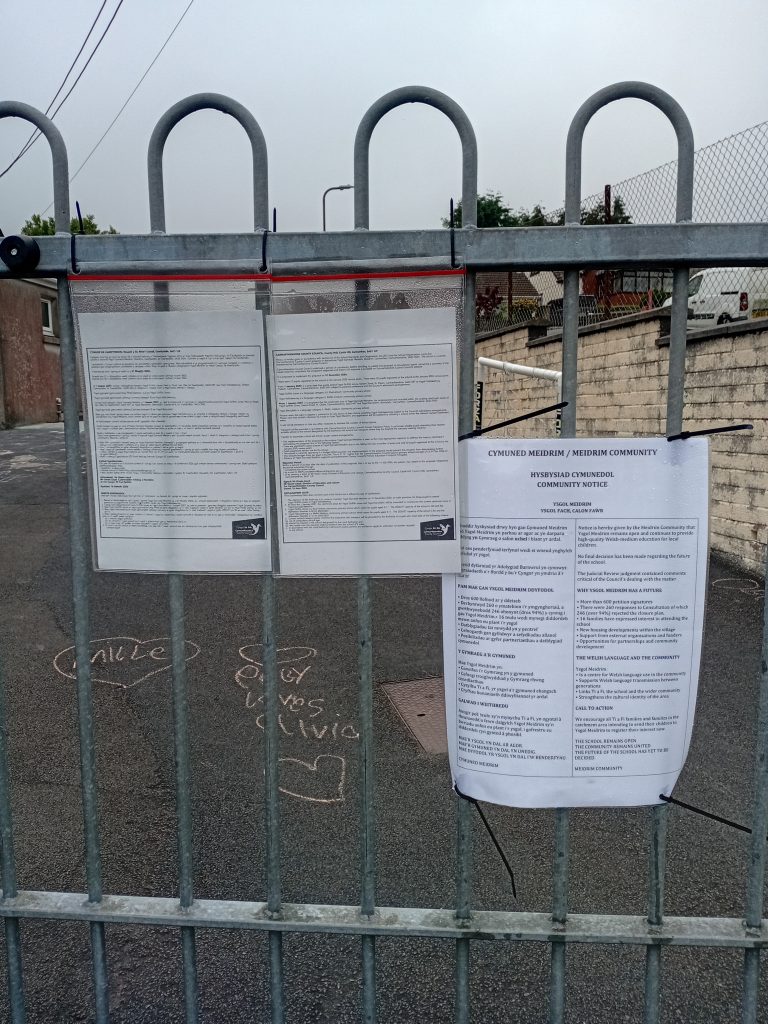
Ysgol Meidrim, near St Clears, currently has around 30 pupils and has been earmarked for closure, with children expected to transfer to other schools from January 2027.
But the school community has mounted a determined campaign to keep it open, arguing that the school remains central to the future of the village, the Welsh language and rural life in the area.
The judgment, handed down by His Honour Judge Jarman KC, found that the challenge should be allowed to proceed, but ultimately dismissed it on the basis that the council still has an opportunity to properly consider alternatives during the ongoing process.
However, the judge made clear that those alternatives must now be considered conscientiously.
Campaigners say this is a significant warning to the council.
Ffred Ffransis, speaking on behalf of Cymdeithas yr Iaith in Carmarthenshire, said the organisation was not a party to the legal action, but understood why a parent of a child with severe medical needs had taken the case.
He said: “The judge criticised the lack of clear communication from the council and that governors had the impression that the council had not yet seriously considered alternatives to closure of Ysgol Meidrim, but found that the evidence did not yet reach the high threshold for legal intervention.
“He has warned the council that they must give conscientious consideration to the alternative proposals drawn up by governors.”
The governors’ proposals include developing the school as part of a wider community hub and exploring federation options rather than closure.
Cymdeithas yr Iaith said the council now had two choices: to press ahead regardless, or to withdraw the closure notice and enter into genuine discussions with governors over their plans.
Mr Ffransis added: “The council must at least demonstrate a new open attitude during the objections period to discussing the alternative proposals.”
The row has deepened after Carmarthenshire County Council was forced to withdraw and reissue its closure notice just three days after it was first published.
According to Cymdeithas yr Iaith, the original notice, issued on June 16, listed nearby Ysgol Bancyfelin as one of three receiving schools. The notice was then withdrawn after it emerged that Ysgol Bancyfelin was already over capacity.
A revised closure notice has now been issued, with the objection period extended until July 17.
The campaign group said this raised further concerns about the way the process was being handled.
Notices have also been placed at the school gates by supporters, making clear that Ysgol Meidrim remains open and encouraging parents to register children there.
One notice states that the judicial review judgment was critical of the council’s handling of the matter and that the future of the school has not yet been decided.
The campaign has attracted wider attention because of the Welsh Government’s presumption against closing rural schools.
Under the School Organisation Code, councils must carefully consider all reasonable alternatives before deciding to close a rural school, including federation and wider community use.
Campaigners argue that Ysgol Meidrim is not simply an education issue, but a question about the survival of Welsh-speaking rural communities.
The council has previously cited low pupil numbers, surplus places, budget pressures and curriculum challenges as reasons for proposing closure.
But opponents say the financial savings are small compared with the impact on the village and its Welsh-medium provision.



Community20 minutes ago
Lord Rhys emerges from the mist in St Davids
Giant puppet begins historic journey marking 850 years since the first Eisteddfod MIST swirled around St Davids Cathedral on Friday...


News22 hours ago
Tragic tribute paid to Haverfordwest man after A4075 collision
FAMILY REMEMBERS “KIND AND LOVING” CALLUM HANSON THE FAMILY of a 22-year-old man from Haverfordwest who died following a road...


News2 days ago
Motorcyclist, 22, dies in A4075 crash in Pembrokeshire
A 22-year-old woman remains in hospital after two-vehicle collision A MOTORCYCLIST has died following a serious two-vehicle crash on the...


Community2 days ago
Why police will be visiting every home in Pembrokeshire
New operation aims to knock on more than 257,000 doors across Dyfed-Powys over the next three years DYFED-POWYS POLICE has...


Crime2 days ago
Prisons at breaking point: MPs warn Wales is paying the price of a failing system
Frozen healthcare budgets, overcrowded jails, homelessness on release and mounting pressure on staff are undermining rehabilitation across Wales, according to...


News3 days ago
Brexit at 10: How Britain was sold a dream that cost us dearly
A decade after the referendum, the promised benefits remain hard to find while the economic costs are increasingly difficult to...


Crime3 days ago
Worcestershire man jailed after violent attack on woman in Tenby
Defendant was already serving a suspended sentence when serious assault took place A WORCESTERSHIRE man has been jailed for more...


Climate3 days ago
Offshore wind ‘could bring new generation of jobs to Milford Haven’
Pembrokeshire ports and Celtic Sea projects placed at centre of Wales’ green energy ambitions MILFORD HAVEN and Pembroke Dock could...


Community4 days ago
Police officer hailed hero after midnight sea rescue in Milford Haven
PC swam 100 metres offshore to save distressed woman heard calling for help in darkness A DYFED-POWYS POLICE officer has...


Local Government4 days ago
Security privately arranged by Mayor at Beating of the Bounds
HAVERFORDWEST TOWN COUNCIL has confirmed that security personnel seen at this year’s Beating of the Bounds were privately arranged and...
-

 Community6 days ago
Pembrokeshire Chess Club crowned Welsh champions
-

 Crime2 days ago
Milford Haven man jailed for breaching domestic violence protection order
-
Local Government4 days ago
Security privately arranged by Mayor at Beating of the Bounds
-

 News2 days ago
Crash on Freeman’s Way causes school-run chaos across Haverfordwest
-

 Crime4 days ago
Man wanted by court after failing to attend hearing over alleged shop thefts
-

 Crime4 days ago
Man jailed after admitting strangulation and assaults
-
 Crime4 days ago
Man banned from roads after drink-driving offence
-

 Crime4 days ago
Man sentenced over stalking campaign and lock knife offence