


News
Murco decommissioning: ‘Someone is going to die’ say whistle-blowers

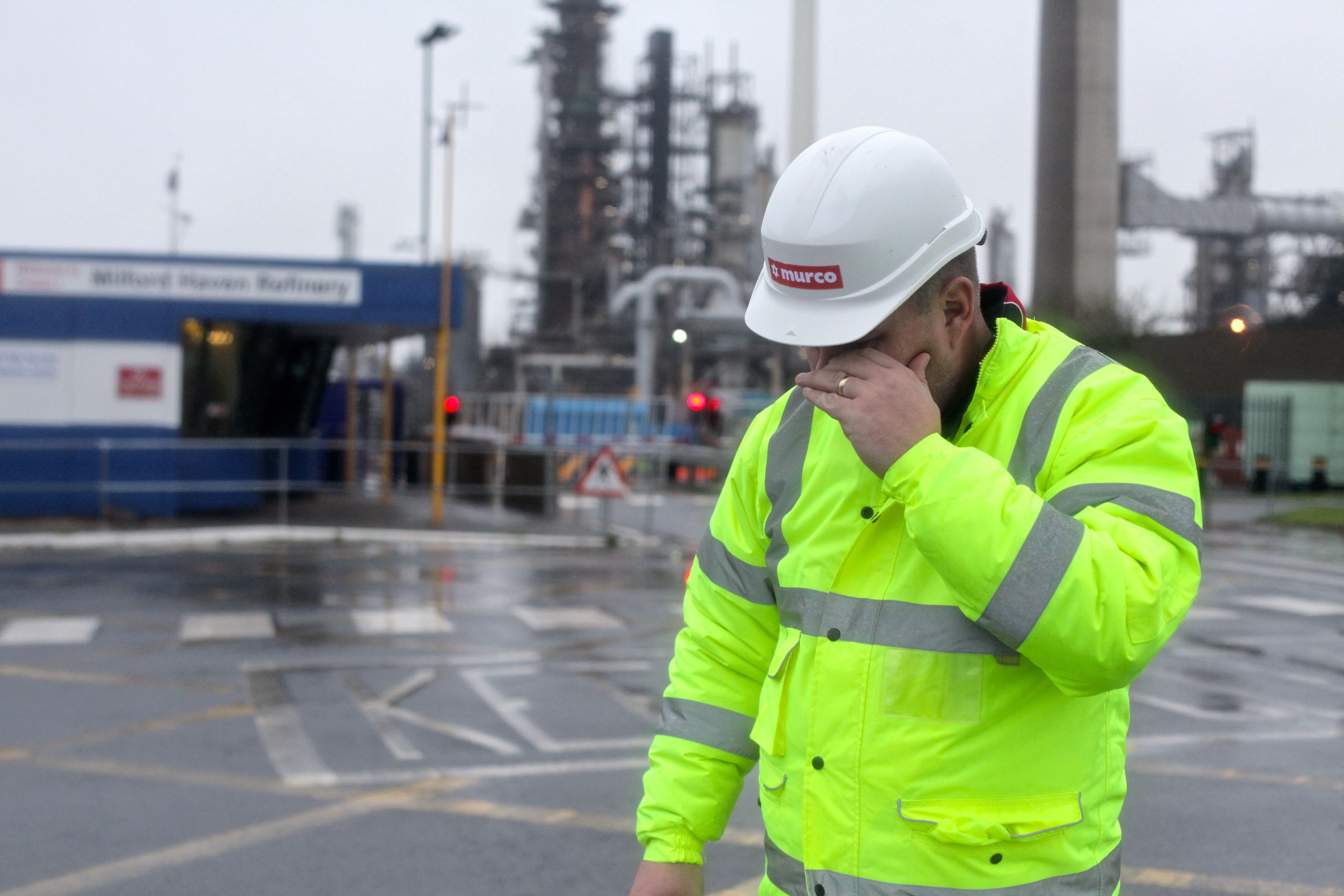
THE WORKFORCE doing the risky job of decommissioning the former Murco oil refinery were left in shock on Friday (Oct 20), when 24 members of staff received redundancy letters in the post completely out of the blue.
Staff said that a few of them had “been through this before when Murco originally closed”, and “now we are living the same nightmare again”.
But some of the members of staff given the axe have taken the opportunity to get into contact with The Pembrokeshire Herald to blow the whistle poor working conditions and health and safety concerns at the site.
A number of those affected by the lay-offs, which have come just weeks before Christmas, said that they were promised work until October 2018 at the time they commenced work with Waste Recycling and Decommissioning Ltd (WRD) from Sheffield and REM Engineering (REM), which has ISO 9001 accreditation, based in Failsworth, near Manchester
One engineer got in touch with The Pembrokeshire Herald to offer his views following his dismissal. He said: “WRD and REM are a complete joke.

“The managers and supervisors would not even give us decent explanation as to why we were let go, and it was all done with no warning what so ever.
“The company then on Monday morning (Oct 23) had all Mobile Elevating Work Platforms and Scissor Lifts shut down by Nationwide Platforms as the bill has not been paid.”
Others have expressed dissatisfaction at the lack of proper equipment on the site as well as health and safety standards.
Mr David Beardow, Managing Director of REM told The Herald in a brief emailed statement that “due to a change in the project programme and reduced daylight hours”, that it had been “necessary to reduce the workforce and equipment.”
He did not expand as to what the change in the project programme was and added in no uncertain terms: “No further comments or statements will be issued.”

‘A NUMBER OF ACCIDENTS’
This newspaper was contacted by another member of staff, again this week, who said: “We are expected to work with the very minimum of equipment and most of this is broken or apparently on order. There have been a number of accidents which have just been brushed under the table due to a big accident earlier in the year where a local worker almost lost his life.
In an extraordinary email our source, who asked not to be named because of fears regarding future employment contracts added: “The site manager refers to us as ‘mongo farmers’ because we are Welsh, and he has, in my opinion, a total disregard towards health and safety. I personally have seen various health and safety failings which in my professional opinion may result in another an accident.”
The Herald was told: “This firm needs to be exposed as an unfit contractor to carry out the decommissioning of the former Murco refinery and Puma Energy needs to be made aware of this company’s short comings.”

The former employees’ warning was stark: “Plain and simple they are cowboys. Someone is going to die out there.”
Our source added: “The supervisors are labourers who have little or no experience in the oil and gas sector and have no clue what they are doing.
“We want answers and want to stop someone getting hurt on this job due to the company running it.
“We have been told that the client from Pakistan has not paid WRD or REM for six months or so, causing them cash flow problems.”
The Herald contacted Tony Fenwick, boss of WRD. The Managing Director told us on the telephone yesterday (Oct 26) that we should direct any questions to REM.
We asked REM the following question: How many accidents have occurred on the former Murco site since decommissioning began? And how serious were any injuries? How many staff members required medical treatment? But REM refused to comment on this the brief statement they sent us, but did not attempt to deny that our sources were accurate in their very serious allegations.
PASSING THE BUCK
In May, Dyfed-Powys Police were investigating an industrial accident at the former refinery. A man was taken to hospital with serious injuries following the incident, which happened shortly after 9am on Wednesday, May 31.
The worker became trapped while assisting with the dismantling of the site, but at the time WRD was quick to disassociate itself with the incident, directing our inquiries to Puma Energy, the new owners of the site.
Speaking at the time, a police spokesman said: “Dyfed-Powys Police, jointly with Health and Safety Executive, is investigating an industrial accident at Puma Energy, Milford Haven.”
The Herald was in contact with the police yesterday (Oct 26), who said that further inquiries about the progress of the investigation should be directed to the Health and Safety Executive who are now taking a lead in the case.
The Health and Safety Executive have confirmed they are dealing with an active investigation.
Emma Deeny, Communications Manager for the regulator said: ““The HSE investigation into this incident is ongoing.
She added: “We cannot comment further at this time.”
It was confirmed in May that the injured party was a contractor working on behalf WRD Ltd, and that the member of staff was not under the control of Puma Energy.
A spokesman for Puma Energy told The Herald at the time: “The incident was not on a working site under Puma Energy’s control, but was in the dismantling of the former refinery area within Milford Haven, which Puma Energy did not purchase. This is segregated from Puma Energy’s site by a fenced boundary and operates under its own safe systems of work.”
KEEPING SCHTUM
In relation to the redundancies, lack of equipment and health and safety concerns from staff, David Beardow, MD of REM also told this newspaper: “We will not comment on personal circumstances or commercial relationships.
“We have, and will continue to utilise local labour and suppliers.
“We continue to work with the local community and employ and provide comprehensive training for many employees from the Pembrokeshire area.
The statement from REM was short, lacked detail and disappointingly did not go any way to answer the serious allegations raised by former workers at the Murco site.
HEALTH AND SAFETY ‘CENTRAL’
On its website page REM Engineering paints a very professional image. The company states: “Health and safety is absolutely central to our business and you can be sure that when we are working on your premises or on your project, the safety of everyone involved is uppermost in our minds and in our processes.
“Our health and safety policy sets out responsibilities for managers, employees and sub-contractors so everyone knows what is required of them – and we provide continual health and safety training to help them achieve it.
“To assist us in putting our commitment to health and safety into action and maintaining the most rigorous standards, we use external auditors who visit our sites, unannounced; to check we are following procedures.
“Where we feel there is a need for a specialist response to the health and safety aspects of a particular project, we always call on the expert services of experienced consultants to support our own meticulous approach.
“We are proud of our teams’ safety track record on site. For larger projects where appropriate, we produce a comprehensive health and safety file.”
The website also boats: “We share risks and benefits; working together to trial and develop innovative solutions to service delivery to the benefit of our clients.”
- Have you been unexpectedly been made redundant from the former Murco site? Are you able to give us more information – confidentially if you wish – which will help us develop this story? Please message us on Facebook. We always protect sources.















Collie cross German Shepherd left suffering after illness went unaddressed, court told
A CARMARTHEN man has admitted causing unnecessary suffering to a dog after failing to properly address a serious skin condition.
David Allen Murphy, aged 40, of Quay Street, Carmarthen, appeared before Llanelli Magistrates’ Court on Thursday (Jun 11) after previously pleading guilty to an offence under the Animal Welfare Act.
The court heard that between November 28 and December 28, 2025, Murphy caused unnecessary suffering to a Collie Cross German Shepherd dog named Cora by failing to adequately investigate and address the animal’s skin disease.
Prosecuted by the RSPCA, the charge stated that Murphy either knew, or ought reasonably to have known, that failing to deal with the condition would likely cause suffering to the dog.
Murphy, of Flat 2, 12 Quay Street, entered a guilty plea on May 21.
The case was adjourned for a pre-sentence report to be prepared, with magistrates remanding Murphy on unconditional bail.
He is due to return to Llanelli Magistrates’ Court on Thursday, July 23, at 10:00am for sentencing.

WELSH CONSERVATIVES have called on the Welsh Government to explain who knew what, and when, about reported delays to Tata Steel’s new electric arc furnace at Port Talbot.
Shadow Economy, Energy and Planning Minister Janet Finch-Saunders MS raised the issue in the Senedd during an emergency statement following the recent fire at the steelworks.
While much of the focus has been on the fire, reports have suggested that separate concerns about delays to the electric arc furnace may have been known for several weeks.
It was reported on June 7 that Tata Steel had discussed potential delays linked to National Grid connectivity issues with “investors” during a conference call around a month earlier.
Mrs Finch-Saunders is now seeking clarity on whether those investors included the UK Government, which is investing £500m towards the £1.25bn project.
The previous UK Conservative Government also established an £80m transition fund to support workers at risk of losing their jobs. The Welsh Conservatives say they want clarification on whether any of that funding remains available if delays create further financial pressure for affected workers.
Mrs Finch-Saunders said: “If UK Government Ministers were aware of the issue a month ago, were Welsh Government Ministers informed?
“If Welsh Government Ministers were not informed, why not? If they were informed, why did the Economy Minister tell the Senedd that he only became aware of the delay on Monday?
“We now need a clear timeline setting out exactly when concerns first emerged and who was told.
“Port Talbot workers and their families deserve answers.”

A 16-YEAR-OLD from Pembroke Dock has been sentenced after admitting intentionally strangling a woman on board a train.
The youth, who cannot be named because of reporting restrictions, appeared before Haverfordwest Magistrates’ Court on Thursday (Jun 11) for sentence.
He had previously admitted intentionally strangling the woman on a train service between London Paddington and Reading on January 21.
He also admitted assault by beating at Reading Railway Station on the same date.
The court heard that a victim personal statement was read by the prosecutor.
Magistrates imposed a 12-month referral order to the Pembrokeshire Youth Offender Panel. A parent or guardian must attend panel meetings.
The teenager was also ordered to pay £100 compensation, £85 prosecution costs and a £26 surcharge.
Payments are to be made at £25 per month from July 9.



Crime5 hours ago
Man accused of six rapes including alleged Haverfordwest offence
A MAN has been sent to Crown Court accused of six rapes, including an alleged offence at a Haverfordwest campsite....


News7 hours ago
Childcare row erupts as Plaid faces questions over costs and delivery
Opposition parties clash over flagship pledge as Senedd debate exposes growing divisions PLAID CYMRU’S flagship promise to create what it...


Crime22 hours ago
Farmers fined in bovine TB scandal face fresh court action
Hartt family members listed at Haverfordwest Magistrates’ Court over unpaid penalties linked to major cattle prosecution TWO PEMBROKESHIRE farmers convicted...


Crime1 day ago
Pembrokeshire child killer stabbed to death in prison cell, murder trial hears
Kyle Bevan, jailed for the murder of Haverfordwest toddler Lola James, was allegedly stabbed 25 times and left ‘as if...


News1 day ago
Pendine cliff fall victim recovering after major emergency response
A 22-YEAR-OLD man who suffered serious injuries after falling from cliffs overlooking Pendine Beach is recovering well following emergency surgery....


Community1 day ago
Commissioner launches free course to help tackle ageism in Wales
A NEW free learning course has been launched to help people across Wales recognise and challenge ageism. The Older People’s...


News2 days ago
First Minister challenged over jobs for student nurses
REFORM WALES has accused the First Minister of failing to guarantee jobs for student nurses in Wales, despite continuing pressure...

Crime2 days ago
Knife blankets call as school staff face rising violence fears
GMB says protective equipment should be considered where risk assessments show staff could face blades SCHOOL staff should be given...


News2 days ago
Claire Archibald secures review of Milford Haven train times
RURAL TRANSPORT CONCERNS RAISED WITH TFW CLAIRE ARCHIBALD MS has secured a review of train times between Milford Haven and...


Crime2 days ago
PCC review calls for stronger youth crime prevention work
REPORT MAKES 13 RECOMMENDATIONS A REVIEW into crime and anti-social behaviour services for young adults has called for stronger prevention...
-

 Crime6 days ago
Paddleboard company owner loses bid to cut sentence over Haverfordwest tragedy
-

 Crime5 days ago
Milford Haven man admits harassment and assault
-

 News5 days ago
Community appeal for privacy after serious emergency in Pendine
-

 Crime3 days ago
Sex offender in senior role at Tenby family hotel
-

 Community3 days ago
Forgotten wartime archive found in Pembroke Dock attic after 80 years
-
Crime2 days ago
Families condemn failed appeal by paddleboard boss jailed over Haverfordwest tragedy
-

 Crime2 days ago
Haverfordwest pair accused of £80,000 rogue trading frauds
-
Crime2 days ago
Knife blankets call as school staff face rising violence fears