


News
AM petitions Government to overturn Royal Mail sale


The Labour AM for Mid and West Wales has written to business minister Vince Cable MP urging him to ditch the £3bn sell-off.
Mrs Watson says a privately owned service would not maintain the unprofitable parts of the business leading to higher prices and worse services in rural Wales.
“This sale is all about securing a short-term win for the Treasury not the Royal Mail’s future. It is bad enough that the Tories are selling the family silver, but they are flogging it cheap. Royal Mail’s assets are worth billions and the quality of the service it provides to isolated communities is priceless. I have been inundated with messages from constituents who are furious that another British institution is being sold off. The UK Government must listen to the public outcry and drop these plans now.”
The Pembokeshire Herald can being you the letter in full:

The Rt. Hon. Vince Cable MP
Secretary of State for Business, Innovation and Skills
Dear Dr Cable,
I have received concerns from many of my constituents regarding the proposed privatisation of the Royal Mail by the UK Government. Any such privatisation could have a significant impact on the towns and rural communities of Mid and West Wales that I represent.
Until 2012 stamp prices were subject to regulatory control which meant that individuals and businesses were protected from excessive price rises. However, the price of a first class stamp rose from 46p to 60p. As a private company, focused on increasing shareholder returns, it is likely that the Royal Mail will want more significant price increases.
Many businesses are dependent on the Royal Mail. The delivery of letters and parcels to any address in the UK is a service we cannot do without. For many small businesses, especially those in rural areas there is often no alternative to the Royal Mail. While these businesses are already suffering from high overhead costs, they can ill afford to see the cost of using the postal service rocket.
The Royal Mail delivers where competitors refuse to go. In my region of Mid and West Wales I see little evidence of private companies seeking to compete. My constituents understand that it costs more than the price of a stamp to deliver a letter to a rural address. That is why, despite assurances to the contrary, the postal services regulator is working to determine the real cost for deliveries to rural areas. It has also looked recently at how it can reduce the daily delivery service to addresses in the countryside. A privately owned Royal Mail will not want to maintain this non-profit making service. It is difficult to see how the government might be able to compel a private enterprise to continue to provide this service.

The local post office is a focal point for the life of so many small towns and villages across Mid and West Wales. Where pubs and other shops have disappeared, the post office has remained. But when that goes, I fear that the life of these communities will also disappear. This would have a significant impact on the elderly, disabled and those who cannot travel – already the most vulnerable members of these communities.
Many small post offices have a fragile existence and rely upon Royal Mail for business to survive. Yet the 2001 Postal Services Act fully separates the Post Office Counters’ network from Royal Mail. The government will point to a recently signed business agreement between the two. But that cannot guarantee that a new, private owner, free to do as they choose, will honour that agreement in the long-term. For example, they may wish to re-negotiate its terms or move more of its business to other retail outlets.
Many of my constituents will also miss the traditional red liveried vehicles, the use of Her Majesty’s head on stamps and the distinct pillar boxes are all part of the rich history of Royal Mail and a feature of our towns and countryside. While we must always look to the future, it would be a great shame if this heritage would disappear following privatisation.
I would be grateful if you would consider the concerns of my constituents and review your decision to privatise the Royal Mail.


Teams are being urged to get their carts ready as Fishguard Round Table brings back one of the town’s most popular community events
FISGHUARD is gearing up for one of its most colourful community events as the Fishguard Soapbox Derby returns on Saturday, June 27.
The event, organised by Fishguard Round Table, will get underway from midday and promises a day of speed, creativity, family fun and community spirit.
Teams are being encouraged to build their own soapbox carts and take part, with organisers hoping this year’s event will be the biggest and best yet.
The derby brings together racers, families, spectators and local supporters for a fun-filled day in the town, with prizes, food, stalls and entertainment also planned.
Organisers say the event is all about “speed, creativity and community”, giving teams the chance to show off their designs while spectators enjoy the action from the roadside.
The event poster promises “fun family action” and urges people to “race it, build it, watch it, love it”.
Fishguard Round Table, which supports community causes through its fundraising and events, is encouraging people to come along, support the racers and enjoy a full afternoon out.
Entries are currently open, with teams urged to get together and prepare their carts ahead of race day.


New study says marine conservation is becoming a “functionally middle-class” profession as barriers to entry grow
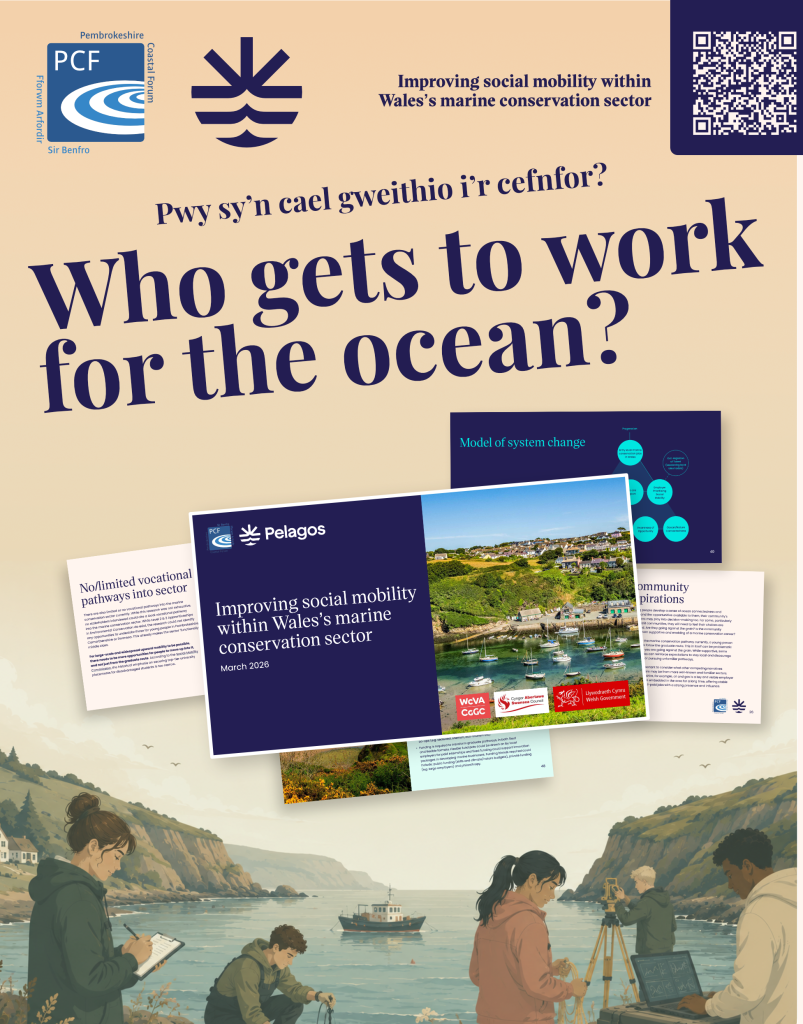
A NEW report has warned that marine conservation is becoming a “functionally middle-class” profession, with young people from working-class backgrounds facing significant barriers to entering the sector despite growing demand for environmental careers.
The study, Improving Social Mobility within Wales’s Marine Conservation Sector, published by Pembrokeshire Coastal Forum and Pelagos, says a lack of vocational training routes, a shortage of entry-level jobs and financial pressures are preventing many talented young people from pursuing careers protecting Wales’ coastline.
Researchers found there are currently no local vocational pathways into marine conservation in South West Wales, meaning university has become the main route into the profession. The report argues this risks excluding capable young people who cannot afford higher education or unpaid work placements.
The report describes marine conservation as becoming “functionally middle class”, warning that greater social mobility will only be achieved if more practical routes into the sector are developed alongside traditional graduate pathways.
Researchers interviewed 26 employers and stakeholders alongside 20 young people aged between 16 and 26 from Pembrokeshire, Carmarthenshire and Swansea between January and March this year. They also carried out an extensive review of existing research into social mobility and employment.
Among the biggest concerns identified was the severe shortage of entry-level jobs.
One graduate told researchers: “I’m now totally stuck. I’ve been applying for six months. Most jobs require a Master’s degree. I know so many people getting one but then being in the same position.”
Another employer revealed that a single vacancy attracted 293 applications, while another described the situation as “selling tickets to a gig that is oversubscribed”.
The report also highlights wider structural challenges facing young people in rural Wales.
Researchers say poverty, limited public transport, geographical isolation and reduced access to professional networks all make it harder for young people outside major cities to access higher education, internships and skilled employment. Around 31 per cent of children in Wales live in poverty, one of the highest rates in the UK, with many living in households where at least one adult is in work.
The study identifies four key factors influencing whether young people pursue marine conservation careers: their connection with the natural environment, awareness of career opportunities, community aspirations and academic confidence. It concludes that these must be supported by better funding, mentoring, employer engagement and significantly more entry-level opportunities if social mobility is to improve.
Sea Trust Wales Director Nadia Tomsa, who contributed to the research, said unpaid internships and fierce competition for experience were creating unnecessary barriers.

She said: “The conservation sector is becoming increasingly difficult to access, with a huge shortage of entry-level opportunities. Unpaid internships create a barrier to lower-income individuals gaining experience.
“I see numerous talented, passionate young people who are struggling to find a role in the marine conservation world.”
Ms Tomsa revealed that Sea Trust Wales recently received more than 100 applications for a two-month volunteer placement, many from graduates hoping to gain enough experience simply to compete for paid work.
The report concludes that Wales needs a joined-up vocational pathway into marine conservation alongside stronger financial support, mentoring and employer initiatives if the sector is to attract talent from all backgrounds rather than those who can most easily afford to enter it.
The research was funded through the Welsh Government’s Marine Resilience Fund.

FAMILIES heading to the cinema in Milford Haven this summer will be able to take advantage of reduced ticket prices at the Torch Theatre.
From Friday, July 3, to Tuesday, September 1, the Torch will offer cinema tickets for under-16s at £5.25 as part of the UK Government’s Great British Summer Savings scheme.
Family tickets will be available for £21, while 3D tickets for under-16s will cost £5.80. A 3D family ticket will be priced at £23.
The discount will be applied automatically to eligible screenings during the offer period. It cannot be used on tickets already purchased or for screenings outside the stated dates.
Chelsey Gillard, Artistic Director and Interim CEO at the Torch Theatre, said: “The Torch is delighted to be offering these reduced cinema ticket prices for families over the summer months.
“We are not required to pass on the VAT saving, but we are firm believers in providing the best value for audiences and this scheme is allowing us to do just that.
“With a summer full of blockbuster titles ahead, including Toy Story 5 and the latest instalment of the Minions, we are looking forward to welcoming you soon.”
The summer savings scheme is part of a wider government package aimed at helping households with rising costs, including support around energy bills, fuel costs, holiday activities and wages.
Tickets can be booked at torchtheatre.co.uk or through the Box Office on 01646 695267.




Community2 hours ago
Working-class young people ‘shut out’ of marine conservation careers in Wales
New study says marine conservation is becoming a “functionally middle-class” profession as barriers to entry grow A NEW report has...


News4 hours ago
Reform MS: ‘I felt like shouting get out of the water’
Paul Marr says children playing in streams at Pembrokeshire beaches deserve better protection from pollution risks REFORM UK MS Paul...


Health1 day ago
Senedd backs call to rule out hospital downgrades after heated NHS debate
Reform UK amendment passes as West Wales hospital fears remain central political issue THE SENEDD has backed a call for...

News1 day ago
Coastguard callout payments axe sparks fears for coastal communities
VOLUNTEER coastguards across the UK are set to lose callout payments, prompting concern over the future resilience of emergency cover...


Farming1 day ago
Rural Wales ‘left out’ of net zero debate, warns carbon entrepreneur
A WELSH carbon entrepreneur has warned that rural Wales risks being left behind in the national conversation about net zero....


Local Government2 days ago
Tenby Spectacular row continues as organisers say key question remains unanswered
Round Table says legal clarity over pedestrian access is still holding up event plan TENBY ROUND TABLE has welcomed Pembrokeshire...


Community3 days ago
Manorbier fire scandal: Council’s payout just £63,777 after school destroyed
PEMBROKESHIRE COUNTY COUNCIL has accepted an insurance settlement which leaves it with just £63,777.07 after the catastrophic fire which destroyed...


News3 days ago
Bus overturns in major incident near Kidwelly
All passengers rescued as emergency services remain at scene A BUS overturned on the A484 between Kidwelly and Ferryside on...


Community4 days ago
Tenby Summer Spectacular cancelled amid council row over harbour access
Organisers say popular charity events cannot safely go ahead without clear powers to control crowds TENBY ROUND TABLE has announced...


News4 days ago
Motorcyclist dies after four-vehicle crash on A40 in Carmarthenshire
A MOTORCYCLIST has died following a four-vehicle collision on the A40 between St Clears and Whitland. Dyfed-Powys Police said the...
-

 Health6 days ago
Woman jailed assaults on police, harassment and XL Bully possession
-

 Crime1 day ago
Police appeal after reported rape at Young Farmers rally
-

 Crime6 days ago
Milford Haven woman spared jail despite string of shop thefts
-

 Community5 days ago
The gentle giant behind the tattoos
-

 Crime6 days ago
Spittal man to stand trial accused of ABH
-

 Crime6 days ago
Carmarthenshire pensioner, 86, accused of causing prostitution for gain
-

 Entertainment5 days ago
Harbour Fest to bring music, food and maritime magic to Milford Waterfront
-
Health5 days ago
Welsh Government refuses to halt Withybush and Bronglais service review
rent private jet
January 3, 2026 at 4:29 am
This is a topic I’ve been curious about. Thanks for the detailed information.