


News
M4 relief road cancelled after cost estimates rise to over £2 billion


THE WELSH Government has ditched plans to build an M4 relief road.
After years of planning, a lengthy public inquiry, and extensive controversy both about the delays in making a decision and the potential environmental impact of the new road, First Minister Mark Drakeford announced his widely anticipated decision to cancel the project in a statement issued on Tuesday, June 4.
The M4 relief road was a marquee project for the Welsh Government; however, internal Labour politics slowed down progress towards a decision with the result that former First Minister Carwyn Jones passed the buck for the final decision to his successor. Mr Jones favoured the scheme, while Mr Drakeford was more equivocal about its prospects.
Originally proposed in 1991, the scheme was dropped by the Welsh Government in 2009 on grounds of cost (then an estimated £1bn) before being revived in 2011. The project secured UK Treasury support in 2013 and was approved by the then-Welsh Government Transport Minister Edwina Hart in 2014, with a completion date of 2022.
Since 2014, the road lingered in development hell through a raft of consultations and a public inquiry.


M4 decision: Drakeford slated for dither and delay
The First Minister’s decision to cancel the scheme raises questions about the huge amount of public money and government manpower expended on it. His principal objection is the same as that which led to the original scheme’s cancellation in 2009: money, or the Welsh Government lack of it/unwillingness to spend it.
Friends of the Earth Cymru director Haf Elgar said: “This is great news for Wales and the planet.
“As well as costing Welsh taxpayers over £2 billion pounds, this devastating road would have ploughed through the unique, wildlife-rich Gwent Levels, pumped more climate-wrecking emissions into our atmosphere, and ultimately caused even more congestion and air pollution.
“This decision is a testament to the untiring efforts of local residents who have opposed this plan over decades and is a clear signal that the Welsh Government is taking its climate emergency declaration and commitment to future generations seriously.”
Ian Price, CBI Wales Director, said: “This is a dark day for the Welsh economy. After decades of deliberation and over £40m spent, no problem has been solved today. Congestion and road pollution around Newport can only increase. Economic growth will be stifled, confidence in the region will weaken and the cost of an eventual relief road will rise
“Today’s announcement is a short-term measure that regrettably solves nothing and sends the message that Wales is not open for business.
“As the Welsh Government said at the public inquiry, the black route would emit less carbon emissions than the current road and the whole project would be carbon neutral by 2070. The wider south Wales region around Cardiff and Newport constitute only 4% of Welsh carbon emissions in total. That figure will now likely rise at a higher rate than if the black route had been built.”

On his Facebook page, Stephen Crabb MP said: “They’ve bottled it. The Welsh First Minister’s decision not to give the M4 relief road the green light is short sighted and will be deeply frustrating for number of commuters, businesses and tourists.
“I’ve spoken to numerous Pembrokeshire businesses, from hauliers to tourism operators, who are all fully aware the damage the congestion around Newport does for our local economy. One Pembrokeshire haulage firm alone runs 40 lorries each way through the M4 bottle neck each day, with drivers calling it a ‘no go’ area between 7.30am and 10am in the morning and from 4pm to 6.30pm in the afternoon.
“This decision even contradicts the independent public enquiry led by a planning inspector which backed the project. This is a failure of devolution as the Welsh Assembly was supposed to help projects such as this get off the ground.
“I recently held a debate in Parliament about the importance of this project for the wider Welsh economy, so it is very disappointing that Mark Drakeford has dropped it especially as this issue has dragged on for nearly 30 years.”
Full in-depth coverage in The Herald this Friday



Judge says 75-year-old Stewart Laugharne behaved ‘disgracefully’ as he avoids jail but is ordered to sign sex offenders register
A MILFORD HAVEN pensioner has avoided jail after exposing himself to women on two separate occasions near his home.
Stewart Laugharne, 75, of Dairy Park Grove, Hakin, appeared before Swansea Crown Court on Tuesday, June 30, after pleading guilty to two counts of exposure.
Sian Cutter, prosecuting, told the court the offences took place weeks apart in August 2025.
On the first occasion, Laugharne was seen naked near his home and thrust his hips towards a woman who was walking alone.
On the second occasion, a woman was walking with her baby when Laugharne called out to the child in an apparent attempt to get the mother’s attention. When she looked over, she saw Laugharne naked and again thrusting his hips.
The court heard that children had been present, although it was not believed they had seen Laugharne without his clothes on.
Laugharne had one previous conviction for an unrelated matter dating back more than 40 years, to 1980.
Sarah John, representing him, said Laugharne had lived a law-abiding life for the majority of his years and was capable of leading a “pro-social lifestyle”.
The court heard that Laugharne had endured a difficult childhood after being adopted, had never met his biological mother, and had been physically assaulted by his adoptive mother.
His barrister added that Laugharne now leads a lonely existence, is estranged from his three children, and has no partner.
Judge Paul Thomas KC told Laugharne: “You behaved quite disgracefully.
“On one occasion, you also thrust your hips forward.

“You can only be described as a dirty old man.”
The judge imposed a two-year community order, with Laugharne required to complete 20 days of rehabilitation activity. He must also sign the sex offenders register for five years and pay a victim surcharge.
Judge Thomas warned him: “This court is determined that this offending will not occur again.
“It was clearly persistent behaviour on your behalf.
“There will be a different outcome if you were to be so foolish as to repeat it.
“It will not end well for you if you come back to court, Mr Laugharne.”
The case first came before Haverfordwest Magistrates’ Court in December last year, when Laugharne, then aged 74, denied both charges.
Although the Crown Prosecution Service had indicated the case was suitable to be dealt with by magistrates, Laugharne elected trial by jury and the case was sent to Swansea Crown Court, where he later admitted the offences..


SCHOOL leaders have called for greater funding and support for Relationships and Sexuality Education in Wales after a new Estyn report found that provision is helping pupils feel safe and respected, but is not yet consistent across schools.
The report looked at how schools are delivering RSE under the Curriculum for Wales, where it is a statutory part of learning for pupils aged 3 to 16.
RSE is intended to help children and young people understand healthy relationships, personal safety, respect, rights and wellbeing in a way that is appropriate to their age and stage of development.
However, the subject has also been one of the more controversial parts of the new curriculum, with some parents and campaigners raising concerns about transparency, age-appropriateness and the removal of the parental right to withdraw children from lessons.
Supporters argue that high-quality RSE helps pupils recognise healthy and unhealthy behaviour, challenge bullying and harassment, and build respect for others. Schools and unions say the difficulty is not the principle of the subject, but the uneven level of support available to staff expected to deliver it.
Responding to Estyn’s findings, Laura Doel, national secretary of school leaders’ union NAHT Cymru, said the report highlighted both strong practice and areas where improvement was still needed.
She said: “We welcome the spotlight Estyn has shone on RSE in Wales, including both the examples of really positive practice and areas for improvement.
“One of the issues is that many schools are left to develop their own practice and programmes due to a lack of funding and investment in effective professional learning or collaborative work for local clusters of primary and secondary schools.
“At a time when schools are facing unprecedented financial shortfalls, it feels as though areas like this in the school curriculum have not been prioritised, and we urge the new Welsh Government to put this right.”
NAHT Cymru said schools need more investment in training, resources and collaborative working so that pupils receive high-quality RSE regardless of where they live or which school they attend.
The union’s comments come as schools continue to face wider pressures, including budget shortfalls, staff workload, additional learning needs reform and post-pandemic challenges around pupil wellbeing and attendance.
The Welsh Government has previously said RSE must be developmentally appropriate and delivered in line with statutory guidance. It says the aim is to support learners to form and maintain healthy relationships, understand their rights and responsibilities, and stay safe.
Estyn’s findings are likely to increase pressure on ministers to ensure schools are not left to interpret the curriculum alone, particularly in an area where public concern and political debate remain high.
The Herald has approached the Welsh Government for comment.

COASTGUARD rescue officers are to gather outside Parliament this week as pressure grows on the UK Government to reinstate emergency call-out payments.
Dozens of coastguards from across the country are expected at College Green, Westminster, at 5pm on Wednesday (July 1), where they will call for the Maritime and Coastguard Agency to reverse plans to remove hourly remuneration for emergency incidents and training.
The protest, organised with the GMB union, follows a Court of Appeal case which found that Coastguard Rescue Officers could be classed as workers when carrying out paid duties.
Until now, volunteer coastguards have been able to claim modest hourly payments when called out to emergencies or attending training exercises. The MCA says the legal ruling means the current arrangements cannot continue in their existing form, and that from September 2026 officers will instead be able to claim expenses only.
GMB says the decision is unacceptable and risks undermining one of the UK’s statutory emergency services.
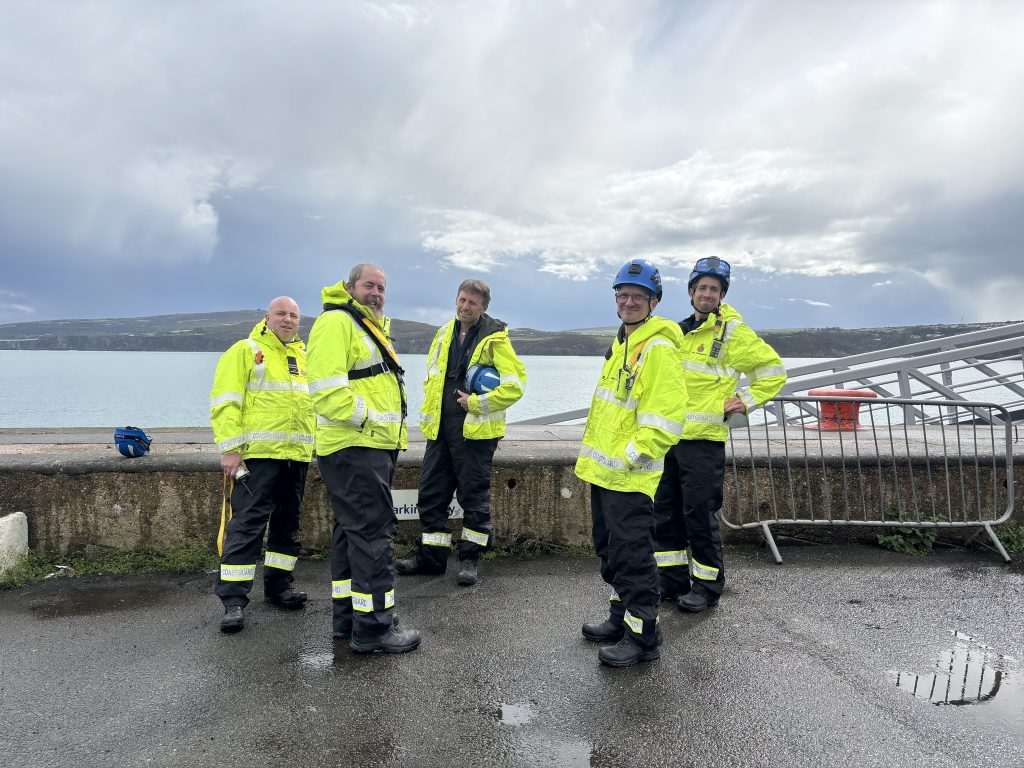
Coastguard Rescue Officers are often the first to respond when people are trapped on cliffs, cut off by tides, stuck in mud, missing near the coast or in difficulty in the water. They work alongside lifeboat crews, police, ambulance services, fire crews, air ambulances and Coastguard helicopters.
The issue is of particular importance in Pembrokeshire and across Wales, where coastguard teams are regularly involved in difficult and dangerous rescues along remote coastline, beaches, cliffs and tidal waters.
The Herald has repeatedly reported on incidents where coastguard teams have played a key role. These include the major rescue of three climbers at St Govan’s Head, where teams from Fishguard, St Govan’s and Tenby were deployed alongside helicopters, lifeboat crews, police and air ambulance teams.
In another incident, Milford Haven Coastguard Operations Centre coordinated the rescue of six children from the sea at Aberavon, with Port Talbot and Porthcawl Coastguard Rescue Teams among those sent to the scene.
Angle RNLI has also been tasked this year to searches coordinated by the coastguard, including concern for a fishing vessel near Marloes and a separate search after a vehicle was found abandoned on the Cleddau Bridge.
Supporters of the campaign say these incidents show how reliant coastal communities are on trained volunteers who leave work, family life or rest periods at short notice when pagers sound.
The Westminster photocall will take place after a Westminster Hall debate earlier the same day on the remuneration of coastguard volunteers. That debate is due to be opened by Liberal Democrat MP Alistair Carmichael.

The House of Commons Library says the Coastguard Rescue Service had more than 3,500 volunteers in 287 teams across the UK in 2024/25, supported by more than 100 employed operational staff. HM Coastguard responded to 39,147 incidents during the same year.
Plaid Cymru MPs have already raised concerns about the impact on Welsh coastal communities, warning that removing call-out payments could make it harder to retain and recruit trained responders.
The UK Government has defended the move, saying the change follows the Court of Appeal ruling and that the revised volunteer model is intended to protect the future of the service.
In a parliamentary answer, Transport Minister Keir Mather said changing the operating model was “not something which we wanted to do” but was a consequence of the legal position.
He said moving to a volunteer model with expenses, but without hourly remuneration, was judged to be the best option to protect the service and allow people to continue serving alongside their main employment.
The Government has also said serving Coastguard Rescue Officers are entitled to compensation for up to the previous six years of service, with the MCA calculating individual entitlements.
GMB argues that the answer should be to protect both the volunteer nature of the service and the right of coastguards to be fairly compensated when they are called out to save lives.
A GMB spokesperson said Coastguard Rescue Officers carry out rescues and save lives around the UK’s coast, including Scotland, Wales and England’s south coast.
The union said: “The coastguard is a statutory emergency service, like the police, fire or ambulance.
“They have always been given hourly remuneration for attending incidents and training exercises, but the MCA has now removed the payments.
“The move follows a landmark case by GMB Union which saw the Court of Appeal uphold a judgement classifying coastguards as workers.”
GMB says coastguards will be available for photographs and interviews at College Green on Wednesday evening.
The row comes only days after The Herald reported fresh concern over the loss of call-out payments, and amid a series of recent incidents showing how often coastguard teams are used across west Wales. In the past week alone, Milford Haven Coastguard paged lifeboats after an aircraft ditched in Cardigan Bay, while Fishguard and Teifi Coastguard teams helped stretcher an injured woman from the coast path at Dinas Island.
Earlier this year, coastguard teams from Fishguard, St Govan’s and Tenby were among the emergency services sent to a fatal climbing incident at St Govan’s Head.



Crime1 hour ago
Judge calls pensioner a ‘dirty old man’ as he avoids jail for exposing himself to women
Judge says 75-year-old Stewart Laugharne behaved ‘disgracefully’ as he avoids jail but is ordered to sign sex offenders register A...


Health2 hours ago
Stroke services consultation reaches halfway point as public urged to have say
HYWEL DDA University Health Board is urging people to take part in its consultation on the future of stroke services,...


Business3 hours ago
Welsh firms eye share of £5bn defence drone boom
WELSH defence and aerospace firms could be in line for a share of billions of pounds in new military spending...


Community2 days ago
Thousands line Cardigan streets for Lord Rhys homecoming parade
THOUSANDS of people lined the streets and quayside in Cardigan on Saturday as the town marked 850 years since Lord...


Crime3 days ago
Dyfed-Powys Police rated only ‘Adequate’ in organised crime inspection
A WATCHDOG has rated Dyfed-Powys Police only “Adequate” in its response to serious and organised crime, despite praise for the...


News3 days ago
Two taken to hospital after aircraft ditches in Cardigan Bay
Coastguard helicopter spotted two casualties after light aircraft came down off west Wales coast TWO people were taken to hospital...


Sport4 days ago
Long Course Weekend gets underway in Tenby as thousands head for county
Three days of swimming, cycling and running begin with The Wales Swim at North Beach THOUSANDS of athletes and supporters...


Climate4 days ago
Welsh waters, Westminster profits: Crown Estate row reignited in Wales
PLAID CYMRU has renewed calls for the Crown Estate to be devolved to Wales after figures showed income linked to...

News4 days ago
Reform MS: ‘I felt like shouting get out of the water’
Paul Marr says children playing in streams at Pembrokeshire beaches deserve better protection from pollution risks REFORM UK MS Paul...
Health5 days ago
Senedd backs call to rule out hospital downgrades after heated NHS debate
Reform UK amendment passes as West Wales hospital fears remain central political issue THE SENEDD has backed a call for...
-

 Crime6 days ago
Milford man threatened to smash parents’ windows, court hears
-

 Crime6 days ago
Haverfordwest father stole groceries amid cost-of-living struggle
-

 Crime5 days ago
Police appeal after reported rape at Young Farmers rally
-

 Crime6 days ago
Woman sentenced over neglect of child at Haverfordwest property
-

 Crime6 days ago
Dock woman given mental health treatment order after supermarket thefts
-

 Crime6 days ago
Hakin man stole Tesco goods to fund drink and gambling addictions
-

 Crime6 days ago
Grandmother banned after cocaine drug-drive offence
-

 Crime7 days ago
Government fraud squad hunts down Covid loan scams