


Cymraeg
Cân i Gymru yn nôl, nôl, nôl


MAE hi bron yr amser o’r flwyddyn ble y gall pobl Cymru ddod at ei gilydd i ddathlu diwylliant Cymraeg ac ymfalchïo yn eu Cymreictod. Ydi, mae Cân i Gymru 2020 yn agosáu.
Gyda Elin Fflur a Trystan Ellis-Morris yn cyflwyno, caiff y gystadleuaeth ei darlledu’n fyw ar S4C o Ganolfan y Celfyddydau yn Aberystwyth ar 29 Chwefror am 8.00.
Meddai Siôn Llwyd o gwmni Avanti, sy’n cynhyrchu’r rhaglen ar gyfer S4C: “Mae’r panel eleni, sef; Bryn Fôn, Georgia Ruth, Ani Glass ac Owain Roberts wedi dewis wyth can wych.
“Ond yn ogystal â chael mwynhau y caneuon gwreiddiol, newydd sbon yma, bydd Bryn Fôn yn mynd â ni nôl i’r nawdegau gyda perfformiad arbennig o Gwlad yr Rasda Gwyn i nodi ei bod hi’n dri deg blwyddyn ers i’r gân gipio tlws Cân i Gymru.
Dywedodd Bryn: “Ma’n ryfeddol meddwl fod deg mlynedd ar hugain wedi mynd heibio ers i Rasda fynd â hi. Mi fydd hi’n braf camu i’r llwyfan heb y pwysa o gystadlu.

“Dwi newydd ffeindio toriadau o hen bapurau newydd oedd fy Mam wedi cadw. Digwydd bod roedd two-page spread am Cân i Gymru 1990 yn rhestru pawb ath trwyddo. Diddorol iawn gan mod i wedi anghofio pwy arall oedd yn cystadlu. Wedi’i rhestru oedd Eryr Wen, Gareth Morlais a dwy ferch o Pen-Llyn. Ar y pryd, doedd gen i ddim syniad y bysa un o’r merchaid hynny yn dod i ganu gyda Sobin a’r Smaeliaid ychydig yn ddiweddarach.
“Roedd hi’n dipyn o dâsg dewis wyth cân gan fod lot o geisiadau da. Mae’r pedwar ohonom yn cynrychioli gwahanol fathau o gerddoriaeth, felly dwi’n credu fod dipyn o drawsdoriad. Mae na amrywiaeth da, rhywbeth i bawb. Fydd hi’n gystadleuaeth agos iawn dwi’m yn ama gan fod sawl cân yn sefyll allan.”
Yr wyth cân sy’n cystadlu am wobr o £5,000 a’r cyfle i gynrychioli Cymru yn yr Ŵyl Ban-geltaidd eleni yw: Arianrhod gan Beth Celyn; Adref yn ôl gan Tesni Jones; Sara Williams, Roo Walker; Dawnsio’n Rhydd gan Ben Hamer a Rhianna Loren; Pan Fyddai’n 80 Oed gan Rhydian Meilir; Morfa Madryn gan Alistair James; Y Tir a’r Môr gan Rhydian Meilir; Cyn i’r Lleni Gau gan Gruffydd Wyn a Tim Goodcare ac Anochel gan Aled Mills.
Ymhlith yr wyth act bydd sawl wyneb cyfarwydd gyda rhai eisoes wedi cystadlu ac ambell un wedi ymddangos ar Britain’s Got Talent a The Voice. Efallai y bydd rhai o’r caneuon yn gyfarwydd hefyd gan fod BBC Radio Cymru am eu chwarae ac rhoi cyfle cynnar i wrando.

Mae Siôn am eich atgoffa fod ffawd y cystadleuwyr yn eich dwylo chi. “Cofiwch godi’r ffôn a pleidleisio. Neu pam ddim bod yn ran o’r gynulleidfa ar y noson? Ma’n rhad ac am ddim, yr oll sydd angen gwneud yw cysylltu â swyddfa docynnau Canolfan y Celfyddydau ar 01970 623232.”
Os ydych chi am drydar am y gystadleuaeth eleni, cofiwch ddefnyddio’r hashnod #CiG2020. Bydd manylion am sut i bleidleisio yn cael eu cyhoeddi ar y rhaglen, a’r gân fuddugol yn cael ei chyhoeddi yn fyw ar S4C yn hwyrach yn y noson.


SEVEN local volunteers will be honoured at this year’s Eisteddfod yr Urdd Ynys Môn in recognition of their long-standing service to the Urdd movement.
The festival returns to Anglesey for the first time since 2004 and will be held at the Anglesey Showground from Saturday, May 23 to Friday, May 29.
For the first time in its history, Eisteddfod yr Urdd will run as a seven-day festival.
The Honorary Presidents for 2026 are Alwen Jones, of Amlwch; Ann Peters Jones, of Holyhead; Derek Evans, of Llannerch-y-medd; Edward Morus Jones, of Llangristiolus; Grês Pritchard, of Llannerch-y-medd; Helen Evans, of Talwrn; and Rhian Lloyd Jones, of Bodffordd.
Each year, the Urdd works with the local executive committee to select its Honorary Presidents, recognising people who have made a significant contribution to the organisation and to Welsh youth culture.
Llio Maddocks, Director of the Arts at Urdd Gobaith Cymru, said: “The seven individuals honoured this year have dedicated years of support to the Urdd.
“Volunteers play a vital role in the work of the Urdd, and we look forward to recognising the commitment and contributions of all seven individuals at a special ceremony during the Eisteddfod on Sunday, May 24.”
Long service to the Urdd
Alwen Jones, originally from Amlwch, has been involved with the Urdd since her school days at Ysgol Syr Thomas Jones.
She competed successfully when the Urdd came to Menai Bridge in 1976, winning the public speaking competition, coming second in the Chair competition and third in the Literature Medal.
After studying education at Trinity College, Carmarthen, she returned to Anglesey and became involved with Aelwyd yr Ynys, coaching young people and writing lyrics for action songs.
She went on to serve as regional secretary for 25 years, helping organise county eisteddfodau, and was secretary of the executive committee when the Urdd National Eisteddfod was last held on Anglesey in 2004.
Ann Peters Jones, of Holyhead, is a musician, teacher and accompanist who has supported young performers for more than forty years.

Educated at Valley Primary School, Holyhead High School, Wrexham Cartrefle College and the Royal Scottish Academy, she began her teaching career at Llanfawr School in Holyhead before spending fifteen years as Head of Music at Ysgol Gyfun Llangefni.
She now works as a freelance musician, with the Gwynedd and Anglesey Music Service and the dementia charity Forget Me Not. Four songs she co-wrote with Delyth Wyn Jones are included in this year’s Urdd festival competitions.
Derek Evans, of Llannerch-y-medd, began teaching at Ysgol Rhoscolyn in 1978 and joined the local Urdd committee in the same year.
He later became deputy headteacher at Ysgol Gwalchmai and headteacher of Ysgol Llanddeusant, where he encouraged children from rural Anglesey to compete in Urdd eisteddfodau and attend camps at Glan-llyn and Llangrannog.
In 2004, he chaired the executive committee for the Urdd National Eisteddfod on Anglesey. He remains chair of the Anglesey Regional Committee and is also vice-chair of this year’s executive committee.
Decades of dedication
Edward Morus Jones, of Llangristiolus, joined the Urdd nearly 75 years ago after growing up in Llanuwchllyn, the home village of Urdd founder Sir Ifan ab Owen Edwards.
Over the years, he has served as President of the Day at the Urdd National Eisteddfod in Swansea in 1971, vice-president of the organisation during the 1970s, and a member of the Urdd Council for more than 25 years.
He also led the humanitarian panel responsible for the Peace and Goodwill Message, coached and adjudicated locally and nationally, and helped bring the Urdd Eisteddfod to Anglesey in 2004.
Grês Pritchard, of Llannerch-y-medd, is widely known as an accompanist, teacher, coach and conductor.
She received the Green Robe of the Gorsedd in 1960 and the White Robe in 2006, and was awarded an MBE in 2010.
She was accompanist to Côr Meibion y Traeth for 46 years and has helped generations of children through school and Urdd competitions, including pupils at Amlwch, Penysarn, Ysgol Gymraeg Morswyn and other primary schools.
Helen Evans, of Talwrn, joined the Urdd in the early 1960s and later became a teacher.
She was responsible for Urdd activities at Ysgol Gyfun Llangefni for more than thirty years and played a key role in Cylch Cefni Committee and the Anglesey Regional Committee.
For a period, she also served as secretary of the Anglesey Primary and Secondary Regional Eisteddfodau. During the 1980s, she helped re-establish the Aelwyd in Talwrn.
Rhian Lloyd Jones, of Bodffordd, originally from Meirionnydd, developed her love of singing and competition through the Urdd in Corwen, Ysgol y Berwyn and Ysgol y Gader.
After training at the Normal College in Bangor, she moved to Anglesey for her first teaching post at Ysgol Llanfachraeth, where she began coaching children to sing individually and in groups.
She continued that work at Ysgol Rhosneigr and Ysgol Llanddeusant, helped bring success to Bodffordd’s Urdd branch, and remains an accompanist at Urdd eisteddfodau across Anglesey as well as for Côr Meibion Goronwy.

THE NUMBER of Welsh speakers living in Wales has fallen for the second year in a row, according to the latest annual population survey.
Figures published on Wednesday (Apr 22) show that 844,300 people aged three and over were able to speak Welsh in the year ending December 31, 2025.
That represents 27.3% of the population.
The figure is down from 896,300, or 29.2%, in the year ending December 31, 2023.
Despite the recent fall, the overall trend since 2010 remains upward. In March 2010, the survey recorded 731,000 Welsh speakers in Wales, equivalent to 25.2% of the population.
The Welsh Government said the latest data showed that the number of Welsh speakers had “declined in general over the past two years”, but added that the longer-term picture since 2010 was still one of growth.
However, officials have also urged caution when interpreting the figures.
The Annual Population Survey has seen falling sample sizes in recent years, and the estimates have not been reweighted to the latest population estimates. As a result, the Office for Statistics Regulation has agreed that the figures should no longer be treated as accredited official statistics for the time being.
The Welsh Government says the census remains the key source for measuring the number of Welsh speakers in Wales.
According to census data, the number of Welsh speakers was 582,400 in 2001, 562,000 in 2011, and 538,300 in 2021.
Cardiff had the highest estimated number of Welsh speakers in the 2025 survey, with 96,800, followed by Gwynedd with 91,300 and Carmarthenshire with 88,100.
The lowest estimated numbers were in Blaenau Gwent, with 8,200, and Merthyr Tydfil, with 10,200.

Gwynedd had the highest estimated percentage of Welsh speakers, at 74.7%, followed by Anglesey at 63.5%.
The lowest percentages were recorded in Blaenau Gwent, at 12.1%, and Bridgend, at 15.5%.
Children and young people aged three to fifteen remain the age group most likely to speak Welsh, with 48.8%, or 237,900, reporting that they could do so.
But the percentage of children and young people able to speak Welsh has generally fallen since the start of 2019.
The survey also found that 14.5% of people aged three and over, around 448,800 people, said they spoke Welsh daily.
A further 4.9%, or 151,200 people, said they spoke Welsh weekly, while 6.5%, or 200,400 people, said they spoke it less often.
Around 43,500 people said they could speak Welsh but never did so.
The figures also showed that 31.5% of people could understand spoken Welsh, 24.9% could read Welsh, and 22.3% could write in Welsh.


COMEDIAN Elis James will take to the Pavilion stage at the National Eisteddfod for the first time this year, performing on Wednesday, August 5 as part of the festival programme. Entry to the gig is included in the Maes day ticket, and with strong roots in the area, his return promises an evening of laughter and a warm homecoming atmosphere.
Famous for making quick connections with people from across Wales on his podcast ‘Elis & John’ on BBC Sounds, Elis will no doubt receive a warm welcome at the National Eisteddfod, arguably one of the best places in the world to connect with fellow Welsh people. With his observational comedy, often inspired by his upbringing in west Wales, this is expected to be an evening full of humour, marking the halfway point of the Eisteddfod week.
Elis said: “I’m very excited. I’ve never done stand-up in the Pavilion before. Mam will be there, I’m sure other members of the family will be there too, but don’t worry, I’m one of those people who is funny under pressure!”
Betsan Moses, the Eisteddfod’s Chief Executive, added: “It’s a pleasure to welcome Elis back home to the Garreg Las area.
“As a Welsh comedy giant, we’re looking forward to a night of humour in his company, reflecting the true spirit of the Eisteddfod.”
Elis was born in Haverfordwest and raised in Carmarthen. He’s a comedian, podcast presenter, actor and broadcaster. Since 2014, he’s presented a radio show with his friend and fellow comedian, John Robins, originally on Radio X before moving to BBC 5 Live in 2019.
Among the UK’s most popular comedians, Elis toured Wales with his show Derwydd in 2024, recording a performance at Carmarthen’s Lyric Theatre. He has since returned to English‑language stand‑up after a ten‑year break.
Day Maes tickets, which include admission to the gig, are available on the Eisteddfod website.
Eisteddfod Genedlaethol y Garreg Las will be held in Llantwd, north Pembrokeshire between August 1 and August 8.

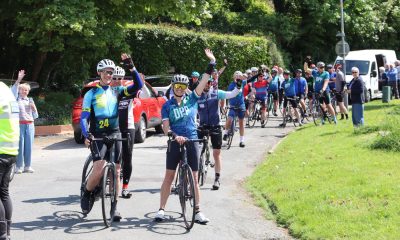

Charity3 hours ago
Chief’s Tour honours fallen officers with 75-mile Pembrokeshire ride
Dyfed-Powys Police team raises thousands for bereaved police families charity A TEAM of officers and staff from Dyfed-Powys Police cycled...

Crime5 hours ago
Racial abuse suspect barricaded himself inside Johnston lodge
ARMED police were called to a supported accommodation building in Johnston after a man allegedly barricaded himself inside a room...

Crime6 hours ago
Milford Haven woman denies causing suffering to cat
Jury hears evidence over alleged failure to seek treatment for tumour A MILFORD HAVEN woman has denied causing unnecessary suffering...


News1 day ago
Plaid Cymru projected to lead Senedd as Labour faces historic collapse
Final poll suggests Welsh politics could be on the brink of a major realignment PLAID CYMRU is on course to...
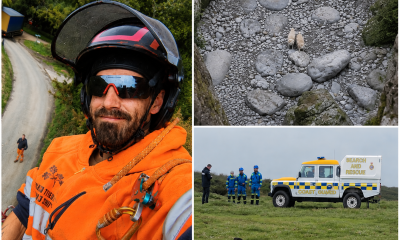

Community1 day ago
Rescue bid planned for lambs stranded below Stack Rocks cliffs
Tree surgeon preparing 150ft descent after live firing delayed rescue attempt A MAJOR rescue operation is being planned this afternoon...

News1 day ago
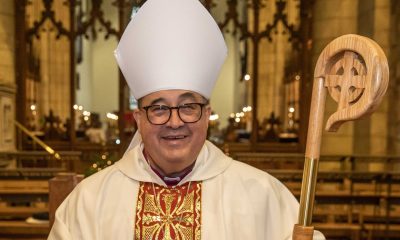
Bishop’s report reveals major renewal challenge at St Davids Cathedral
Formal Visitation highlights financial, structural, leadership and spiritual pressures at one of Wales’ most important religious sites ST DAVIDS CATHEDRAL...

Crime2 days ago
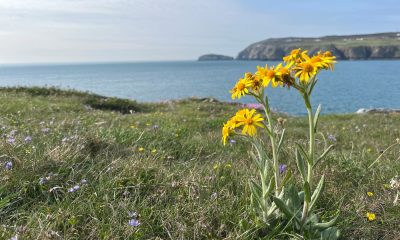
Farming company fined £19,000 for damaging protected wildlife site
A CARDIGAN farming company has been ordered to pay almost £20,000 after recklessly damaging a Site of Special Scientific Interest....

News2 days ago
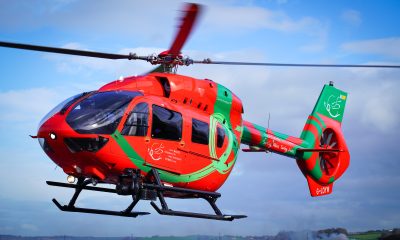
Baby in critical condition after Fishguard emergency
Teenagers arrested as police investigate circumstances A BABY remains in hospital in a critical but stable condition after being taken...


Community3 days ago
Tenby phone signal crisis goes national as businesses warn of summer disruption
TRADERS SAY CARD PAYMENTS, TAXIS AND VISITOR SAFETY ARE BEING HIT BY ‘DEAD ZONE’ COVERAGE TENBY’S long-running mobile phone signal...


News3 days ago
Final poll puts Plaid and Reform level ahead of Senedd vote
Labour faces historic setback as new modelling points to a hung Senedd PLAID CYMRU and Reform UK are projected to...
-
News2 days ago
Baby in critical condition after Fishguard emergency
-

 News1 day ago
Former housing officer admits drink-driving in Pembrokeshire retail park
-

 Crime1 day ago
Job loss threat for convicted Pembrokeshire drug-driver
-
 Crime1 day ago
Milford motorist disqualified for drug-driving
-

 Crime1 day ago
Police tip-off leads to driving ban for Milford motorist
-
 Crime1 day ago
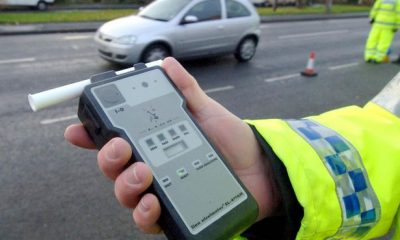
Delivery driver caught twice over legal drink-drive limit
-
Crime5 hours ago
Racial abuse suspect barricaded himself inside Johnston lodge
-

 Community1 day ago
Sixth-former firefighter balances schoolwork with saving lives