


News
HM Coastguard Fishguard assists ambulance service in coastal path rescue


IN A JOINT effort with the Welsh Ambulance Services NHS Trust, the highly skilled team from HM Coastguard Fishguard successfully assisted in the rescue operation of a casualty with suspected spinal injuries on the coastal path near Aberforrest Dinas. An update on the story reveals the seamless collaboration between emergency response agencies and the positive outcome of the incident.
Upon receiving the distress call, HM Coastguard Fishguard swiftly mobilized their experienced team to provide support and expertise in the challenging rescue mission. Coordinating with the Welsh Ambulance Services NHS Trust, their combined efforts aimed to ensure the safety and well-being of the injured hiker.
Arriving at Aberforrest, the team from HM Coastguard Fishguard found that the casualty had already received vital medical attention from the skilled paramedics of the Welsh Ambulance Services NHS Trust. The prompt response and effective treatment administered by the paramedics had stabilized the casualty’s condition.
With the immediate medical concerns addressed, the focus shifted to safely transporting the injured individual to the awaiting ambulance for further care. Utilizing their specialized training and equipment, the HM Coastguard Fishguard team expertly executed a short carry on a stretcher, ensuring the utmost care and comfort for the casualty during the transfer.
The collaborative efforts between HM Coastguard Fishguard and the Welsh Ambulance Services NHS Trust exemplify the importance of effective interagency coordination in emergency situations. Their seamless cooperation and shared expertise resulted in a swift and successful rescue operation.

Following the stretcher carry, the casualty was safely placed into the waiting ambulance, which promptly departed for the hospital. The commitment and professionalism displayed by both teams throughout the operation ensured the highest standard of care for the injured individual.












THE WIDOW of a Carmarthenshire father killed by a dangerous driver has been left facing months of uncertainty after being told the man jailed over her husband’s death may fall under new sentencing rules.
Aaron Jones, 38, from Llanpumsaint, died while walking his dog on December 23, 2024. His death devastated his family and shocked the close-knit village community.
Daniel Douglas Wyke, from Carmarthen, later admitted causing death by dangerous driving. He was jailed at Swansea Crown Court for four-and-a-half years and banned from driving for eight years and two months.
Now Aaron’s widow, Lisa Jones, has received correspondence indicating that Wyke may be affected by provisions introduced under the Sentencing Act 2026.
The family has been told it may not know until the end of August whether the changes will affect the time he spends in custody.
Ann Davies MP for Caerfyrddin and Nerys Evans MS for Sir Gaerfyrddin have now written to the Ministry of Justice seeking assurances that Aaron’s family will be heard during any review process.
They said the uncertainty had added further pain for a family already living with unimaginable loss.
“Our thoughts remain firmly with Lisa Jones, her family and the community of Llanpumsaint, who continue to endure unimaginable grief following the tragic loss of Aaron,” they said.
“To now face uncertainty over the sentence of the man responsible for his death adds further distress at an already devastating time.
“It is vital that the Ministry of Justice listens to victims and their families. Any move to shorten sentences in cases of this seriousness must be approached with the utmost caution and sensitivity.”
Nerys Evans MS said victims and their families must remain at the centre of the justice system.
She added: “We have written to the Ministry of Justice to seek assurance that the voice and view of Aaron’s family are able to be heard as part of any process to review the sentence.”

Ann Davies also raised the case in Westminster on Thursday, July 2.
Speaking in the House of Commons, she said her constituent Aaron Jones had been killed in a hit-and-run while walking his dog, and that his widow had since received a letter from the Ministry of Justice about sentence changes under the Sentencing Act 2026.
She asked whether ministers accepted that waiting until the end of August to learn whether Wyke could be released earlier than expected was causing further distress to victims’ families.
Sir Alan Campbell, Leader of the House of Commons, said he understood the sensitivity of the case and the distress caused to Aaron’s family.
He said: “These are difficult decisions, but I understand the point about assurances as far as they can be given to families.”
He added that he hoped the Ministry of Justice had heard the concerns and said he would raise the matter directly.
The Sentencing Act 2026 received Royal Assent in January. The Government says the reforms are intended to tackle prison overcrowding, increase the use of tougher community restrictions and make greater use of supervision and tagging after release.
However, the case has highlighted the anxiety caused to victims’ families when changes to release arrangements are communicated before the full impact on individual cases is known.
For Lisa Jones and her children, the question now is not only what decision will be made, but why they must wait weeks to find out.

PEMBROKESHIRE-BASED Ascona Group has completed the acquisition of Truckhaven (Carnforth) Ltd, a major trunk road services area in Lancashire.
The deal expands Ascona’s national portfolio to 70 sites and strengthens the group’s position in the UK roadside retail and services sector.
Truckhaven is located at Junction 35 of the M6 and has long been regarded as an important stopping point for the commercial transport industry and travelling public.
The 17-acre site includes an Esso-branded filling station, a detached 24-hour forecourt retail shop, overnight parking for 245 lorries, and an amenity building with a restaurant, showers, retail shop, licensed bar and launderette.

The site also includes a 26-bedroom en-suite hotel, providing accommodation and respite for drivers and other customers.
Darren Briggs, founder and CEO of Ascona Group, said: “We are delighted to complete the acquisition of Truckhaven.
“This is an exciting addition to our growing portfolio and reflects our confidence in the long-term opportunities within the UK roadside services market.
“Our ambition is to build on Truckhaven’s strong reputation by investing in the site, enhancing the customer retail experience, and creating a first-class destination for drivers and visitors alike.
“We have ambitious plans for the site. We intend to improve the forecourt facilities with a brand-new retail shop offering, and for HGV drivers, a brand-new state-of-the-art truck wash in the coming months.”
Ascona Group has become one of the UK’s most acquisitive independent forecourt operators, with continued investment across fuel retail, convenience, food-to-go and roadside services.
The acquisition of Truckhaven further broadens the group’s presence in a strategically important part of the market.
Michael Jelley, of Stonplan, who originally developed the Truckhaven site at Carnforth in the early 1990s, said: “We are confident that Ascona are the right people to take the site forward as the industry develops.

“They inherit a robust business that has prioritised the provision of high-quality facilities for the haulage industry, along with an outstanding operational team.”
Ascona Group said it continues to evaluate further acquisition opportunities across the UK as it pursues its long-term vision of building one of the country’s leading independent roadside retail and services businesses.
Legal work was undertaken by Simmons & Simmons for Ascona Group and Keystone Law for Truckhaven (Carnforth) Ltd.

Report due in September on replacing appointments with ANPR and CCTV monitoring
A PLAN to remove the booking system at Pembrokeshire’s waste and recycling centres is set to be brought before Cabinet later this year.
Council Leader Cllr Tessa Hodgson has confirmed that it is the intention of her administration to scrap the current system, which requires residents to book before using the county’s waste and recycling centres.
She has asked Cabinet Member for Residents’ Services, Cllr Rhys Sinnett, to work with officers on a report setting out the options for a new approach.
Cllr Hodgson said Pembrokeshire had a strong record on recycling, but added that the booking system remained a regular concern for local residents.
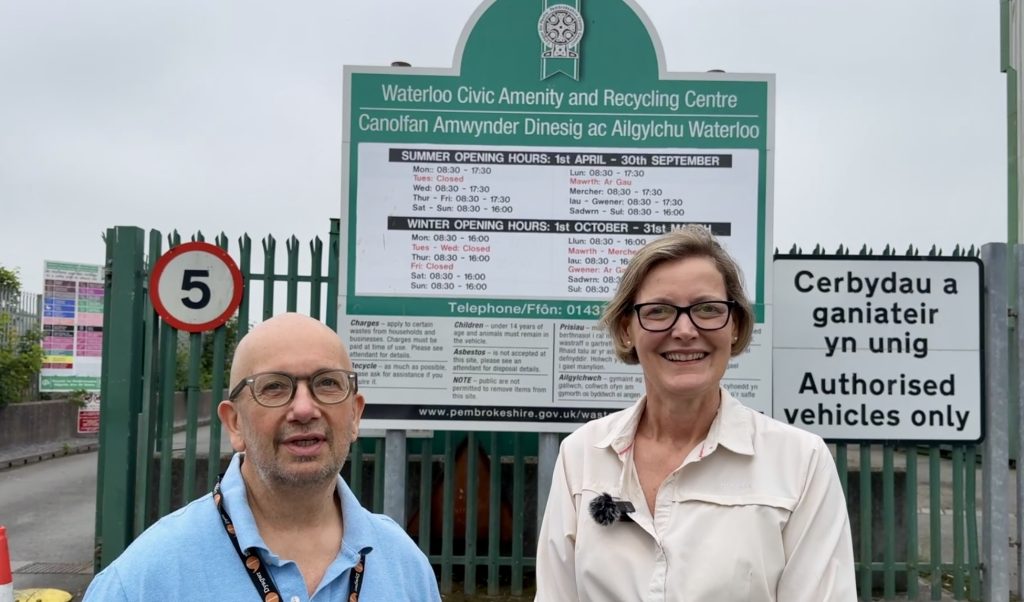
She said: “Pembrokeshire is consistently one of Wales’ best performing local authorities when it comes to waste and recycling, and I thank our staff and the people of Pembrokeshire for helping us continue to improve.
“However, the booking system is an issue that is raised with me time and time again by residents, and so removing the booking system is a priority for me and my administration.
“With modern technology such as number plate recognition and CCTV monitoring, I see no reason why we cannot ensure the sites are used appropriately and safely by council taxpayers, while minimising any unauthorised use, without the need for a booking system.”
Cllr Hodgson said the current arrangements could be “time-consuming and bureaucratic” and that the council should be able to protect the service while making it easier for residents to use.
She added: “I believe we can create a system that maintains high standards of waste disposal, provides value for money for taxpayers, and continues to maximise recycling, all without unnecessary bureaucracy.
“It is our administration’s intention that a report is brought to the September Cabinet meeting with a clear plan to remove the booking system from our waste and recycling centres.”
Cllr Rhys Sinnett said the council would look at a practical replacement which keeps sites safe and prevents misuse.
He said: “We know how important it is for residents to have straightforward, convenient access to their local waste and recycling centres, and I welcome this work to explore how we can make that happen.
“Our focus will be on developing a practical, modern approach that improves the experience for residents while maintaining safety, protecting the service from misuse, and continuing to deliver strong recycling performance for Pembrokeshire.
“I look forward to bringing forward proposals that strike the right balance for our communities.”
Any change would be subject to Cabinet considering the report and agreeing the next steps. The report is expected to go before members in September.



Business4 hours ago
Pembrokeshire-based Ascona Group expands UK portfolio with Truckhaven acquisition
PEMBROKESHIRE-BASED Ascona Group has completed the acquisition of Truckhaven (Carnforth) Ltd, a major trunk road services area in Lancashire. The...


Health1 day ago
Wales begins early NHS winter planning after long waits and ambulance pressure
Ministers say health boards and councils must act now to ease pressure on hospitals, ambulances and social care before winter...


Crime2 days ago
Judge calls pensioner a ‘dirty old man’ as he avoids jail for exposing himself to women
Judge says 75-year-old Stewart Laugharne behaved ‘disgracefully’ as he avoids jail but is ordered to sign sex offenders register A...
Health2 days ago
Stroke services consultation reaches halfway point as public urged to have say
HYWEL DDA University Health Board is urging people to take part in its consultation on the future of stroke services,...


Business2 days ago
Welsh firms eye share of £5bn defence drone boom
WELSH defence and aerospace firms could be in line for a share of billions of pounds in new military spending...


Community4 days ago
Thousands line Cardigan streets for Lord Rhys homecoming parade
THOUSANDS of people lined the streets and quayside in Cardigan on Saturday as the town marked 850 years since Lord...


Crime5 days ago
Dyfed-Powys Police rated only ‘Adequate’ in organised crime inspection
A WATCHDOG has rated Dyfed-Powys Police only “Adequate” in its response to serious and organised crime, despite praise for the...


News5 days ago
Two taken to hospital after aircraft ditches in Cardigan Bay
Coastguard helicopter spotted two casualties after light aircraft came down off west Wales coast TWO people were taken to hospital...


Sport6 days ago
Long Course Weekend gets underway in Tenby as thousands head for county
Three days of swimming, cycling and running begin with The Wales Swim at North Beach THOUSANDS of athletes and supporters...


Climate6 days ago
Welsh waters, Westminster profits: Crown Estate row reignited in Wales
PLAID CYMRU has renewed calls for the Crown Estate to be devolved to Wales after figures showed income linked to...
-
Crime5 days ago
Dyfed-Powys Police rated only ‘Adequate’ in organised crime inspection
-

 Entertainment6 days ago
Torch cuts children’s cinema tickets to £5.25 for summer
-

 News3 days ago
Biker dies and woman seriously injured in Black Mountain crash
-

 News6 days ago
Reform MS: ‘I felt like shouting get out of the water’
-
Climate6 days ago
Welsh waters, Westminster profits: Crown Estate row reignited in Wales
-

 Crime6 days ago
Former Swansea Prison inmate died 48 hours after release
-

 Crime5 days ago
Swansea man jailed for 16 years after attacking vulnerable woman
-

 Community6 days ago
Working-class young people ‘shut out’ of marine conservation careers in Wales