


News
Food rating system scores a success

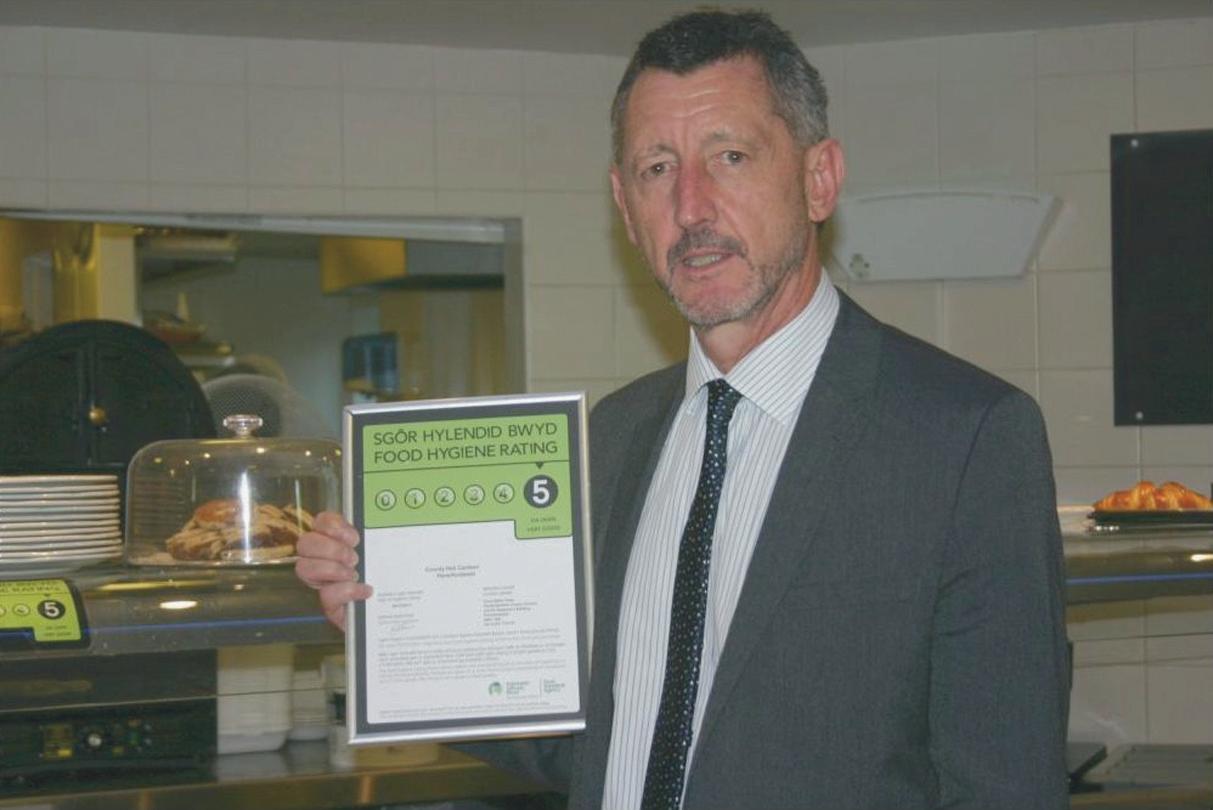
 A LEADING Welsh environmental health officer has praised the success of the Food Hygiene Rating system.
Mark Elliott, Chair of Wales Heads of Environmental Health Group and Head of Public Protection at Pembrokeshire County Council said 23,540 businesses across Wales now received a hygiene rating with the number getting top marks increasing by almost a fifth. Conversely, the number of businesses rated 0-2 has declined by a third since the introduction of the mandatory scheme. “Giving consumers more information is having a positive effect on food hygiene standards,” he said. “The number of businesses rated 5 (very good) has increased by almost 20% since the start of the scheme and many have reported that a good rating has increased their takings significantly. “In Pembrokeshire too the number of food business operators improving their food hygiene standards is also increasing with 94 per cent of food premises now scoring 3, 4 or 5 under the scheme.” But he warned that the scheme’s success was taking place against a background of rapidly shrinking local authority budgets and if it were to be continued would have to be adequately resourced. “The Food Hygiene Rating Scheme’s success so far reflects the hard work and dedication of Environmental Health Practitioners in Pembrokeshire and across Wales,” he said. “It is vital that such services are adequately resourced in future to protect public health.” The Food Hygiene Rating system was introduced in 2010 when all 22 Welsh local authorities took the voluntary decision to implement one food premises inspection scheme. The scheme aims to improve business food hygiene standards by making them visible to the consumer so that they can make informed choices about where to eat safely. The ratings awarded by Local Authority officers follow inspections and are then made available to the Food Standards Agency, which publishes them on their website. In November 2013, the Welsh Government made the implementation of the Food Hygiene Rating scheme mandatory. Food businesses were also required to display their food hygiene rating in a prominent place, such as the front door or entrance, or face a fine or prosecution with money generated from fixed penalty notices going to the Welsh Government. Meanwhile businesses that score poorly and want to improve are given assistance to enable them to improve their hygiene rating – although in some cases further appropriate enforcement activity may also be carried out. In November this year the Rating scheme will be extended to businessto- business trade, which means that almost everyone from small producers to factories will also be included. This will help small businesses choose their suppliers and could be used as a selection criterion when public sector contracts are tendered. “Environmental Health Practitioners will take all necessary action, including prosecution, to protect the health of the public where serious failures of law are found during inspections,” said Mr Elliott, who is also a Trustee of the Chartered Institute of Environmental Health. “We are working hard to improve the services we deliver but it is against a background of rapidly shrinking local authority budgets. It is vital that such services are adequately resourced in the future to protect public health.” *Members of the public wanting to check on the rating of a business can do so at http://tinyurl.com/dyvdbgc


Environmental group says Pembrokeshire MP’s North Sea stance risks undermining climate policy
PEMBROKESHIRE MP Henry Tufnell has been accused by local environmental campaigners of backing “drill baby drill” tactics over future North Sea oil and gas production.
Pembrokeshire Friends of the Earth made the claim after Mr Tufnell wrote an article in The Sun in March criticising the UK Government’s position on new oil and gas drilling.
The group said it wrote to the Labour MP on April 3, challenging his comments and urging him to reconsider his position.
In its letter, the group argued that further North Sea drilling would do little to reduce energy bills or improve energy security, because UK oil and gas prices are linked to international markets.
A spokesperson for Pembrokeshire Friends of the Earth said Mr Tufnell’s approach was “supported by the likes of Reform UK and Donald Trump” but rejected by energy and climate experts.

The group said the UK Energy Research Centre had concluded that additional UK oil and gas production would have “negligible impact” on the cost of living, and that the priority should instead be reducing demand and investing in renewable energy.
It also pointed to Climate Change Committee analysis suggesting that job losses in fossil fuel industries would be outweighed by job creation in areas such as renewable energy, retrofitting and electric vehicles.
Pembrokeshire Friends of the Earth also criticised Mr Tufnell’s call for the removal of carbon taxes in manufacturing, saying it showed a lack of understanding of the urgency of climate change.
The group said Mr Tufnell had failed to reply to its letter, despite allegedly promising to do so during a face-to-face conversation in Narberth in April.

The spokesperson added: “The fact that the MP has refused to reply to our letter suggests that he either has more respect for a London tabloid newspaper than for his own constituents or is having difficulty justifying the viewpoints he presented in The Sun.”
MP says transition must protect jobs
In response, Mr Tufnell said he was “immensely grateful” for the work of Pembrokeshire Friends of the Earth and praised the group’s campaigning on environmental issues.
He said he was proud to have supported the group last month by attending its screening of the People’s Emergency Briefing film, which highlighted threats to nature and climate.

Mr Tufnell said Pembrokeshire was “uniquely placed” to lead the clean energy transition, citing floating offshore wind, hydrogen, carbon capture, sustainable aviation fuel and battery storage.
He added that the county was proud of its coastline, rivers and wildlife, and that the community was committed to protecting them.
However, he said the transition to clean energy had to be “a just one”.
Mr Tufnell said: “Pembrokeshire’s energy sector has powered the UK for decades, and still supplies 20% of the country’s energy demand.
“I am calling on the Government to protect our established energy industries by cutting carbon taxes. Failure to act puts jobs and livelihoods in industrial communities like ours at risk.
“Decarbonisation cannot come at the cost of deindustrialisation and greater deprivation in our county.”
He said households and businesses across the UK had felt the impact of conflicts in the Middle East and Ukraine, and argued that Britain must strengthen energy security by making full use of its own resources rather than relying on imports.
Mr Tufnell added: “Oil and gas will remain part of our energy mix for decades to come. It therefore makes sense to use our domestic resources.
“Doing so will not only strengthen our energy security, but support British industry — protecting jobs, boosting tax revenue, cutting our trade deficit and strengthening the economy.
“I will continue to work hard to ensure we have a just energy transition, protecting the jobs and skills base of today, while building the industries of tomorrow.”

Health, police and support services unite after rising concerns in Pembrokeshire, Ceredigion and Carmarthenshire
COCAINE has been identified in a significant number of drug-related deaths across Pembrokeshire, Ceredigion and Carmarthenshire over the past year.
Frontline teams have also reported rising incidents of violence, aggression and criminal justice involvement among people accessing drug and alcohol support services.
Dyfed-Powys Police data shows cocaine is now the force’s second most seized drug, and remains widely used across a range of settings.
In response, the Dyfed Area Planning Board brought together representatives from health, policing, commissioned services, social services and community organisations for a regional summit aimed at understanding the scale of the problem and agreeing joint action.
Hywel Dda’s Community Drug and Alcohol Team opened the event with an overview of emerging substance use trends. Dyfed-Powys Police then shared enforcement intelligence, while Public Health Wales provided a national perspective on stimulant use.
Clinical specialists also outlined the impact of cocaine use on maternity services, blood-borne virus transmission, exercise culture and the night-time economy.
The summit concluded with harm reduction training and group discussions focused on strengthening prevention, treatment pathways and community support across West Wales.
Steve Reynolds, Dyfed Drug and Alcohol Service manager, said: “DDAS are incredibly encouraged by the success of this cocaine summit. Cocaine-related harms are complex and evolving, and through collaboration and open dialogue we can respond effectively.
“The summit reinforced the importance of reducing stigma, expanding access to support, and ensuring that people who use our services receive compassionate, person-centred care.
“We remain committed to working with partners in developing practical actions that improve outcomes for individuals, families and communities.”
Detective Superintendent Gareth Roberts, of Dyfed-Powys Police, said: “It was a pleasure to host this valuable event at Dyfed-Powys Police.
“As a force, we are committed to working in partnership to improve the health, wellbeing, and safety of our communities as we work hard to reduce the risk of drug-related harm.”

Craig Jones, Hywel Dda Prevention and Population Health Improvement Manager, said: “This summit marks the beginning of a coordinated regional effort to reduce harm, improve outcomes and strengthen support for individuals, families and communities affected by cocaine use.
“Partners will now work together to address availability, risk reduction and access to support.”
Anyone experiencing problems with substance use, or anyone seeking more information about the Community Drug and Alcohol Team, can visit hduhb.nhs.wales/drug-and-alcohol.


Council awarded control of animals after magistrates hear claims of unlicensed breeding
A PEMBROKESHIRE farm owner has appeared before Haverfordwest Magistrates’ Court after 26 dogs were removed from her care under animal welfare legislation.
Rachel Roberts, of Penlan Oleu, Puncheston, appeared in court on Friday (May 1) in relation to an application brought under Section 20 of the Animal Welfare Act 2006 following action by Pembrokeshire County Council.
The court heard that 26 dogs had been taken into possession, including spaniels, dachshunds, poodles, chihuahuas and six puppies.
It was alleged in court that Roberts had been breeding and selling dogs without the appropriate licence, and that some animals had not received the correct vaccinations.
Magistrates granted the application, allowing Pembrokeshire County Council to take control of the dogs and make decisions about their future, including rehoming.
Roberts was also ordered to pay £99,463.35 in costs to the council.
RSPCA investigation
An RSPCA investigation was reportedly opened last year after images emerged of horses said to be in poor condition.
The Herald has also been contacted by a concerned member of the public, who provided videos and photographs which they claim show a dead horse concealed beneath wooden pallets.
The source further alleged that a person staying at the property had witnessed a horse being dragged by its neck using a tractor.
These claims have not been independently verified by The Herald.
Wider allegations
The Herald has also been told that other members of the family may have been involved in the sale of dogs from the property, with allegations that animals were later sold outside Pembrokeshire.
The paper understands that Roberts’ daughter, Eliza Roberts, has previously appeared before the courts in connection with dog-related offences.

Roberts, 36, was sentenced to three months in prison and banned from owning animals for seven years after pleading guilty to two counts of possession of a fighting dog and one count of being in charge of a dog dangerously out of control.
The charges followed an incident in Hanwell, near Banbury, on March 26, in which a schnoodle named Winnie was killed by two XL Bully dogs, Kobi and Kardi.
At the sentencing hearing, Roberts was ordered to pay £1,295 compensation, and a destruction order was made for the dogs.



Community19 hours ago
Safety first as Milford Haven’s new pilot boat marks end of troubled chapter
Gary Solomon, who was aboard St Davids during the 2016 collision, helped shape new self-righting vessel Llanion from conception to...


Crime21 hours ago
Cocaine courier caught with £15,000 haul in Pembroke Dock
Defendant transported high-purity drugs from Cardiff to Pembrokeshire for £210 A PEMBROKESHIRE man caught transporting more than £15,000 of high-purity...


News1 day ago
Car bursts into flames near Redberth Croft as road closed after incident
Nobody injured after vehicle fire near A477 prompts emergency response A CAR was destroyed by fire near the entrance to...


News2 days ago
Welsh Labour unveils new Senedd spokesperson team
Ken Skates says Labour group will hold Plaid Cymru government to account WELSH Labour’s interim leader Ken Skates MS has...


Cymraeg2 days ago
Two new Milford Haven schools could be built and open by 2032
NEW SCHOOLS in Milford Haven won’t be built before 2030 at the earliest, and 2032 for a planned Welsh Medium...


Crime2 days ago
Stolen vehicle investigation after late-night crash in Waterston
A VEHICLE involved in a late-night single-vehicle crash in Waterston, Milford Haven, is believed to have been stolen, police have...


Community3 days ago
Paul Davies MS calls for review of parking charges in Ceredigion following concerns
SENEDD Member for Ceredigion Penfro, Paul Davies, has called on Ceredigion County Council to urgently review its policy on car...

Crime3 days ago
Former Lostprophets singer’s killing ‘not justified’, jury told
JURORS in the trial of two prisoners accused of murdering former Lostprophets singer Ian Watkins have been told that his...


Health4 days ago
Occupational therapists urge Welsh Government to act before NHS crisis deepens
More than 300 professionals sign open letter calling for prevention-focused care and urgent reform OCCUPATIONAL therapists across Wales are urging...


Community4 days ago
Surfers take sewage protest to Broad Haven beach
CAMPAIGNERS took to the sea at Broad Haven today in a colourful protest demanding urgent action over sewage pollution in...
-

 News6 days ago
Palestine pledge backed by 36 new Senedd Members
-
Community4 days ago
Surfers take sewage protest to Broad Haven beach
-
 Crime21 hours ago
Tree surgeon sentenced for failing to provide breath test
-

 Crime23 hours ago
Pembrokeshire teenager admits driving almost four times over drug-drive limit
-

 Crime17 hours ago
Farm owner in court after 26 dogs removed over welfare concerns
-

 Crime3 days ago
Builder jailed for £82,000 fraud affecting 18 victims
-
 Health5 days ago
New NHS regional body raises questions over future hospital services in Pembrokeshire
-
 Crime23 hours ago
Pembroke Dock drink-driver arrested on Cleddau Bridge