


Climate
Record year for Welsh heat pumps and solar panels


RECORD numbers of solar panels and heat pumps were installed in Welsh homes and businesses last year.
2023 saw more than double the amount of certified renewable installations in Wales than the previous year, bringing the total number of Welsh homes and businesses with renewable energy to over 100,000. 2023 was also the first year that installations rose above 20,000 in a single year, according to the MCS database of certified installations.
Solar panels made up the majority of the new renewable energy, with 14,730 MCS-certified installations across Wales. This represents a twelve-year high and is the highest level since Feed-In Tarriff grants were cut in 2011.
But the largest increase was in the heat pump sector, with a 147% increase in certified installations between 2022 and 2023. Experts at the MCS Foundation, which compiled the figures, said that Government grants introduced in 2022 have helped drive the rise in uptake. Households can now get £7,500 off the cost of a heat pump under the Boiler Upgrade Scheme, with applications for the grants rising rapidly.
Grants available for homeowners via the Welsh Government’s Nest scheme have also helped with the rollout of renewables. The Nest scheme is coming to an end, and is due to be replaced by a new scheme with a greater focus on low carbon technologies for the home.

Nearly one-in-ten households in Wales now have MCS-certified renewable installations, the highest proportion anywhere in the UK.
David Cowdrey, Director of External Affairs at the MCS Foundation, said: “The rapid rise of renewables in Wales is good news for people’s energy bills and for the climate.
“However, while the upward trend is encouraging, we need to be installing many more heat pumps, much faster, to meet climate change targets. Government policies like mandating heat pumps in all new-build homes and reducing the price of electricity so that heat pumps are guaranteed to be cheaper to run than a gas boiler will help to increase uptake.”
Nick Salini, Director of heat pump installer Thermal Earth, said “It is positive to see the increased uptake of renewables in Wales. Heat pumps are the future of home heating systems and viable in every type of building with correct design and installation.

“While this growth is welcome, we need significantly higher growth to get anywhere near the long term targets set by UK Government and reduce our national dependency on fossil fuels. In addition to installation financial support such as the BUS, we need lower electricity costs for heat pumps to further increase the running cost savings and more positive messaging of the advantages heat pumps offer homeowners to transition to away from traditional fossil fuel systems.”



A PETITION call to Pembrokeshire councillors, which raises concerns at the “hefty funds” needed to support its commitment to net zero, will be heard at full council next week.
Last July, councillors agreed to set up a group to review its own decision to declare a climate emergency some seven years ago.
In May 2019, the council declared a climate emergency following a notice of motion by Cllr Joshua Beynon calling on the authority to back the global consensus that climate change poses a risk to the well-being of future generations.
He had urged county councillors to back a motion to take “bold, decisive action” to fight “truly, catastrophic” climate change, with the council to committing to becoming a zero-carbon local authority by 2030.
At the July 2025 meeting of Pembrokeshire County Council, a successful notice of motion by the late Cllr Mike Stoddart called for the establishment of a working group to review that decision.
That led to a recent petition, by Lynda Duffill of West Wales Climate Coalition, which attracted 725 signatures, calling on the council to reaffirm its Declaration of a Climate Emergency, and retain the ambition to deliver Net Zero Council operations by 2030.
That petition was considered at the October 2025 meeting of full council; members agreeing the working group be asked to ensure the petition is included as evidence in its consideration of the matters referred to it by the council resolution in July 2025.
That has now led to a further petition, concerned at a potential increase in council tax from a re-affirmation of a Declaration of a Climate Emergency.
The latest e-petition, on the council’s own website, created by Carolyn Ellis, read: “We call upon all elected members of Pembrokeshire County Council to support and to take seriously the working group tasked with the review of the ‘climate emergency’ called in 2019 (by the-then 21-year-old councillor Joshua Beynon) and to question the hefty funds needed to spend on ‘net zero’.
“We refer to the recent petition by the West Wales Climate Coalition which purports to speak for the residents and council tax-payers of Pembrokeshire.
“There is potentially a far higher number of residents who do not share this unsubstantiated view and who are extremely concerned about the potential for huge hikes in council tax, especially if this tax is linked in future to the carbon efficiency of homes and businesses.
“This was hinted at as a possible lever for encouraging ‘compliance’ with decarbonising homes in the ‘Better Homes, Better Wales, Better World’ report. Therefore, not only could we be faced with more taxes, but also inevitable deterioration in service provision by PCC.”

The current petition ran to March 26 and attracted 753 signatures; any petition of over 500 triggers a debate at full council, the petition due to be heard at the May 14 meeting.
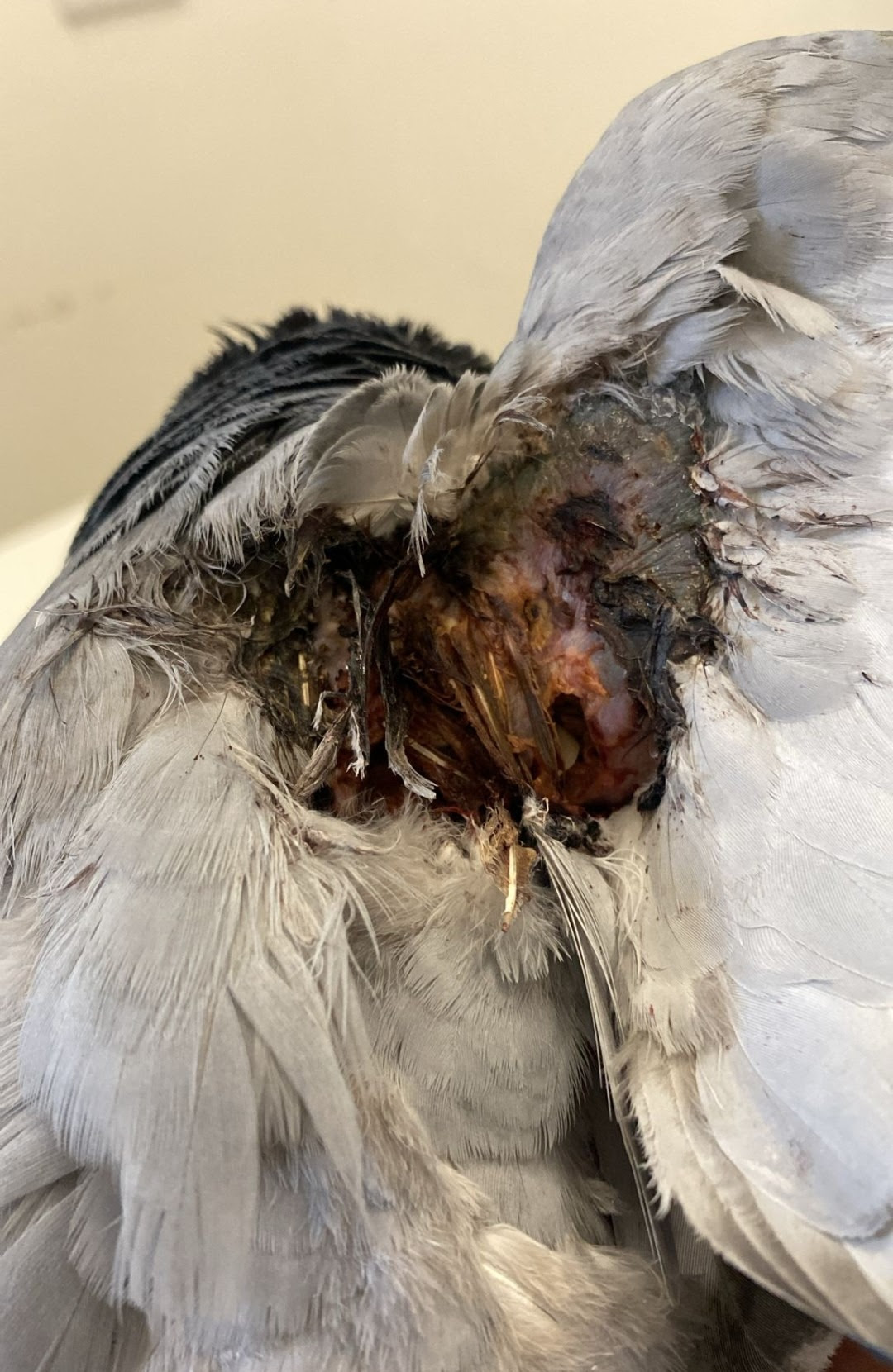
AN APPEAL has been launched after an injured pigeon was found on Charles Street, Milford Haven after being shot through its wing bone with an air gun,
The bird was discovered by a member of the public on April 21 and was taken to All Pets Vet Care.
This incident follows a previous RSPCA appeal as several cats were shot by an air gun in the Hakin area in March. At least one cat died and three were injured.
When examined by a veterinary surgeon, the pigeon was found to have a wound on his left wing, with infection and lots of swelling. A subsequent radiograph showed that a pellet had shattered through its wing bones.
“As a result the pigeons sadly had to be euthanised,” commented Dr Cethin Ravenhill of the All Pets Vet Care. “The RSPCA were informed and as far as I’m aware, this is the only bird we’ve treated with this type of injury “
Meanwhile staff have been asked to radiograph any more injured birds brought in to the veterinary practice.
“I am so shocked and saddened that any individual would shoot an animal with an air gun, as the shot is very unlikely to kill the animal, but just maim and seriously wound them,” added Dr Ravenhill. “This leads to a slow and painful death and significant suffering.
“It’ss very upsetting to think there is someone in the local area doing this to both cats, and sadly pigeons.”
RSPCA Cymru fears other cats and wildlife may have been targeted and is now calling on the community to look out for any suspicious behaviour and report potential offences.
RSPCA Inspector Keith Hogben, who is investigating the incident, said: “We are extremely concerned about reports of a pigeon and cats being deliberately targeted and killed in this way.
“Our hearts go out to the owners and to anyone who has been involved or discovered an animal injured in this way.
“It is always very distressing to think that people may be taking pleasure in causing such horrific injuries to defenceless animals.
“Unfortunately at the moment we only have limited information and so we hope an appeal for information will help with our enquiries.

“We would urge anyone who saw what happened, or who may have any further information, to please get in touch with us as soon as possible. We would also ask parents and carers to speak and educate young people about this.”
Anyone caught deliberately using an air gun to injure an animal can face up to five years in prison and/or an unlimited fine if found guilty under the Animal Welfare Act.
Deliberately injuring or killing wild birds is a criminal offence under the Wildlife and Countryside Act 1981.
Anyone with any information is asked to contact the RSPCA appeals line number on 0300 123 8018 and refer to incident number 01794965.
Every year the RSPCA receives almost 1,000 calls to investigate cases, and help hundreds of animals that are the victims of air gun attacks.
Cats and wildlife are the animals most vulnerable to being shot simply because they are out in the open with no one to protect them. Unfortunately, air rifle attacks are not as rare as the charity would like. The injuries caused by such attacks can be horrific and often fatal.
Keith added: said: “We want to see a world where every kind of animal is treated with compassion and respect, and deliberate and brutal acts of cruelty should be consigned to the past.
“We continue to call for tighter controls on air weapons. This, along with better education and explanation of the law when buying an air gun, and requirements that everyone must receive basic safety training before being allowed to walk out of the shop, could help relieve the problem.”

BROADCASTER and environmental campaigner Chris Packham has backed a free public screening in Carmarthen aimed at encouraging local discussion about the climate and nature crisis.
The People’s Emergency Briefing will be shown at St Peters Civic Hall, Carmarthen, on Friday, May 22, at 7:00pm.
The screening will be followed by a facilitated community discussion involving residents, local leaders and invited decision-makers.
The event forms part of a UK-wide programme intended to help the public and policymakers better understand the risks posed by climate change and biodiversity loss.
The film follows the National Emergency Briefing held at Westminster Central Hall in November 2025, where more than 1,200 MPs, peers and leaders from business, culture, faith, sport and the media gathered to hear evidence from leading experts.
The briefing, introduced by Chris Packham CBE, examined the impact of climate and nature breakdown on food security, public health, infrastructure, the economy and national security.
It has since been adapted into a 50-minute public film, which launched nationally in April and is now being screened in communities across the UK.
Chris Packham said: “I’d encourage people everywhere to attend a screening of The People’s Emergency Briefing.
“It creates exactly the kind of honest local conversation we now urgently need, both about what these changes mean where we live, and about what we can do together to address them.”
Organisers say the Carmarthen event comes at a time of growing local concern over flooding on the rivers Towy and Gwili, as well as biodiversity loss linked to pollution incidents.
After the film, those attending will be invited to take part in a structured discussion about the issues raised and what they may mean locally.
Local MPs, councillors and other influential figures have also been invited.

Philip Hughes, one of the organisers, said: “This is about creating space for people to come together, look at the evidence, and begin a more open and informed conversation about what it means for our community.
“It is also about how we can support the bolder action now called for by the science, which will also do so much to improve lives, as the film explains.”
Tickets for the Carmarthen screening are free, but advance registration is encouraged.




News20 hours ago
Plaid Cymru celebrates historic victory as Rhun ap Iorwerth arrives at Cardiff Bay
CROWDS gathered outside the Senedd as Plaid Cymru leader Rhun ap Iorwerth arrived in Cardiff Bay following his party’s historic...


Crime21 hours ago
Police standoff ends after four-hour incident in Pembroke Dock
ELIZABETH COURT SCENE STOOD DOWN AFTER DOMESTIC INCIDENT A FOUR-HOUR police standoff in Pembroke Dock has ended with a 21-year-old...


Crime1 day ago
Teen denies attempted murder of Milford Haven teacher
TEENAGER REMANDED AHEAD OF JULY TRIAL A 15-YEAR-old boy has denied attempting to murder a teacher during a stabbing incident...


News2 days ago
Catastrophe for Labour as Plaid and Reform reshape Welsh politics
ELUNED MORGAN LOSES SEAT AS OLD CERTAINTIES ARE SWEPT AWAY THE VOTERS of Wales have delivered one of the most...


News2 days ago
Labour wiped out in Ceredigion Penfro as Plaid tops poll and First Minister loses seat
Shock result sends political shockwaves across Wales as Reform also surges in historic Senedd count LABOUR suffered one of the...


News2 days ago
Labour deputy says party ‘will not form next Welsh Government’
LABOUR FACES HISTORIC DEFEAT AS COUNTING CONTINUES ACROSS WALES LABOUR’S Deputy Leader in Wales has effectively conceded the Senedd election,...

News2 days ago
Counts underway in historic Senedd election
Wales waits for results as first election under new voting system reaches count stage COUNTING is underway across Wales today...


Charity3 days ago
Chief’s Tour honours fallen officers with 75-mile Pembrokeshire ride
Dyfed-Powys Police team raises thousands for bereaved police families charity A TEAM of officers and staff from Dyfed-Powys Police cycled...


Crime3 days ago
Racial abuse suspect barricaded himself inside Johnston lodge
ARMED police were called to a supported accommodation building in Johnston after a man allegedly barricaded himself inside a room...

Crime3 days ago
Milford Haven woman denies causing suffering to cat
Jury hears evidence over alleged failure to seek treatment for tumour A MILFORD HAVEN woman has denied causing unnecessary suffering...
-

 News5 days ago
Baby in critical condition after Fishguard emergency
-

 News4 days ago
Former housing officer admits drink-driving in Pembrokeshire retail park
-
 Crime4 days ago
Job loss threat for convicted Pembrokeshire drug-driver
-
 Crime4 days ago
Milford motorist disqualified for drug-driving
-

 Crime4 days ago
Police tip-off leads to driving ban for Milford motorist
-
Crime3 days ago
Racial abuse suspect barricaded himself inside Johnston lodge
-
 Crime4 days ago
Delivery driver caught twice over legal drink-drive limit
-

 Community4 days ago
Sixth-former firefighter balances schoolwork with saving lives