


Community
Be wary of gulls as breeding season approaches

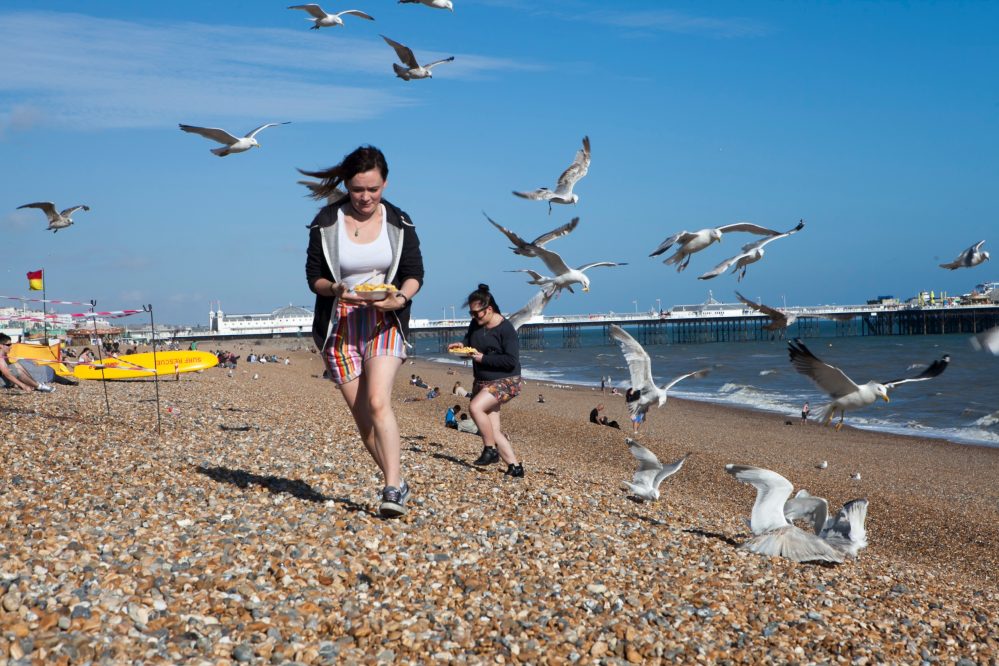
AS families across Wales head to the seaside for the bank holiday weekend, a national trade body is urging people to be wary of gulls as their egg-laying season gets underway.
During the breeding season, gulls have been known to launch attacks on people, says British Pest Control Association (BPCA).
After mating and nest-building in February and March, many gulls will be protecting nests and eggs towards the end of April and into May.
However, BPCA is also reminding people that avoiding gulls wherever possible is always the best course of action as interfering with wild birds, their eggs or nests could lead to prosecution.
The Wildlife and Countryside Act 1981 states that all wild birds and their eggs are protected, but people with the appropriate knowledge on licences, such as BPCA members, can take steps if the birds are causing a public health and safety concern.

Natalie Bungay, Technical Manager at BPCA, said: “We love British birds. All wild birds and their eggs are rightfully protected by law in the UK, so it is absolutely vital that holidaymakers, householders or business owners don’t interfere with them.
“However, gulls can pose a serious safety concern. They have been known to attack people unexpectedly, which can be a frightening experience, especially if they draw blood, which can occasionally happen.
“We often think of gulls as a coastal problem – which they can be in seaside towns where people have fed them regularly. But for some time now they have also been an increasing problem in towns and cities away from the coast too.”
Gulls can live for 25 to 30 years and many weigh around 1kg, with wingspans of around one metre.

Seaside visitors can try to avoid attracting gulls by ensuring picnic foods or chippy take-aways are kept covered or eaten out of sight of gulls where possible.
Nesting gulls can cause problems for homes and businesses both on the coast and inland, as well as at supermarkets and hospitals, as these buildings can offer ideal nesting sites which are difficult to access and proof.
Nests can clog gutters or chimneys, which may cause water overflows, or potential issues with carbon monoxide, as well as bringing a risk of secondary infestation from bird mites, ticks, fleas and beetles.

Properties are also at risk from bird droppings, which can carry some harmful bacteria and diseases, as well as even cause slips, trips and falls where they build up.
Natalie added: “Gulls are also protected by the law, so it really is important to seek professional help.
“BPCA members are trained in bird control and will be able to offer a management plan that will alleviate the issue.
“There are a variety of bird-proofing measures available, all of which will deter birds without causing them harm, and as gulls are large and heavy, any proofing measures need to be suitable for the job, very heavy duty and correctly installed by a professional.
“Bird prevention, proofing and control is a highly specialised area requiring specific equipment and techniques. Pest professionals are required to try all reasonably practicable non-lethal bird control methods before they consider lethal control.
“Always consult a BPCA member before considering any form of bird management. You could be prosecuted if you illegally interfere with a bird, its nest or eggs.”
BPCA members are trained, experienced professionals with access to a range of specialist products not available to the public, as well as being regularly assessed to the British Standard in Pest Management BS EN 16636.
BPCA members are also endorsed by the Government via the TrustMark quality scheme.
To find a professional pest controller visit bpca.org.uk/find


THE FAMILY of a 30-year-old father who died following a motorcycle crash near Aberystwyth have described him as a much-loved partner, relative and friend who will be “sadly missed by so many people”.
Matthew Sims, known to his family and friends as Matt, was seriously injured in a single-vehicle collision on the A487 at Blaenplwyf on the morning of Saturday, July 11.
The crash, involving a blue Suzuki motorcycle, happened at around 7am as Mr Sims was travelling to work.
He was taken by air ambulance to the University Hospital of Wales in Cardiff, where he died on Thursday, July 16.
No other vehicles were involved in the collision.
Mr Sims, who was from Lampeter, leaves behind his partner Katie and his daughters, Emma and Beca.
In a tribute released through Dyfed-Powys Police, his family said: “Matt passed away on Thursday 16th July 2026 at the University Hospital of Wales in Cardiff, following a motorcycle accident on the Aberystwyth road on his way to work on the morning of Saturday 11th July 2026. No other vehicles were involved.
“He was a loving father to his daughters Emma and Beca and partner to Katie.
“He had a wide circle of family and friends and will be sadly missed by so many people.
“Rest in peace Matt.”
Dyfed-Powys Police said officers are continuing to investigate the circumstances surrounding the collision.
Anyone who was travelling on the A487 near Blaenplwyf at around 7am on July 11, particularly anyone with dashcam footage, is urged to contact the force.

Information can be provided online through the Dyfed-Powys Police website, by emailing [email protected], sending the force a direct message on social media, or calling 101.
The reference to quote is 82 of July 11.

A FURTHER secular group has backed Pembrokeshire County Council’s plan to redesignate a north county faith primary school as a nonreligious community school.
Back in May, Pembrokeshire County Council voted to remove Voluntary Controlled (VC) status from Welsh-medium Ysgol Cilgerran’s Church in Wales school despite 97 per cent of the responses to a consultation having opposed a change which the church describes as ‘entirely unnecessary’.
That consultation followed a review which “considered the extent of surplus school places in the area, set against a significant decline in the pupil population,” the council has previously said.
Hundreds opposed the proposed changes, with a petition on the council’s own website gaining 391 signatures.
The Church in Wales has objected formally to the proposal and has warned it will take legal action on the grounds of “public misrepresentation and unqualified legal assertions made by Pembrokeshire County Council officers,” and “discrimination against faith schooling”.

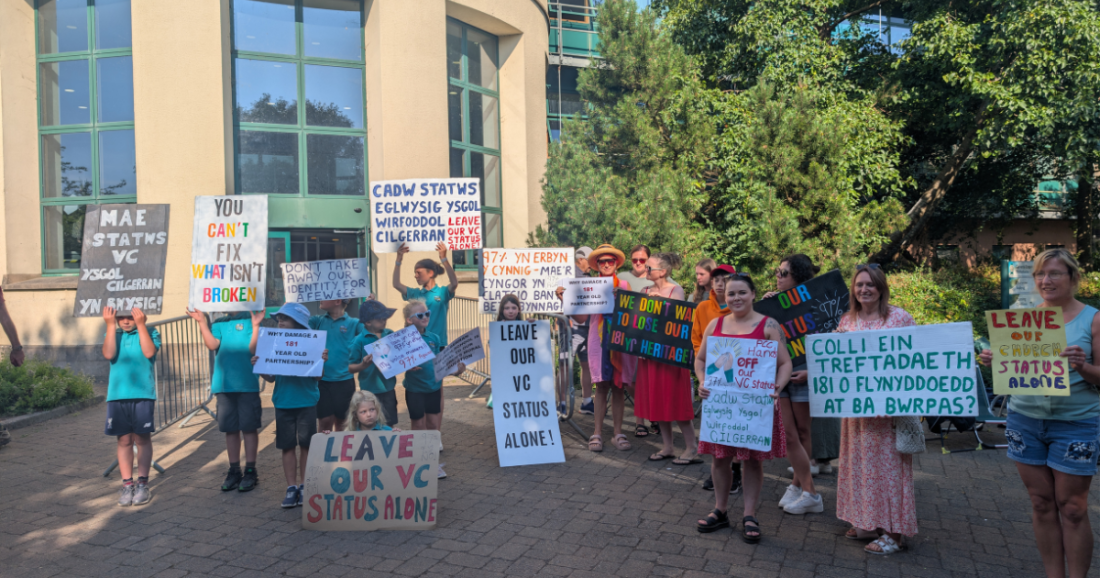
At the council’s July meeting, Cilgerran parents, teachers, and students travelled to County Hall, Haverfordwest to protest.
Their colourful protest signs, made by students, carried messages such as “You can’t fix what isn’t broken”, “Leave our VC status alone”, and “Don’t take away our identity for a few £££”.
One of the protesters, an ex-pupil and governor, Sarah Moore, has said: “I’m here today because I’m horrified that the council are talking about taking the church status away from our school. The church gave that land for the school over 180 years ago.
“97 per cent have voted against this and yet they’re still trying to do it. If we want our children to stay in a church school, the nearest one is Letterston. So where will these children have that good education that they are getting now?”
The Church has said it has deep concern about what it sees as a pattern of the council’s recent actions regarding Church Schools.
In June, councillors voted to close Manorbier Church in Wales Voluntary Controlled School, which was damaged by a fire in 2022.
It has also expressed concerns about VC status being lost for Tenby Church in Wales VC school after councillors backed a consultation on penitential education changes in the Tenby area.

Wales Humanists recently supported the council plans, writing to Pembrokeshire County Council expressing its support for the proposal “on behalf of the area’s substantial non-religious community”.
It says, according to the 2021 Census, almost half of people in Pembrokeshire identified as having no religion.
Since then, another secular group, The National Secular Society (NSS), has expressed its support for the council.
The NSS campaigns for publicly funded faith schools to be phased out, and for religiously selective admissions to be abolished.
Welcoming the move, the NSS praised the council’s “secular approach to education” as the “best means of ensuring publicly funded schools are equally welcoming to all children, regardless of their backgrounds”.
The NSS added: “Inclusive schools which educate pupils together are one of our best means of promoting community cohesion, whilst faith schools which divide children on the basis of religion and are entirely out of step with the irreligious and religiously diverse Wales of today.
“Schools we all pay for should be managed in the best interests of everyone, not used as a vehicle for the agenda of religious institutions.”

PEMBROKESHIRE is continuing to operate a “warn and inform” approach to tackling to dog owners bringing their pets to beaches where they are restricted, councillors heard.
Bylaws connected to restrictions on dogs on Pembrokeshire beaches are to come under the spotlight later this week in a series of questions to be heard at full council.
Traditionally running from May 1 to September 30, there are total bans on dogs at Tenby’s North Beach and Whitesands in St Davids.
Partial bans are in operation on parts of Lydstep, Newgale, Saundersfoot, Tenby Castle and South Beach, Amroth beach, Poppit Sands, Broad Haven North, and Dale.
There is also a voluntary dog restriction on the beach at Coppet Hall between 10am and 6pm.
Guide dogs are welcome on Pembrokeshire’s beaches all year round.
In a three-pronged series of submitted questions heard at the July meeting of Pembrokeshire County Council, Councillor Rhys Jordan asked for details surrounding dogs on beaches bylaws.
“Can the relevant Cabinet Member confirm where the operative beach dog bylaws, schedules, amendments and deposited plans are currently published, and whether all public-facing maps, signs and webpages accurately reflect the legal restrictions in force?
“Can the relevant Cabinet Member confirm who formally approved the council’s 2026 approach to beach dog restrictions, including any warning-led or ‘warn and inform’ approach, and who is currently authorised to enforce the byelaws following the end of WISE’s ([Waste Investigations Support & Enforcement)] involvement in enforcement for Pembrokeshire County Council?
“Given the lack of substantive response to requests for this information, the apparent difficulty in producing relevant and legal governance documents, and the need for residents and visitors to understand any legal restrictions with certainty, will the relevant Cabinet Member agree to suspend enforcement and active promotion of the 2026 beach dog restrictions until the byelaws, deposited plans, decision records and enforcement arrangements have been verified and published in one accessible location?”
Cllr Jordan has previously said he felt that “blanket bans” on some of the county’s beaches were “overly punitive on dog owners”.
Responding to the submitted question Cabinet Member for Residents Services Cllr Rhys Sinnett said the authority “remains satisfied the current restrictions continue to operate lawfully and doesn’t consider there to be grounds to suspend enforcement relating to these restrictions”.
He said, however, the council is reviewing enforcement implementation and wider authorisations as part of ongoing work relating to antisocial behaviour and public protection matters, adding the information was available on the council’s website.
In a series of supplementary questions, Cllr Jordan asked: “If a member of the public ignores dog beach restrictions today, what statutory enforcement will Pembrokeshire County Council take?”
Cllr Sinnett said the council was continuing a “warn and inform” approach as it had since the cessation of the WISE contract, adding: “Officers provide advice, guidance and warnings as a primary approach; for known or persistent offenders the authority retains the ability to utilise statutory measures such as community protection warnings or community protection notices.
“While breaches of a bylaw may result in a financial penalty it’s important to note this is not automatic and any decision will be proportionate and evidence-based; no Fixed Penalty Notices are being issued this season.”



News11 hours ago
Princess Royal celebrates Pembrokeshire craftsmanship at family-run weaving mill
A Pembrokeshire business that began after a mother grew tired of waiting three weeks for her children’s name tapes has...


Local Government11 hours ago
Burger King could be coming to Haverfordwest as plans submitted
Plans have been lodged for a Burger King outlet at the Morrisons petrol station on Bridge Meadow Lane BURGER KING...


Crime1 day ago
Murder investigation launched into death of Pembrokeshire man in 1991
A 67-YEAR-OLD man has been arrested on suspicion of murder after new potential evidence emerged in connection with a death...


Community1 day ago
‘Paying £29 to reach a cashpoint is absurd’: Narberth’s urgent ATM appeal
Residents, businesses and visitors are being urged to provide evidence after two High Street cash machines were removed, leaving the...


Crime2 days ago
Haverfordwest man jailed for seven years for historic rape and sexual assault of girl
A HAVERFORDWEST man has been jailed for seven years after being convicted of raping and indecently assaulting a girl during...


News2 days ago
Burnham more willing to listen on Welsh devolution, says First Minister
Rhun ap Iorwerth says he will press the new Prime Minister for powers over policing, railways and Wales’ natural resources...


Crime3 days ago
Women jailed after man chased through Milford home and attacked with knives
Kelly Rees receives further 27-month sentence while already serving prison term for notorious taxi robbery TWO women have been jailed...


Crime3 days ago
Mother headbutted and clawed police officers after threatening social worker
Court shown body-worn footage of violent confrontation at Goodwick property A COURT has been shown police body-worn footage capturing the...


Crime3 days ago
Man, 37, found dead following major police response in Pembroke Dock
Death not being treated as suspicious as police make statutory referral to IOPC following active investigation A 37-YEAR-OLD man has...

Community3 days ago
Household Cavalry drum horse returns home to Pembrokeshire for final farewell
Dyfed Willa Rose, who became Major Juno and the first mare to serve as a Household Cavalry Drum Horse, was...
-
Crime1 day ago
Murder investigation launched into death of Pembrokeshire man in 1991
-

 News9 hours ago
Burnham’s first week – what it means for Wales
-
Community1 day ago
‘Paying £29 to reach a cashpoint is absurd’: Narberth’s urgent ATM appeal
-

 Business1 day ago
Port of Milford Haven named among UK’s best workplaces for women
-

 Health1 day ago
Record summer waits expose deepening crisis in Wales’ A&E departments
-

 Community1 day ago
Green Flag flies at Manorbier Community Garden for first time
-
 Community2 days ago
Contentious DARC space radar scheme to be decided by Welsh Government
-

 Crime1 day ago
Jury retires in trial of man accused of attempting to murder former partner