


News
Why did Senedd vote against fair funding for Wales from HS2?


THE SENEDD recently voted down a motion demanding fair funding for Wales from the High-Speed Rail 2 (HS2) project, reigniting concerns over Westminster’s treatment of Welsh interests in major infrastructure investments. The decision has sparked frustration across political lines, particularly given the widely accepted view that Wales has been unfairly denied financial compensation for a rail scheme that provides no direct benefit to the country.
A flawed classification

The root of the controversy lies in HS2’s classification as an ‘England and Wales’ project, despite not a single mile of track being laid in Wales. This designation, originally justified by the Conservative UK Government on the grounds that HS2 would benefit North Wales via a link to Crewe, has deprived Wales of consequential funding under the Barnett formula. However, the scrapping of the Birmingham-Manchester leg of HS2 by former Prime Minister Rishi Sunak further undermined this justification, leaving many to question why Wales has continued to be excluded from receiving a fair share of funding.
While Scotland and Northern Ireland have received consequential funding from the HS2 project, Wales has been left without any direct financial benefit. Estimates suggest that Wales should have received around £4bn-5bn in consequential funding if HS2 had been correctly classified as an England-only project. However, recent recalculations by the Treasury have seen those figures fluctuate dramatically, with more recent estimates dropping to mere millions—a shift that suspiciously coincides with the arrival of a Labour government in Westminster.
Cross-party recognition of unfairness
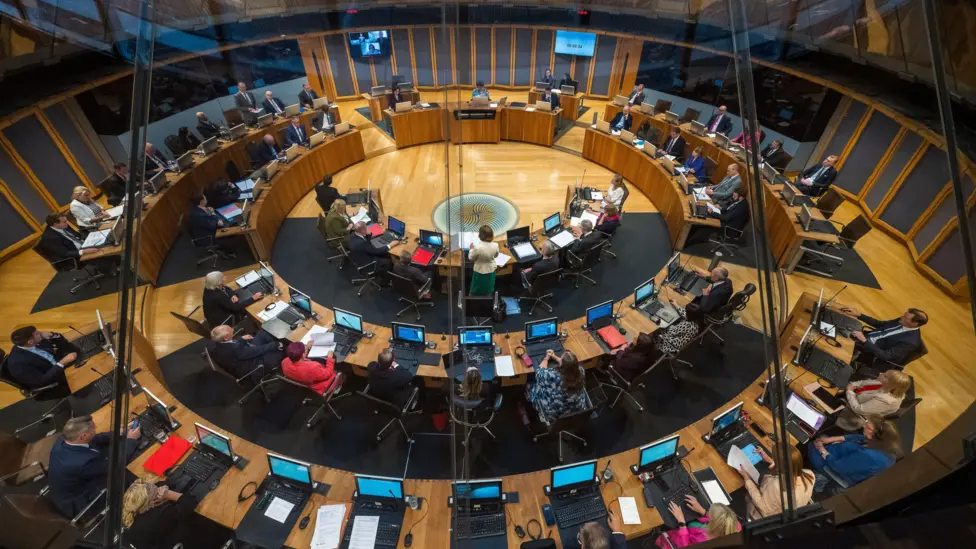
There is a broad political consensus in the Senedd that Wales has been shortchanged. In 2022, Welsh Conservative leader Andrew RT Davies broke ranks with his party to tell Boris Johnson that Wales was owed funding from HS2. Labour in Wales has long argued that the country has been systematically underfunded in rail infrastructure, and Plaid Cymru, alongside the Welsh Liberal Democrats, has also championed the cause.
Yet, despite this shared recognition of unfairness, when a motion was tabled in the Senedd this week demanding that HS2 be reclassified as an England-only project and that Wales receive its fair share of funding, both Labour and Conservative MSs voted against it.

Why did the motion fail?
The failure of the motion appears to be as much about political maneuvering as it is about policy disagreements.
The motion, proposed by Plaid Cymru, called for:
- Updated figures on the rail enhancement funding shortfall in Wales.
- A confirmation from the Welsh Government that HS2 should be reclassified as an England-only project.
- A formal request to the UK Secretary of State for Transport to release the full consequential funding to Wales.
However, Labour and Conservative MSs rejected the motion, with Labour opting instead to delete its contents entirely and replace it with a statement highlighting the supposed benefits of having a Labour government in Westminster. Several Welsh Conservative MSs indicated that they might have supported the motion if Plaid Cymru had not included language that criticised the previous UK Government’s unfulfilled pledge to electrify the North Wales Main Line. This suggests that party rivalries overshadowed any genuine attempt to secure additional funding for Wales.
Apathy and absenteeism in the debate
The broader issue at play is the growing sense of disengagement from Senedd members during opposition debates. The HS2 debate saw conspicuously low attendance from both Conservative and Labour MSs. Onlookers noted that only two or three Conservatives were present, while Labour benches had around seven members in attendance. Such poor participation, despite the significance of the topic, raises concerns about whether some MSs are taking their duties seriously.
Welsh Liberal Democrat MS Jane Dodds described the debate as “depressing,” noting that while all parties seem to agree that Wales has been shortchanged, they were unable to unify on the issue.
Labour’s dilemma: Party loyalty vs Welsh interests
The shift in Labour’s stance on HS2 funding is notable. Before Keir Starmer’s election as Prime Minister, Welsh Labour had been vocal in demanding fair funding for Wales. However, since the new UK Government took office, Labour MSs in Cardiff Bay appear to have softened their approach, likely to avoid disrupting relations with their Westminster counterparts.
This reluctance to push for what is widely acknowledged as a fair claim for Wales has led to accusations that party loyalties are being prioritised over the national interest. Labour backbencher Alun Davies, one of the few to go on record about the issue, acknowledged the problem, stating that while HS2 funding is a historic and ongoing issue, the real solution lies in the full devolution of rail infrastructure.

The bigger picture: Structural inequality in UK funding
At its core, the HS2 funding dispute highlights a deeper issue: Wales remains the only UK nation without full control over its rail infrastructure funding. Without these powers, Wales is at the mercy of UK Government decisions that consistently prioritise England’s transport needs while leaving Welsh infrastructure underfunded.
Even if Plaid Cymru’s motion had passed, the UK Government would still have had to be pressured into acting. However, the rejection of the motion sends a worrying signal that the Welsh political establishment is not willing to present a united front on an issue of major financial importance.
In the end, the Senedd’s decision to reject the motion is a stark reminder of how political maneuvering can obstruct meaningful progress. While MSs from across the political spectrum claim to support fair funding for Wales, when the opportunity arose to take a stand, party interests and political calculations took precedence. The failure to secure HS2 consequential funding is not just a financial injustice—it is yet another example of how Wales continues to be placed at the back of the queue when it comes to Westminster’s spending priorities.


SAMUEL Kurtz MS has welcomed more than £4.3 million in National Lottery funding awarded to community projects across Carmarthen West and South Pembrokeshire since 2021.
Figures released by The National Lottery Community Fund show that £4,318,484 has been distributed through 122 grants in the constituency since the 2021/22 financial year, the same year Mr Kurtz was elected.
The funding has supported a wide range of grassroots charities, voluntary organisations and community groups through programmes including National Lottery Awards for All, offering grants of up to £20,000, and People and Places, which provides larger awards of up to £500,000.
Projects backed locally include mental health support for young people, environmental and sustainability initiatives, community workshops, outdoor wellbeing activities, support for vulnerable adults, and programmes aimed at building skills and confidence.
Among the organisations to benefit is Pembrokeshire Coast National Park Authority, which received £343,584 for its Routes to Discovery project, helping improve mental and physical wellbeing through accessible outdoor activities.
St Davids Diocesan Council for Social Responsibility was awarded £398,078 to deliver its Plant Dewi: Strengthening our Communities initiative, supporting families and local groups.
Other recipients include The VC Gallery, Redberth Croft CIC, The Tenby Project CIC and Neptune’s Army of Rubbish Cleaners, with funding supporting projects ranging from food initiatives and nature-based wellbeing to volunteering and environmental action.
Mr Kurtz said: “Community groups and charities across Carmarthen West and South Pembrokeshire do incredible work supporting people and strengthening local communities.
“It is fantastic to see more than £4.3 million of National Lottery funding invested in projects that are improving wellbeing, tackling isolation and creating opportunities for people of all ages during my time in office.
“The voluntary sector plays a vital role in our area, and this funding is helping organisations deliver projects that bring people together and make a real difference to people’s lives.”
The National Lottery Community Fund is the largest funder of community activity in Wales, supporting initiatives that bring communities together, promote environmental sustainability, help children and young people thrive, and improve health and wellbeing.
Organisations across Wales can apply for funding through the Awards for All and People and Places programmes to support projects that matter most to their communities.

Further information is available on The National Lottery Community Fund website.

A NEW national framework aimed at securing a lasting legacy from the National Eisteddfod has been published jointly by the festival’s organisers and the Welsh Government.
The plan sets out how the Eisteddfod’s impact will be strengthened before, during and after each annual event, bringing together partners from across education, community development, culture, the economy and the Welsh language sector.
While each Eisteddfod reflects the identity of its host community, the framework aims to ensure long-term benefits are consistently delivered nationwide, rather than limited to the festival period.
The legacy programme will cover a wide range of areas including education, inclusion, digital innovation, volunteering and economic development, with new national and local structures designed to coordinate delivery more effectively.
A national project board will oversee the strategy, setting direction and sharing best practice year-on-year. At a local level, a steering group will drive community-based work, helping turn the Eisteddfod into a catalyst for lasting change.

Cabinet Secretary for Finance and the Welsh Language, Mark Drakeford said the festival’s impact goes far beyond a single week.
“The Eisteddfod is far more than a week-long festival. It is a multi-year project that leaves a lasting legacy for the Welsh language and culture in the area,” he said.
“By bringing together partners from across key sectors, this framework will help deliver real and lasting change for our communities and support our ambition of reaching a million Welsh speakers by 2050.”
Nic Parry, President of the Eisteddfod Court and Chair of its Management Board, said the framework strengthens collaboration at both local and national level.

“It allows us to deliver on a long-held ambition to drive language planning through the lens of the National Eisteddfod,” he said.
“It also positions the Eisteddfod as a powerful tool for boosting local economies and supporting sustainable communities for future generations.”
Further details are expected later this year, with membership of the national project board due to be confirmed by mid-June.

A dedicated session at this year’s Eisteddfod will also gather evidence from the 2026 host area to help shape future plans for 2027 and 2028.
More information is available via the Eisteddfod’s legacy framework online.
Tributes pour in for former Neyland officer remembered as a “true gentleman” and “local legend”
A FORMER Neyland police officer remembered as a “true gentleman” and “local legend” has died at the age of 83, prompting an outpouring of tributes from across Pembrokeshire.
Louis Knight, of Neyland Hill, Neyland, passed away peacefully at Withybush Hospital, Haverfordwest on Thursday (Mar 5).
Mr Knight, who served as a police officer in the area for many years, was a familiar and respected figure in Neyland and beyond. In the hours following the announcement of his death, hundreds of messages flooded social media, painting a picture of a man whose impact stretched far beyond his time in uniform.
Many described him simply as “one of the best,” while others called him “a proper local legend” and “a tremendous police officer.”
One resident wrote: “A face and name I will never forget from my youth.”
Another said: “He was a tremendous police officer… a kick up the backside and a word was enough. It stayed with you.”
Others remembered his warmth and humour away from policing.
“He always had a story to tell on the way home in the taxi,” one tribute read, while another added: “Every time you asked him how he was, the answer was always ‘bloody marvellous.’”
Many spoke of his kindness and the time he gave to people.

“Louis was one of the most kindest gentlemen around. Always made time to chat,” one message said.
Another added: “Neyland won’t be the same again.”
While some reflected fondly on a different era of policing, what came through most strongly was the respect Mr Knight earned within his community — something repeatedly highlighted in tributes from those who knew him as children, neighbours, and later as adults.

Mr Knight was the beloved husband of the late Angela, devoted father of Andrew and Alison, and adored father-in-law of Frank. He was also a loving grandfather to Michelle and Laura, and a cherished brother of Jennifer, Charles and Richard.
His family said he was loved dearly and will be greatly missed by all who knew him.
The funeral service will take place on Wednesday (Apr 1) at 11:30am at Parc Gwyn Crematorium, Narberth.
Family flowers only. Donations in memory of Louis, if desired, are for Ward 8 at Withybush Hospital and may be sent directly to the ward at SA61 2PZ.
All enquiries to Tom Newing & Sons Ltd, Funeral Directors, Dartmouth Street, Milford Haven (01646 693180).
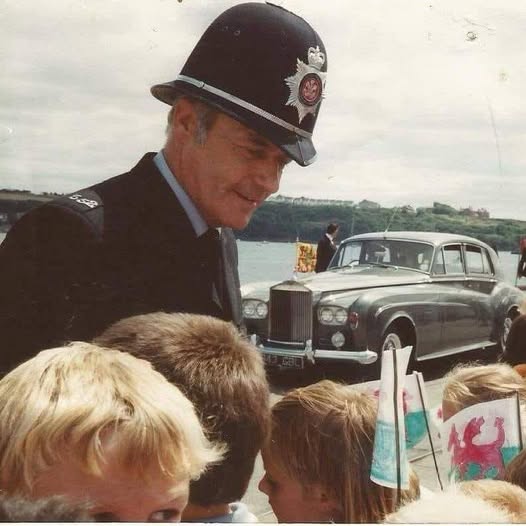
Photo caption:
PC Louis Knight pictured during a Royal Visit, engaging with local children — a familiar sight in Neyland for many years (Pic: Supplied).


Education11 hours ago
Milford Haven school plans unveiled but funding not yet secured
PLANS for a new £100 million school in Milford Haven have been unveiled, but the project has not yet secured...


News11 hours ago
Council unveils plans for new state-of-the-art secondary school in Milford Haven
PEMBROKESHIRE COUNTY COUNCIL has revealed plans for a new state-of-the-art school in Milford Haven, promising modern, inspiring learning spaces for...


Health14 hours ago
NHS waiting list falls — but cancer delays and diagnostic backlog worsen
Record progress claimed by Welsh Government as critics warn key targets are still being missed THE NHS in Wales has...


Crime2 days ago
Rapist jailed after ‘abhorrent’ attacks on woman and children
Haverfordwest man told police “women won’t have sex without force” A HAVERFORDWEST man who raped a woman and a young...


News2 days ago
Reform secures first Pembrokeshire councillor in Hakin by-election win
Late Reform candidate takes seat as independent surge and Labour withdrawal shape contest REFORM UK candidate Scott Thorley has won...

News2 days ago
Scott Thorley elected as Pembrokeshire’s first Reform councillor
REFORM UK candidate Scott Thorley has won the Hakin by-election after securing 179 votes. The full result is as follows:...


News2 days ago
Police confirm man has died after being recovered from River Cleddau
Major emergency response in town centre after concerns raised for man in water A MAN has died after being recovered...

Community2 days ago
Davies and Kurtz urge groups to seek employability funding
Community organisations in Pembrokeshire encouraged to apply for new grants supporting skills and job access LOCAL Senedd Members Samuel Kurtz...


News2 days ago
Emergency services flood Haverfordwest after reports of person in river
Town centre sealed off as multi-agency response continues A MAJOR emergency response is underway in the centre of Haverfordwest after...


News3 days ago
Detectives receive surge of new information in bid to identify man found at Powys reservoir
Public response follows release of facial image as officers pursue fresh lines of enquiry DETECTIVES investigating the identity of a...
-

 Health7 days ago
Welsh Ambulance Service to host bi-monthly Board meeting
-
 News6 days ago
Rayner and Lammy visit Wales to discuss justice and community safety
-
 News5 days ago
Fishguard linked to allegations in Many Tears Animal Rescue investigation
-
News2 days ago
Emergency services flood Haverfordwest after reports of person in river
-
 Local Government6 days ago
Investigation confirmed after inspectors visit Many Tears Animal Rescue
-

 Community7 days ago
Local charity hosts cancer awareness event in Cardigan
-

 Farming7 days ago
Plea to remove decades old ‘unviable’ planning conditions from property
-
 Business7 days ago
Work set to begin on £50m hydrogen plant in Milford Haven