


Entertainment
Challenging the traditional telling of Welsh Patagonia’s story


THE ROMANTIC story of the Welsh people who settled in Patagonia over a century ago is challenged in a new book, revealing a darker side to the establishment of Y Wladfa.
Written by Aberystwyth University academic Dr Lucy Taylor, Global Politics of Welsh Patagonia draws on archival sources in Spanish, Welsh and English to disrupt the myth that the relationship between the Welsh and the Indigenous people was built solely on friendship and harmony.
The publication brings in the voices of the Tehuelche and Mapuche people, and foregrounds unfamiliar accounts of the role the Welsh pioneer settlers played in Argentina’s nation-building project in the second half of the nineteenth century.
Dr Taylor, a Senior Lecturer in the Department of International Politics who specialises in Latin American studies, says the aim of the book is to present a more rounded version of the history and reveal just how complex settler colonial relationships can be.
“The establishment of a Welsh colony in Patagonia in 1865 is familiar to everyone in Wales. It was a courageous, heroic endeavour in many ways, driven by anti-colonial resistance at home, but it also saw the Welsh become agents of colonisation,” says Dr Taylor.

“In a contemporary Wales seeking to promote anti-racist policies, I believe the time has come for a candid reappraisal of what can be considered the darker side of Y Wladfa and to re-examine conventional narrative through a decolonial lens.”
The book makes it clear that the Welsh did not use physical violence during the settlement process and says their policy of peaceful engagement has often been celebrated and romanticised, especially when drawn in contrast to the use of physical force by ‘English’ and British imperial colonisers in other parts of the world.
“As a result, Y Wladfa has not only been viewed as legitimate, it has been deployed as an asset, contributing to Welsh strategies for cultural resistance and social renewal back home,” according to Dr Taylor.
“Yet Y Wladfa was undeniably fundamental to Argentina’s nation-building project and, while the Welsh pioneer settlement might have had its own agenda, it was also a key factor in the Argentinian Government’s campaign at that time to dispossess the Indigenous people of their lands, and assert their own sovereignty and capitalist modernity.
“My book invites readers to think beyond the conventional stories so familiar to us all, to listen to the voices of Indigenous people from the past and to consider Wales’s complex position as both colonised at home and coloniser in Pagatonia.”
Dr Taylor hopes her research will help inform the new history curriculum in Wales as well as contribute to wider discussions around decolonisation and anti-racism.
Global Politics of Welsh Patagonia (University of Wales Press, 2025) will be launched at the National Library of Wales at 7pm on Wednesday 2 April when Dr Taylor will be in conversation with Emeritus Professor Paul O’Leary from Aberystwyth University’s Department of History and Welsh History. Tickets are available free of charge online but booking is essential.



Colourful parade, towering creations and Victorian flair bring town centre to life
TENBY was transformed into a vibrant Victorian fantasy on Saturday (Mar 21) as hundreds of visitors descended on the town for the annual Steampunk Festival.
The highlight of the day came with the much-anticipated Peacock Parade, which saw elaborately dressed participants wind their way through Tenby’s narrow streets, drawing large crowds of spectators.

Residents and visitors lined the route, many stopping to take photos as performers in eye-catching costumes passed by. From brass goggles and top hats to military-inspired uniforms and elegant gowns, the outfits on display reflected the creativity and theatrical spirit of the steampunk scene.
Among the most striking sights were the towering pink flamingo creations, which rose high above the crowds and became an instant talking point. Musicians in period costume added to the atmosphere, playing lively tunes as they marched through the town.
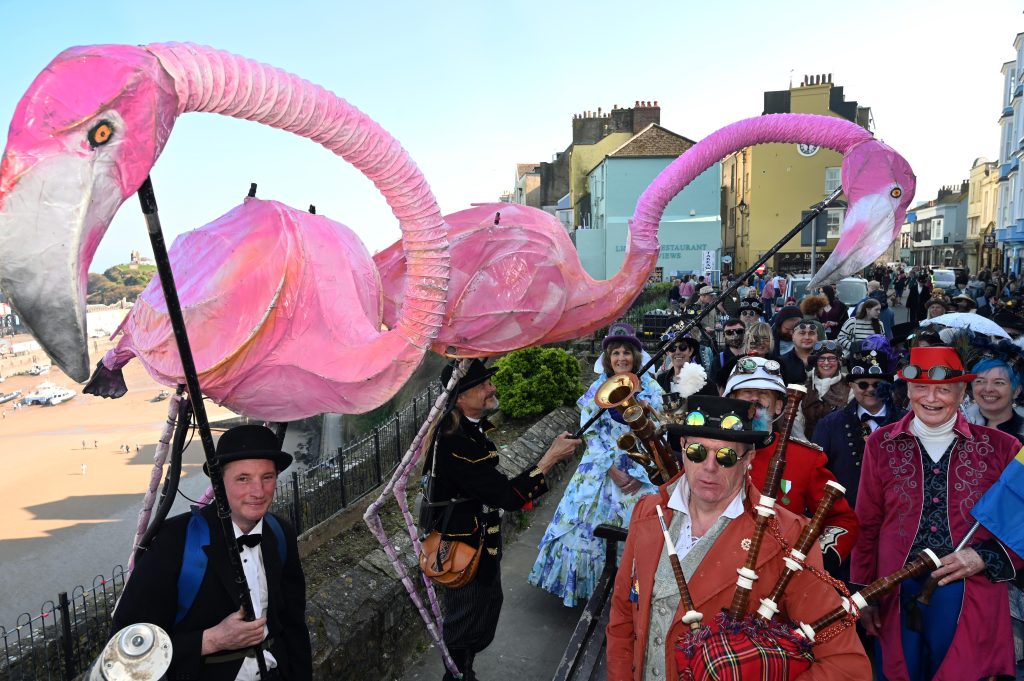
Families were out in force, with children and adults alike enjoying the spectacle. Many visitors had travelled from across Wales and beyond to attend the event, which has grown in popularity in recent years and is now firmly established as a key date in Tenby’s events calendar.

The Herald understands that local businesses also benefited from the influx of visitors, with cafés, pubs and shops seeing a steady flow of customers throughout the day.
In addition to the parade, a range of activities were taking place across the town, including markets, performances and themed entertainment centred around the De Valence Pavilion.
Organisers have worked to create an inclusive and welcoming event, with many people choosing to dress up while others simply come along to enjoy the unique atmosphere.
The festival continues on Sunday, with further events planned as Tenby remains firmly in the grip of steampunk fever for the weekend.

Photos: Colourful characters take part in the Peacock Parade through Tenby on Saturday (Pic: Gareth Davies).
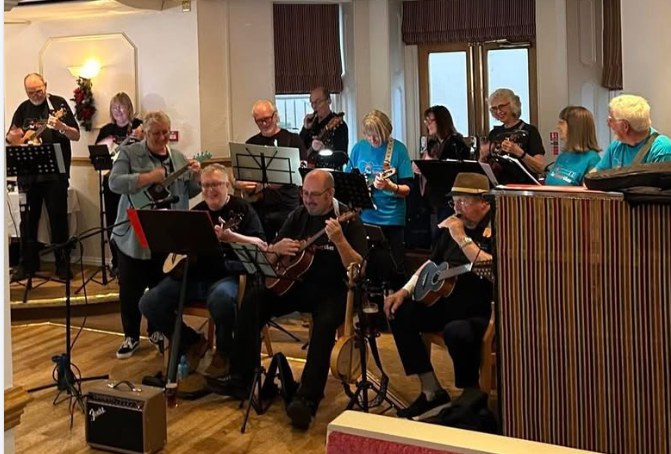
GET ready to celebrate St Patrick’s Day in style this Friday at the Giraldus Centre in Manorbier.
The community venue is hosting a lively evening of music, dancing and Irish-themed fun, with entertainment from popular local group The Slipway Ukes.
Doors open at 7:00pm on Friday (Mar 20), with free entry for all. A fully licensed bar will be open throughout the evening, serving drinks and snacks with an Irish twist.
Organisers are encouraging everyone to “unleash their inner leprechaun” and enjoy a night on the dance floor.
There is no need to book—just turn up and join in.
Donations on the night will be gratefully received in support of the Paul Sartori Foundation.
The event takes place at the Giraldus Centre, Manorbier, SA70 7TN.

Lise Davidsen leads star cast in Wagner’s epic tale of love and death in special cinema broadcast on Sunday (Mar 22)
AFTER years of anticipation, a truly unmissable event arrives in cinemas worldwide as the electrifying Lise Davidsen takes on one of the ultimate roles for dramatic soprano – the Irish princess Isolde – in Wagner’s transcendent meditation on love and death, Tristan und Isolde.
Heroic tenor Michael Spyres stars opposite Davidsen as the love-struck Tristan in what promises to be a powerful and emotionally charged performance.
The production also marks the arrival of a new staging at the Metropolitan Opera by Yuval Sharon, making his Met debut. Sharon has been hailed by The New York Times as “the most visionary opera director of his generation” and was the first American to direct an opera at the famous Wagner festival in Bayreuth.
Music Director Yannick Nézet-Séguin also leads Tristan und Isolde at the Met for the first time in this landmark production.
The cast includes mezzo-soprano Ekaterina Gubanova reprising her acclaimed portrayal of Brangäne, alongside bass-baritone Tomasz Konieczny as Kurwenal following his celebrated Met appearances in Wagner’s Der Fliegende Holländerand the Ring cycle. Bass-baritone Ryan Speedo Green makes an important role debut as King Marke.
Reviewing the production for The Observer, Fiona Maddocks described it as a “glorious production” and “well worth catching”, adding: “This was one of those rare and blissful nights when dropped jaws silenced noisy opinion in the queue for coats afterwards.”
The recorded broadcast of Tristan und Isolde will be screened at the Torch Theatre on Sunday (Mar 22) at 4:00pm.
For further information visit www.torchtheatre.co.uk or contact the Box Office on (01646) 695267.
ENDS



Community5 hours ago
Broad Haven volunteers secure ‘national asset’ status for nature reserve
A SMALL stretch of woodland and former opencast coal mine has been transformed into a nationally recognised biodiversity site, in...


Entertainment1 day ago
Tenby steams up in spectacular style as crowds flock to festival
Colourful parade, towering creations and Victorian flair bring town centre to life TENBY was transformed into a vibrant Victorian fantasy...


Crime2 days ago
Publican jailed for six years for supplying cocaine and cannabis
Milford Haven man sentenced at Swansea Crown Court following drug dealing operation A MILFORD HAVEN publican has been jailed for...

Local Government2 days ago
Poverty summit highlights support efforts across Pembrokeshire
A SUMMIT bringing together key organisations from across Pembrokeshire has highlighted both the scale of local poverty and the work...


Education3 days ago
Milford Haven school plans unveiled but funding not yet secured
PLANS for a new £100 million school in Milford Haven have been unveiled, but the project has not yet secured...


News3 days ago
Council unveils plans for new state-of-the-art secondary school in Milford Haven
PEMBROKESHIRE COUNTY COUNCIL has revealed plans for a new state-of-the-art school in Milford Haven, promising modern, inspiring learning spaces for...


Health3 days ago
NHS waiting list falls — but cancer delays and diagnostic backlog worsen
Record progress claimed by Welsh Government as critics warn key targets are still being missed THE NHS in Wales has...


Crime4 days ago
Rapist jailed after ‘abhorrent’ attacks on woman and children
Haverfordwest man told police “women won’t have sex without force” A HAVERFORDWEST man who raped a woman and a young...


News5 days ago
Reform secures first Pembrokeshire councillor in Hakin by-election win
Late Reform candidate takes seat as independent surge and Labour withdrawal shape contest REFORM UK candidate Scott Thorley has won...


News5 days ago
Scott Thorley elected as Pembrokeshire’s first Reform councillor
REFORM UK candidate Scott Thorley has won the Hakin by-election after securing 179 votes. The full result is as follows:...
-

 News5 days ago
Emergency services flood Haverfordwest after reports of person in river
-

 Crime4 days ago
Mother given community order after admitting child cruelty offence
-
Health3 days ago
NHS waiting list falls — but cancer delays and diagnostic backlog worsen
-

 News5 days ago
Senedd vote to ban greyhound racing hailed as ‘landmark moment’ by charities
-
News5 days ago
Reform secures first Pembrokeshire councillor in Hakin by-election win
-
 News5 days ago
Senedd votes to ban Greyhound racing in Wales to protect animal welfare
-

 Crime4 days ago
Woman stole from pharmacy despite ban, court hears
-

 News6 days ago
£3.8m to help Welsh families struggling with soaring heating oil costs