


Community
‘Landmark’ homelessness bill ‘a missed opportunity’


SENEDD Members welcomed a bill aimed at ending homelessness in Wales but warned of missed opportunities to support veterans, prisoners and those discharged from hospital.
Jayne Bryant gave a statement on the introduction of the homelessness bill which aims to increase access to services and prioritise social housing for those most in need.
With around 11,000 people currently housed in emergency temporary accommodation, Wales’ housing secretary told the Senedd: “Across Western Europe and beyond, homelessness poses an escalating and urgent challenge.
“It is a devastating and pervasive issue. It shortens lives and isolates people from their communities. It impacts people’s health, mental wellbeing, people’s ability to engage in work or with the economy, or indeed on educational outcomes.”
Ms Bryant, who is also responsible for councils, said the pandemic revealed a hidden homelessness need, placing unsustainable pressure on households and services.

“This is why reform is absolutely necessary,” she said, describing the “landmark” bill as an important step towards a bold vision of a Wales free from homelessness.
She explained that the bill, “which is rooted in evidence and experience”, will move away from a system that responds to crises to one focused on early identification and prevention.
She said the priority need and intentionality tests for homelessness support – which have been criticised as “unjust and immoral” for setting a high threshold – will be abolished.
Ms Bryant was particularly proud of a new duty in the bill on councils to take reasonable steps to secure suitable accommodation for young people transitioning from care.

“These reforms are ambitious,” she said. “They have to be to match the scale of the challenge. They will take time to implement. This is not a quick fix.”
Laura Anne Jones, the Conservatives’ shadow housing secretary, broadly welcomed the “much-needed” reforms, particularly the commitment to care leavers.

But she expressed concerns about ministers not taking forward proposals to specifically support those leaving hospital or custody – “two of the most high-risk groups”.

“Ignoring these proposals misses a vital opportunity for a joined-up approach,” she warned.
Ms Jones asked: “What message does that send, that support for people leaving NHS care or prison has been dropped from our most significant homelessness reforms in years?”
She added: “While we support these reforms, let’s not pretend they solve the deeper crisis that we face… the chronic shortage of social housing in Wales.”
She called for radical levels of investment to deliver desperately needed housing, pointing out that the Welsh Government is set to miss its target of 20,000 social homes by 2026.
Ms Jones raised concerns about an Audit Wales report, which suggested between £580m and £740m extra could be required to deliver on the target.
Calling for an exemption, she warned that the local connection test for support could discriminate against veterans who may not live near family nor friends.
“We all owe them a debt, not just local communities,” she said, pointing out that the UK Government removed the local connection rule for veterans in England.
Ms Bryant argued that ensuring nobody is discharged from hospital into homelessness can best be achieved by using existing mechanisms rather than creating a new duty.
She said guidance will be introduced to stop people being discharged onto the streets or stuck in hospitals due to a lack of suitable housing.
Ms Bryant agreed the bill must be underpinned by an increased supply of social homes, with a record £2bn set to be invested from 2021 to 2026.
Turning to veterans, she said the bill provides powers for ministers to reconsider certain elements including problems associated with the local connection test.
Ms Bryant told the Senedd her officials are working on regulations to stop veterans being “pushed down the list for social housing just because they do not have a local link”.
The bill was part of the now-collapsed cooperation agreement between the Welsh Government and Plaid Cymru in return for support to pass budgets.
Siân Gwenllian, Plaid Cymru’s shadow housing secretary, welcomed the trauma-informed, person-centred approach taken in the bill.

She said: “We have to confront the situation… because the figures on homelessness today are truly staggering. There are more than 11,000 people in temporary accommodation, including over 2,600 and 400 children living in B&Bs or hotels.
“At the moment, we are letting the most vulnerable people down – with one in four young care leavers homeless, so I am pleased to see this bill focusing on those at particular risk.”
Warning of a lack of social housing, Ms Gwenllian told the Senedd: “You as a government have to recognise that you have entirely failed to meet your own targets.”
Ms Bryant stressed: “Legislation alone can’t end homelessness… we do recognise that supply and social housing has a really important role to play.”
Closing her statement on May 20, the Labour minister said: “This is a government that cares about the future of Wales – a future where homelessness is confined to the history books. These reforms take us closer to realising that vision.”



A RECORD number of young musicians from across Pembrokeshire took part in this year’s Valero Primary Music Festival, with nearly 600 pupils showcasing their talents.
The event, organised by Pembrokeshire Music Service, was held at Ysgol Caer Elen on Saturday (March 14), drawing a large and enthusiastic audience.
The festival’s overall winner was Hafan y Môr pupil Carys Meiring, who impressed judges with a standout trombone performance of Let’s Call the Whole Thing Off. She had earlier secured victory in the open brass class.

Young talent shines
The afternoon Spotlight concert opened with an energetic performance from the county’s Second Steps ensembles, bringing together young players from across Pembrokeshire.
Winners from the day’s open classes also took to the stage, highlighting the depth of musical talent across local schools.

Osian Kite, of Roch CP School, won the open woodwind class with a performance of Sentimental Serenade on alto saxophone.
Cadi Marshall-Jones, from Ysgol Bro Preseli, claimed the open piano and harp title with Over the Sea to Skye, while Roch CP School cellist Mari Broomfield won the open strings category with Vamoose.
In percussion, Ysgol Caer Elen’s Aled Hooper secured first place in the open class with a drum kit performance of Are You Gonna Go My Way.
The open ensemble prize went to Tavernspite pupils Finn Hickman and Evelyn James, whose piano duet of Handel’s Passacaglia impressed both judges and audience.
Building confidence through music
Head of Pembrokeshire Music Service, Philippa Roberts said the festival continues to play a vital role in developing young performers.
She said: “Pembrokeshire Music Service is proud to deliver the Valero Music Festival, offering an exciting opportunity to nearly 600 young performers from across the county.
“Providing children with the chance to perform, shine, and receive supportive feedback from professional musicians is incredibly powerful and helps build lasting confidence.

“In line with the Music Plan for Wales, we remain committed to creating meaningful musical experiences for children throughout Pembrokeshire. Our sincere thanks go to Valero for their fantastic support.”
The festival forms part of a wider effort to promote music education across Wales, encouraging participation and nurturing the next generation of performers.
Photo caption:
Talented performers: Overall winner Carys Meiring is pictured with fellow category winners and organisers (Pic: Pembrokeshire Music Service).

NEARLY £1 million has been secured to strengthen marine biosecurity across the Milford Haven Waterway in a major new environmental initiative.
The Aberdaugleddau Biosecurity Community Development (ABCD) project has been awarded £959,180 from the Nature Networks Fund, delivered by the Heritage Fund on behalf of the Welsh Government. The three-year scheme aims to combat the growing threat of invasive non-native species and protect one of Wales’ most important marine ecosystems.
The project will introduce a coordinated, waterway-wide approach, combining new infrastructure with training, monitoring and public awareness campaigns.
Washdown facilities key focus
A central part of the scheme will see new vessel washdown facilities installed at boatyards around the waterway. These are designed to prevent biofouling – the build-up of organisms on hulls – which is a major pathway for invasive species entering and spreading in local waters.
By capturing and safely managing waste from thousands of vessel cleanings, the project aims to significantly reduce the risk of harmful species re-entering the marine environment.

Boatyard staff will also receive specialist training, while water users will be given targeted guidance alongside bilingual materials promoting the “Check Clean Dry” campaign.
Cutting-edge monitoring
The initiative will also utilise advanced monitoring techniques, including environmental DNA (eDNA), allowing experts to detect invasive species earlier and respond more effectively.
The work supports the Pembrokeshire Marine Special Area of Conservation Biosecurity Action Plan and builds on previous studies carried out by environmental consultants.
Leaders welcome funding
Tom Sawyer, Chief Executive of the Port of Milford Haven, said: “We are absolutely delighted to be leading this important partnership project alongside some great partner organisations.

“The Milford Haven Waterway is central to our communities, economy and natural heritage, and invasive non-native species pose a growing threat to its ecological health.
“This funding allows us and our partners to put sector-leading biosecurity measures in place, supporting local businesses while safeguarding the marine environment for the long term.”
Sue Burton, Pembrokeshire Marine SAC Officer, added: “This project tackles one of the top five drivers of global biodiversity loss.

“Reducing the introduction and spread of invasive species requires collective action, and this collaborative, waterway-wide approach is exactly what is needed.”
Wide partnership involved
The ABCD project will run from April 2026 to March 2029 and involves a broad partnership including the Port of Milford Haven, Dale Sailing, Rudders Boatyard, East Llanion Marine, Lawrenny Yacht Station and Mainstay Marine Solutions.
It will also work closely with Natural Resources Wales, the RYA’s Green Blue programme, the GB Non-Native Species Secretariat and local water users.
The scheme is expected to leave a lasting legacy through improved infrastructure, increased awareness and stronger collaboration in tackling marine invasive species.
Photo caption: New washdown facilities will be installed at boatyards across the Milford Haven Waterway (Pic: Rudder’s Boatyard).

A GROUP of former colleagues from a Welsh steelworks are celebrating after scooping £1 million in the EuroMillions draw — a win that has brought them back together after years apart.
The 15-strong syndicate, made up of ex-finance staff at Tata Steel, landed the prize in the draw on Friday (Feb 27) after matching the Millionaire Maker code.
What began as a light-hearted workplace tradition has turned into a life-changing windfall — and a long-overdue reunion.
The group, dubbed the “Tata Steel Syndicate”, first started playing during long shifts in the finance department, pooling £5 each whenever the jackpot climbed above £100 million.
Even after leaving the company, members kept the tradition alive — staying in touch through emails, the occasional pint, and the hope that one day their numbers would come in.
That moment finally arrived when syndicate leader Paul Davy, aged 61, spotted the winning code.
He said: “I couldn’t believe it — a message just popped up on the app.
“I was checking Saturday’s draw when I saw the notification. I thought it must be an error, but then I saw the Millionaire Maker code. I was in complete shock.”
Paul, who has managed the syndicate for seven years, said he always treated the lottery as “a bit like donating to charity — with the chance of winning as a bonus”.

Now, the win is set to fund a host of dreams across the group, from clearing mortgages to once-in-a-lifetime holidays.
For Paul, that includes another cruise — despite initial nerves on his first.
He said: “My partner didn’t like the idea of boats at first, but we absolutely loved it. So another cruise is definitely on the cards — maybe the Mediterranean this time.”
While some members have stayed in touch over the years, the full group has not met up in person for a long time.
“This win has given us the perfect excuse to celebrate together properly,” Paul added.
Among those sharing in the prize are Gill Furlong, Christine Davies, Sally Wise, Julie Lambert, Allan Evans, Ian Howells and Raja Prasad.
The syndicate members — many of whom still live locally — are now planning how to spend their share, with priorities including home improvements, new cars, and helping family and friends.
The ticket was played via The National Lottery app, with the group winning through the EuroMillions Millionaire Maker draw.


Charity10 hours ago
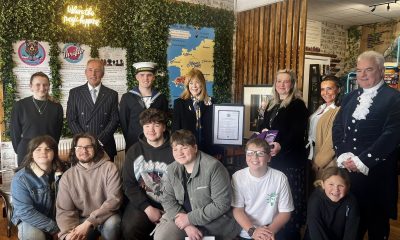
Milford Haven charity honoured with King’s Award for voluntary service
A PEMBROKESHIRE charity supporting vulnerable young people has received one of the highest honours in the UK for voluntary work....


News1 day ago
Plaid Cymru launches bid to lead next Welsh Government
Party positions itself as ‘government-in-waiting’ ahead of May election PLAID CYMRU has formally launched its campaign for the 2026 Senedd...


Crime1 day ago
Police appeal after attempted child abduction in Haverfordwest
DYFED-POWYS POLICE has launched an appeal for witnesses following a reported attempted abduction of a 12-year-old girl in Haverfordwest. The...


Crime2 days ago
Gunshot fired by police during incident in Milford Haven
A POLICE officer discharged a firearm during an incident in Milford Haven on Saturday evening (March 28), prompting an investigation...


Community3 days ago
Three Amigos Easter Run roars through Pembrokeshire
MOTORCYCLE enthusiasts turned out in force today (Saturday, March 28) as the popular Three Amigos Easter Run returned to the...


Education5 days ago
Ysgol Henry Tudor reassures parents over Sikh ceremonial kirpan
School says religious item worn by pupil is secured, symbolic and non-functional YSGOL HENRY TUDOR has moved to reassure parents...


Crime5 days ago
Teen jailed after starting fire while others slept
Fire set in shared home left sleeping residents at risk and caused £130,000 damage A TEENAGER who started a fire...


Health5 days ago
GP crisis driving NHS pressure in Wales, Senedd report warns
Falling GP numbers and funding gaps blamed for worsening hospital delays THE NHS crisis highlighted earlier this week is being...


News6 days ago
Reform reveals west Wales candidates for Senedd battle
Monkton councillor tops Pembrokeshire list as party confirms Carmarthenshire names and includes Haverfordwest councillor in unwinnable Swansea spot REFORM UK...


Health6 days ago
Clash over Withybush Hospital services as Paul Davies challenges First Minister
A HEATED exchange in the Senedd has laid bare growing tensions over the future of hospital services in west Wales....
-

 News6 days ago
Welsh Government outlines progress on flood resilience plans
-

 Community5 days ago
Hero female officer keeps job after sexual touching finding
-
Education5 days ago
Ysgol Henry Tudor reassures parents over Sikh ceremonial kirpan
-

 Business5 days ago
Popular Italian restaurant hit with £278,000 tax bill plus £186,000 fine
-
Health6 days ago
Clash over Withybush Hospital services as Paul Davies challenges First Minister
-

 Crime6 days ago
Hakin motorist banned after drink-drive crash
-

 Sport6 days ago
Record-breaking disability swim gala celebrates success in Fishguard
-

 Health6 days ago
Doctors say Wales is failing to value NHS staff over new pay award