


Community
Council could force long-term empty Pembrokeshire home sales


A CALL for Pembrokeshire councillors to back potential enforced sales of problem long-term empty properties in the county has been put on hold as the paperwork was not 100 per cent complete.
At Pembrokeshire County Council’s Policy and Pre-Decision Overview and Scrutiny Committee of June 10, members were asked to recommend the council’s Cabinet approve an Enforced Sales Policy and Procedure for Long Term Problematic Empty Properties.
In Pembrokeshire, long-term empty properties and second homes pay a premium on council tax rates.
Second homes in Pembrokeshire have a council tax premium of 150 per cent above the standard rate, while long-term empty properties are now charged at a 300 per cent premium for those empty over two years, replacing a more complicated sliding scale rate used previously.
A report for members at the June meeting said: “A principal motivation for producing this policy is to improve the ability to deal with empty properties and create new homes. An additional consideration, however, is that it will also have wider corporate benefits in relation to aiding in the regeneration of commercial empty properties, debt recovery for outstanding works and court costs which can be significant in relation to works that may need to be carried out.”

It said, as of April 2023, there were around 1,000 residential properties in Pembrokeshire which had been empty for six months or more, along with “numerous empty non-residential properties that also remain empty for significant periods of time thus contributing to potential detriment to the amenity and appearance of our communities”.
It added: “Long-term empty properties are considered a waste of a valuable resource which could be added to the pool of much-needed housing in the county. They can also frequently become blights to neighbourhoods by becoming targets for antisocial behaviour, trespass, vandalism and arson.
“Pembrokeshire County Council wishes to work with the owners of empty properties to encourage them to bring their properties back in to use, and to provide information and advice on the assistance schemes available to owners of long-term empty properties, both residential and commercial.
“There is opportunity also to bring empty commercial buildings back into use through conversion into residential or improvement for re-use for non-residential purposes.”

It went on to say that legislation available would be used to deal with problematic long-term empty properties, and to recover outstanding debts which have been placed as land charges in “circumstances where the present owner is either unwilling or unable to comply with legal notices issued by the council, or the ownership is unknown whereby works in default have had to be undertaken on properties and a legal charge lodged to reclaim this charge”.
“Pembrokeshire County Council will consider the appropriateness of pursuing an enforced sale as part of a wider consideration of all available options to achieve the goal of bringing long-term empty properties back into use. Each case will be treated on its merits.”
It said any enforced sales would be “essentially a debt recovery process which recoups debts owed to the council with a threshold of £1,000 placed to trigger the procedure, with any costs incurred by the council in the process also recoverable.

“At no time will the council take ownership or responsibility for the property,” it stressed, adding: “Should the owner repay the council debt before the enforced sale process is completed, then the process is stopped, and the property remains with its current owner.”
It finished: “The policy is only one of a range of tools for dealing with empty properties and utilising the policy would be a last resort. The work carried out by officers prior to considering using the enforced sales route will provide an opportunity to support owners and individuals to ensure they are dealt with in a fair and sympathetic manner.”
At the meeting itself members were told the item had been withdrawn from the agenda, to return to the September committee, with new vice-chair Cllr Aled Thomas expressing his disappointment.
“I was expecting to come here today to talk this over, we all agree it’s a big issue, could we have a flavour of why it was removed? It feels like it’s pushed back with little or no explanation.”
Chair Cllr Simon Hancock said a “cast iron assurance” had been made that the matter would be heard at the September meeting, an issue having arisen the previous day, with more work needed on the report for members.
He said it was “right and proper” that any report for members was “100 per cent” before any further discussions.
The agenda item was withdrawn from the meeting, earmarked to return to the September committee.



Beloved character to greet visitors as Heritage Centre reopens for new season
CHARLIE the 100-year-old ventriloquist’s doll is coming out of retirement — and back to where it all began.
Visitors to Pembroke Dock Heritage Centre will be greeted by the much-loved character when the attraction reopens for the new season on Monday (March 30).
It marks a nostalgic return for Charlie, who once performed in the very same building — then the Royal Dockyard Chapel — alongside his original owner, Ernie James, a Pembroke Dock bus company proprietor. Over the years, the duo became a familiar and popular act on the Pembrokeshire variety circuit.
Today, Charlie is cared for by Paul Elliott, of Llanreath, who inherited the doll from his father, Fred Elliott — better known locally as magician ‘Mr E’, whose shows delighted audiences for decades.
Charlie has also recently enjoyed a brush with national attention, appearing alongside Paul at a BBC Antiques Roadshow event in Swansea.

The Heritage Centre will offer free entry on opening day, with Charlie and Paul on hand to meet visitors and share stories from a century of entertainment.
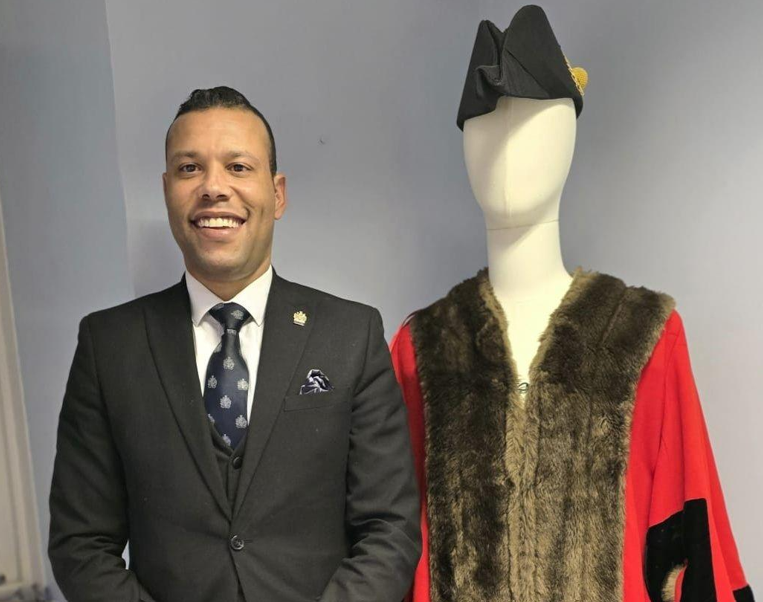
A PEMBROKESHIRE town council will soon have its first-ever person of colour as mayor, and its youngest mayor in a century.
Haverfordwest Town Councillor Randell Iziah Thomas-Turner, aged 37, is to become mayor this May.
Cllr Turner said: “Tonight [March 19], I had the honour of accepting the nomination as mayor-elect — a moment that will forever stay with me.
“In doing so, I am humbled to be making history as the first mayor of colour in Haverfordwest and the youngest mayor in a century. This is not just my achievement, it belongs to every person who believes in progress, representation, and the power of community. This is a new chapter for our town — one built on unity, opportunity, and hope.
“My mayor-making will take place this May, and I cannot wait to officially step into the role and begin serving the people of Haverfordwest with pride, passion, and purpose. Haverfordwest is the best in the West — and together, we are just getting started.
“Diversity is not a challenge to overcome, but a strength to embrace. When people from different backgrounds, experiences, and perspectives come together with respect and openness, we unlock new ideas, stronger solutions, and deeper understanding.”
It’s a double celebration for the Thomas-Turner family.
Wife, and fellow town councillor, Dani, has been voted as sheriff of the town for the second-year-running, the first woman to serve as sheriff for two consecutive years.
“The coming civic year will be one to watch as my husband Councillor Randell Izaiah Thomas-Turner is becoming the first mayor of colour in Haverfordwest’s history,” said Cllr Dani Thomas-Turner, adding: “It’s going to be a year of history and memory making for sure.”


SAMUEL Kurtz MS has welcomed more than £4.3 million in National Lottery funding awarded to community projects across Carmarthen West and South Pembrokeshire since 2021.
Figures released by The National Lottery Community Fund show that £4,318,484 has been distributed through 122 grants in the constituency since the 2021/22 financial year, the same year Mr Kurtz was elected.
The funding has supported a wide range of grassroots charities, voluntary organisations and community groups through programmes including National Lottery Awards for All, offering grants of up to £20,000, and People and Places, which provides larger awards of up to £500,000.
Projects backed locally include mental health support for young people, environmental and sustainability initiatives, community workshops, outdoor wellbeing activities, support for vulnerable adults, and programmes aimed at building skills and confidence.
Among the organisations to benefit is Pembrokeshire Coast National Park Authority, which received £343,584 for its Routes to Discovery project, helping improve mental and physical wellbeing through accessible outdoor activities.
St Davids Diocesan Council for Social Responsibility was awarded £398,078 to deliver its Plant Dewi: Strengthening our Communities initiative, supporting families and local groups.
Other recipients include The VC Gallery, Redberth Croft CIC, The Tenby Project CIC and Neptune’s Army of Rubbish Cleaners, with funding supporting projects ranging from food initiatives and nature-based wellbeing to volunteering and environmental action.
Mr Kurtz said: “Community groups and charities across Carmarthen West and South Pembrokeshire do incredible work supporting people and strengthening local communities.
“It is fantastic to see more than £4.3 million of National Lottery funding invested in projects that are improving wellbeing, tackling isolation and creating opportunities for people of all ages during my time in office.

“The voluntary sector plays a vital role in our area, and this funding is helping organisations deliver projects that bring people together and make a real difference to people’s lives.”
The National Lottery Community Fund is the largest funder of community activity in Wales, supporting initiatives that bring communities together, promote environmental sustainability, help children and young people thrive, and improve health and wellbeing.
Organisations across Wales can apply for funding through the Awards for All and People and Places programmes to support projects that matter most to their communities.

Further information is available on The National Lottery Community Fund website.



Entertainment3 hours ago
Tenby steams up in spectacular style as crowds flock to festival
Colourful parade, towering creations and Victorian flair bring town centre to life TENBY was transformed into a vibrant Victorian fantasy...


Crime1 day ago
Publican jailed for six years for supplying cocaine and cannabis
Milford Haven man sentenced at Swansea Crown Court following drug dealing operation A MILFORD HAVEN publican has been jailed for...


Local Government1 day ago
Poverty summit highlights support efforts across Pembrokeshire
A SUMMIT bringing together key organisations from across Pembrokeshire has highlighted both the scale of local poverty and the work...


Education2 days ago
Milford Haven school plans unveiled but funding not yet secured
PLANS for a new £100 million school in Milford Haven have been unveiled, but the project has not yet secured...


News2 days ago
Council unveils plans for new state-of-the-art secondary school in Milford Haven
PEMBROKESHIRE COUNTY COUNCIL has revealed plans for a new state-of-the-art school in Milford Haven, promising modern, inspiring learning spaces for...


Health2 days ago
NHS waiting list falls — but cancer delays and diagnostic backlog worsen
Record progress claimed by Welsh Government as critics warn key targets are still being missed THE NHS in Wales has...


Crime3 days ago
Rapist jailed after ‘abhorrent’ attacks on woman and children
Haverfordwest man told police “women won’t have sex without force” A HAVERFORDWEST man who raped a woman and a young...


News3 days ago
Reform secures first Pembrokeshire councillor in Hakin by-election win
Late Reform candidate takes seat as independent surge and Labour withdrawal shape contest REFORM UK candidate Scott Thorley has won...


News4 days ago
Scott Thorley elected as Pembrokeshire’s first Reform councillor
REFORM UK candidate Scott Thorley has won the Hakin by-election after securing 179 votes. The full result is as follows:...


News4 days ago
Police confirm man has died after being recovered from River Cleddau
Major emergency response in town centre after concerns raised for man in water A MAN has died after being recovered...
-

 News6 days ago
Fishguard linked to allegations in Many Tears Animal Rescue investigation
-

 News4 days ago
Emergency services flood Haverfordwest after reports of person in river
-

 Crime3 days ago
Mother given community order after admitting child cruelty offence
-
Health2 days ago
NHS waiting list falls — but cancer delays and diagnostic backlog worsen
-

 Sport7 days ago
Wales end Six Nations losing run with bonus-point win over Italy
-

 Crime6 days ago
Man cleared of sexual assault allegation after magistrates rule no case to answer
-
 News4 days ago
Senedd votes to ban Greyhound racing in Wales to protect animal welfare
-

 News4 days ago
Senedd vote to ban greyhound racing hailed as ‘landmark moment’ by charities