


Politics
Call for legal action over rail and NI funding


ADAM PRICE urged ministers to consider legal action over £432m “owed” to Wales by the UK Government for rail spending and increased national insurance costs.
The former Plaid Cymru leader warned that a decision to reclassify an Oxford-to-Cambridge railway line as a “England-and-Wales” project cost Wales £360m in consequential funding.
Mr Price asked Welsh ministers: “If the change was made – as it ostensibly was – without consultation or adequate reasoning, what legal hurdles would the Welsh Government face in bringing a case and what remedies might be available?”
Julie James, who is counsel general, the Welsh Government’s chief legal adviser, replied: “I don’t think that’s something we want to particularly take to court.”
Ms James pointed to an extra £445m for rail in Wales in last week’s UK Government spending review, welcoming a “step change” in the level of investment in the past year.

But Mr Price suggested the decision to reclassify East West Rail after four years as an England-only project created a legitimate expectation in legal terms for budget planning.
During counsel general questions in the Senedd on June 17, he criticised the “completely unexplained reversal” on the project which has “no direct nor indirect benefit to Wales”.
The shadow justice secretary said: “That seems to me to amount to a breach of procedural fairness, or potentially even cross the Wednesbury threshold of irrationality because it’s a perverse decision – and that’s why no real explanation has been proffered.”
He urged Welsh ministers to issue a pre-legal action letter compelling the UK Government to disclose the reasoning behind the reclassification.

Ms James, who could not explain the four-year delay, replied: “I don’t think that that would be a good use of the government’s resources at all.”

The Labour politician told the Senedd national planning on heavy rail is done on a England-and-Wales basis, so any scheme in England would proceed as such.
“And, actually, so would any scheme in Wales be on an England-and-Wales basis,” she said. “So, a line with nothing touching England would also be on an England-and-Wales basis.

“The real issue for us is that there aren’t any of those second ones. We’ve been seriously underinvested in and what we now need to see are those investments coming into Wales.
“We need to make sure that the pipeline is an England-and-Wales pipeline and not just an England pipeline, as it was under the previous [UK] Government.”
Ms James said she would like to see heavy rail devolved because the current system has “muddied the waters for sure”.
Mr Price also suggested legal action over a £72m shortfall in funding from UK ministers to cover the increased cost of national insurance contributions in the Welsh public sector.
He told Senedd members the UK Government’s statement of funding policy states devolved administrations should suffer no detriment from UK policy decisions.
Questioning whether there is a credible legal route through judicial review or other means to secure full reimbursement, he asked: “What factors would determine whether that policy wording is legally enforceable?”
Ms James replied: “I think it is a clear breach of the funding policy and the finance minister has been more than plain that he also regards it as a clear breach….
“The question you’re asking me, though, is is it worth trying to take some sort of judicial approach to putting that right and I think that our view is that it isn’t because that will involve an enormous amount of expenditure, it’s quite a sledgehammer.”

She was further pressed by Plaid Cymru’s shadow finance secretary Peredur Owen Griffiths, who warned the UK Treasury acts as “judge, jury and executioner” on such decisions.
Reiterating that heavy rail is not devolved, Ms James replied that the rail example “perfectly illustrates” what’s wrong with the Barnett formula – the mechanism used to allocate additional funding to Wales.
But she said: “I don’t think that it would best serve the Welsh public to spend resources on arguing with HM Treasury about whether that’s a mistake or the classification—.
“I don’t think that would get us anywhere. I don’t think that we would have a decent legal argument to put up that it wasn’t a mistake, and I think that we would ultimately fail.”
Ms James said ministers are concentrating on making sure the England-and-Wales pipeline “has a Wales bit in it”, arguing a legal case would cost a lot and not get very far.



A PADDLEBOARDING and canoeing company’s call for an extension to a boat shed at Pembroke’s South Quay, below its historic castle, has been submitted to county planners.
In an application to Pembrokeshire County Council, G Booth of Paddle West CIC, through agent James Dwyer Associates, seeks permission for an extension to the stone-built boathouse, adjacent to the cliff on South Quay fronting the Mill Pond, Pembroke.
A supporting statement says: “It is intended to erect a single storey ‘lean-to’ building, or ‘shed’ for the storage of boats, such as canoes and kayaks, and related equipment, on a vacant space adjacent to the existing stone-built boathouse.”
It adds: “The boathouse and the intended adjacent boat storage shed is located, as is to be expected, in close proximity to water, the Mill Pond. The Mill Pond is the main area of activity for Paddle West, a Community Interest Company, providing boating activities, kayaking, canoeing and paddle boarding, frequently for young people and families.”
It goes on to say: “It is intended that the structure would be lightweight, erected on the exiting hard standing. The ‘shed’ would be used for the storage of boats and related equipment.”

With regard to the historic setting, it adds: “Although the stone-built boathouse appears not to be listed, it is recognised that the walls above are listed and together they are a piece.
“Accordingly, through form and external materials proposed, timber cladding and profile sheet roofing, the aim is to ensure that the structure would be subservient and muted and not detract or compete with the visual aesthetic of the boathouse or historic walls. In effect the addition would blend into the background.”
The application will be considered by county planners at a later date.
The boathouse is sited near to the new Henry Tudor Centre in South Quay, which is due to open in Spring 2027.
The centre, expected to receive around 30,000 visitors a year, will tell the story of Henry Tudor, son of Pembroke, his Welsh ancestry and his impact on our national story, Welsh culture and our wider British heritage.
The restored derelict South Quay buildings will also house a new library and community café, and a healthcare, social services and supported employment facility in the adjoining premises.
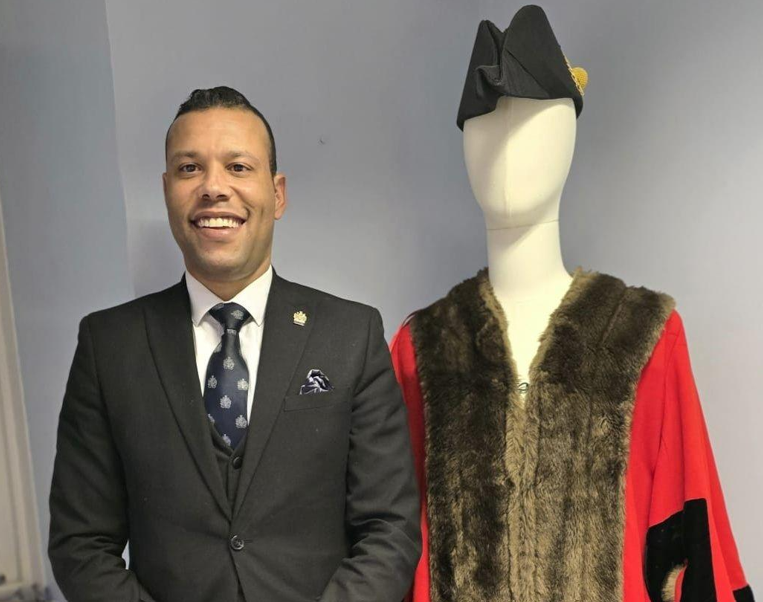
A PEMBROKESHIRE town council will soon have its first-ever person of colour as mayor, and its youngest mayor in a century.
Haverfordwest Town Councillor Randell Iziah Thomas-Turner, aged 37, is to become mayor this May.
Cllr Turner said: “Tonight [March 19], I had the honour of accepting the nomination as mayor-elect — a moment that will forever stay with me.
“In doing so, I am humbled to be making history as the first mayor of colour in Haverfordwest and the youngest mayor in a century. This is not just my achievement, it belongs to every person who believes in progress, representation, and the power of community. This is a new chapter for our town — one built on unity, opportunity, and hope.
“My mayor-making will take place this May, and I cannot wait to officially step into the role and begin serving the people of Haverfordwest with pride, passion, and purpose. Haverfordwest is the best in the West — and together, we are just getting started.
“Diversity is not a challenge to overcome, but a strength to embrace. When people from different backgrounds, experiences, and perspectives come together with respect and openness, we unlock new ideas, stronger solutions, and deeper understanding.”
It’s a double celebration for the Thomas-Turner family.
Wife, and fellow town councillor, Dani, has been voted as sheriff of the town for the second-year-running, the first woman to serve as sheriff for two consecutive years.
“The coming civic year will be one to watch as my husband Councillor Randell Izaiah Thomas-Turner is becoming the first mayor of colour in Haverfordwest’s history,” said Cllr Dani Thomas-Turner, adding: “It’s going to be a year of history and memory making for sure.”


A WELSH Government-funded scheme to provide rates relief for hospitality businesses has been backed by senior Pembrokeshire councillors.
A report for members of Pembrokeshire County Council’s Cabinet at their March meeting said: “Welsh Government has introduced the Food and Drink Hospitality Rates Relief, this relief is aimed at eligible businesses in Wales in the food and drink hospitality sector for example, pubs, restaurants, cafes, bars and live music venues.
“The aim of the relief is to support eligible businesses to manage continued cost pressures. The relief will apply to all eligible occupied properties by offering a discount of 15 per cent on non-domestic rate bills for the period April 1 to March 31, 2027. The relief is capped at £110,000 per business across Wales.
“As this is a temporary measure, Welsh Government is providing the relief by reimbursing local authorities that use their discretionary relief powers under Section 47 of the Local Government Finance Act 1988.”
It concluded: “The food and drink hospitality rates relief 2026-27 requires the local authority to adopt a discretionary scheme [as outlined] and in accordance with the criteria and conditions specified in the guidance issued by Welsh Government.
“It is proposed that Cabinet resolve to adopt [the scheme] which can be applied to administer the relief. Welsh Government will reimburse local authorities for the relief provided in line with their guidance via a grant under section 31 of the Local Government Act 2003.”
Members backed the recommendation.
All eligible businesses must apply for this relief by the March 31, 2027, and an application form will be available on the council’s website from the April 1.
The maximum cash value of the rates relief allowed, across all properties in Wales occupied by the same business should not exceed £110,000. Businesses claiming the relief must declare that the amount being claimed does not exceed those limits.




Crime17 hours ago
Publican jailed for six years for supplying cocaine and cannabis
Milford Haven man sentenced at Swansea Crown Court following drug dealing operation A MILFORD HAVEN publican has been jailed for...


Local Government19 hours ago
Poverty summit highlights support efforts across Pembrokeshire
A SUMMIT bringing together key organisations from across Pembrokeshire has highlighted both the scale of local poverty and the work...


Education2 days ago
Milford Haven school plans unveiled but funding not yet secured
PLANS for a new £100 million school in Milford Haven have been unveiled, but the project has not yet secured...


News2 days ago
Council unveils plans for new state-of-the-art secondary school in Milford Haven
PEMBROKESHIRE COUNTY COUNCIL has revealed plans for a new state-of-the-art school in Milford Haven, promising modern, inspiring learning spaces for...


Health2 days ago
NHS waiting list falls — but cancer delays and diagnostic backlog worsen
Record progress claimed by Welsh Government as critics warn key targets are still being missed THE NHS in Wales has...


Crime3 days ago
Rapist jailed after ‘abhorrent’ attacks on woman and children
Haverfordwest man told police “women won’t have sex without force” A HAVERFORDWEST man who raped a woman and a young...


News3 days ago
Reform secures first Pembrokeshire councillor in Hakin by-election win
Late Reform candidate takes seat as independent surge and Labour withdrawal shape contest REFORM UK candidate Scott Thorley has won...


News3 days ago
Scott Thorley elected as Pembrokeshire’s first Reform councillor
REFORM UK candidate Scott Thorley has won the Hakin by-election after securing 179 votes. The full result is as follows:...


News4 days ago
Police confirm man has died after being recovered from River Cleddau
Major emergency response in town centre after concerns raised for man in water A MAN has died after being recovered...


Community4 days ago
Davies and Kurtz urge groups to seek employability funding
Community organisations in Pembrokeshire encouraged to apply for new grants supporting skills and job access LOCAL Senedd Members Samuel Kurtz...
-

 News7 days ago
Rayner and Lammy visit Wales to discuss justice and community safety
-
 News6 days ago
Fishguard linked to allegations in Many Tears Animal Rescue investigation
-

 News4 days ago
Emergency services flood Haverfordwest after reports of person in river
-

 Local Government7 days ago
Investigation confirmed after inspectors visit Many Tears Animal Rescue
-

 Crime3 days ago
Mother given community order after admitting child cruelty offence
-

 News3 days ago
Senedd vote to ban greyhound racing hailed as ‘landmark moment’ by charities
-

 Business7 days ago
Oil firm praised for putting customers first during price surge
-

 Community7 days ago
Town hall takeover plan questioned as cost figures conflict