


Education
Great Bibles of Henry VIII and Thomas Cromwell are reunited after 500 years


THE GREAT BIBLES of Henry VIII and Thomas Cromwell have been reunited for the first time in nearly 500 years at the National Library of Wales, Aberystwyth.
Many people will be familiar with the life of Thomas Cromwell through the acclaimed novel and TV drama ‘Wolf Hall’, but now visitors can discover the real-life drama in a unique exhibition.

It’s a once in a lifetime opportunity to see these two matching bibles, which were the personal copies of Henry VIII and Thomas Cromwell, side-by-side for the first time since they were made.
They are displayed as part of the ‘Treasures’ exhibition in the National Library of Wales’ Hengwrt Gallery.
With so much religious and political conflict, it is remarkable that both Bibles have survived, with one now kept at the National Library of Wales and the other at St. John’s College, Cambridge. However, it is unknown for sure which one belonged to Henry and which to Cromwell.

The luxurious copies, made in 1538-‘9, were printed on parchment and carefully hand-coloured by Europe’s finest artists. The printing was supported by Thomas Cromwell who was a strong supporter of religious reform and had the two special copies made as part of the campaign to convince the King.
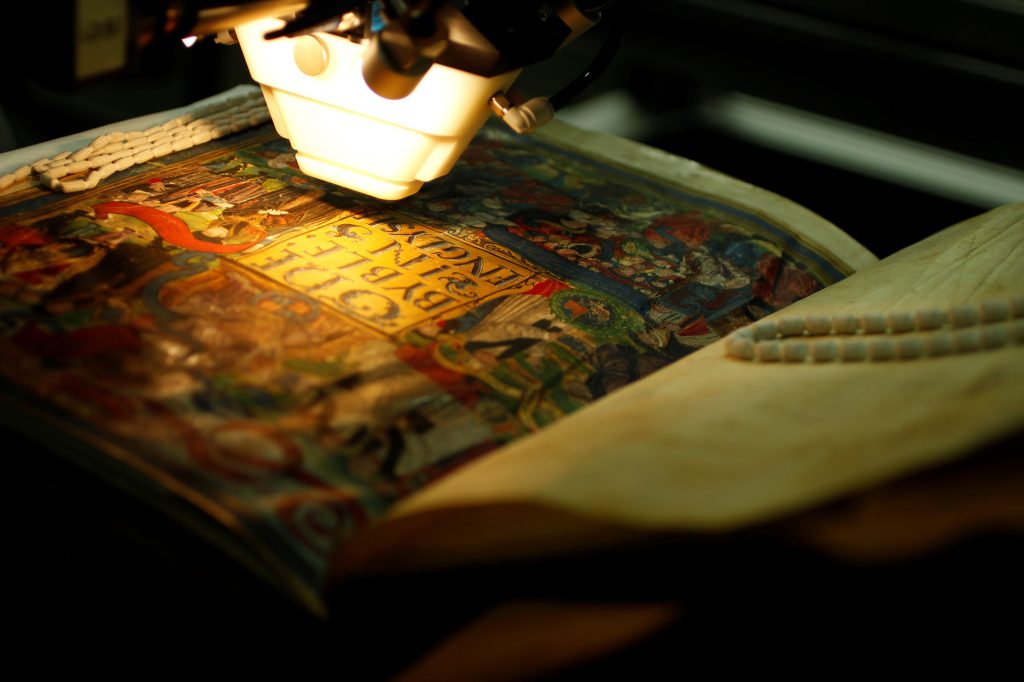
The Great Bible was the first English translation of the Bible to be disseminated across the realm. By royal order it was to be placed in every church in England and Wales in a place accessible to the laity.
At a time when prayers were still primarily in Latin, providing ordinary people with an English Bible was truly revolutionary. It marked the beginning of a new era of giving people more access to the Bible than ever before.
Despite the interesting title page, showing an idealised image of Henry VIII distributing bibles to ordinary people, he wasn’t fully comfortable with letting ordinary people read the Bible and he imposed restrictions on access after Cromwell’s execution.

However, the impact of the Great Bible could not be undone. After Henry’s death, the use of Bibles in churches and homes proliferated.
Rhodri Llwyd Morgan, National Library of Wales chief executive, said: “The Age of the Tudors continues to hold a special appeal today. The two bibles were the personal property of two of the period’s great characters and they are the centrepiece of a fascinating exhibition charting the momentous events that are relevant to us now.
“It is a real privilege to be able to exhibit together the two volumes of such a significant publication at the national library. In the exhibition, we also show the story of the major political and social changes of the age, including the quest for a Welsh language Bible, a key development in the history of the language and its safeguarding today.

“It has also been a privilege to work with Cambridge University Library and the research team as innovative technologies help reveal more of the secrets within the two bibles and discovering more about the circumstances in which they were created.”
The Bibles have recently been carefully studied as part of the Hidden in Plain Sight research project, in collaboration with Cambridge University Library and Queen Mary University of London, and funded by the Arts and Humanities Research Council, which looks at how ancient books were used, changed and respected.
Using a range of scientific tools, from x-ray to microscopes and even DNA analysis, new light has been shed on the books, revealing some unknown histories and leading to discoveries about how the books were made and changed over time.
The project has revealed that Cromwell had his portrait painted and pasted into the title page of the St John’s copy, a move expertly hidden for centuries. The opening title page was further manipulated to gain Henry’s support, by altering an image of a courtly woman to resemble Jane Seymour, his beloved and recently deceased consort. Other discoveries are set to be revealed during the course of the exhibition.
Dr Amelie Roper, Cambridge University Library Research Institute head of research and manager, said: “This rare opportunity to study the Bibles side-by-side has unearthed new secrets and created exciting paths of discovery.
“Hidden in Plain Sight project members from Cambridge University Library and Queen Mary University of London have used innovative heritage science techniques to capture these findings, ready to be explored in the exhibition and as the project continues.”
Prof. Eyal Poleg, Queen Mary University of London, said: “These are two of the most important artefacts of the Tudor Court. New technologies have unearthed modifications, hidden for centuries.
“We can now appreciate how Cromwell manipulated the appearance of the Bibles as they were being printed, carefully navigating the religious and political turmoil of Henry’s court.
“The ability to see the Bibles side-by-side, for the first time in nearly 500 years, is a rare opportunity to witness first-hand this unique period.”
Other contemporary items from the library’s collection, which tell the story of the dissolution of the monasteries, the development of the Welsh language, and which look at Anne Boleyn and court gossip, will also be on display with the Bibles.
Picture caption:
The Great Bibles of Henry VIII and Thomas Cromwell.


PLANS for a new £100 million school in Milford Haven have been unveiled, but the project has not yet secured full approval and remains subject to further funding decisions.
Pembrokeshire County Council this week released details of the proposed development, alongside a professionally produced video featuring First Minister Eluned Morgan, senior council figures and school leaders outlining the vision for a modern, state-of-the-art school.
The announcement comes just seven weeks before the Senedd election.
The proposed scheme would see the development of a new, purpose-built school designed to provide modern learning environments for pupils across Milford Haven and the surrounding area. Plans include specialist teaching facilities, improved accessibility throughout the site, and enhanced outdoor learning and play areas.
Council officials say the project will also place a strong emphasis on sustainability, incorporating energy-efficient systems and modern building standards aimed at reducing long-term environmental impact and running costs.

Outline stage only
Despite the high-profile launch, the project is currently at Strategic Outline Case (SOC) stage — an early stage in the public sector approval process.
SOC approval means the scheme has been accepted in principle, but key elements — including final costs, detailed design and overall value for money — have not yet been fully assessed.
Crucially, no final funding commitment has yet been made.
Before the project can proceed to construction, it must pass through the full business case (FBC) process. This stage requires detailed financial modelling, technical planning and formal sign-off from funding bodies, including the Welsh Government.

Only if that process is successfully completed will funding be formally approved and delivery authorised.
Political and funding context
Major school developments in Wales are typically delivered through joint funding arrangements between local authorities and the Welsh Government, often under long-term investment programmes aimed at modernising the education estate.
While both council leaders and Welsh Government representatives have expressed support for the Milford Haven project, schemes at SOC stage can still be subject to revision, delay or, in some cases, may not proceed if funding or value-for-money criteria are not met.

Large infrastructure announcements are often made at this stage to outline ambition and begin public engagement, ahead of final decisions on funding and delivery.
Long-running campaign
Cllr Guy Woodham, Cabinet Member for Education, said he had been working towards securing a new school for several years.
He said: “I have been Cabinet Member for Education since 2019 and I have been fighting for a new school for Milford all that time.
“This project represents a major investment in our children’s future and will provide a safe, modern and inclusive environment where pupils can thrive.”
The Welsh Government has also welcomed the plans, describing them as part of its wider programme to improve school facilities across Wales.
Community involvement
The council has confirmed that the next phase of the project will involve consultation and engagement with pupils, staff, parents and local residents.
This process is expected to help shape the detailed design of the school before a full business case is submitted.
Not yet a confirmed build
While the plans have been presented as a significant step forward for education in Milford Haven, the project remains a proposal rather than a confirmed construction scheme.
At this stage, timelines for delivery have not been finalised, and progression will depend on the outcome of the business case process and the availability of funding.
For now, the new school remains an ambition backed in principle — but not yet a guaranteed build.
Cover image:
Delighted with announcement: First Minister, Eluned Morgan MS


THE PRICE of school meals in Pembrokeshire is to rise after senior councillors heard their current costs can no longer be sustained without financial losses to the authority.
At the March meeting of Pembrokeshire County Council’s Cabinet, members were asked to back increases to the price of paid school meals in primary and secondary schools from September 1.
A report for members said prices “have remained unchanged for seven years and can no longer be sustained due to rising operational and staffing costs”.
It said the School Meals Service is experiencing significant financial pressure as a result of food price inflation and National Living Wage increases, rising to £12.21 per hour, adding: “While the service currently maintains an overall surplus, recent analysis shows that the secondary school catering service will enter a deficit in 2026/27 without a price adjustment.”
For primary schools, the service provides approximately 6,500 meals per day across 53 schools, adding: “The unit cost of producing a paid for primary school meal now exceeds the costs of production (this include ingredients and additional overheads). This misalignment has created a structural deficit for each meal served.

“As we are managing to a total cost recovery model rather than a static unit price, the £3.40 Universal Primary Free School Meals rate is the most reliable proxy for current production costs for a primary pupil meal.”
Members were recommended to increase paid meals by 20p and adult meals by 49p.
For secondary schools, the service provides 3,500 meals daily across eight secondary schools, where a cafeteria style- model is used.
The report said: “Meal prices have been frozen since 2019. Despite efficiency measures such as supply chain reviews and menu consolidation, food inflation and wage increases now exceed what can be absorbed operationally. It is no longer possible to provide a high quality, nutritionally balanced two- course meal within the current pricing structure.”

As part of a proposed service saving of £200,000 for this financial year it was recommended to increase the price of individual menu items by some 11 per cent.
It added: “Despite maintaining static meal prices for seven years, the Council’s proposed rates remain competitive when compared with neighbouring authorities. Recent benchmarking shows widespread variation, with many councils planning further price increases before September 2026.”
Members backed recommendations that the price of a paid primary school meal increases from £2.55 to £2.75, with adult meals rising from £3.51 to £4.

They also backed increasing the price of individual secondary school meal menu items by 11 per cent, subject to targeted increases rather than a blanket rise.

LEVEL 1 teaching assistants in Wales will be moved to level 2 roles from September 2026.
This move will benefit up to 3,350 current level one teaching assistants, who will receive a pay rise of up to £1,350.
Teaching assistants play a vital role in supporting teaching and learning in our schools and settings. Working with local authorities and unions, the Cabinet Secretary for Education, Lynne Neagle has today (March 18) confirmed that the Welsh Government will fund the salary increase for level 1 teaching assistants to move to level 2, subject to local consultation*. Future teaching assistant roles will also be recruited at a minimum of level two.
Alongside increased pay, the move will ensure consistent teaching assistant role descriptions and will support improved recruitment and retention.
The announcement comes on the same day the Strategic Education Workforce Plan for Schools is published. The plan outlines a shared vision of developing a confident, resilient, and well‑supported education profession, responding directly to feedback from practitioners, unions, local authorities, Estyn, the Education Workforce Council (EWC) and other key partners.
To support the current and future workforce, the plan sets out a range of actions for Welsh Government and partners to take forward under five themes, which are –
- Ensuring quality of teaching and learning
- Addressing workload issues
- Responding to new challenges for the school workforce and ensuring access to support through a specialist and pastoral workforce
- Ensuring that teaching, supporting teaching an educational leadership are attractive career pathways
- Ensuring effective use of data and evidence to inform workforce planning
- The well-being of staff is addressed under each theme and is central within the plan.
Actions outlined within the plan include a commitment to establish career-long national professional learning pathways for teachers, leaders and teaching assistants working closely with Dysgu. The initial teacher education incentives and pathways into teaching will also be reviewed to support recruitment of future teachers.
There’s also a commitment to understand alternative models for supporting teachers with time away from the classroom, and to support the appropriate use of generative artificial intelligence in learning and to reduce workload.
The plan also recognises new challenges the school workforce is facing in supporting learners outside of their day-to-day teaching duties. This includes strengthening multi-agency collaboration to support the school workforce to respond to wider societal changes. It also commits to investing and supporting non-teaching pastoral roles including Family Engagement Officers and the work of Community Focused Schools Managers.

Cabinet Secretary for Education, Lynne Neagle, said: “Today is a milestone day for education with the plan outlining key commitments that will benefit the sector in many ways in the short and long term.
“The plan has been developed in collaboration with the sector and will support our leaders, teachers, and support staff now and in the future. Equipping them with the skills they need to meet the needs of learners, with wellbeing support for the staff at the heart of the plan.
“I am also pleased to announce the uplift for level 1 teaching assistants today, this is the first step towards the long-term goal of pursuing fairer pay and conditions for all teaching assistants.”
Councillor Lis Burnett, WLGA Spokesperson for Education, said: “Teaching assistants are at the heart of our schools, building trusted relationships with pupils and providing the day-to-day support that helps children feel confident and ready to learn. We welcome this funding from Welsh Government to support the move from level 1 to level 2 roles, recognising the important contribution they make. It’s vital this sits alongside ongoing work to ensure fair and equitable conditions across the whole workforce, so staff feel properly valued and supported in the role they play in children’s lives.”



Education11 hours ago
Milford Haven school plans unveiled but funding not yet secured
PLANS for a new £100 million school in Milford Haven have been unveiled, but the project has not yet secured...


News11 hours ago
Council unveils plans for new state-of-the-art secondary school in Milford Haven
PEMBROKESHIRE COUNTY COUNCIL has revealed plans for a new state-of-the-art school in Milford Haven, promising modern, inspiring learning spaces for...


Health14 hours ago
NHS waiting list falls — but cancer delays and diagnostic backlog worsen
Record progress claimed by Welsh Government as critics warn key targets are still being missed THE NHS in Wales has...


Crime2 days ago
Rapist jailed after ‘abhorrent’ attacks on woman and children
Haverfordwest man told police “women won’t have sex without force” A HAVERFORDWEST man who raped a woman and a young...


News2 days ago
Reform secures first Pembrokeshire councillor in Hakin by-election win
Late Reform candidate takes seat as independent surge and Labour withdrawal shape contest REFORM UK candidate Scott Thorley has won...


News2 days ago
Scott Thorley elected as Pembrokeshire’s first Reform councillor
REFORM UK candidate Scott Thorley has won the Hakin by-election after securing 179 votes. The full result is as follows:...


News2 days ago
Police confirm man has died after being recovered from River Cleddau
Major emergency response in town centre after concerns raised for man in water A MAN has died after being recovered...


Community2 days ago
Davies and Kurtz urge groups to seek employability funding
Community organisations in Pembrokeshire encouraged to apply for new grants supporting skills and job access LOCAL Senedd Members Samuel Kurtz...

News2 days ago
Emergency services flood Haverfordwest after reports of person in river
Town centre sealed off as multi-agency response continues A MAJOR emergency response is underway in the centre of Haverfordwest after...


News3 days ago
Detectives receive surge of new information in bid to identify man found at Powys reservoir
Public response follows release of facial image as officers pursue fresh lines of enquiry DETECTIVES investigating the identity of a...
-

 Health7 days ago
Welsh Ambulance Service to host bi-monthly Board meeting
-

 News6 days ago
Rayner and Lammy visit Wales to discuss justice and community safety
-

 News5 days ago
Fishguard linked to allegations in Many Tears Animal Rescue investigation
-
News2 days ago
Emergency services flood Haverfordwest after reports of person in river
-

 Local Government6 days ago
Investigation confirmed after inspectors visit Many Tears Animal Rescue
-

 Community7 days ago
Local charity hosts cancer awareness event in Cardigan
-

 Farming7 days ago
Plea to remove decades old ‘unviable’ planning conditions from property
-

 Business7 days ago
Work set to begin on £50m hydrogen plant in Milford Haven