


Business
Welsh Water chief quizzed over plans to slash 500 jobs


SENEDD Members quizzed the boss of Dŵr Cymru Welsh Water about plans to cut around 500 jobs amid concerns about the “enormous” pay and bonuses pocketed by executives.
Peter Perry, the outgoing chief executive, appeared before a Senedd committee today (November 5) after Welsh Water unveiled plans to cut annual spending by £50m.
Mr Perry is retiring from the industry after joining the company as an apprentice in 1979, with former Sydney Water boss Roch Cheroux set to take the reins in the new year.
He told the climate committee: “In my 46 years, I’ve never seen a time for the industry or the company where there is so much external focus, so much challenge.
“Customers are, rightly, expecting better standards and there’s an unparalleled interest in the environment… we welcome both but there are also considerable challenges.”

He outlined Welsh Water’s trawsnewid (transformation) plan to reduce its workforce by approximately 500 full-time-equivalent roles over the next 18 to 24 months.
“This is not a desired outcome, this is a necessity,” he said.
Mr Perry explained the sector has faced hundreds of millions in extra costs due to the pandemic and droughts, with £60m spent on the Felindre water treatment works alone.
He told Senedd Members a sector-wide credit-rating downgrade has increased borrowing costs, reducing Welsh Water’s financial wiggle room.

“We are not in the same strong financial position we would have been in five years previously,” he said. “The whole idea of trawsnewid is the company taking responsible action now to make sure we remain in a sustainable financial position for five, ten, 15, 20 years.”
Llŷr Gruffydd, who chairs the committee, asked whether Welsh Water will have to do less due to having fewer people – warning of a “doom loop” of worsening performance.

Mr Perry insisted: “That’s not the case at all… we would not, for one second, look at service levels dropping – our targets are tightening.”

Welsh Water stressed the transformation programme will not impact its £4bn investment plan for 2025 to 2030, which is nearly double the amount of the previous five years.
Sam James, commercial managing director at Welsh Water, added: “It’s about doing more with the people we have. How do we make it easier for people to do their job?
“There is still a lot of manual data processing, for example.”

The not-for-profit company is focusing on reducing “back-office” support and management roles to limit the impact on front-line teams.
Ms James said the plan is broader than a restructuring, with 50% of savings to come from employment costs and 50% from other efficiencies, such as better use of data and AI.
Martin Driscoll, Welsh Water’s business support and people director, said 316 people have so far put their name forward for voluntary redundancy.

On the risk of losing experienced staff, Mr Perry said: “We will be disappointing some colleagues who would like to go on the basis that we can’t lose their expertise.”
Janet Finch-Saunders, a Tory committee member, said: “There’s been so much concern about the level of executive pay and bonuses at a time… when it is felt by many people that there has been a lot of failings within the water industry and, in particular, Dŵr Cymru.”
Welsh Water’s chief executive received a £460,000-a-year base salary in 2025/26, with total target remuneration of £894,000, according to the company’s latest accounts.

Mr Perry, who earned a base salary of £369,000 in 2024/25, replied: “First and foremost, any of the variable pay that executives have is entirely based on performance so there has been a proportionate reduction.”
He added: “I acknowledge I’m well paid, I’m not going to win the argument on that, but what I would say: the figure that’s been in the public domain of an £800,000 salary is incorrect. 40% of it was linked to an accounting practice… for a future pension accrual.”
Mr Driscoll described the £892,000 listed in the 2021 accounts as total remuneration as “to some extent fictional”, claiming the chief executive’s pay has “tracked downward” over the past five years.
Asked whether executives will take a pay cut, Mr Perry told the committee: “Trawsnewid is not about cutting people’s pay in the organisation at all.
“We’re losing colleagues, regrettably, but we’re not attacking people’s terms and conditions.”



A PEMBROKESHIRE heating oil supplier has been praised by a local customer after choosing to honour its original prices despite a sharp rise in fuel costs.
Sarah Maling contacted The Herald after receiving a delivery from J E Lawrence & Son Ltd, saying the company had prioritised fairness to customers during a period of intense demand.
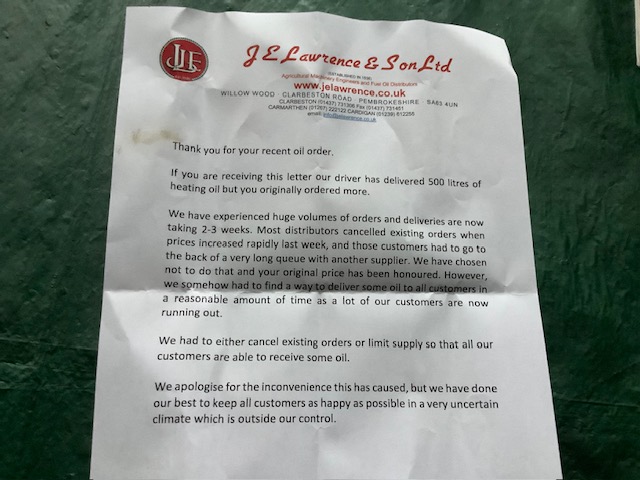
The customer had ordered around 800 litres of heating oil on March 2 after her tank began running low. However, due to extremely high demand, the company was unable to deliver until Friday (Mar 13). Despite heating oil prices increasing rapidly since the order was placed, the firm honoured the original quoted price and delivered 500 litres instead, ensuring more households could receive some oil.
Sarah said the delivery driver arrived at her home at around 11:30am after already completing 27 deliveries that day.
She said: “Prices have gone insane since I ordered yet they stuck with the quoted price and delivered 500 litres and explained why in the letter.

“This is putting the customer before profit and making sure everyone who needs oil will hopefully get oil at a more affordable price.
“I just wanted it acknowledged that not all delivery companies are out to make a profit but care about their customers – the people of Pembrokeshire.”
The letter included with the delivery explained that distributors across the sector had cancelled existing orders as prices surged last week.
However, the company said it had chosen not to cancel earlier orders and instead decided to limit deliveries so that more customers would receive some fuel.

The letter stated: “We have experienced huge volumes of orders and deliveries are now taking two to three weeks.
“Most distributors cancelled existing orders when prices increased rapidly last week, and those customers had to go to the back of a very long queue with another supplier.
“We have chosen not to do that and your original price has been honoured.”

The company added that limiting deliveries was the only way to ensure all customers could receive oil during the current supply pressures.
It apologised for the inconvenience caused but said the situation was being driven by “a very uncertain climate which is outside our control”.


LEGAL action against a landowner, who repeatedly failed to comply with an enforcement notice served back in 2023, has been backed by Pembrokeshire’s national park.
Members of Pembrokeshire Coast National Park’s March development management committee meeting were asked to back delegated authority for prosecution proceedings in the magistrates’ court for failure to comply with steps required to be taken by an enforcement notice on land to the south of Parc Yr Eglwys, Brynhenllan, Dinas Cross.
A report for the committee said that, in May 2023, the park received a complaint that a green field in the open countryside had been stripped of its vegetation and turned into a mobile home park by the new landowners.
Following a site inspection, a planning contravention notice was served in relation to the removal of hedgebanks/hedgerows, widening of the existing access, alterations to ground levels, construction of a track and the siting of a storage container.
After that, a 2024 retrospective planning application was received by the park seeking retention of the hardstanding area, siting of storage container and additional landscape works, which was refused that May.
“As no voluntary steps were taken to remedy the breach of planning control and no appeal made against the refusal of planning permission, the Authority considered it expedient to issue and serve an Enforcement Notice as the development and use of the land resulted in an unnecessary incursion into the rural countryside which causes a significant visual intrusion to the detriment of the special qualities of the National Park,” the report said.
An enforcement notice was service in January 2025, but, the following month, the landowner lodged an appeal with Planning & Environment Decisions Wales, which was dismissed that June; the enforcement notice taking effect.
A further application, seeking permission for a small-scale seasonal campsite on the land was received in June 2025, subsequently refused that October; officers confirming to the landowner the enforcement notice remained in effect, running through to January 3 of this year.
A site inspection undertaken by officers on January 6 confirmed the breach of planning control continued, the report added.
This was followed by a further planning application seeking to regularise the development on January 21.
That application was refused on March 9.
The report concluded: “The landowner has had multiple opportunities to regularise the development through both retrospective applications and an appeal against the enforcement notice. Those processes have not resulted in permission being granted nor compliance being achieved.
“The continued failure to comply with the enforcement notice undermines the integrity of the planning system and public confidence in its proper operation.
“It also results in an unnecessary incursion into the rural countryside which causes a significant visual intrusion to the detriment of the special qualities of the National Park.
“Officers therefore consider it expedient and in the public interest to pursue prosecution proceedings should the breach remain unresolved.”
Members backed the recommendation.

PLANS for a B&Q ‘click and collect’ pod at a Pembrokeshire supermarket, to save customers having a make a round trip of nearly 60 miles to the nearest home improvement store, have been approved.
In an application to Pembrokeshire County Council, B&Q Ltd, through agent Pyrke Planning, sought permission to install a modular ‘Click and Collect’ pod, with associated livery and signage, on the access road to Haverfordwest’s Portfield Road Tesco Extra superstore.
The application included a related scheme for signage for the proposal.
A supporting statement said: “This planning application seeks permission for the installation of a Click and Collect pod to be operated by B&Q Limited within the car park of the Tesco Extra store at Portfield Road, Haverfordwest.

“It does not involve any construction but simply the placing of a modular unit within the car park which, together with dedicated collection spaces, will take up 12 parking spaces and be situated within the customer car park.
“B&Q Limited (B&Q) is the UK’s largest home improvement retailer, serving both the general public and tradespeople. It supplies a wide range of DIY, home improvement and garden products, primarily from its stores across the UK but also through its online website.
“The trial of a new fulfilment service – B&Q Collect – in partnership with Tesco, is another step forward in their evolution. It gives customers greater choice over how they collect and return their items and helps make it easier to do their home improvement projects.
“B&Q does not have a store in Haverfordwest, with the nearest outlets being situated in Carmarthen (28 miles), Llanelli (37 miles) and Swansea (46 miles).
“It is consequently proposed to introduce a click and collect option for DIY customers and local tradespeople to allow next day collection of products which it is inconvenient for people to have delivered at home and to remove the need for a minimum c.50-mile plus round trip to one of the established stores.”

No objections to the proposal were raised by Haverfordwest Town Council.
The application, and the related signage scheme, were conditionally approved by county planners.



Sport11 hours ago
France crowned Six Nations champions after extraordinary final-day drama
Ramos penalty in Paris seals title as Ireland fall just short and Wales end losing run FRANCE were crowned 2026...


News16 hours ago
Fishguard linked to allegations in Many Tears Animal Rescue investigation
Claims about puppies arriving through Pembrokeshire port emerge as licensing probe continues FISHGUARD has been named in allegations linked to...


Local Government2 days ago
Investigation confirmed after inspectors visit Many Tears Animal Rescue
Licensing authority declines to comment as police confirm attendance at Carmarthenshire rescue centre AN INVESTIGATION is underway following a visit...


Business3 days ago
Work set to begin on £50m hydrogen plant in Milford Haven
A MAJOR new hydrogen production facility worth around £50 million is expected to begin construction in Milford Haven later this...


Education4 days ago
Manorbier school closure approved while insurance claim still unresolved
Council confirms negotiations with insurer ongoing following 2022 fire PEMBROKESHIRE COUNTY COUNCIL has confirmed that negotiations with its insurer over...


Crime4 days ago
‘Knife attack’ at Spittal property leaves man in hospital
POLICE have arrested a woman following what is being described as a ‘knife attack’ at a property in Spittal on...


Community4 days ago
Pembrokeshire to receive its first banking hub in Pembroke Dock
LINK, the UK’s Cash Access and ATM network, has today announced local people and businesses in Pembroke Dock will benefit from a new banking...


Health6 days ago
Future of Withybush Hospital petition sparks urgent call for Senedd debate
CALLS have been made for an urgent debate in the Senedd over the future of services at Withybush Hospital as...


Sport6 days ago
Sean Bowen set for historic Welsh clash at Cheltenham Gold Cup
PEMBROKESHIRE jockey Sean Bowen could be part of a historic all-Welsh showdown when he lines up in the Cheltenham Gold...


Community6 days ago
Tenby still waiting as Wales hits 50 rural mobile mast upgrades
Seaside town plagued by signal congestion again absent from latest government-backed coverage improvements A NEW milestone in the UK Government’s...
-

 Health3 days ago
Welsh Ambulance Service to host bi-monthly Board meeting
-

 News2 days ago
Rayner and Lammy visit Wales to discuss justice and community safety
-

 Local Government5 days ago
Register now to vote in May’s Senedd election
-

 Crime7 days ago
Former Pembrokeshire Army officer stripped of MBE after fraud conviction
-
Community6 days ago
Tenby still waiting as Wales hits 50 rural mobile mast upgrades
-

 Community6 days ago
Carmarthenshire woman celebrates 100th birthday surrounded by family
-

 Crime5 days ago
E-bike rider who sped through pedestrian alley sentenced by court
-

 Sport6 days ago
Jake Paul surprises Welsh boxing club with donation after coach’s death