


News
New OS tideline data could strengthen coastal erosion and flood monitoring


NEW data released by Ordnance Survey (OS) could significantly improve how coastal erosion and flood risk are monitored across Great Britain as sea levels rise and extreme rainfall becomes more frequent.
The continuous tidelines dataset provides a clearer and more accurate picture of where high and low tides fall around the coast and along tidal rivers. The data is expected to support environmental monitoring, flood modelling, and long-term planning as the impacts of climate change accelerate.
Earlier this year, the Environment Agency updated its National Flood Risk Assessment (NaFRA), which for the first time factored in projected climate change impacts. The assessment found that around 6.3 million homes and businesses in England — roughly one in five — are currently at risk of flooding. That figure could rise to one in four properties by 2050.
The Agency has also updated its national coastal erosion risk map, which estimates that around 3,500 properties could be affected by coastal erosion by 2055.
The new OS dataset builds on existing information held in the OS National Geographic Database (OS NGD). Previously separate tidal boundary features have now been automatically merged into continuous high- and low-tide lines, creating two new feature types within the OS NGD Water theme. These can also be used as overlay layers through the OS Tiles API, allowing for clearer visual mapping and large-scale analysis.

The data is expected to support a wide range of environmental and regulatory work, including coastal erosion and flooding modelling, updating boundary features to reflect coastal change, climate change impact assessments, and identifying areas of foreshore that act as natural flood defences.
William Russell, Senior Coastal Process Scientist at the Wales Coastal Monitoring Centre, said the dataset would remove uncertainty from coastal monitoring.
“One of our core values is ‘data, not opinions’. When information is missing, we seek out or collect the data needed to support sound decision-making,” he said.
“The OS Continuous Tidal Boundaries dataset removes uncertainty from our strategic monitoring programme and gives us clearer insight into intertidal extents, delivering cost savings and efficiencies for our survey contractors.”
Ordnance Survey says the data is particularly valuable for environmental policy and regulation, including decisions around water discharge and flood management. Accurately defining the intertidal zone helps identify natural coastal defences, which play a vital role in protecting communities and ecosystems.

Intertidal information has also been enhanced within the Land theme of the OS NGD, with improved coverage of previously obscured areas to create a more complete national coastal dataset.
Lily Brown, Product Manager at Ordnance Survey, said the data would support evidence-based decision-making.
“The OS National Geographic Database contains trusted, accurate features that support everything from climate resilience and infrastructure planning to coastal management,” she said.
“By incorporating authoritative tideline data, we are enabling decisions that will help protect and monitor Britain’s evolving coastlines.”

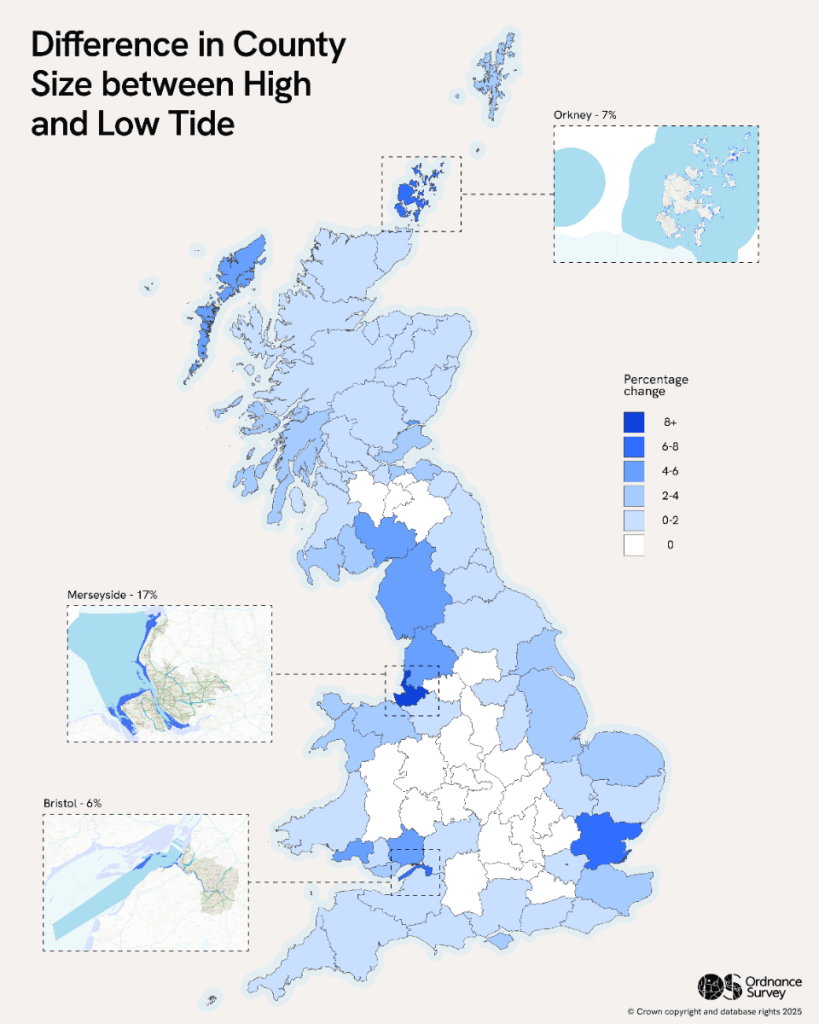
Following the dataset’s release, Ordnance Survey analysed how ceremonial counties change in size between high and low tide. Merseyside showed the greatest variation, with a nearly 17% difference, followed by Orkney at around 7%.
The analysis also highlighted that counties considered landlocked, such as Nottinghamshire and South Yorkshire, still experience significant tidal influence due to rivers like the Trent and the Don being tidal far inland.
When combined with Unique Property Reference Numbers (UPRNs), the tideline data shows that Greater London has the highest number of homes and businesses within 15 metres of the high-tide line, at around 5,500. Cornwall ranks second with just over 3,000 properties, followed by Devon with around 2,400.
The new data has been released under the Public Sector Geospatial Agreement (PSGA), which provides emergency services and public sector organisations with access to Ordnance Survey data and services.


More than 1,200 lives lost each year as charity warns of growing public health crisis
ACCIDENTAL deaths in Wales have risen by 43% over the past decade, with more than 1,200 people now dying each year, prompting calls for urgent action from the next Welsh Government.
New figures released by the Royal Society for the Prevention of Accidents (RoSPA) show that Wales now has a death rate 22% higher than the UK average, with preventable harm placing increasing pressure on the NHS and disproportionately affecting poorer communities.
Falls remain the leading cause of accidental death, accounting for nearly half of all fatalities. People in Wales are around 24% more likely to die from a fall than those elsewhere in the UK.
RoSPA has warned that the situation represents a growing public health crisis, as it launches its Stronger, Safer Wales manifesto ahead of the next Senedd election.
The charity is urging ministers to treat accident prevention as a national priority, arguing that many deaths could be avoided through relatively simple and low-cost interventions.

Accidental harm is also linked to a range of other risks, including rural road collisions, accidental poisonings, machinery incidents, and dog-related injuries.
The wider impact is significant, with preventable accidents costing the NHS billions, reducing workforce participation, and deepening inequality across Wales.
RoSPA is calling for a range of measures, including improved home safety standards, compulsory water safety education in schools, and stronger road safety interventions.
Among its proposals are mandatory eyesight tests for drivers every three years, better road markings to protect motorcyclists, and tighter regulation of unsafe or counterfeit products sold online.

The charity also wants to see national home safety programmes introduced to support vulnerable households, along with clearer responsibilities for local authorities in managing water safety risks.
Becky Hickman, Chief Executive of RoSPA, said the figures should act as a wake-up call for policymakers.
She said: “Wales is facing a clear and escalating crisis of accidental deaths, and the evidence shows the situation is worsening year on year.

“Behind every statistic is a life that could have been saved with practical, proven interventions.
“We are calling on the next Welsh Government to make accident prevention a national priority, because coordinated action will save lives, reduce inequalities and relieve pressure on the NHS.”
She added: “Accidents are not inevitable. With strong leadership and consistent standards across Wales, we can significantly reduce preventable harm.”
RoSPA says tackling the issue will require coordinated action across government, emergency services, local authorities and industry, but insists that the solutions are both achievable and cost-effective.
The charity’s manifesto is intended to shape future policy in Wales, with a focus on reducing avoidable deaths while easing pressure on overstretched public services.

National scheme aims to support hundreds of victims of modern slavery across the UK
MORE than 600 adult survivors of modern slavery are set to receive dedicated support through a new national pilot scheme providing accredited, independent advocates.
The initiative will see specially trained professionals working directly alongside survivors of human trafficking and exploitation, helping them navigate complex legal, social, and recovery processes.
While survivors of crimes such as domestic and sexual abuse already have access to specialist advocacy, no equivalent provision previously existed for victims of modern slavery—despite the often severe and long-term trauma they experience.
Over the next three years, 24 Independent Modern Slavery Advocates (IMSAs) will be deployed across the UK. Each advocate will complete a postgraduate qualification and receive support from a central hub hosted by anti-trafficking charity Hope for Justice.
Tim Nelson, CEO at Hope for Justice, said the pilot aims to tackle inequalities in support: “We want to end the postcode lottery that adult survivors of modern slavery and human trafficking are experiencing in the UK.
“There are many organisations already doing incredible work, but by working together and setting new standards, we can give survivors the best possible chance of rebuilding their lives.”
The scheme is backed by a £1 million National Lottery grant and involves several organisations, including Unseen UK, Medaille Trust, Bawso, SOHTIS, Hope for Justice, and the Snowdrop Project.
Since the pilot began six months ago, advocates have already supported 121 survivors, helping to secure housing, legal recognition, and access to vital services.
Key outcomes so far include:
Ten survivors provided with safe and secure housing
Seventeen Home Office decisions successfully challenged, granting victims access to support
Humanitarian protection secured for a young adult survivor
Advocates have also helped individuals access healthcare, mental health support, education, employment, and secure immigration status.
One survivor described the support as “life changing” after escaping a trafficker. In a letter to her advocate, she said: “You have fought our corner tirelessly when I did not have the strength. You stood beside us every step of the way.

“You helped me rebuild trust, believe in myself, and slowly find my voice again.”
The IMSA role aligns with international guidance on independent advocacy and has been shaped by experts and those with lived experience.
Louise Mensah, Head of Frontline at Unseen, said: “This pilot is a step towards a world without slavery. We are proud to be part of something that will improve outcomes and change futures.”
Ben Ryan, Deputy CEO at Medaille Trust, added: “We know the value of long-term support in recovery. This partnership allows us to embed best practice and develop new approaches.”
Organisations wishing to join the final phase of the pilot have until May 2026 to apply.
Further information is available at www.hopeforjustice.org/imsa/

Beloved character to greet visitors as Heritage Centre reopens for new season
CHARLIE the 100-year-old ventriloquist’s doll is coming out of retirement — and back to where it all began.
Visitors to Pembroke Dock Heritage Centre will be greeted by the much-loved character when the attraction reopens for the new season on Monday (March 30).
It marks a nostalgic return for Charlie, who once performed in the very same building — then the Royal Dockyard Chapel — alongside his original owner, Ernie James, a Pembroke Dock bus company proprietor. Over the years, the duo became a familiar and popular act on the Pembrokeshire variety circuit.
Today, Charlie is cared for by Paul Elliott, of Llanreath, who inherited the doll from his father, Fred Elliott — better known locally as magician ‘Mr E’, whose shows delighted audiences for decades.
Charlie has also recently enjoyed a brush with national attention, appearing alongside Paul at a BBC Antiques Roadshow event in Swansea.

The Heritage Centre will offer free entry on opening day, with Charlie and Paul on hand to meet visitors and share stories from a century of entertainment.



Crime1 day ago
Publican jailed for six years for supplying cocaine and cannabis
Milford Haven man sentenced at Swansea Crown Court following drug dealing operation A MILFORD HAVEN publican has been jailed for...


Local Government1 day ago
Poverty summit highlights support efforts across Pembrokeshire
A SUMMIT bringing together key organisations from across Pembrokeshire has highlighted both the scale of local poverty and the work...


Education2 days ago
Milford Haven school plans unveiled but funding not yet secured
PLANS for a new £100 million school in Milford Haven have been unveiled, but the project has not yet secured...


News2 days ago
Council unveils plans for new state-of-the-art secondary school in Milford Haven
PEMBROKESHIRE COUNTY COUNCIL has revealed plans for a new state-of-the-art school in Milford Haven, promising modern, inspiring learning spaces for...


Health2 days ago
NHS waiting list falls — but cancer delays and diagnostic backlog worsen
Record progress claimed by Welsh Government as critics warn key targets are still being missed THE NHS in Wales has...


Crime3 days ago
Rapist jailed after ‘abhorrent’ attacks on woman and children
Haverfordwest man told police “women won’t have sex without force” A HAVERFORDWEST man who raped a woman and a young...


News3 days ago
Reform secures first Pembrokeshire councillor in Hakin by-election win
Late Reform candidate takes seat as independent surge and Labour withdrawal shape contest REFORM UK candidate Scott Thorley has won...


News4 days ago
Scott Thorley elected as Pembrokeshire’s first Reform councillor
REFORM UK candidate Scott Thorley has won the Hakin by-election after securing 179 votes. The full result is as follows:...


News4 days ago
Police confirm man has died after being recovered from River Cleddau
Major emergency response in town centre after concerns raised for man in water A MAN has died after being recovered...


Community4 days ago
Davies and Kurtz urge groups to seek employability funding
Community organisations in Pembrokeshire encouraged to apply for new grants supporting skills and job access LOCAL Senedd Members Samuel Kurtz...
-

 News6 days ago
Fishguard linked to allegations in Many Tears Animal Rescue investigation
-

 News4 days ago
Emergency services flood Haverfordwest after reports of person in river
-

 Crime3 days ago
Mother given community order after admitting child cruelty offence
-
Health2 days ago
NHS waiting list falls — but cancer delays and diagnostic backlog worsen
-

 Crime6 days ago
Man cleared of sexual assault allegation after magistrates rule no case to answer
-
 News4 days ago
Senedd votes to ban Greyhound racing in Wales to protect animal welfare
-

 News4 days ago
Senedd vote to ban greyhound racing hailed as ‘landmark moment’ by charities
-

 Sport7 days ago
Wales end Six Nations losing run with bonus-point win over Italy