


Health
Generous local grant funds specialist bed for bereaved parents at Glangwili Hospital

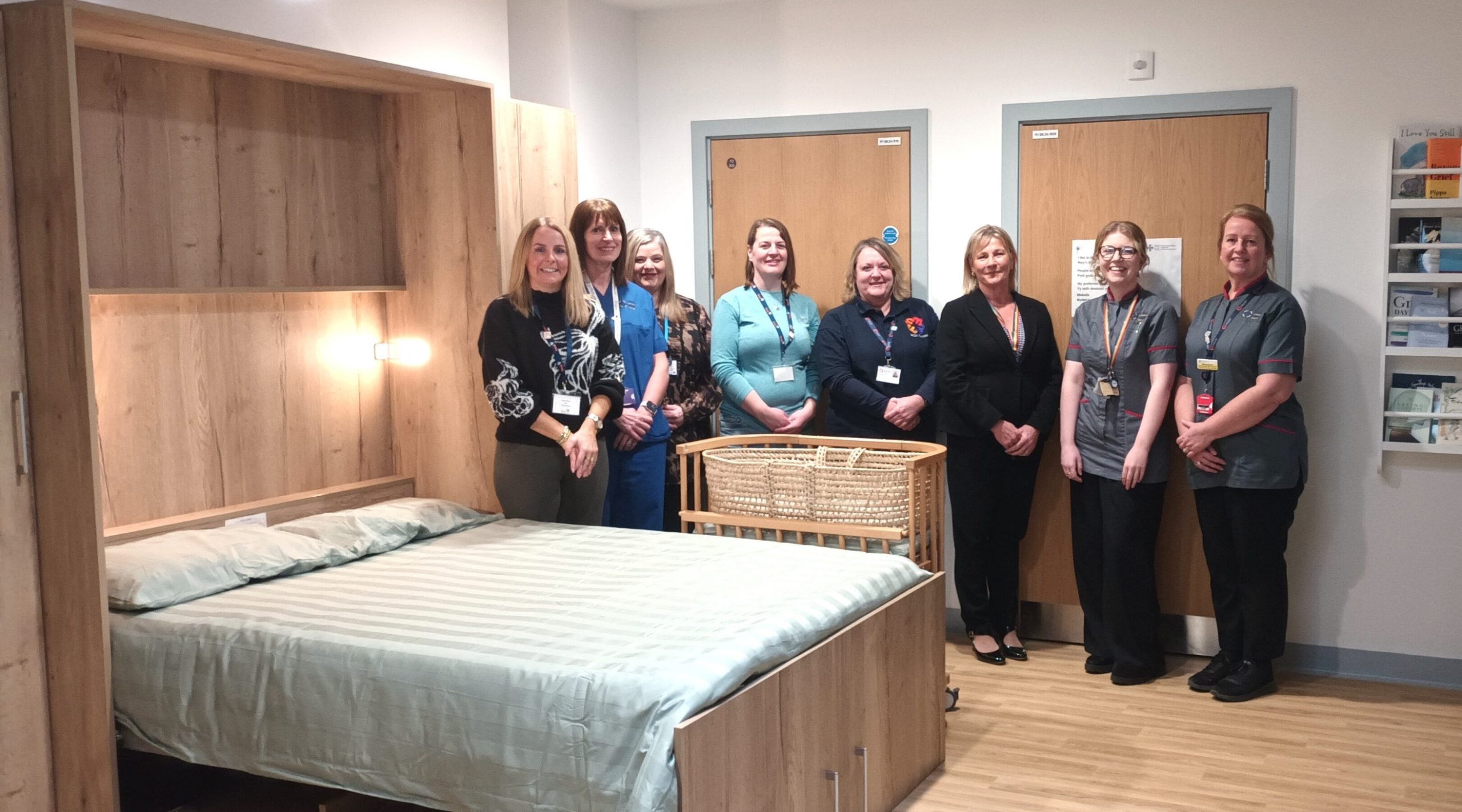
A GENEROUS grant from a volunteer-led local group, part of Sands, has funded a bespoke pull-down double bed for the bereavement room on the labour ward at Glangwili Hospital.
The specialist fitted bed, which cost more than £16,000, has transformed the bereavement room into a more family-focused space, allowing parents to remain close and support one another at an incredibly difficult time.
The bereavement room forms part of the hospital’s newly built Labour Suite and is fully self-contained, with a kitchenette, small dining area and ensuite bathroom. Until now, however, the room only included a birthing bed and a single sofa bed, meaning partners were unable to rest together.
Feedback gathered from bereaved families through Sands and local parent support groups highlighted the importance of physical closeness following the loss of a baby. Parents described how being able to lie together, rather than apart, can provide comfort, reassurance and a sense of shared support during the early stages of grief.
The funds for the bed were raised by Carmarthenshire & Pembrokeshire Sands volunteers Hayley Vallance, Astra Shipton and Sioned Twose, who organised a burlesque-inspired charity event, Zoo-la-la, at Manor House Wildlife Park in September 2025. The event raised more than £20,000.

The volunteer-led Carmarthenshire & Pembrokeshire Sands group supports anyone affected by pregnancy loss or the death of a baby across the two counties.
Alison Jones, Clinical and Operational Lead Midwife, said: “The loss of a baby is a devastating experience, and the environment in which families grieve can make a real difference.
“This bespoke bed allows parents to be physically close, to hold each other and to share their grief in a private, dignified space. It will have a profound impact, and we are incredibly grateful to Carmarthenshire & Pembrokeshire Sands for making this possible.”
Hayley Vallance and Astra Shipton, volunteers with Carmarthenshire & Pembrokeshire Sands, said:
“Our fundraising is in memory of George, Owen and all the babies gone too soon, and to help raise awareness of the vital support provided by Sands and the NHS to families when they need it most.

“We hope this specialist bed will bring comfort and dignity to parents during the hardest moments of their lives. Couples deserve to be together at such times, and we are honoured to have supported such a meaningful improvement in care for our community.”
Jen Coates, Director of Bereavement Support, Community and Volunteering at Sands, said:
“We are extremely grateful to Hayley, Astra and Sioned for their dedication and hard work supporting bereaved families in Carmarthenshire and Pembrokeshire.
“By fundraising for this bed at Glangwili Hospital, our volunteers have made a lasting and meaningful difference to the experience of families at an unimaginably difficult time.”



Confusion grows over decision-making as concerns mount about future of local hospital services
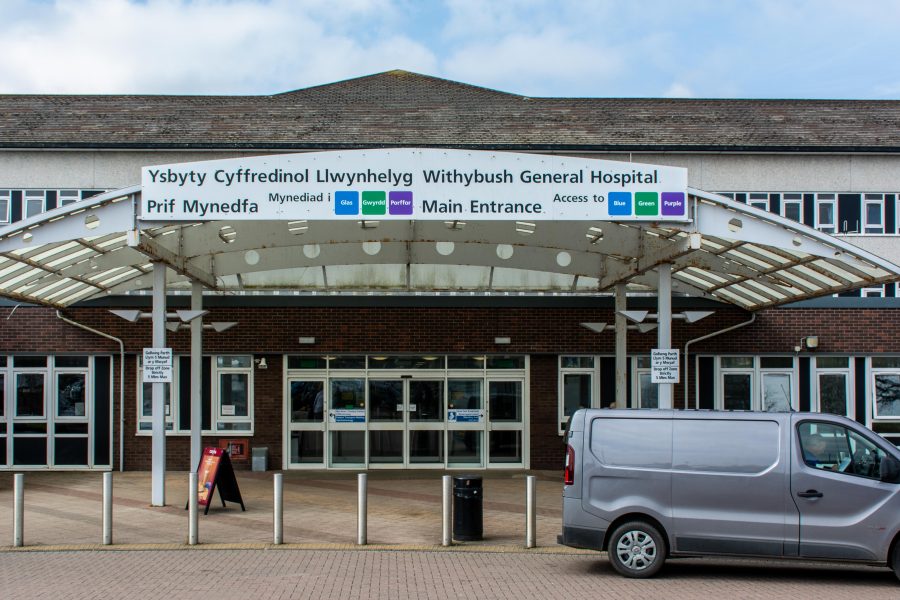
QUESTIONS over who ultimately decides the future of NHS services in west Wales are becoming increasingly prominent as uncertainty continues around proposals affecting hospitals including Withybush and Bronglais.
With public concern rising, political debate intensifying, and a petition attracting thousands of signatures, many residents are asking a simple question: who is actually responsible for decisions that could reshape healthcare across the region?
The answer is complex — but responsibility does not sit in just one place.
Welsh Government Ministers hold overall responsibility for the NHS in Wales because health is devolved to Cardiff Bay. The Cabinet Secretary for Health and Social Care sets national policy, determines funding allocations and has the power to intervene in major service reconfiguration proposals. While Ministers often emphasise that local health boards manage delivery, they remain politically accountable to the Senedd for NHS performance and outcomes across the country.
At a regional level, Hywel Dda University Health Board is responsible for planning and delivering services across Pembrokeshire, Carmarthenshire and Ceredigion. The health board manages hospitals including Withybush, Glangwili and Bronglais, oversees staffing and budgets, and develops proposals for service changes. It is the body that produces consultation documents and makes operational decisions, but it does so within financial and strategic frameworks set by Welsh Government.
Public consultation exercises play an important role in shaping proposals, but they do not determine the final outcome. Feedback gathered from residents, clinicians and stakeholders is considered by the health board before decisions are taken. In some circumstances, proposals may be referred to Welsh Ministers for approval or intervention, particularly if there is significant controversy or political concern.
Members of the Senedd, including local representatives, scrutinise decisions and raise constituent concerns, but they do not directly control NHS services unless they are part of the Welsh Government. Opposition politicians can apply pressure and influence debate, but executive authority ultimately rests with Ministers and the health board.
The shared nature of responsibility has led to frustration among some residents, who feel accountability is unclear when services face potential change. Health boards point to funding constraints and national policy requirements, while Welsh Government often emphasises that operational decisions are taken locally.
In practice, both levels of the system play critical roles. Health boards design and implement plans, while Welsh Government sets the strategic direction and retains the power to intervene if necessary.

Concerns about healthcare provision in west Wales have intensified in recent months amid wider debate about NHS performance, waiting times and access to services. Political disagreements have also sharpened ahead of the Senedd elections scheduled for 2026.
For patients and communities, however, the central issue remains access to safe and timely care close to home — regardless of where responsibility ultimately lies.
The Herald has asked Welsh Government and Hywel Dda University Health Board for comment on decision-making processes relating to potential service changes affecting west Wales.
Staff shortages and safety concerns highlighted in national assessment
A MAJOR national assessment of maternity and neonatal services in Wales has exposed systemic weaknesses, staffing shortages and missed opportunities to improve patient safety, raising concerns that families are being let down while frontline staff struggle under increasing pressure.
The Maternity and Neonatal National Assurance Assessment — The Path to Safer Beginnings in Wales — found examples of compassionate, dedicated care across the country, but warned that key vulnerabilities remain in safety, consistency and outcomes for women, babies and families.
The independent review, led by former Children’s Commissioner for Wales Professor Sally Holland, gathered evidence from more than 600 women, parents, families and staff, alongside visits to maternity and neonatal units in every Welsh health board.
While many families reported positive experiences and praised staff professionalism, others described poor communication, inconsistent postnatal support and limited involvement in decision-making. A small number who experienced serious harm or loss said their trauma was worsened by defensive responses rather than openness and learning.
The report also found that national organisations responsible for improving maternity care are often working in parallel rather than collaboratively, with data not being used effectively to identify emerging risks, inequalities or areas needing urgent intervention.
Rising medical interventions — including record caesarean rates — alongside delays in reconfiguring neonatal services in south Wales were also highlighted as factors affecting both safety and staff morale. Postnatal and perinatal mental health provision was found to lag behind services elsewhere in the UK.
Staff told assessors they felt overstretched by increasing complexity in care needs and lacked time to provide the continuity and postnatal support they believed families required.
The panel identified eight priority areas for improvement rather than adding to the more than 500 recommendations made over the past decade, calling for stronger national coordination, better use of digital records for real-time safety monitoring, and the introduction of a national 24-hour pregnancy triage line.
Professor Holland said: “Excellent maternity and neonatal services are central to our health as a society. They have life-long impacts on physical health, mental health and family relationships.
“The challenges are large, but they are solvable, if they include those who rely on or work in Wales’s maternity and neonatal services every step of the way.”
Midwives’ leaders have also called for urgent action, particularly on workforce pressures.
Julie Richards, Director of the Royal College of Midwives (RCM) Cymru, said the findings reflected longstanding concerns raised by frontline staff.

She said: “This report echoes what midwives and maternity support workers across Wales have been telling us for some time. There is real compassion and commitment across our workforce but there are serious and urgent challenges that must now be addressed.
“Safe staffing is the foundation of safe care — you cannot deliver safe, high-quality maternity care without a workforce that is properly staffed, supported and resourced.
“Staffing shortages must be treated as an immediate safety issue and we are calling on the Welsh Government to address this urgently, with dedicated funding and a commitment to fully implement these recommendations.”
She added that the right skill mix, stronger leadership support and investment in newly qualified midwives were essential to creating a sustainable workforce.
The report has already prompted political criticism.
Welsh Conservative Shadow Cabinet Secretary for Health and Social Care, Peter Fox MS, said: “After 27 years of Labour running our NHS, propped up by Plaid, this report lays bare a maternity system that is overstretched, under-supported and lagging behind the rest of the UK.
“Families are being let down by poor postnatal care, inadequate mental health provision and inconsistent investigations when things go wrong, while staff are left battling unsafe staffing levels and rising intervention rates.
“The Welsh Government must take responsibility for these failings and urgently fix systemic problems in maternity care.”
The Welsh Conservatives say they would bolster the workforce, improve data collection and establish a dedicated mother and baby unit to address gaps in provision, particularly in North Wales.
The report concludes that Wales has the expertise and commitment needed to deliver high-quality maternity care, but warns that meaningful improvement will require sustained investment, clear accountability and national coordination.
Public response now far exceeds health board consultation figures
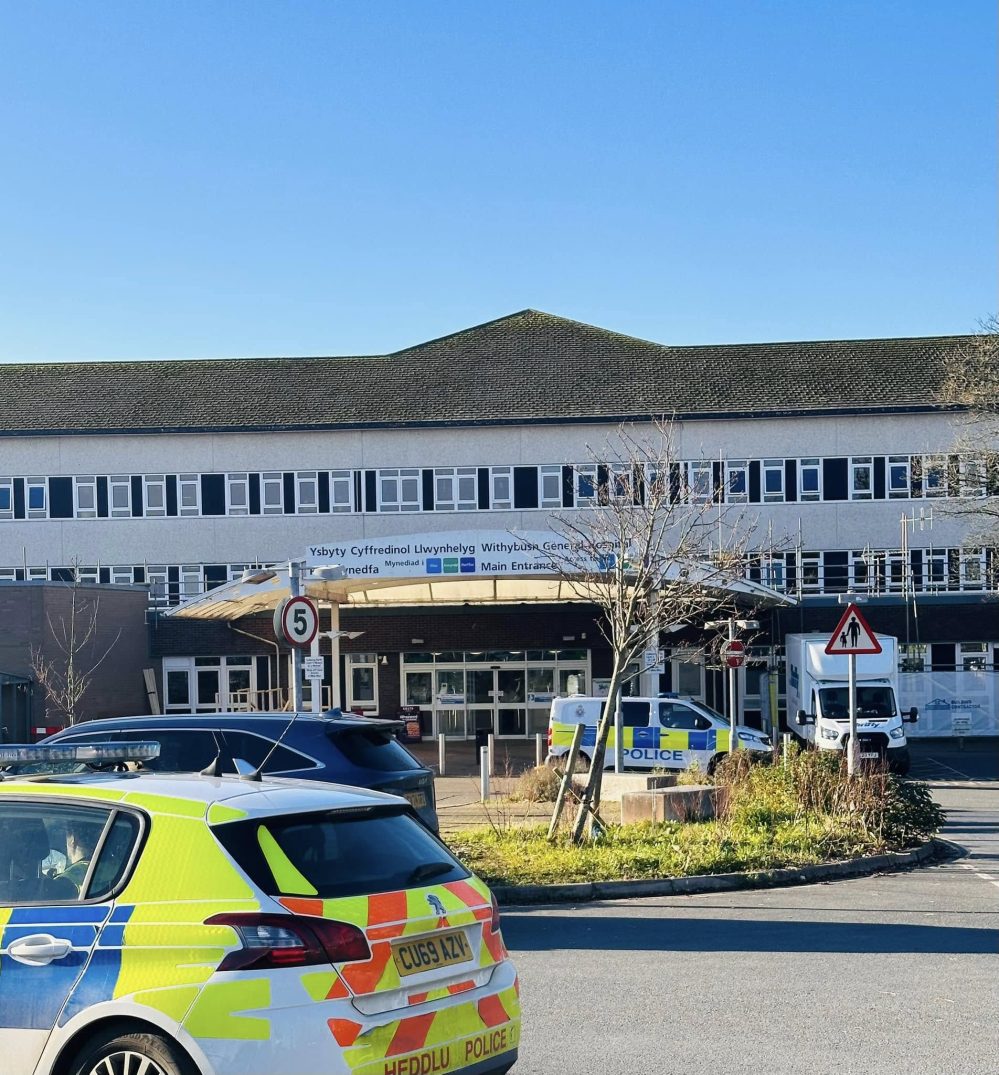
A PETITION calling for urgent Welsh Government intervention over services at Withybush Hospital has now attracted more than 6,000 signatures — significantly higher than the number of people who formally responded to Hywel Dda University Health Board’s major consultation last year.
The Senedd petition, titled “Urgent Pembrokeshire Healthcare & Resident Safety – Withybush Hospital & Health Board Intervention,” demands direct government oversight of the health board and restoration of key services in Pembrokeshire.
The surge means public engagement with the campaign has now overtaken the roughly 4,140 questionnaire responses submitted during the health board’s official consultation on its Clinical Services Plan.
Campaigners say the growing numbers demonstrate that opposition to the changes is continuing to build rather than fade.
Safety concerns raised
The petition states that the current configuration of services represents a threat to patient safety, particularly in a rural county where travel times to alternative hospitals can be significant.
It calls on the Welsh Government to:
• intervene directly in the running of Hywel Dda University Health Board
• guarantee core hospital services locally
• equalise healthcare standards across Wales
• restore services to Withybush
The campaign was launched after the health board confirmed plans to change emergency general surgery provision, with operations expected to transfer away from Withybush Hospital while other services are reconfigured.
Health board leaders have previously said the changes are designed to improve safety and ensure services are clinically sustainable in the long term.
However, critics argue the proposals risk increasing travel times for critically ill patients and placing further pressure on ambulance services.
‘Removal of vital services’
The petition’s creator, Ajay Owen, said the campaign had been prompted by what he described as the “repeated and systematic removal of vital services from Pembrokeshire.”
“For someone living in a coastal community like St David’s, Carmarthen is over an hour away by car — and that is assuming they have access to a vehicle,” he said.

“With virtually non-existent public transport links and prohibitive taxi costs, the golden hour — the critical window where medical intervention offers the best chance of survival — is being lost. This isn’t just a matter of convenience; it is a significant safety risk to life.”
He said he had been encouraged by the level of public support so far.
“Every signature represents a voice that refuses to be ignored and a person who values the safety of their community,” he said.
“The momentum behind the petition highlights a shared anxiety across Wales: people are worried that their local hospitals are being hollowed out.”
Owen added that he believed Welsh Government intervention was now necessary.
“When a health board’s strategy creates a safety risk by placing life-saving care outside of the golden hour for an entire segment of the population, it is the duty of the Welsh Government to step in,” he said.
Political pressure growing
Under Senedd rules, petitions that exceed 10,000 signatures may be considered for debate in the Welsh Parliament.
With the current total already past 6,000 and rising, campaigners believe the threshold could be reached within weeks if momentum continues.
Residents wishing to sign the petition can do so here:
https://petitions.senedd.wales/petitions/246864
The Herald understands that concerns about rural healthcare access and the future of Withybush Hospital are likely to remain a major political issue in Pembrokeshire ahead of the Senedd elections in May.



News7 hours ago
Hoax 999 call sparks massive lifeboat and helicopter rescue — man arrested
Emergency services diverted from real incidents after false report off south Wales coast A MAJOR sea rescue operation involving three...


Crime10 hours ago
St Dogmaels man jailed over hundreds of indecent images
Previous convictions for similar offences revealed to court A 57-YEAR-OLD man from St Dogmaels has been jailed for two-and-a-half years...


Health10 hours ago
Petition against hospital service changes surges past 6,000 signatures
Public response now far exceeds health board consultation figures A PETITION calling for urgent Welsh Government intervention over services at...

Crime1 day ago
Milford Haven pensioner admits sexually assaulting two shop workers
76-year-old touched victims and kissed one on the neck, court hears A MILFORD HAVEN man has admitted sexually assaulting two...


News2 days ago
Senedd backs assisted dying legislation in historic vote
POLITICIANS in the Senedd have voted in favour of legislation that could allow assisted dying services to be provided through...
Crime2 days ago
Manchester men deny aggravated burglary after armed raid on dog breeder
Prosecution says machete-armed gang carried out “carefully planned” attack TWO men have gone on trial accused of involvement in an...


News2 days ago
Labour and Plaid criticised over £1.2m anti-racism ‘metaverse’ project
Figures revealed in Senedd questions as political row intensifies ahead of election THE WELSH GOVERNMENT has come under political pressure...


Business2 days ago
Local Senedd member hears retailer concerns ahead of election
INDEPENDENT shop owners in Pembrokeshire have warned that rising costs and increasing pressures could threaten the future of small high-street...


Charity3 days ago
Charity launches bid to save Foley House with new community cooperative
A PEMBROKESHIRE charity has launched an ambitious bid to restore Foley House, one of Haverfordwest’s most significant historic buildings, through...
Crime3 days ago
Man who threatened to kill Herald editor given suspended prison sentence
A PEMBROKESHIRE man who sent a message threatening to kill Pembrokeshire Herald editor Tom Sinclair has been given a suspended...
-

 Health6 days ago
Concerns grow over Bronglais stroke plans as politicians demand clarity
-
 Local Government4 days ago
Candidate who withdrew from Hakin race will still appear on ballot paper
-
 Crime4 days ago
BBC documentary reveals local man murdered mother then lived with her body
-

 Local Government5 days ago
First Minister left red-faced as Labour candidate pulls out during Hakin campaign visit
-
 Entertainment6 days ago
New theatre show explores realities of motherhood in Pembrokeshire
-

 Business6 days ago
Pembrokeshire businesses ‘squeezed to breaking point’ amid economic pressures
-
 News6 days ago
Thousands of potentially contaminated land sites recorded across Pembrokeshire
-
 Crime6 days ago
Teacher stabbed by pupil criticises school weapon scanner plans