


News
Why NASA’s new race to the moon is partly powered by Wales


SPECIAL REPORT – How latest lunar plans are a truly an international effort
THE SPACE RACE is back — but forget Apollo’s flag-planting sprint. NASA’s Artemis programme is a marathon of supply chains, standards and long-term presence. As NASA’s massive Artemis II rocket slowly rolls out to the launch pad today (Sunday) this isn’t just about who plants a flag first. It’s about who builds the infrastructure, sets the rules, and sustains influence in the next era of lunar exploration and beyond.


On the surface, Artemis looks like an American show: a Florida launchpad, NASA’s Space Launch System rocket, an Orion spacecraft. But peel back the layers and it becomes obvious this is a genuine coalition effort — one where the United Kingdom, and increasingly Wales, has a meaningful supporting role in the rules, the hardware and the industrial backbone that will define deep-space missions for decades.


The UK is not a passenger
Britain isn’t supplying the giant rocket, running the launch, or leading the programme overall. Yet the UK is embedded in Artemis through three critical dimensions: diplomatic frameworks, essential hardware and specialist capability.
First, the UK signed the Artemis Accords in October 2020. That sounds like paperwork, but it matters. In a future of frequent missions, lunar bases and commercial activity, the real competition will be over behaviour, interoperability and trust: who shares data, who can work safely together, and who helps shape the norms that govern activity beyond Earth. The Accords are the scaffolding for all of that — and signing them puts Britain inside the tent as the rules of the next space era are written.

Second, the most tangible proof that Artemis is international is bolted directly to the spacecraft. Orion relies on a European Service Module delivered through the European Space Agency, with Airbus as prime contractor. This module isn’t a decorative “European contribution”. It provides the unglamorous essentials that make the mission possible: electricity, propulsion, thermal control, and key life-support resources such as air and water. Without it, the spacecraft cannot operate as intended.

Third, that European contribution draws on a distributed industrial chain — the modern reality of spaceflight. The UK’s space sector matters because it is strong in the behind-the-scenes work: high-reliability engineering, advanced electronics, precision materials, software and testing. These are not headline-grabbing roles, but they are the difference between a mission concept and a mission that flies.
So where does Wales fit?
To be clear and honest about scale: Wales isn’t designing the SLS rocket, selecting the crew, or dictating mission timelines. But Wales is demonstrating real relevance in the technologies the long-duration exploration economy will depend on — and that is what “powered by Wales” should mean.
Cardiff-based Space Forge is the standout example. At the end of 2025, the company successfully generated plasma aboard its ForgeStar-1 satellite — describing it as a world-first capability for commercial orbital semiconductor manufacturing. In plain English, it showed that the extreme conditions needed for processes like gas-phase crystal growth can be created and controlled autonomously in low Earth orbit.
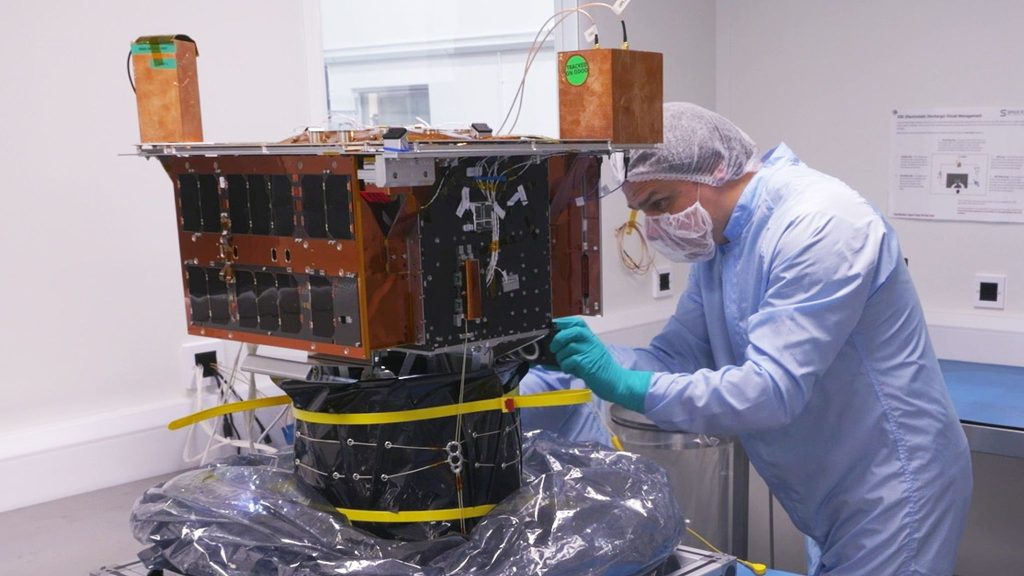
Why does that matter to a Moon programme? Because better semiconductor materials and tougher high-performance components can mean more efficient power systems, more resilient communications, and hardware that survives harsh environments for longer. These are the incremental gains that ripple through satellites today and, in time, through the systems needed for sustained lunar operations tomorrow.

This is not isolated innovation, either. Wales is building the kind of ecosystem that turns a clever demonstration into a supply-chain advantage. The Wales Space Cluster Catalyst Fund — backed by the UK Space Agency in partnership with Space Wales and the Welsh Government — is designed to unlock opportunities for Welsh businesses and researchers, building skills and collaboration across the sector.
In the new space race, that ecosystem-building is not window dressing. It is how places secure a future share of contracts and talent. You do not have to own the rocket to benefit from the industry — but you do have to be ready when primes and agencies decide who they trust to deliver.
Why the international angle matters — especially for Wales

The new Moon race isn’t just prestige. It is strategic: presence, influence, and economic leverage in a domain where China is advancing its own lunar ambitions and partnerships. America’s answer is not isolation, but alliance — spreading cost and risk, and building legitimacy through international cooperation.

For the UK, Artemis offers leverage: a voice in standards, industrial participation through ESA-linked hardware, and the technology spillovers that come with serious programmes. For Wales, the opportunity is more specific: to become known for specialist capability — in advanced manufacturing, materials, electronics, and the research-to-industry pipeline that turns prototypes into products.
The real prize isn’t the first set of footprints. It is the long tail: sustained supply-chain roles, industrial growth and well-paid skilled jobs.
This isn’t about waving a flag at a distant launch. It is about doing what Wales has always done best: building clever, reliable things the world increasingly needs — and making sure Wales is on the supply lists when lunar exploration stops being a spectacle and becomes routine.


Police increase presence as enquiries into school incident continue
PUPILS at Ysgol Maesydderwen will return to class tomorrow (March 4) after the school was closed for a day following a second threat.
Dyfed-Powys Police confirmed that officers are continuing to work closely with Powys County Council after threats were received by the school on Monday (March 2).
A second threat, sent via email, was reported to police later that evening.
The school remained closed on Tuesday (March 3) while enquiries were carried out. Following a review of the circumstances, a decision has been made to reopen the school on Wednesday.
Superintendent Gareth Grant said: “We understand this is a very unsettling time for the school’s pupils, teachers, parents and the wider community.
“I want to reassure the public that there is no evidence to suggest any threat against any other schools or businesses in the local area.
“Our priority is to ensure the safety of pupils and teachers at the school, and we are working closely with Powys County Council and the senior leaders at Ysgol Maesydderwen to this end.
“I want to thank the community for their understanding and patience while we carry out our enquiries. The impact of school closures on parents and carers cannot be underestimated, and I extend my thanks to everyone who has supported us to this point.
“You will see an increased police presence in the area as we continue our enquiries and provide reassurance to the local community.
“We will continue to share more information as soon as we are able to.”
Police have confirmed that enquiries remain ongoing.

NATIONAL EDUCATION UNION CYMRU has published a new manifesto outlining its vision to “Save Education in Wales” ahead of the Senedd elections in May.
The union says the document is designed to help political parties ensure their policies reflect the needs of the education workforce and learners across Wales.
Launching the manifesto, Nicola Fitzpatrick, Wales Secretary of the National Education Union, said education must be at the heart of the next Welsh Government’s priorities.
“NEU Cymru members are clear that education must be a priority for the next Welsh Government. May’s election is important — this is our chance to vote for education in Wales,” she said.
She identified funding, workforce trust and tackling child poverty as key issues.

“Funding is clearly a priority for NEU Cymru, along with trusting the workforce and ending child poverty. The next Welsh Government needs to invest in education to ensure that we are supporting the next generation. But we can’t be complacent,” she added.
The union also set out areas it believes must be protected, including opposition to academisation.
“There are parts of the education system that we need to protect — no academisation of schools, for example, because in Wales children are the priority, not private interests. Free school meals for all our primary school children must be protected. And our Welsh values are important too — protecting diversity, equality and inclusion.”
The manifesto sets out a series of policy proposals aimed at strengthening public education in Wales as parties prepare their campaigns for May’s vote.


Class A drugs, cash and suspected supply items seized during warrant in Aberystwyth
POLICE have charged two people following a drugs warrant executed at a property in Penparcau, Aberystwyth.
Officers carried out the warrant under the Misuse of Drugs Act on Friday (Feb 27), as part of an operation targeting the supply of illegal substances in the area.
During a search of the address, police recovered a quantity of Class A drugs, cash and items believed to be linked to drug dealing.
Gareth Farr, aged 45, of no fixed abode, and Chloe Evans, aged 38, of Penparcau, have both been charged with possession with intent to supply Class A drugs.
The pair appeared before Haverfordwest Magistrates’ Court on Monday (Mar 2), where they were remanded in custody pending further court proceedings.
Two other individuals arrested in connection with the investigation have been released on bail while enquiries continue.
PC Sturdy, from the Neighbourhood Policing and Prevention Team, said: “This warrant forms part of our continued efforts to disrupt the supply of illegal drugs in our communities. Drug-related activity causes significant harm, and we remain committed to targeting those involved.”
Police are urging anyone with information about suspected drug activity to contact Dyfed-Powys Police, or to report anonymously via Crimestoppers on 0800 555 111 or online.



Health8 hours ago
Hywel Dda warns of ‘significant pressure’ as A&E departments remain packed
Patients urged to use NHS 111 as Withybush, Glangwili and Bronglais face continued strain HYWEL DDA University Health Board has...


News1 day ago
War stops Qatar gas: Milford Haven LNG supplies disrupted
UK energy security concerns grow after shutdown at major export facilities ENERGY bills in the UK could rise sharply after...


Community1 day ago
Martyn Butler dies aged 71 months after Haverfordwest visit
Co-founder of Terrence Higgins Trust attended local plaque unveiling honouring friend Terry Higgins A LEADING figure in the UK’s response...


Crime1 day ago
Nine deny Class A drugs conspiracy as case set for Crown Court trial
Eight remanded in custody as four-week trial fixed for May 18 NINE people have denied conspiring to supply Class A...


Community1 day ago
No asylum seekers housed in west Wales hotels, latest Home Office figures show
WEST Wales currently has no asylum seekers being housed in hotels, according to the latest figures published by the Home...


Community4 days ago
St David’s Day parade brings colour and celebration to Haverfordwest
HAVERFORDWEST town centre was a hive of activity today (Friday, Feb 27) as hundreds of children from schools across Pembrokeshire...

News5 days ago
Hoax 999 call sparks massive lifeboat and helicopter rescue — man arrested
Emergency services diverted from real incidents after false report off south Wales coast A MAJOR sea rescue operation involving three...


Crime5 days ago
St Dogmaels man jailed over hundreds of indecent images
Previous convictions for similar offences revealed to court A 57-YEAR-OLD man from St Dogmaels has been jailed for two-and-a-half years...


Health5 days ago
Petition against hospital service changes surges past 6,000 signatures
Public response now far exceeds health board consultation figures A PETITION calling for urgent Welsh Government intervention over services at...


Crime6 days ago
Milford Haven pensioner admits sexually assaulting two shop workers
76-year-old touched victims and kissed one on the neck, court hears A MILFORD HAVEN man has admitted sexually assaulting two...
-

 Health7 days ago
Health services row escalates as MSs demand action over Withybush and Bronglais
-
Crime6 days ago
Milford Haven pensioner admits sexually assaulting two shop workers
-

 News6 days ago
Welsh Government criticised after Russian-linked drone image used in defence announcement
-

 Business6 days ago
Council reviewing complaints over Computer Solutions Wales as concerns continue
-

 Health6 days ago
Petition calling for Withybush intervention nears 5,000 signatures
-

 Business7 days ago
Bosherston Bistro 10pm alcohol licence granted by council
-
News5 days ago
Hoax 999 call sparks massive lifeboat and helicopter rescue — man arrested
-

 News7 days ago
Senedd backs assisted dying legislation in historic vote