


News
Government plans nuclear overhaul to speed up new reactors

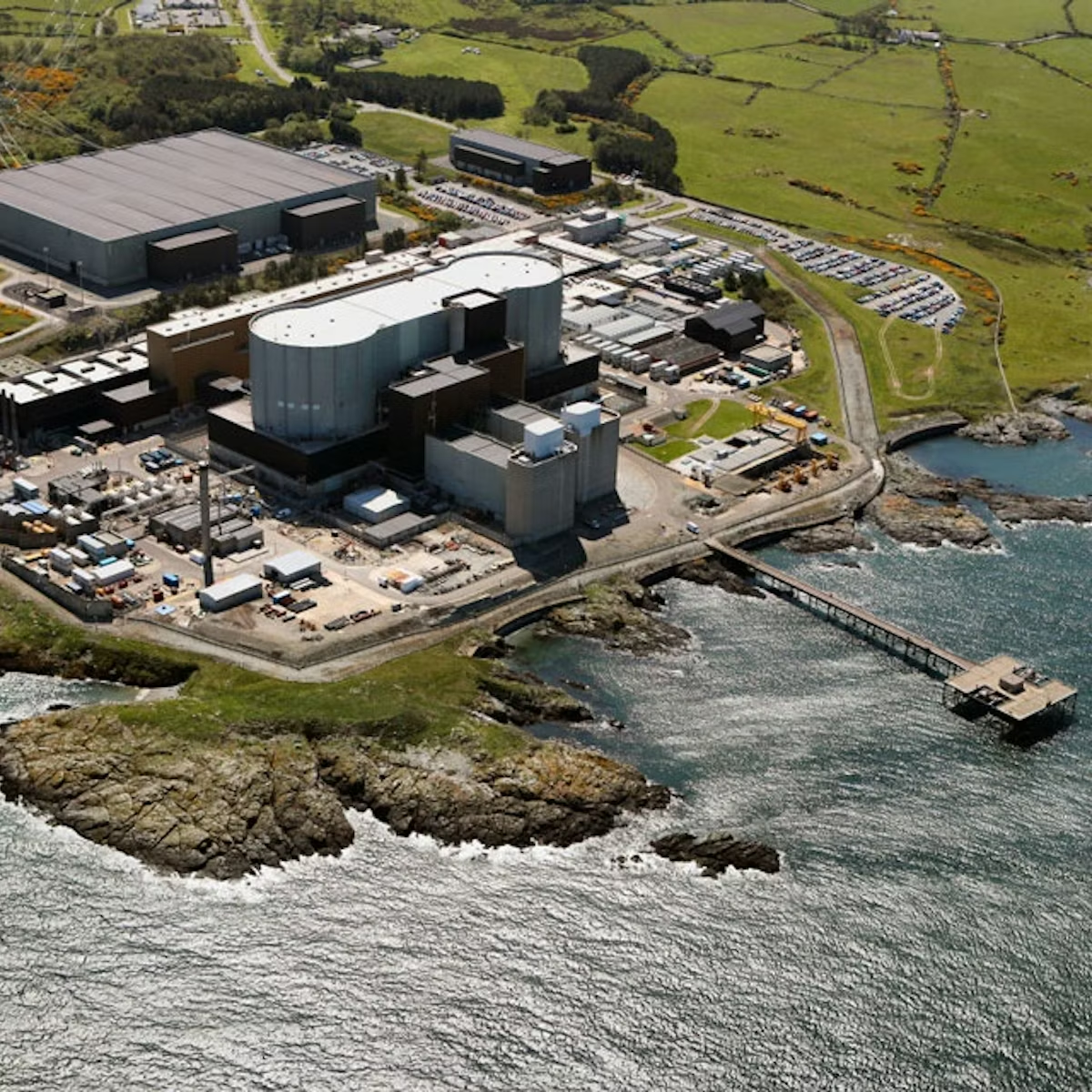
MINISTERS say reforms will cut costs and strengthen energy security, but critics warn projects remain expensive and slow to build
The UK government has announced a major overhaul of the country’s nuclear planning and regulatory system aimed at speeding up the construction of new reactors, reducing costs and strengthening national energy security.
The reforms follow an independent review led by John Fingleton, which concluded that the current regulatory framework is overly complex and bureaucratic, slowing the delivery of nuclear infrastructure.
Ministers say the changes will simplify regulation while maintaining safety and environmental protections, with all recommendations expected to be implemented by the end of 2027.
The government argues that expanding nuclear energy will help reduce Britain’s dependence on volatile fossil fuel markets and support the transition to low-carbon electricity.

Energy Secretary Ed Miliband said: “The current conflict in the Middle East shows why we must move further and faster to build the clean energy system our country needs.
“A crucial part of this is ensuring that we speed up the building of infrastructure in a way that reduces costs while delivering better outcomes for nature.”
Chancellor Rachel Reeves said nuclear energy would play an important role in strengthening the UK’s economic resilience.
“To build national resilience, drive energy security and deliver economic growth, we need nuclear,” she said.

The government has already approved major nuclear projects including Sizewell C in Suffolk and the ongoing construction of Hinkley Point C in Somerset. Ministers are also backing plans for small modular reactors, with the first expected to be built at the former Wylfa nuclear site on Anglesey in North Wales.
Alongside the regulatory reforms, the government confirmed £65.6 million of funding for seven nuclear research programmes at universities across the UK.
Institutions involved include Bangor University and Swansea University, with the funding delivered through UK Research and Innovation and matched by industry partners.

The programme will also fund more than 500 doctoral students over four years to train the next generation of nuclear scientists and engineers.
Research areas will include advanced reactor technologies, nuclear waste disposal, innovative fuels and materials, and technologies linked to national security.
However, environmental campaigners remain sceptical about the expansion of nuclear power.
Groups including Greenpeace UK have previously warned that nuclear plants are expensive and take many years to build, arguing that investment should instead focus on renewable energy such as wind and solar.
Large nuclear projects in the UK have also faced significant delays and rising costs. Hinkley Point C, currently under construction in Somerset, has seen its estimated completion date pushed back several times while projected costs have increased substantially.
Supporters of nuclear power argue that it provides a reliable source of low-carbon electricity that can operate regardless of weather conditions, helping to stabilise the energy system as more renewable power comes online.
The government says the wider nuclear sector could support around 65,000 jobs by 2030, including roles linked to the UK’s defence nuclear programme and the construction of new Dreadnought-class submarines.
The reforms are intended to make it easier to deliver both civil and defence nuclear projects while maintaining safety standards and environmental protections.


SUPPORT organisations from across Ceredigion will gather at Cardigan Guildhall Market next week to raise awareness about cancer and the importance of early detection.
The event, organised by HAHAV Ceredigion, the county’s volunteer-led hospice-at-home charity, will take place on Thursday (Mar 19) between 10:00am and 3:00pm.
Visitors will have the opportunity to learn about local cancer support services, speak directly with specialists and pick up information about screening programmes which can help detect cancer at an earlier stage.
While one in four people in Wales sadly die from cancer, survival rates have doubled over the past 50 years. Health experts say this improvement is largely due to earlier diagnosis through national screening programmes.
HAHAV Ceredigion’s Living Well Manager, Susie Scott said: “A significant reason for the increase in survival rates is the success of screening programmes. Early detection saves lives and can mean shorter treatment times.
“However, survival rates in rural communities, of which we have many in Ceredigion, are still lower. That means it is even more important that people have access to the right information and support.”
Several organisations will be attending the event alongside HAHAV Ceredigion, including Hywel Dda University Health Board’s Cancer Information Support Service and the Lingen Davies Cancer Champions.
Susie added that a recent grant from the Lingen Davies cancer charity has helped HAHAV deliver important awareness and prevention work across rural communities.
Other groups attending include Cardigan Cancer Care and Knitted Knockers, a charity that creates handmade breast prostheses for women recovering from breast cancer surgery.

Susie said: “Breast cancer screening is a great example of how awareness and early detection can improve survival, with more women now reaching the five and ten-year survival milestones.
“But bowel cancer cases are increasing in people under fifty, and deaths from kidney and liver cancer are also rising. That makes it vital that people know where they can go locally for advice and support.”
Members of the public are encouraged to visit the event to speak with support organisations and learn more about cancer prevention, symptoms and local services.
Photo caption: Susie Scott, HAHAV Ceredigion’s Living Well Manager, with a giant breast model created by Ann Shrosbree of Small World Theatre in Cardigan. The model will also feature in the Lingen Davies ‘Titty Trail’, an 11-mile awareness walk highlighting the signs and symptoms of breast cancer.

PHARMACIES across Wales carried out more than 600,000 clinical consultations for a wide range of common health issues over the last twelve months, according to the latest community pharmacy services statistics.
Almost 346,000 people used the Common Ailments Service, which offers free advice and treatment for twenty-seven common conditions and is available in ninety-nine per cent of pharmacies across Wales.
Figures covering April 2024 to March 2025 show that more than 462,000 Common Ailments Service consultations took place during the period – the highest number ever recorded.
The most frequent reasons people sought help from their local pharmacy included sore throats, hay fever, conjunctivitis and dermatitis.
Pharmacies also carried out more than 53,000 consultations specifically for sore throat treatment, around 33,000 consultations for contraception advice and treatment, and over 121,000 consultations to provide emergency supplies of medicines.

During those emergency consultations pharmacists issued more than 189,000 prescription-only medicines to patients who had run out of medication and were unable to obtain a new prescription in time.
In addition to these consultations, pharmacies across Wales dispensed more than eighty million prescription items over the same twelve-month period.
The Common Ailments Service allows people to receive treatment closer to home while helping free up GP appointments for patients with more complex or urgent medical needs.
Health Secretary Jeremy Miles said: “Community pharmacies play a vital role in providing healthcare across Wales.

“Nearly half a million consultations in a single year shows just how much people value being able to walk into their local pharmacy and get the help they need quickly, without having to wait for a GP appointment.
“We are working to ensure more people can receive convenient care closer to home, and expanding access to these services is a key part of that.
“The right care, in the right place, at the right time — that is what people in Wales want, and what our pharmacies are delivering.”

A NEW report has urged the Welsh Government to work more closely with voluntary organisations to ensure communities are better prepared for future emergencies.
The call comes from the Senedd’s Public Accounts and Public Administration Committee, which examined how lessons from the COVID-19 pandemic have shaped Wales’ current emergency planning.
The report highlights the crucial role played by voluntary groups during the pandemic, particularly in supporting vulnerable people and responding quickly to rising community needs.
Clair Swales, Chief Executive of the Powys Association of Voluntary Organisations (PAVO), welcomed the committee’s findings and its recommendation that government bodies strengthen collaboration with the voluntary sector and commissioning organisations.
The recommendation includes making greater use of long-term funding arrangements to support infrastructure investment and improve the sector’s ability to respond to sudden surges in demand during emergencies.
Giving evidence to the committee last November, Swales warned that continued financial pressures across the sector could weaken its ability to respond effectively in future crises.
She said: “If I was asked to bring the third sector together to respond to an emergency at this moment, I could. However, future involvement may become more challenging as the sector continues to face significant financial and capacity pressures.”
The committee’s report, published on Tuesday (Mar 11), explored how the Welsh Government and public bodies responded to the pandemic and what improvements have been made since.
It also considered findings from Module 1 of the UK COVID-19 Inquiry, which examined resilience and preparedness across the UK.

Swales said the report recognises that the work carried out by voluntary organisations during the pandemic came at a significant cost to the sector.
She added: “Evidence from a number of voluntary organisations shows the sector is facing considerable funding and resource challenges.
“We will continue to work with commissioners and the Powys third sector to maximise opportunities, represent the sector’s voice in policy and investment discussions, and ensure rural communities are considered when funding and commissioning services.”

The report has been submitted to the Welsh Government and will be debated by Members of the Senedd during a plenary session on Wednesday (Mar 18).
Powys Association of Voluntary Organisations is the County Voluntary Council for Powys and operates offices in Newtown and Llandrindod Wells.



Business33 minutes ago
Work set to begin on £50m hydrogen plant in Milford Haven
A MAJOR new hydrogen production facility worth around £50 million is expected to begin construction in Milford Haven later this...


Education1 day ago
Manorbier school closure approved while insurance claim still unresolved
Council confirms negotiations with insurer ongoing following 2022 fire PEMBROKESHIRE COUNTY COUNCIL has confirmed that negotiations with its insurer over...


Crime2 days ago
‘Knife attack’ at Spittal property leaves man in hospital
POLICE have arrested a woman following what is being described as a ‘knife attack’ at a property in Spittal on...

Community2 days ago
Pembrokeshire to receive its first banking hub in Pembroke Dock
LINK, the UK’s Cash Access and ATM network, has today announced local people and businesses in Pembroke Dock will benefit from a new banking...


Health3 days ago
Future of Withybush Hospital petition sparks urgent call for Senedd debate
CALLS have been made for an urgent debate in the Senedd over the future of services at Withybush Hospital as...

Crime4 days ago
Man jailed after threatening to chop teen’s ears off in drunken phone call
17-year-old victim said she feared for her life after a series of threats A MAN who threatened a teenage girl...


Sport4 days ago
Sean Bowen set for historic Welsh clash at Cheltenham Gold Cup
PEMBROKESHIRE jockey Sean Bowen could be part of a historic all-Welsh showdown when he lines up in the Cheltenham Gold...


Community4 days ago
Tenby still waiting as Wales hits 50 rural mobile mast upgrades
Seaside town plagued by signal congestion again absent from latest government-backed coverage improvements A NEW milestone in the UK Government’s...


Crime5 days ago
Man raped 15-year-old girl in caravan while she was on family holiday in west Wales
Jury convicts Pendine man after court hears he raped intoxicated teenager in caravan during family holiday A MAN who raped...


Community5 days ago
Crash sparks fresh questions over future of former Haverfordwest library
CONCERNS have been raised about the future of a distinctive Haverfordwest building after a car crashed into it last week,...
-

 Local Government2 days ago
Register now to vote in May’s Senedd election
-
 Health5 days ago
Women’s health services ‘expanding’ across mid and west Wales says Health Board
-
 Community6 days ago
Councillors vote to close Ysgol Clydau despite community concerns
-

 Comment6 days ago
Manorbier deserved honesty — not false hope
-

 Crime4 days ago
Former Pembrokeshire Army officer stripped of MBE after fraud conviction
-

 News7 days ago
Mother’s Day treats by the coast at Milk Wood House
-

 Cymraeg5 days ago
Commissioner’s five-year report highlights key opportunities to strengthen Welsh language
-
 Community6 days ago
Farm matriarch who built family poultry business dies aged 90