


Business
Resilience is becoming one of the UK’s greatest competitive advantages


Phil Jones, founder of Defence Security Resilience Cymru, says Welsh businesses of every size could have a role to play in strengthening the UK’s defence and security capabilities
THE CONVERSATION around defence has changed.
For many years, defence was viewed largely through the lens of military capability. It was considered primarily a matter for government, the armed forces and a relatively small group of specialist suppliers.
That view no longer reflects the challenges facing the UK.
Cyber attacks, geopolitical instability, disrupted supply chains, energy security, disinformation and climate-related emergencies are increasingly interconnected. Each demonstrates how national resilience depends not only on military strength, but also on the strength, adaptability and security of the wider economy.
The organisations helping to build that resilience are no longer confined to what might traditionally be described as the defence sector.

Across Wales and the wider UK, manufacturers are developing advanced engineering solutions, cyber security businesses are protecting critical infrastructure and technology companies are applying artificial intelligence to complex operational challenges.
Universities are producing world-leading research, while small and medium-sized businesses are developing specialist products and services capable of responding rapidly to new threats and requirements.
These organisations are increasingly becoming part of the UK’s national resilience story.
The UK Government’s direction of travel places growing emphasis on innovation, sovereign capability and secure supply chains alongside conventional military assets. The focus is shifting from simply purchasing equipment towards strengthening the wider industrial network that supports national defence and security.

That presents a significant opportunity, not only for established defence contractors, but also for businesses that may never previously have considered themselves part of the sector.
One of the greatest misconceptions is that defence opportunities are relevant only to companies manufacturing military equipment.
Modern defence and national resilience rely on expertise across software, engineering, data, communications, logistics, energy, construction, professional services and advanced manufacturing.

For many SMEs, the question is no longer whether they can contribute, but how they can navigate what may appear to be a highly complex landscape.
That concern is understandable.
Procurement routes may be unfamiliar, supply chains can be complicated and businesses often struggle to identify where their expertise fits or which organisations they need to approach.
The answer is rarely found by organisations working in isolation.
Businesses that succeed are often those that collaborate, build relationships across industry, academia and government, understand future capability requirements and invest in skills and innovation before opportunities develop into contracts.
National resilience follows the same principle.
No single organisation can build it alone. It depends on partnerships, trusted relationships and a willingness to share knowledge across sectors that have not always worked closely together.
For Wales, this represents an opportunity as well as a challenge.
The country has recognised strengths in advanced manufacturing, cyber security, compound semiconductors, engineering, digital technology and innovation. The task now is to connect that capability with opportunities in the defence, security and resilience sectors.
Welsh businesses must be given opportunities to meet, collaborate and learn from one another if they are to play a greater role in strengthening the UK’s resilience.
The future will belong to organisations that are prepared to build partnerships as readily as they build products.
That conversation is already under way, and businesses of every size should have the opportunity to take part.
Writing for The Herald, Phil Jones is the founder of Defence Security Resilience Cymru and chief executive of Business in Focus. Defence Security Resilience Cymru will take place at ICC Wales, Newport, on September 3 and 4, bringing together representatives from business, government, academia and industry.


By Lisa Mytton, Strategic Director of the National Training Federation for Wales
WALES cannot tackle skills shortages and the growing number of young people outside education, employment or training as separate problems.
They are closely connected, and apprenticeships must be placed at the heart of the solution.
The new Deputy Minister for Skills and Tertiary Education, Cefin Campbell, has outlined plans for a business-led review of Wales’s skills system, with a greater focus on data, employer demand and the needs of the future economy.
That approach is both welcome and urgently needed.
Latest Welsh Government figures show that 11.6% of people aged between 16 and 24 in Wales were not in education, employment or training, known as NEET, in the year ending December 2024.
At the same time, employers across Wales continue to report difficulties finding people with the right skills.
These challenges are two sides of the same coin.
If Wales is serious about growing its economy, improving productivity and creating meaningful opportunities for young people, it must develop a skills system that responds directly to the needs of both employers and communities.
Businesses should have a strong voice in shaping that system.
Employers are on the frontline of economic change. They understand where shortages already exist and where new opportunities are likely to emerge.
The forthcoming Skills Audit and Future Skills Summit provide an important opportunity to ensure that training provision reflects the realities of the labour market.
Apprenticeships are one of the most effective ways of turning that employer knowledge into genuine employment opportunities.

They allow people to earn while they learn, gain recognised qualifications and develop practical skills in a real working environment.
For young people who may not see university or further academic study as the right route, an apprenticeship can offer a clear and accessible pathway into a worthwhile career.
That is particularly important for those who have become disconnected from education or employment.
The long-term effects of the Covid pandemic on young people’s confidence, resilience and mental wellbeing should not be underestimated.
Re-engaging those young people will require more than simply offering another course.
They need clear pathways, supportive workplaces and opportunities that are visibly linked to stable and rewarding careers.
Apprenticeships can provide that structure.
They offer workplace mentoring, practical experience and the chance to build confidence through meaningful employment. They also help young people develop the behaviours, communication skills and experience needed to succeed at work.
Apprenticeships will also be essential if Welsh communities are to benefit from investment in the industries expected to drive future economic growth.
The Deputy Minister has identified green energy, advanced manufacturing, health and social care and the nuclear sector among the areas likely to create future jobs.
Wales must begin building the workforce needed to support those industries now.
That means developing apprenticeship routes aligned with emerging opportunities and ensuring that young people across the country can access them.
Apprenticeships should not, however, be seen solely as a route for school leavers.
They also have an important role in helping existing employees develop new skills, progress in their careers and respond to technological and economic change.
For businesses, they can support innovation, productivity and long-term workforce planning.
The Skills Audit represents an opportunity to take a fresh look at how Wales prepares its workforce for the future.
To succeed, it must keep employers at the centre of decision-making and recognise apprenticeships as a key way of delivering the skills the economy needs.
Wales has an opportunity to address youth disengagement and employer skills shortages at the same time.
By strengthening employer-led apprenticeship programmes and aligning them with future growth sectors, we can create clearer routes into employment, support Welsh businesses and unlock the potential of thousands of young people.
Apprenticeships are not simply training programmes.
They are an investment in people, businesses and the future prosperity of Wales.


PLANS to convert a vacant former coffee shop next to a Pembrokeshire seaside town’s Sainsbury’s supermarket to healthcare clinic have been approved.
In an application before Pembrokeshire Coast National Park, Tenby Health Ltd, sought permission for a change of use of the former The Grind coffee shop, Supermarket Complex, Unit 3, Upper Park Road, Tenby to a private musculoskeletal healthcare clinic.
Tenby Town council recommended approval, saying: “Whilst councillors are disappointed in loss of retail, retail businesses have failed in the past. It will be good to have the space utilised and diversification may last longer,” adding it did not want empty units in the town.
Tenby Civic Society said: “Members of the executive committee felt these units have had a chequered history in retail use, and note that much needed renovation and re-marketing of the units has produced some new users whose lower footfall seems appropriate, though the issue of loss of retail use is disappointing.”
It did raise concern about the potential use of privacy film to the windows and prominent signage, which could affect the appearance of the courtyard, requesting that details of any such treatments be secured.
A supporting statement accompanying the application said: “The applicant is Tenby Health Ltd, a private musculoskeletal (MSK) healthcare clinic incorporated in Wales and operated by directors Hannah and Ben Horne. Ben is the sole practising clinician. The clinic provides the following services: chiropractic care, diagnostic musculoskeletal ultrasound imaging, shockwave therapy, rehabilitation, and exercise-based programmes.
“Tenby Health serves both the resident population of Tenby and the surrounding area, as well as visitors to the national park.”
It added: “The clinic will operate on an appointment-only basis during regular working hours. Patient numbers at any one time will be limited to those attending individual appointments.
“The low-intensity, appointment-based nature of the clinic means there will be no material increase in noise, disturbance, or activity at the site compared to the previous use. Opening hours will be limited to typical daytime business hours.”
An officer report, recommending approval, said the concerns raised by Tenby Civic Society were acknowledged, but the current application sought permission solely for the change of use of the premises and associated internal alteration, with no changes mentioned by the society forming part of the application.
Of the scheme itself, it said: “The site forms part of an established commercial complex adjacent to Sainsbury’s supermarket and Tenby’s multi-storey public car park, where commercial activity is an established characteristic of the area.
“Given the nature of the proposed use, together with its location within an existing commercial environment, the development is not considered likely to give rise to unacceptable impacts in respect of noise, disturbance, overlooking, loss of privacy, odour or visual intrusion.”
The application was conditionally approved.

A CALL for a two-year period of grace to test a previously-refused Pembrokeshire dog exercise area has again been turned down by planners.
In a resubmitted application to Pembrokeshire Coast National Park after a 2025 refusal, Lawson and Penny Owen, through agent Hayston Developments & Planning Ltd, sought retrospective permission for a farm diversification scheme for a dog exercise area with a small hardstanding area for parking on land near Williamston Farm, Long Lane, Broad Haven, near Haverfordwest.
The previously-refused scheme sought a permanent seasonal exercise area, the latest application seeking a temporary two-year year-round option so that the impact of dog exercise on agricultural land could be fully assessed.
That application was refused on the grounds it was not considered to be sited in a sustainable location which will assist in removing the need for private motor vehicle trip generation, and the potential impact on neighbours.
Local community council The Havens again objected to the latest application, objections including it too close to neighbouring residential properties resulting in unacceptable noise impacts, is incompatible with the adjoining agricultural use, and is located adjacent to a cycle route.
A supporting statement said: “It is clear that, whilst the whole of the field has been operating as a dog exercise area for the past two years, staff in Public Protection have not received any complaints in respect of noise or any other form of objection. As a result of additional information gained from [the previous application], this re-submission sets out to explore a suggested temporary two-year option so that the impact of dog exercise on agricultural land can be fully assessed.”
It said the applicants, who have some 400 acres spread across four farms in the Broad Haven/Nolton area have had a need to diversify, with previous activities including holiday lets, a weddings/summer cinema show venue, and a submitted planning application for nine holiday units.
It said the non-framing activities amounted to under a third of the applicants’ income, the dog exercise operation now foreseen to be some five per cent of income, at up to £20,000 per year.
An officer report recommending refusal said that, as with previous application, objections had been received; concerns including it being in an unsustainable countryside location, noise and disturbance to neighbouring residential properties, disturbance to grazing livestock, and concerns the proposal relies entirely on private motor vehicle journeys and conflicts with sustainable transport objectives.
The report said that while many planning matters could be addressed, they didn’t outweigh the principal policy objections that it had not been demonstrated the particular location was needed or it accords with the sustainable transport objectives [of planning policy], representing “an unsustainable form of development within the open countryside”.
It also said officers were of the view “that the proximity of the commercial dog exercise area to neighbouring residential properties would give rise to an unacceptable impact upon residential amenity through noise and associated activity”.
It concluded: “The proposed temporary two-year permission does not overcome these fundamental planning objections. The use has already operated for a significant period, enabling the Authority to assess the proposal on its planning merits, and a temporary consent would not resolve the inherent conflict with the adopted Development Plan.”

The resubmitted application was refused on the grounds highlighted in the officer report.



Health7 hours ago
More than 3,000 people have their say as Hywel Dda stroke consultation closes
Final decision on proposals, including a central 24-hour stroke unit at Glangwili and treat-and-transfer services at Withybush, is expected in...


Crime9 hours ago
James McKenna guilty of attempted murder after Carmarthen Park knife attack
Jury rejects defendant’s claim he only intended to cause serious injury after ambush attack on former partner SPECIAL REPORT FROM...


Community1 day ago
New creative team transforms the Maes ahead of Eisteddfod y Garreg Las
Festival site in Llantwd is taking shape ahead of the National Eisteddfod’s arrival in Pembrokeshire from August 1 to 8...


Community1 day ago
From Tenby to Llandudno: Wales’ seaside towns face the same signal crisis
Businesses in two of Wales’s busiest resorts say unreliable mobile coverage is disrupting payments, bookings and everyday life TWO of...


Crime1 day ago
Judge orders Dyfed-Powys Police review after £3,912 fraud error
Force responsible for policing Pembrokeshire criticised after an officer understated the amount stolen from a vulnerable care-home resident A JUDGE...


Community2 days ago
Narberth bursts into colour as carnival brings Civic Week to spectacular close
Crowds lined the streets for an afternoon of floats, fancy dress, music and family entertainment at one of Pembrokeshire’s longest-running...

Community2 days ago
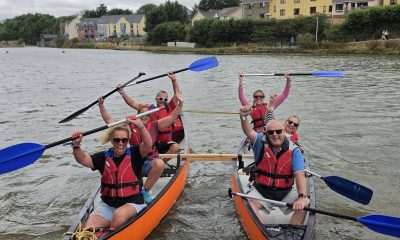
More than 100 racers take to Castle Pond for Paddle West’s inaugural regatta
Successful community event raised money for Forever11 and launched three consecutive weekends of waterside activity in Pembroke MORE than 100...


News2 days ago
NASA chief meets west Wales scientist helping search for life on Mars
Aberystwyth-led technology will guide Europe’s first Mars rover as it drills beneath the planet’s surface, while the proposed DARC radar...


News3 days ago
Princess Royal celebrates Pembrokeshire craftsmanship at family-run weaving mill
A Pembrokeshire business that began after a mother grew tired of waiting three weeks for her children’s name tapes has...


Local Government3 days ago
Burger King could be coming to Haverfordwest as plans submitted
Plans have been lodged for a Burger King outlet at the Morrisons petrol station on Bridge Meadow Lane BURGER KING...
-

 Community6 hours ago
Huge water main burst sends geyser over Fishguard town centre
-

 Health1 hour ago
Welsh A&E performance hits record low as parties clash over NHS pressures
-

 Crime3 hours ago
Man in custody accused of intentionally strangling woman in Haverfordwest
-

 Crime1 day ago
Steynton man fined after breaching dog mess and anti-social behaviour notice
-
Community1 day ago
New creative team transforms the Maes ahead of Eisteddfod y Garreg Las
-

 Health1 day ago
Welsh NHS executive pay revealed as patients face lengthy waits
-

 News1 day ago
Landmark rural law could reshape public services across west Wales
-
Community1 day ago
From Tenby to Llandudno: Wales’ seaside towns face the same signal crisis