


News
Badger goes to the farm


 HELLO READERS! WELL, just when you thought that the aff airs of Pembrokeshire County Council could not slip any deeper into the realms of Whitehall farce (keep your trousers on, Huw!), we had the fi nal act in the saga of ‘A Funny Th ing Happened on the Way to the Dole Queue’, which Badger can only describe as not only being beyond parody but almost beyond belief. Back when Badger wrote his last column, our hero – Bryn Parry-Jones – was on his way out of County Hall, borne aloft on the narrow shoulders of the IPPG along a path strewn with palm fronds and rose petals, while Unison members sobbed with laughter. And then there was a surprise last minute twist of the type beloved by fi lm directors like Alfred Hitchcock, David Fincher and Peter Rogers (the last being an auteur of the genre, being behind classic crime thrillers like Carry on Constable).
Rather like Banquo’s ghost rocking up at the feast, the Auditor made an appearance and threw over the council’s ‘best off er’ possible deal. Now, readers, to understand this you have to ask yourself a very straightforward question based upon events at County Hall over the last calendar year. Let us swift ly recap the situation, readers: • In September 2013, this newspaper exposed the fact that Bryn Parry- Jones had entered into a scheme designed to help him avoid tax on his seven-fi gure pension pot.
Instead, Mr Parry-Jones would receive the grossed up equivalents of the council’s contribution to his pot for him to invest as he wished for his retirement. • In January, the Assistant Auditor for Wales ruled that the payments handed to Bryn Parry-Jones in lieu of pension contributions were unlawful.
• In February, the council held an extraordinary meeting at which the council agreed to stop making the payments. • In May the Chief Executive was invited to repay the pay supplements.
• In July, the Chief Executive said, through his representatives, that not only would he not pay back the money he had received but that he was considering his position about suing the council to make it continue the unlawful payments.

• In August, the Chief Executive took a ‘period of absence’ aft er this paper revealed how he subjected two councillors to a tirade of abuse for not voting in accordance with his wishes and interests in relation to his repayment of the unlawful payments. • On October 16, the council agreed a £330K settlement package. Crucially, that settlement package included compensating the Chief Executive in respect of the unlawful payments he had not received since February and the unlawful payments were taken into account when calculating other elements of the compensation package. Several councillors parroted the view that, while it was a lot of money, the £330K was a triumph for tough negotiating and was the best the council could do.
• Last Tuesday, the Assistant Auditor for Wales stepped in and pointed out the logical fl aw in Baldrick Adams’ cunning plan. Can you guess what the Wales Audit Offi ce thought of compensating an offi cer for unlawful payments made to him? I bet you can, readers! But, apparently, the assembled brainpower of the council, its own legal team and their external advisors had not considered the Auditor might look askance at the prospect. For a few desperate hours, the carefully laid plans of mice and men (well, readers, certainly those of rodents) lay in tatters all about them. Contrary to the spin the council tried to put on events, this was not a case of dotting the i’s and crossing the t’s to the Auditor’s satisfaction. Th e Auditor made it clear that there was no agreement between him and the council to sign off on a deal which contained elements he had earlier this year ruled unlawful.
Drawing a comparison with modes of travel: it appeared as though that the council was in a small canoe on a well known brown and smelly waterway without a means of propulsion. Several issues arose: if the agreement was not signed, would Bryn return? Put another way: How could Bryn return when the leader of council, in an earlier interview, had related how much better things were now he had gone? More to the point, would the council need to call councillors together to vote on any revised deal? (Almost certainly) And what were then the risks of no deal being approved? Would the council allow the Investigatory Committee to meet and to potentially suspend Bryn to avoid him appearing at County Hall on Monday (Nov 3), like a cross between last night’s dodgy curry and Fu Manchu? But a deal was announced on Friday (Oct 31).
The council had appeased the Auditor by shaving the unlawful elements out of the deal. Bryn had taken a hit of £52K and would now receive a paltry £280K for piloting the council to public ignominy and to levels of ridicule that s u c c e e d e d in giving the impression that the council were to government what Laurel and Hardy were to piano moving. Now, readers, Badger has it from an impeccable source that his Royal Bryness’ opening gambit in negotiations was for a settlement around £550K in value. In the end, he has copped just over half that fi gure. And here, readers, here is the big question that arises from all of this?

If – on short notice – the former CEO of our council was prepared to shed over £50K from his pay off , what confi dence can we have that this was best settlement possible? Because the fact Bryn accepted over £50K less than the council agreed on October 16 suggests that, unless the council put another sweetener on the table to sugar taking £50K off the settlement, the £330K plus deal agreed originally was signifi cantly more than he would have settled for. The question for the thinking councillor is not whether or not they should have had the chance to scrutinise the lower deal, but rather whether they can have any faith whatsoever in the bland and blithe assurances of the council’s leadership that everything necessarily is as they are being told.
It is remarkable, readers, that a supposed group of independent councillors can come together – without whipping or direction – and as one not only back “the best deal possible” but churn out the same line of re-assuring drivel, self-justifi catory nonsense, and abuse of those who questioned whether £330K was the best deal possible. Pull the other one. It’s got bells on. No doubt another magnum opus from the council’s own Beria, former PC Rob Summons, is headed for the pages of another local newspaper explaining how – rather like the desperate propaganda put about by Squealer in Animal Farm – black is really white and that Boxer really was only taken to the hospital and not to the knacker’s yard. If Orwell shone the same light as on the Kremlin on the Cleddau, which animal would represent your councillor, readers?


Historia Normannis Wales brings combat displays, Norman justice and living history to the famous fortress
PEMBROKE Castle is stepping back into the 12th century this weekend as Historia Normannis Wales returns for two days of living history.
The event, taking place on Saturday (Apr 11) and Sunday (Apr 12), promises visitors an immersive glimpse into medieval Britain, with reenactors recreating the sights, smells and sounds of the Norman age within the castle grounds.
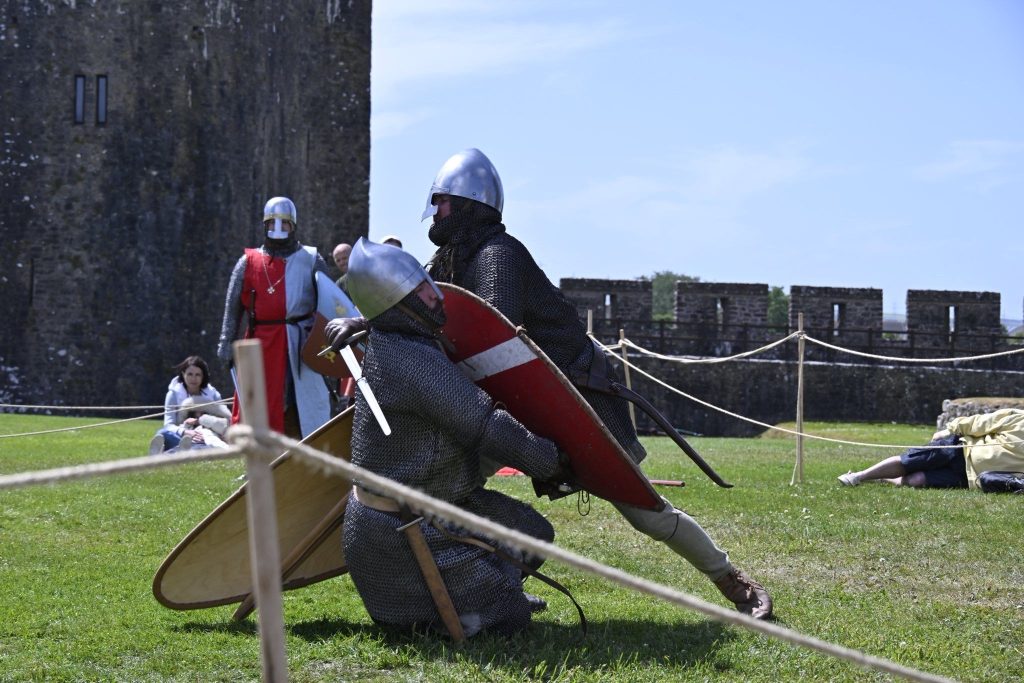
Among the attractions planned are a medieval fashion show, a Shire Court, combat displays and an arming of the knight demonstration, giving families and history enthusiasts the chance to see how people lived, fought and were judged in Norman times.
The weekend forms part of Pembroke Castle’s wider Easter programme and is included with normal admission.
Pembroke Castle said it was delighted to welcome Historia Normannis Wales back for another weekend of “real life medieval experiences”.

One of the best-known historic attractions in west Wales, Pembroke Castle was founded in 1093 and is famous as the birthplace of Henry VII.
The castle remains a major draw for visitors to Pembrokeshire, and this weekend’s event is expected to be popular with families looking for something different during the Easter break.
The event is included with normal castle admission, with standard ticket prices from £13 for adults and £9 for children, while online bookings receive a 10 per cent discount.

Milford Haven firefighters and Dragon LNG staff worked together in a realistic training scenario involving a workshop fire, missing casualties and a breathing apparatus emergency at the Waterston site.
MILFORD HAVEN Fire Station and Dragon LNG, Waterston, carried out a joint training exercise this week in the workshop and warehouse area of the site.
The exercise gave both organisations the opportunity to work through a different type of incident, as most of their usual joint training is focused on Dragon LNG’s liquefied natural gas process areas.
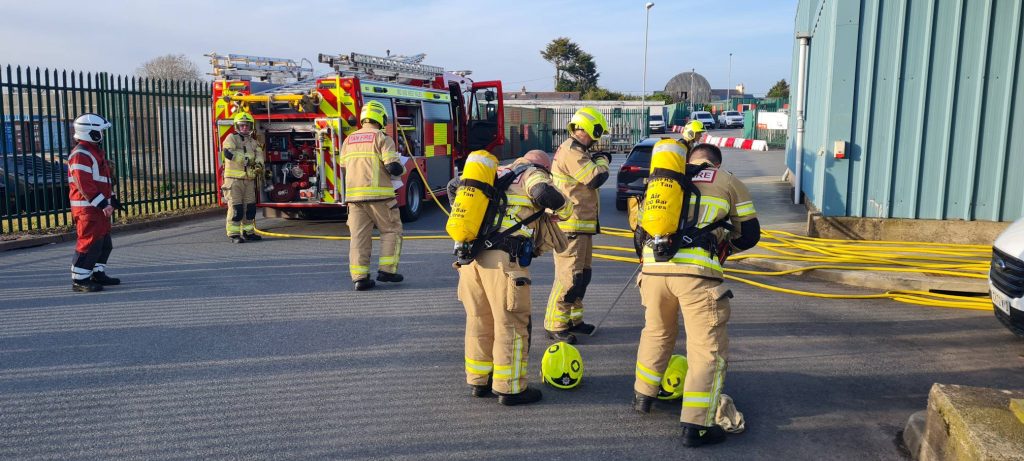
The scenario involved a fire in the workshop, with three people unaccounted for.
On arrival, the first fire crew was met by a member of Dragon LNG staff, who provided key information to the initial officer in charge. Once that handover had taken place, crews quickly set to work setting up fireground equipment while breathing apparatus teams prepared to enter the building.
A key part of the exercise was testing communication between the site’s responsible person and the officer in charge, before that information was passed on to breathing apparatus teams to ensure safe entry and the rescue of casualties.
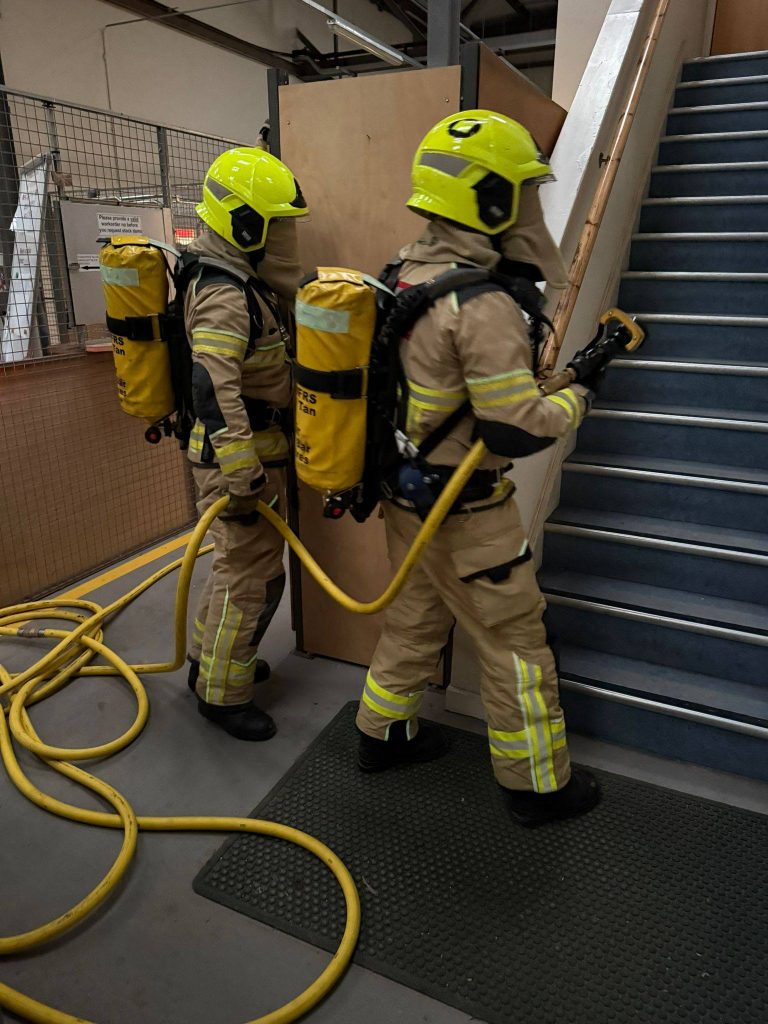
Crews also practised new procedures, including the use of a smoke curtain at entry points to help control the amount of air entering the building.
A breathing apparatus emergency was also introduced during the exercise to simulate a firefighter in distress. The aim was to reinforce established procedures and help ensure the safety of crews operating inside the building.
Both organisations said the training provided valuable learning points for future incidents.
Milford Haven Fire Station thanked Dragon LNG staff for allowing crews to use the site’s facilities.


Conservative candidates Paul Davies and Samuel Kurtz say feed, fuel and fertiliser pressures are leaving farm businesses under growing strain
FARMERS in Ceredigion have warned that rising costs and political uncertainty are placing increasing pressure on the agricultural sector.
The issue was raised during a visit to Penlanlas Isaf dairy farm in Talsarn, where Paul Davies and Samuel Kurtz met farmers including FUW Ceredigion chair Emyr Evans and his family.
The lead Welsh Conservative candidates for Ceredigion Penfro said the rising cost of the “three Fs” – feed, fuel and fertiliser – was a major concern for those working in the industry.
Farmers told the pair that all three essential inputs have faced sustained price pressure, while many businesses have little ability to pass on higher costs. They said this is squeezing already tight margins and adding to wider concerns about the future of farming.
The candidates also heard that uncertainty linked to policy changes from both the UK and Welsh Labour governments is making it harder for farmers to plan ahead with confidence.

Paul Davies said: “The message from farmers was clear – costs are rising across the board, but it is the three Fs, feed, fuel and fertiliser, that are hitting hardest right now. These are essential inputs, and when their prices rise, it has an immediate and unavoidable impact on farm businesses.”
Samuel Kurtz added: “Agriculture is the backbone of our rural economy, but farmers are being squeezed from all sides. Global instability is pushing up the cost of feed, fuel and fertiliser, while uncertainty around wider policies is making it even harder for farmers to plan for the future.”
During the visit, farmers explained that higher feed costs are directly affecting livestock operations, while rising fuel prices are increasing the cost of machinery, transport and day-to-day work. Fertiliser prices, they said, also remain volatile, putting further pressure on already stretched budgets.
Paul Davies said: “These are not optional costs. Farmers cannot simply cut back on feed, fuel or fertiliser. On top of that, uncertainty around new schemes and regulations is creating real anxiety within the sector. Farmers need clarity and confidence, not more unpredictability.”
Davies and Kurtz said the Welsh Conservatives are committed to supporting farm businesses and ensuring government backing is properly targeted, with a focus on food production and long-term viability.
Their proposals include investing an additional £100 million in the agriculture budget over the next Senedd term, placing food security and productivity at the heart of the Sustainable Farming Scheme, taking action to eradicate bovine TB in both livestock and wildlife, increasing the amount of Welsh food and drink served in schools and hospitals, moving away from an all-Wales NVZ “farming by calendar” policy towards a more targeted catchment-based approach, and continuing to campaign against the Family Farm Tax.
Samuel Kurtz said: “We need a system that recognises the real pressures farmers are under and responds accordingly. That means backing farmers through rising input costs, reducing uncertainty, and ensuring they have the confidence to invest and produce.”

Paul Davies added: “Our farmers are essential to our economy, our food supply and our rural communities. Farming needs a friend right now, and farmers will always have a friend in the Welsh Conservatives.”



Crime13 hours ago
Police and partners launch summer crackdown after Tenby station stabbings
Extra patrols, more rail security and tougher action promised after violent disorder left four youths injured POLICE and partner agencies...


Crime20 hours ago
Drug and weapon charges after Pembroke Dock arrest
Man remanded in custody following Diamond Street vehicle search A MAN has been remanded in custody after appearing at Swansea...

Crime21 hours ago
Woman fights order taking four dogs from her
Swansea Crown Court hears appeal after long-running barking dispute in Trefin A PEMBROKESHIRE woman has told Swansea Crown Court that...


News23 hours ago
Former county councillor Paul Dowson to stand in Ceredigion Penfro
Ex-Pembrokeshire member says he will offer voters a straight-talking independent alternative at the Senedd election FORMER Pembrokeshire county councillor Paul...

News2 days ago
Plaid Cymru sets out childcare, NHS and child poverty pledges in 2026 manifesto
Rhun ap Iorwerth’s party says plan is radical and fully costed as it bids to lead next Welsh government PLAID...


Community2 days ago
Police intervene after post raises fears of planned Pembroke Dock fight
Extra patrols launched after social media alert in aftermath of Tenby stabbings POLICE intervened after an online warning raised fears...

Crime2 days ago
Man arrested after alleged child sexual assault in Haverfordwest
Police enquiries ongoing after incident in Castle Square A MAN has been arrested after an alleged sexual assault of a...

Crime3 days ago
Four youths stabbed at Tenby railway station as two arrested
British Transport Police lead investigation after serious disorder involving group of youths FOUR youths suffered stab wounds during a major...

News4 days ago
Major emergency response in Tenby after incident near train station
Witnesses report injuries as police and ambulance crews remain at scene on Warren Street POLICE and ambulance crews remain at...


News4 days ago
Haverfordwest County AFC faces High Court winding-up threat from HMRC
Chairman says issue has been dealt with, but winding-up notice is still listed ahead of High Court hearing HAVERFORDWEST County...
-
Crime3 days ago
Four youths stabbed at Tenby railway station as two arrested
-
 News6 days ago
Eluned Morgan targets Haverfordwest as Welsh Labour fights to hold its ground
-

 Community6 days ago
Johnston FC pays tribute after sudden death of Rhyan Nolan, 27
-

 Local Government4 days ago
Bridge works on Neyland-Burton road to continue into late April
-
News4 days ago
Haverfordwest County AFC faces High Court winding-up threat from HMRC
-

 Entertainment3 days ago
Little Pigs at Home offers a peaceful sanctuary escape in Pembrokeshire
-

 Sport6 days ago
Haverfordwest County Under-13 girls shine at final FAW festival
-

 Entertainment7 days ago
Will You Be My Friend? BBC series seeks Welsh children