


Farming
Processor code of practice for purchase of cattle

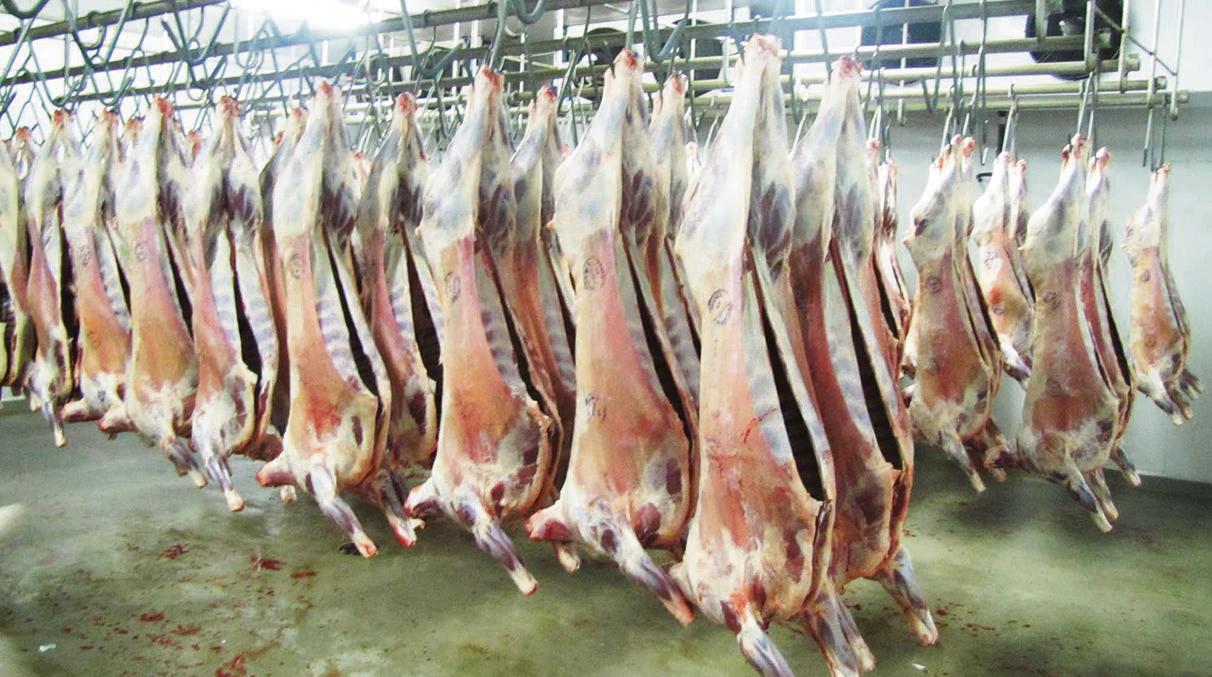

New Code: ‘Fair and responsible trade’
NFU Cymru, the NFU and British Meat Processors Association (BMPA) have agreed the scope of this code which is now set to be introduced.
At last year’s Beef Summit, hosted by Defra Food and Farming Minister George Eustice, which Stephen James attended on behalf of Welsh farmers, the BMPA gave an undertaking to develop a processor code of practice for the purchase of cattle, aimed at enhancing transparency and trust in relations between processors and livestock producers.
The code is voluntary and does not cover prices. It has two main features: it commits individual processor signatories to being open and clear about their own company’s terms and conditions of trading, and signatories undertake to give 12 weeks’ notice of changes to these terms and conditions.
Cattle processors across the UK – whether or not they are member companies of the BMPA – are now being encouraged to sign up to the code.
There are also other parties in the beef supply chain, including retailers, food service companies and renderers, who we urge to operate according to the principles and in the spirit of the code in order to help to minimise volatility and uncertainty in the supply chain.

NFU Cymru President, Stephen James, said, “This is a welcome step in the right direction as we continue to seek more openness and transparency in the supply chain. What is critical to our members is the stability that this code should bring, which will allow producers to plan ahead and market their cattle without sudden or unexpected changes to conditions of sale. We hope this will help beef producers to manage the volatility we have seen in recent years and provide a clearer understanding of the terms and conditions that are on offer.”
BMPA President, Peter Mitchell, said, “Responsible and forward-thinking processors understand the need to be open about their terms and conditions of trading with their producer suppliers and to give reasonable notice of changes to them. Signing up to the code is a visible sign of this recognition, and a commitment to constructive relations with beef producers in order to improve the efficiency of the beef supply chain and so together we can better meet the needs of the marketplace.”
Steve Durrant, Vice Chairman of the Renderers Association, FABRA UK, said, “All efforts toimprove transparency and promote fair and responsible trade should be applauded. As an integral part of the food supply chain our members welcome initiatives of this type and we fully endorse this new code of practice.”
As the host of last year’s Beef Summit, Defra Food and Farming Minister George Eustice MP, said, “I commend the positive and constructive discussions between the BMPA and the Union that have led to the introduction of this voluntary code of practice which aims to increase transparency and trust between processors and livestock producers in the beef supply chain. The code should help to improve people’s confidence in the system. It is a good step forward and I encourage processors to commit to it and retailers and renderers to get behind it and give it their support.”



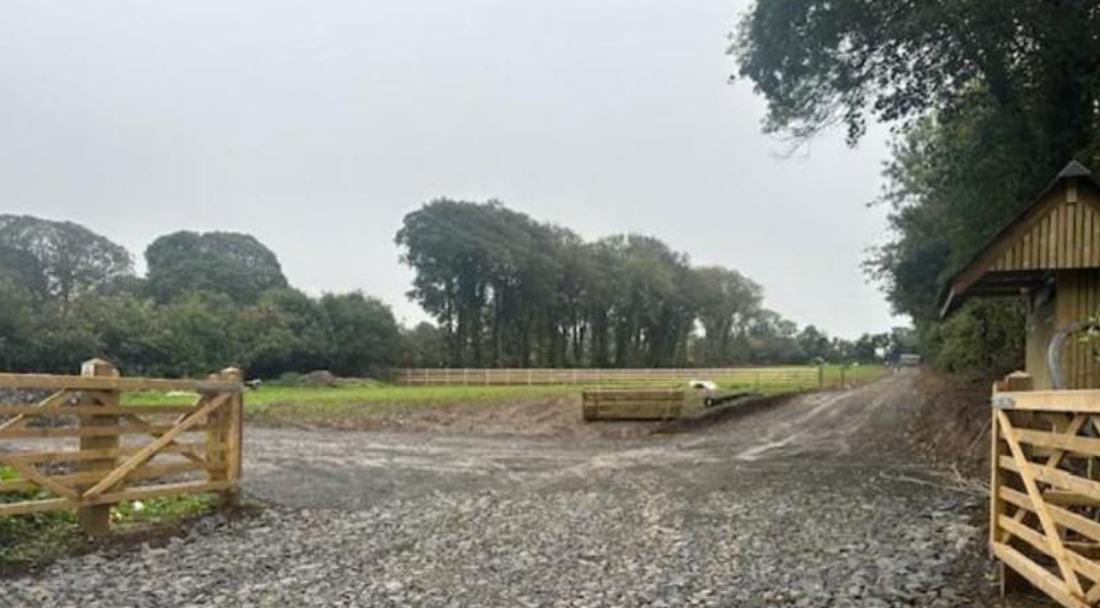
A CALL for a 60-foot-long shed and stables at the proposed home of a gypsy traveller family near a Pembrokeshire village has been refused by planners.
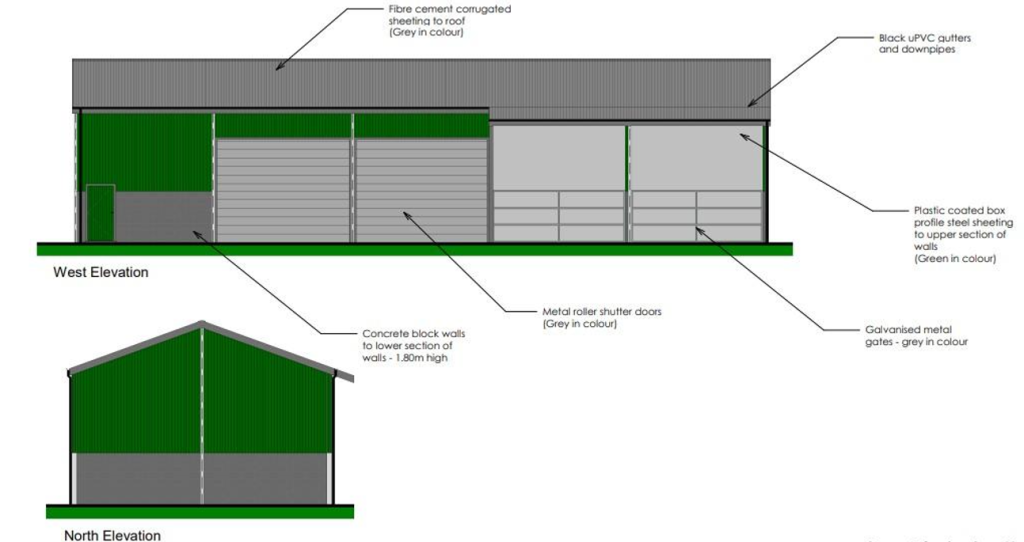
In an application to Pembrokeshire County Council, Ryan Surname Boswell & Family, through agent Hayston Developments & Planning Ltd, sought provision for an access road and replacement of temporary stables and storage containers with a multi-purpose shed and stables at Greenwells, Cosheston Bridge, Cosheston.
The application initially sought a 24.3 by 9.1 metre building, which has now been reduced to 18.3m by nine.
A supporting statement said that land to the north “is subject to a current planning application for the provision of two traveller family pitches with improvements to access and ecological enhancements with other land in our client’s ownership being un-affected”.
It added: “Mr Boswell and his family are of traveller origin and intend to make this site their family home. They own various domestic equipment, children / family articles, mowers / tools and farming equipment that require secure storage. The shed will also be used to house horses/ponies that are currently stabled in the temporary wooden stable block currently on skids on the land in question.”

It concluded: “The scale, design and use of materials (and colours) of the proposed shed is comparable to many new such sheds throughout Pembrokeshire. There will be no significant negative impacts on the level of amenity enjoyed by any neighbours or those travelling along the minor county road to Cosheston from any aspects of the proposed development.”
Local community council Cosheston had raised concerns including the “excessive” size of the proposed building, feeling “this is on the large side of what is required for a couple of ponies”.
It added: “Our concern is that the applicant intends to run his building/property maintenance business from the property. If the council grants the application, restrictions should made on the property’s use. i.e. restricted to agricultural use only.
“We have no objection to the construction of a small stable block, similar in size to the existing one on site.”

Objections were also received from two members of the public, raising concerns including the scale, environmental concerns, and a potential conflict with the ongoing application.
An officer report recommending refusal said the scheme was part-retrospective due to the prior formation of an access track within the field.
It added: “Despite amendments to the application as originally submitted by the reduction in building footprint and scale, the proposal remains a substantial and visually intrusive structure in the open countryside. An essential countryside need has not been justified nor evidence provided of an agricultural or equine enterprise warranting a building of this size or permanence.”

The application was refused on the grounds it “is not typical of a structure intended solely for the storage of paraphernalia associated with grazing land or for equine use and no information has been provided within the application to demonstrate the functional need for a building of this scale”.
It added: “The nature, siting and scale of the building would not be compatible with the capacity and rural character of the site, and together with the access track results in an unjustified and visually intrusive form of development in the open countryside, which does not represent sustainable development.”

A PROGRAMME designed to support farming families in planning for the future is helping to break down one of agriculture’s most sensitive issues – succession.
Farm inheritance and succession planning returned to the spotlight in 2024 following UK Government reforms to inheritance tax (IHT), prompting renewed concern across the industry.
In response, Agrisgôp leader Elaine Rees Jones brought together farming families in the Welshpool area to take part in a structured programme aimed at addressing the issue head-on.
Agrisgôp, a fully funded management development initiative, encourages farmers to work collaboratively, building confidence and business skills through action learning.
Two distinct groups emerged: one made up of parents seeking to plan the future of their farms, and another of younger family members exploring how to take on responsibility and transfer knowledge from the previous generation.

A key theme identified early on was the importance of communication between generations.
Elaine said: “The meetings have offered the opportunity to gain professional and peer advice, time away from the farm to assess situations, and a safe, confidential space for discussion.
“Group members have shared concerns and apprehensions while getting to grips with the scale of the challenge, and have begun to develop action plans.
“The honesty and openness shown has been incredibly humbling.”
For many participants, the programme has provided the confidence to begin formal discussions with professional advisers.
One farming couple, currently working through the process of passing assets to their two sons, said the experience had been invaluable.
“It has made us tackle things properly. We had already started looking at succession before the Rachel Reeves budget, so this wasn’t a knee-jerk reaction.

“It’s a complicated process with no easy answers, and every farm is different. But Agrisgôp has helped us go into meetings with solicitors and accountants informed, rather than just accepting advice blindly.”
Another participant described succession planning as “mind-blowing” before joining the group, adding that expert input had highlighted the importance of early preparation.
The programme included a recent panel session in Welshpool, where professionals returned to answer questions from participants, alongside one-to-one sessions to clarify individual plans.
Specialist advice was provided on legal, financial, and land valuation matters, with a clear message emerging on the importance of having a valid will in place.
Angharad Hird, of Lanyon Bowdler Solicitors, warned that failing to make a will can have serious consequences, highlighting a case where a young farmer died unexpectedly. Under intestacy rules, his estate was divided between his wife and children in a way that may not have reflected the family’s wishes.
Financial planning was also a major focus. From April 2027, unused pension funds will be included within estates for IHT purposes, potentially attracting tax of up to 40%.
Emma Hall, a chartered financial planner, said some clients are already restructuring their finances to mitigate future liabilities, including placing assets into trusts or converting pension funds into income-generating annuities.
Land and property valuation was another key consideration. Richard Corbett, of Roger Parry & Partners, stressed that valuations must reflect current market conditions at the time of assessment, while also taking into account factors such as shared ownership or rights of way.
Accountant Sion Roberts highlighted the importance of setting emotion aside when making decisions.
“There is no one-size-fits-all solution,” he said. “Each farm is different, so it’s vital to understand your priorities and get the right advice.”
The issue of care fees and asset transfers was also raised, with warnings about the risks of deliberately reducing assets to avoid future costs.
Alongside Agrisgôp, Farming Connect’s Succession Pathway offers structured support for families navigating the process. This includes business reviews, facilitated family meetings, bespoke planning, and access to specialist legal services.
Organisers say early planning is crucial to securing both family relationships and the long-term future of farm businesses.
Farmers interested in accessing support can contact Farming Connect on 03456 000 813 or visit their website for further information.

A CALL to keep a holiday pod sited on a Pembrokeshire farm, as part of a wider holiday pod farm diversification over two areas which saw the larger part supported, has been submitted to county planners.
In an application to Pembrokeshire County Council, Bill Ridge of Vaynor Farm Ltd, Bethesda, through agent Gerald Blain Associates Limited, seeks retrospective permission to keep a self-catering pod at Broomley Farm, Sodston, Narberth, works having been completed in 2022.
The application is part of a wider scheme of holiday pods diversification encompassing two farms.
Back in December, Pembrokeshire County Council’s planning committee granted delegated retrospective permission to Vaynor Farm Ltd for the siting of two self-catering holiday accommodation pods at The Cart House, Vaynor Farm, Bethesda, near Narberth as part of a farm diversification enterprise.
A supporting statement accompanying the latest application says: “Vaynor farm is a 400-acre working dairy farm with a herd of 700 milking cows. The enterprise comprises of three self-catering pods. Two of the pods are situated at the Vaynor homestead and another at the opposite end of the holding at Broomley farm.
“The first unit was sited adjacent to Vaynor farm stead some four years ago and a further two added in subsequent years. The units have enjoyed successful occupancy rates over several years offering a unique secluded tourism offer on a working dairy farm, more detail of which is outlined within the supporting business plan.”
It says the Broomley farm application is a resubmission of a previously refused scheme, adding: “It should be noted that this application was originally part of [the application] which was recommended approval at planning committee in December 2025. This element however was separated due to its location on another part of Vaynor farm deeming it not possible to be considered under the same application.”
At the December meeting, an officer report said: “A business plan has been submitted with [that] application, which explains that due to uncertainties associated with dairy farming, the applicant has sought to diversify the farm enterprise to incorporate tourism accommodation.
“The application makes the case that the proposed development represents farm diversification. It is acknowledged that the development has resulted in the provision of an alternative type of holiday accommodation for which it has been demonstrated there is a demand, contributing to the diversity and quality of accommodation available within the county and supporting an existing farm business, with consequent economic and social benefits.

“Evidence has been provided that demonstrates the extent to which the pods have provided income which has been used to support the farm business.”
That application was conditionally approved; the latest part to be considered by planners at a later date.



News42 seconds ago
Major emergency response in Tenby after incident near train station
Witnesses report injuries as police and ambulance crews remain at scene on Warren Street POLICE and ambulance crews remain at...


News10 hours ago
Haverfordwest County AFC faces High Court winding-up threat from HMRC
Chairman says issue has been dealt with, but winding-up notice is still listed ahead of High Court hearing HAVERFORDWEST County...


Local Government10 hours ago
Food hygiene checks have not been carried out in parts of a Welsh county since 2019
FOOD hygiene checks have not been carried out in parts of a Welsh county since 2019 due an inspection backlog,...


Local Government11 hours ago
Bridge works on Neyland-Burton road to continue into late April
Council says safety repairs remain on programme but traffic lights will stay in place as major bridge scheme moves into...

Charity1 day ago
Angle RNLI answers string of call-outs across the Milford Haven Waterway
Volunteer crew launched for searches, police incidents, a medical evacuation and a grounded yacht during a busy spell from mid-February...


Charity1 day ago
St Davids RNLI launches on Easter Monday after drifting kayak spotted off Solva
Missing vessel recovered near shore after coastguard confirms it had been reported lost days earlier ST DAVIDS RNLI launched on...


News1 day ago
Diesel nears £2 a litre in Pembrokeshire as drivers scramble for cheaper fuel
Johnston forecourt hits 194.9p while wide price gaps and rush to fill up pile pressure on motorists across the county...


News2 days ago
St Davids Cathedral marked Easter Sunday with full day of worship
FROM dawn vigil to choral evensong, the cathedral welcomed worshippers for one of the most important days in the Christian...


Crime2 days ago
Neyland man spared immediate jail over aggravated vehicle taking
Defendant given a suspended prison sentence after magistrates heard the offence was serious enough to cross the custody threshold KRISTIAN...


Health3 days ago
Crumbling NHS faces £1bn repairs bill in Wales
Senedd election promises collide with the harsh reality of ageing hospitals, fire safety concerns and a maintenance crisis stretching across...
-

 News4 days ago
Accommodation providers in Wales will be required to register under new law
-

 Business7 days ago
Fishguard to Wexford rail tunnel plan backed by Elon Musk firm
-

 Entertainment5 days ago
From Milford Haven to the world: The story of The Evolution Experience
-

 Entertainment5 days ago
BBC unveils major new Welsh dramas with Tenby set for prime-time spotlight
-

 News6 days ago
Health minister refuses to act on Withybush despite 15,000-signature petition
-
 Community5 days ago
Sycamore Gap legacy takes root at Carew Castle
-

 Business6 days ago
Fire damaged Newgale Duke of Edinburgh Inn plans refused
-
 Community6 days ago
River Cleddau public petition gets backing from councillors