


News
THE HERALD INTERVIEWS • NEIL HAMILTON

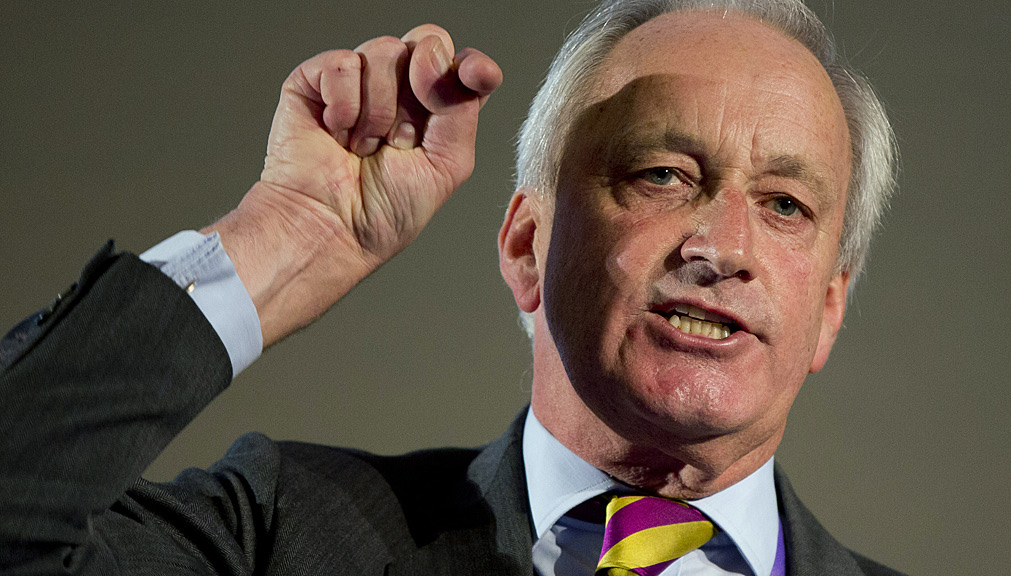

‘Bright future’ ahead: Neil Hamilton
gives his views on the Brexit
ONE OF the fairly small band of Welsh politicians who were pleased with the outcome of last Thursday’s EU referendum was UKIP’s Senedd Leader Neil Hamilton, who has been an outspoken supporter of Free Trade since before the UK joined the Common Market in 1973.
The Herald spoke to the Mid and West AM on Friday morning (Jun 24) to discuss his thoughts on what this historic result would mean for Wales.
“It’s a historic day for Wales – I’ve been fighting for this for 49 years , since I joined the Anti-Common Market League in 1967 when I was at school in Ammanford,” he said.
Given that, with the exception of Ceredigion, Mid and West Wales voted Leave, was he pleased with the local result?
“The result from Carmarthenshire was extremely good. It was 55/45 wasn’t it? So it was better than the national average,” he said. “I’m very, very, pleased. Carwyn Jones’ and Leanne Wood’s constituencies both voted to leave so that’s very satisfying as well.”

Given that, even at the time of writing, another EU referendum looks unlikely, and leaders of the major political parties appear to have accepted that Britain will leave the EU, we asked Mr Hamilton what he thought leaving the EU would mean for Wales.
“First of all , it means there will be more money for Wales, and I’m going to issue a demand today (Jun 24) that the government should guarantee that Wales gets the taxpayers money which is currently spent by the EU in Wales and avoid the possibility that this is siphoned off somewhere else in the UK,” he said.
“And then there will be a Brexit dividend from £10bn a year we send to Brussels which is spent in other parts of Europe. We should have at least £500m a year out of that.”
Wales is used to the NHS being treated as a political football, but did Mr Hamilton think that the increase in NHS funding – promised by both Leave campaigns – would materialise?

His response appeared rather more measured than some of the rhetoric used by Leavers like Boris Johnston during the campaign: “The money is there to spend and we, via our elected politicians , will decide where,” he said. “The NHS is a priority, and I would expect that a certain part of that will be spent on the health service.”
In the interests of fairness, it is worth mentioning that the £350m a week figure which Britain apparently spent on the European Union rather than the NHS was not endorsed by UKIP.
Another matter which is almost sure to prove contentious in the coming months is the subsidies received by Welsh farmers from the EU – most notably the Common Agricultural Payment (CAP). We asked Mr Hamilton whether he would be leading calls for the UK Government to provide a similar level of subsidisation for the industry in Wales.

In response, he claimed that leaving the EU could actually lead to an upturn in farmers’ fortunes: “What we need is a guarantee that at least the same amount of money as the EU spends in Wales – it’s all British taxpayers’ money anyway – should be given to the Welsh Government for it to spend,” he stated.
“And obviously agricultural subsidies are another very high priority, particularly because Wales has so many marginal upland farms.
“We can provide a better system of agricultural subsidy and income support than the CAP and we can have cheaper food into the bargain. It will be good for farmers and consumers.”
While UKIP exceeded expectations across South Wales in the Assembly elections, the party was still some way behind Labour in the region. However , the Leave vote, in spite of Labour MPs and AMs supporting Remain, was particularly strong in the old industrial heartland of the country, from Llanelli to Ebbw Vale. We asked Mr Hamilton why he thought this was the case.
The former Conservative MP suggested that this was the result of disillusionment with mainstream political parties, particularly Labour.
“The Labour Party had given up their working class base. The Labour leadership are very multicultural urban-orientated – they’ve given up on the old industrial communities which founded the Labour Party,” he claimed.
“That is why UKIP is doing so well in the Valleys seats. We got 25% of the vote in places like Merthyr and Ebbw Vale in May, and we’re going to build on that. Our aim now is to replace the Labour Party in those Labour-voting areas.”
“I know that at the General Election last year , UKIP’s support base was the most working class of the major political parties in Britain – much more than the Labour Party.
“The people who run the Labour Party today are middle class academics and professionals who have lost their touch with the ordinary working man. UKIP is a grassroots movement full of ordinary people, so we’re much more representative than the Labour Party,” the former barrister and reality TV star added.
With a minority Labour Government running Wales at present (again) and the leader of the Welsh Conservatives an advocate of Brexit, we asked what role UKIP would play in post-EU negotiations.
“I said in my very first speech in the Senedd that we were going to be a constructive opposition party and we wanted to play a full part in getting the best deal for Wales, ” Mr Hamilton said.
“Of course, that was contemptuously rejected by Carwyn Jones and Leanne Wood, who tried to do their own downstairs stitch-up deal.
“UKIP has seven AMs in the Senedd and support in constituencies. We represent 15% of the people of Wales and we cannot be ignored. I’m going to give support to the demands by the Welsh Government that we should get our fair share of the Brexit dividend.”
When we spoke to Mr Hamilton, the pound had just plummeted to its worst level since the 1987 crash. We asked whether he thought this would be a short-term blip.
He agreed, and wasted no time in laying the blame for the pound’s poor showing squarely at the door of ‘so-called experts.’
“This volatility has taken place because the so-called experts we were told up till yesterday we had to believe didn’t see it coming,” he insisted. “Markets don’t like upset – they don’t like being wrong-footed. It’s a great time to buy at the moment, and the market will bounce back over the next two weeks.
“It will become absolutely clear in no time at all that the doom-mongering scenario the government itself went into overdrive to promote is entirely bogus, and we will carry on trading with Europe and the rest of the world. In the short term , nothing’s going to change, but in the longer term there’s a world of opportunity.”
The so-called ‘Project Fear’ campaigners suggested that a number of businesses could leave Britain if the country gave up EU membership. However, even accepting that was the case, did he think that uncertainty over Britain’s future would discourage new inward investment over the coming years?
Mr Hamilton did not. “I think when people decide to make an investment they look at the whole business environment, particularly staff, and if we have a better regulatory environment than across the channel then businesses are going to invest here,” he claimed.
“They have done for centuries. We have access to the Single Market in the same way as the United States, Canada, Australia, India and China. There is a tariff wall around the EU but that is relatively small – an average of 4%.
“We have a massive trade deficit with the EU so it is pretty much in their interest to agree to a free-trade agreement, which is what we should very quickly put together.”
Mr Hamilton also dismissed suggestions that Britain should ‘buy in’ to the Single Market: “All we want is free trade, and even if we didn’t do a deal with the EU for the Single Market , we would still have access to it.
“All we would have is a tariff barrier, which is on average 4%. We would put a similar tariff on EU exports to us. There is a hundreds of billion pounds deficit in terms of the EU so if they try to discriminate against us , they will be the losers,” he added.
“We will get the benefits of tariffs on their exports to us which we could then return to our exporters so it is more than self-financing.”
One of the claims made by senior figures in the Brexit campaign was that without EU membership, Britain would be in a position to protect its industries, and possibly part-nationalise struggling firms like Tata Steel.
However, Mr Hamilton felt that this would not be a positive move: “The future lies with free trade not with protectionism,” he added. “But, take steel for example. Where foreign competition is unfairly subsidised as it is , with Chinese steel we can take protective measures to even the playing field as the United States has done.”
Renationalising struggling industries was also not on the cards, except as a short-term measure. “Well we could do it, but I don’t think nationalisation is the way forward. Politicians running industries has not proved to be very successful in the past.
“Sometimes as a temporary measure , the government needs to step in. But , it should never be a long-term option in my opinion,” he added.
Looking forward, Mr Hamilton ‘believed that Wales had a bright future outside the EU.’

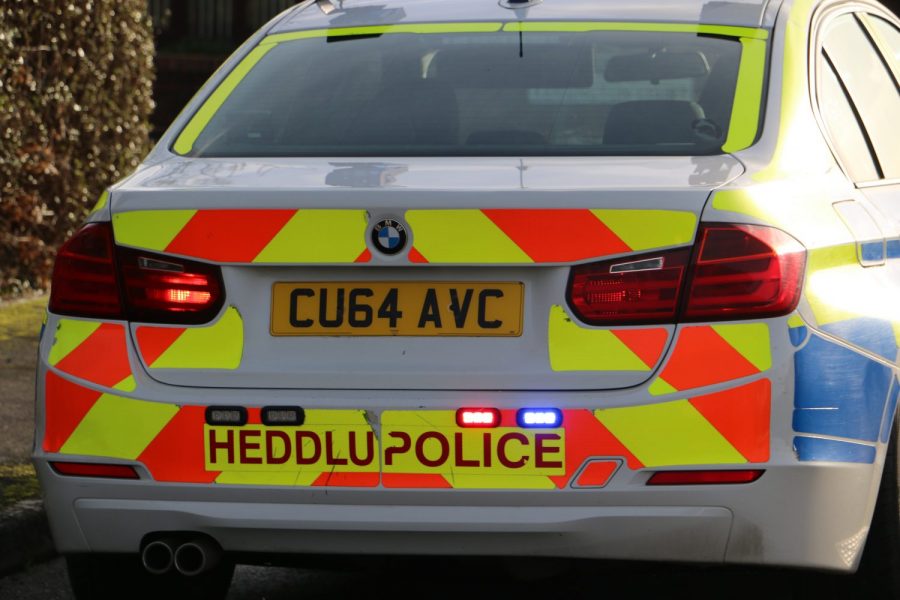
A DANGEROUS driver has been sentenced after attempting to evade the police and hitting speeds of up to 70mph in residential streets.
Liam Williams, 31, from Station Road in Llanelli, was arrested on February 23 after he failed to stop for officers whilst driving without a valid licence and under the influence of drugs.
His black Jaguar XF was spotted travelling along New Dock Road, Llanelli, at around 2am. Williams quickly accelerated away from officers after turning into a residential area. Despite being warned to stop with blue lights, he reached an estimated speed of 50mph over the speed bumps on the 20mph road.
He then cut across a junction and turned on to the 40mph coastal road on the wrong side of a bollard. He continued to reach around 80mph to try and get away from pursuing officers.
Williams was unaware that Dyfed-Powys officers had set up a stinger site to puncture his tyres further along the road. He sped through the stinger site and continued towards the sandpiper roundabout. He reached speeds of 70mph and then appeared to lose control of the car at the roundabout. Officers noted that his front offside tyre was deflated and his brake disc was red hot and sparking.
Despite this, Williams exited the roundabout towards Llanelli town centre and appeared to lose control again. Officers attempted to pass him as he accelerated back up to speeds around 50mph on the 20mph road. Williams turned into smaller side streets to try and escape but was quickly followed by supporting officers.
As he returned to the main road towards Llanelli town centre, officers moved to box the vehicle in. The pursuit quickly came to an end and Williams was arrested for multiple offences.
A drug wipe showed that Williams was under the influence of cocaine. A further blood specimen was taken in custody, before he was charged and remanded.
He appeared in Llanelli Magistrates Court on Tuesday 10th March. He was found guilty of dangerous driving, failing to stop for police, driving without a licence and driving without insurance.
Williams was handed a 34-week prison sentence, suspended for 24 months. He was disqualified from driving for 34 months, followed by an extended re-test. He must also complete 100 hours of unpaid work within 12 months and pay £85 in court costs and a £187 surcharge.

WORKERS in Wales say they now need to earn around £42,000 a year to live comfortably – some £6,000 more than the region’s average salary of £36,000, according to new research.
The findings, based on a survey of 5,000 UK professionals carried out as part of the annual salary guide produced by recruitment firm Reed, highlight the growing financial pressure facing employees across Wales.
Around 15% of workers in Wales said they were unhappy with their pay, with a third (33%) citing the rising cost of living as the main reason salaries no longer feel sufficient.
Becky Hole, Regional Director at Reed, said the results underline a widening gap between earnings and everyday living costs.
“Wales has always had a resilient workforce, but these findings highlight a growing disparity between what people earn and what they need to feel secure,” she said.

“The rising cost of essentials is biting hard, and for many people in the region the gap between income and expenditure is becoming increasingly difficult to bridge.”
The survey also suggests many households are left with very little spare income once essential bills are paid.
More than a quarter of workers in Wales (28%) said they have £100 or less remaining each month after covering necessities such as housing, food, and utilities. A further 9% said their entire salary is consumed by essential costs, leaving them with no disposable income at all.
On average, workers in Wales reported having around £601 per month remaining after essential bills.

The financial squeeze is also influencing career decisions. Reed’s research indicates that employees are becoming increasingly cautious about changing jobs, prioritising stability over risk during uncertain economic times.
“We are seeing a distinct trend in the Welsh job market where stability is becoming the new currency,” Ms Hole added.
“Employees are less inclined to take risks on new roles unless the financial reward is substantial. The data suggests people are prioritising secure employment and strong benefits packages over the unpredictability of changing jobs. For many, it is a time of consolidation rather than speculation.”

The research suggests employers hoping to recruit staff from competitors would need to offer an average pay increase of £10,729 to tempt workers to move. By contrast, an average pay rise of £3,532 would be enough to persuade many employees to stay with their current employer.
More than a quarter of respondents (27%) also said they would not be willing to give up workplace benefits in exchange for a higher salary.
Ms Hole said employers need to consider the wider package they offer staff if they want to attract and retain talent.
“For employers in Wales, this is a wake-up call to look at the total value proposition they offer,” she said.
“It is not just about the salary figure anymore – it is about providing a safety net. Benefits that support financial wellbeing, mental health, and work-life balance are becoming critical tools for retention and recruitment. Businesses that can offer this kind of holistic support will be the ones best placed to keep their talent during these challenging times.”

Licensing authorities yet to explain purpose of visit at one of the UK’s largest dog rescues
INSPECTORS have visited the premises of one of the UK’s largest dog rescue organisations, with police attending in a supporting capacity during the operation.
Dyfed-Powys Police confirmed officers were present at Many Tears Animal Rescue in Carmarthenshire on Tuesday (Mar 10) but stressed that their role was limited to preventing any breach of the peace.
The force said the visit took place without any need for police intervention, and directed enquiries about the purpose of the visit to Animal Licensing Wales, which oversees animal establishment licensing across Wales.
A spokesperson for Dyfed-Powys Police told The Herald: “Officers attended the premises in a supporting capacity only, to prevent any breach of the peace. The visit took place without any need of police involvement or intervention.”
The police statement indicates that the visit itself was led by another agency rather than being a police investigation.
The RSPCA Cymru has also confirmed it was not involved in the visit.
An RSPCA Cymru spokesperson said: “The RSPCA did not attend this premises on March 10 so did not participate in any visit that took place.”
Many Tears Animal Rescue, based near Llanelli, is one of the largest dog rescue charities operating in the UK, rehoming thousands of animals each year and receiving dogs from a range of sources including commercial breeding establishments and other rescues.
Sources have told The Herald that investigators attended the site earlier this week, though the purpose and scope of the visit has not yet been confirmed.
The Herald has contacted Animal Licensing Wales, which administers animal establishment licensing under Welsh Government regulations, to clarify whether the visit formed part of a routine inspection, a complaint-led investigation, or an enforcement action.
At the time of publication, the organisation had not yet responded.
The Herald has also approached Many Tears Animal Rescue for comment.
Animal Licensing Wales operates under the Animal Welfare (Licensing of Activities Involving Animals) (Wales) Regulations 2021, which require organisations involved in activities such as animal boarding, breeding, and rehoming to meet strict standards relating to welfare, veterinary care, record-keeping, and the management of animals on site.
Any inspection or enforcement action carried out under the regulations can result in improvement notices, licence conditions being altered, or in serious cases the suspension or revocation of a licence.
It remains unclear whether the visit to the Carmarthenshire rescue was part of a routine regulatory inspection or a response to specific concerns.
The Herald will update this story when further information becomes available.



Education1 day ago
Manorbier school closure approved while insurance claim still unresolved
Council confirms negotiations with insurer ongoing following 2022 fire PEMBROKESHIRE COUNTY COUNCIL has confirmed that negotiations with its insurer over...


Crime2 days ago
‘Knife attack’ at Spittal property leaves man in hospital
POLICE have arrested a woman following what is being described as a ‘knife attack’ at a property in Spittal on...

Community2 days ago
Pembrokeshire to receive its first banking hub in Pembroke Dock
LINK, the UK’s Cash Access and ATM network, has today announced local people and businesses in Pembroke Dock will benefit from a new banking...


Health3 days ago
Future of Withybush Hospital petition sparks urgent call for Senedd debate
CALLS have been made for an urgent debate in the Senedd over the future of services at Withybush Hospital as...

Crime4 days ago
Man jailed after threatening to chop teen’s ears off in drunken phone call
17-year-old victim said she feared for her life after a series of threats A MAN who threatened a teenage girl...


Sport4 days ago
Sean Bowen set for historic Welsh clash at Cheltenham Gold Cup
PEMBROKESHIRE jockey Sean Bowen could be part of a historic all-Welsh showdown when he lines up in the Cheltenham Gold...


Community4 days ago
Tenby still waiting as Wales hits 50 rural mobile mast upgrades
Seaside town plagued by signal congestion again absent from latest government-backed coverage improvements A NEW milestone in the UK Government’s...


Crime5 days ago
Man raped 15-year-old girl in caravan while she was on family holiday in west Wales
Jury convicts Pendine man after court hears he raped intoxicated teenager in caravan during family holiday A MAN who raped...


Community5 days ago
Crash sparks fresh questions over future of former Haverfordwest library
CONCERNS have been raised about the future of a distinctive Haverfordwest building after a car crashed into it last week,...

Community6 days ago
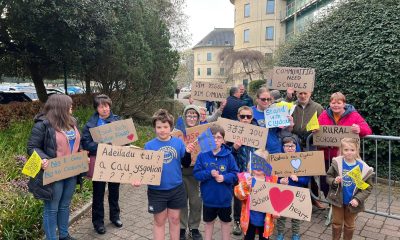
Councillors vote to close Ysgol Clydau despite community concerns
Petition and protests fail to prevent closure of small rural school near Tegryn PEMBROKESHIRE COUNTY COUNCIL has voted to close...
-

 Local Government2 days ago
Register now to vote in May’s Senedd election
-

 Health5 days ago
Women’s health services ‘expanding’ across mid and west Wales says Health Board
-
Community6 days ago
Councillors vote to close Ysgol Clydau despite community concerns
-

 Comment6 days ago
Manorbier deserved honesty — not false hope
-

 Crime4 days ago
Former Pembrokeshire Army officer stripped of MBE after fraud conviction
-

 Entertainment7 days ago
Evening with rugby legend Shane Williams coming to Milford Haven
-

 News7 days ago
Mother’s Day treats by the coast at Milk Wood House
-

 Cymraeg5 days ago
Commissioner’s five-year report highlights key opportunities to strengthen Welsh language
Owen
July 13, 2016 at 4:54 pm
Do you normally interview convicted fraudsters and serial liars?