


News
Amazing eco-home costs family just £27,000

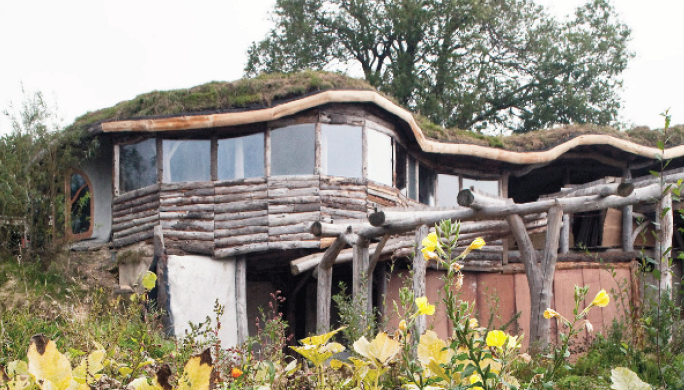

The exterior: The eco home took four years to build (Pic. Grand Designs)
BEGINNING with just £500, Simon and Jasmine Dale built a three-bedroom family home made with recycled goods and reclaimed material that’s being called ‘the cheapest house ever built in the Western Hemisphere’.
Living in the sustainable community of Lammas, in rural Pembrokeshire, Simon and Jasmine’s eco-home has been featured on the TV programme ‘Grand Designs’.
The home, made with reclaimed materials including glass, timber and insulating sheep’s wool, encompasses the family’s dream of living off the land with their children, Elfie and Cosmo.
Lammas is a pioneering sustainable village and in return for the right to build on the open farmland, Jasmine and Simon will have to prove that they had become self-sufficient on the seven acre plot within five years. If not, they will be forced to move on.
Featured on Wednesday’s (Oct 26) episode of Grand Designs, presenter Kevin McCloud told viewers: “This won’t be a cramped hobbit house, but a spacious, solid, three bed, low impact family home.”

Simon excavated 12 feet into the hillside in order to build a retaining wall along the back of the property, made from sandbags filled with excavated earth.
The floors of the eco-home are made from rammed earth, polished and hardened with linseed oil. The structure of the building comprises of round timber poles grown locally. The trees were then felled, prepared and cut by Simon.
The same poles were used to construct the roof, which was then covered in a damp proof membrane and insulated with sheep’s wool. A layer of grass was then planted on top for further insulation.
Due to delays caused by Welsh winter weather, the construction of the ‘Hobbit home’ took four years to complete.

In 2012, Simon had to postpone work on the eco home due to the wet weather; however, in the spring of 2013, he begun again, constructing the retaining walls made from hundreds of yellow sacks bought from eBay for 7p each. The sacks were filled with clay, sand and fine stone.
Simon and Jasmine planned to move their family into the property by autumn 2013 but, due to requirements of living at Lammas, they first had to set up a small business.
The family made the decision to postpone the main building work whilst they constructed greenhouses. During this time, Jasmine ran horticultural courses and Simon took on consultancy work in order to increase their original £500 fund.

Four years after beginning the project, Jasmine and Simon estimate that their eco home cost £27,000 to build, including the costs of £5,500 on sheep’s wool insulation and £5,000 work of vegetables used to feed volunteers.
Following the completion of their project, Simon commented: “I don’t think I could quantify it, but I can feel it in my heart when I walk around at the end of the day and see the bats flying round and hear the birds sing.
“It’s been hard and I wasn’t asking for an easy life. I like challenge. To put in a hard day’s graft and be tired at the end of the day. That exhaustion is a nice feeling.”



Vote.wales to host all essential election information for the Senedd election
A BRAND new voter information website, vote.wales, has been launched today (2 March) by the Electoral Management Board for Wales, part of the Democracy and Boundary Commission Cymru.
Vote.wales is the first website of its kind in Wales and tells people everything they need to know about the election, including advice about voting, information about the Senedd, and a postcode search function to provide tailored local information.
The website holds information about who can register to vote, how voting works in polling stations, as well as postal and proxy voting, and what accessibility support people can expect when they go to vote.
A postcode search function on vote.wales allows voters to see which of Wales’ 16 new constituencies they will be voting in, as well as telling them where their local polling station is located.
Once nominations have closed, the website will also inform voters which political parties and independent candidates are standing in their area.
The website explains how the Senedd works and what it does, highlighting which policy areas are devolved to the Senedd and which remain the responsibility of the UK Parliament. It also sets out the difference between the Senedd and the Welsh Government.
Further developments are expected in the coming weeks. In a first for Welsh elections, voters will soon be able to access detailed accessibility information about their local polling station. Political parties and independent candidates will also be able to publish their election leaflets on the platform, so voters can see not only who is standing but what they stand for.
Following the election, vote.wales will publish the full election results.
Commenting on the launch, Shereen Williams MBE OStJ, Chief Executive of the Democracy and Boundary Commission Cymru, said:

“An important election is coming on 7 May, and vote.wales is the place to go to find out all about it.
“We know that people across Wales are looking forward to making their voices heard at this election, but many people don’t feel they have all the information they need before they go and vote.
“If you have questions about this election, then head to vote.wales. Voting confidence starts here.”


THE POLICE investigation into the serious incident which happened on Felindre Road, Pencoed, in the early hours of Saturday, February 28, is now being treated as murder.
We can confirm the 58-year-old man who was critical in hospital passed away earlier today – his family are being supported by specially trained officers at this time, and our thoughts are with them.
The Major Crime Investigation Team at South Wales Police is now leading the investigation, and the 26-year-old man arrested remains in police custody.
Detectives investigating the incident are appealing to anyone who may have been in the vicinity of Felindre Road, Pencoed, between midnight and 5am on Saturday to get in touch.
Motorists are urged to their check dashcams for any footage which may be relevant.

Detectives would like to speak to two potential witnesses – two elderly people who are believed to have walked along Felindre Road between 12.30am and 4am on Saturday.
Detective Inspector Graham Williams, from the Major Crime Investigation Team, said: “Sadly, a 58-year-old man has died in hospital following the incident on Saturday morning. Our thoughts are with his family at this time and they are being supported. I would like to reassure the local community that we have somebody in custody and are not looking for anybody else at this time. I thank everyone in the community who has helped our investigation so far, and I urge anyone with information which may be relevant to our investigation – particularly the two potential witnesses – to get in touch.”
If anybody does have information, they should contact 101 quoting reference 2600063517. Alternatively, they can submit information via the Major Incident Public – https://mipp.police.uk/operation/62SWP26C30-PO1

PUPILS and staff at Maesydderwen Comprehensive School in Ystradgynlais were released safely on Monday afternoon (Mar 2) after a lockdown was implemented following a reported telephone threat.
Dyfed-Powys Police confirmed officers were called to the school earlier in the day and worked with staff to ensure the safety of everyone on site. As a precaution, the school activated its lockdown procedure while enquiries were carried out.
Police said there were no reports of injuries and that all pupils and staff were safe and secure throughout the incident.
Officers remain at the scene while “diligent enquiries” into the threat continue. At this stage, no arrests have been made, and police have confirmed there is no evidence of any ongoing risk to pupils or staff.
Reassurance patrols will take place in the coming days to support pupils, staff, parents and the wider community.
Parents and guardians will continue to receive updates directly through the school messaging app, including confirmation on whether the school will open as normal on Tuesday.
Maesydderwen Comprehensive School is located in Ystradgynlais, Powys, and is served by Dyfed-Powys Police.



News13 hours ago
War stops Qatar gas: Milford Haven LNG supplies disrupted
UK energy security concerns grow after shutdown at major export facilities ENERGY bills in the UK could rise sharply after...


Community17 hours ago
Martyn Butler dies aged 71 months after Haverfordwest visit
Co-founder of Terrence Higgins Trust attended local plaque unveiling honouring friend Terry Higgins A LEADING figure in the UK’s response...

Crime20 hours ago
Nine deny Class A drugs conspiracy as case set for Crown Court trial
Eight remanded in custody as four-week trial fixed for May 18 NINE people have denied conspiring to supply Class A...


Community20 hours ago
No asylum seekers housed in west Wales hotels, latest Home Office figures show
WEST Wales currently has no asylum seekers being housed in hotels, according to the latest figures published by the Home...


Community4 days ago
St David’s Day parade brings colour and celebration to Haverfordwest
HAVERFORDWEST town centre was a hive of activity today (Friday, Feb 27) as hundreds of children from schools across Pembrokeshire...


News5 days ago
Hoax 999 call sparks massive lifeboat and helicopter rescue — man arrested
Emergency services diverted from real incidents after false report off south Wales coast A MAJOR sea rescue operation involving three...


Crime5 days ago
St Dogmaels man jailed over hundreds of indecent images
Previous convictions for similar offences revealed to court A 57-YEAR-OLD man from St Dogmaels has been jailed for two-and-a-half years...


Health5 days ago
Petition against hospital service changes surges past 6,000 signatures
Public response now far exceeds health board consultation figures A PETITION calling for urgent Welsh Government intervention over services at...


Crime6 days ago
Milford Haven pensioner admits sexually assaulting two shop workers
76-year-old touched victims and kissed one on the neck, court hears A MILFORD HAVEN man has admitted sexually assaulting two...


News6 days ago
Senedd backs assisted dying legislation in historic vote
POLITICIANS in the Senedd have voted in favour of legislation that could allow assisted dying services to be provided through...
-

 News7 days ago
Labour and Plaid criticised over £1.2m anti-racism ‘metaverse’ project
-

 Health6 days ago
Health services row escalates as MSs demand action over Withybush and Bronglais
-

 Politics7 days ago
Farage vows to strip Cardiff’s ‘City of Sanctuary’ status ahead of manifesto launch
-

 Health5 days ago
Petition calling for Withybush intervention nears 5,000 signatures
-
 News7 days ago
Plaid Cymru drug decriminalisation policy under spotlight ahead of Senedd election
-

 Business6 days ago
Council reviewing complaints over Computer Solutions Wales as concerns continue
-

 News5 days ago
Welsh Government criticised after Russian-linked drone image used in defence announcement
-
 Business6 days ago
Bosherston Bistro 10pm alcohol licence granted by council