


News
FUW put spotlight on dairy industry

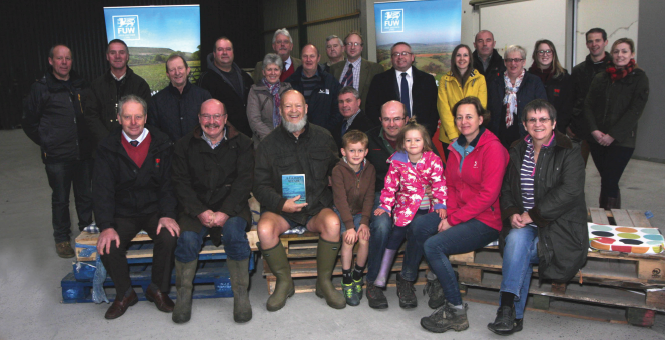

(FUW Eve of Welsh Dairy Show) FUW staff and officials: Enjoying a farm visit at Daioni Organic, highlighting
ON THE EVE of the Welsh Dairy Show on Monday (Oct 24), the Farmers’ Union of Wales put the spotlight firmly on the dairy industry at a farm visit at the home of Daioni Organic.
Joining the visit at Ffosyficer Farm, Boncath, Pembrokeshire, were many Union members and officials, as well as Mr Michael Eavis of Glastonbury Farm, who is mostly known as the founder and organiser of the Glastonbury Festival.
VALUE ADDED FARMING
A dairy farmer for over 40 years, Laurence Harris has taken Daioni – meaning ‘goodness’ – from strength to strength.
Since taking over Ffosyficer Farm – still the heart of the Daioni business – from his father in 1970, Laurence expanded the family farm from 150 acres to well over 3,000 acres of fertile pasture.

The farm was converted to organic production in 1999 and since then, Laurence and his team have added value to their premium quality dairy produce which has culminated in the launch of the Daioni brand and a suite of products that are being sold internationally.
In 2008, Daioni flavoured milk was exported overseas for the first time and is now stocked in outlets around the world as well as in small retailers and major supermarkets across the UK.
In addition, in 2012, Daioni became the first British dairy company to gain organic certification in mainland China and in 2014, they opened their Hong Kong office to focus on Asia Pacific sales. Today, exports account for over 15% of the business turnover.
Around 20 local people are employed by the farming business which, today, is solely owned by the Harris family and continues to go from strength to strength.

Speaking at the farm visit, Mr Harris, who last year was awarded with the FUW/HSBC Outstanding Service to Welsh Dairy Industry award, said: “We all welcome the visit of Michael Eavis to Ffosyficer. As a person who has seriously added value to his dairy farm, we can all learn from his enthusiasm and foresight in attracting urbanites to the lovely pastures of Worthy Farm. It is so important to try and enlighten our consumers to the issues that dairy farmers currently face.”
FUW Deputy President Brian Thomas told delegates at the event: “Our dairy industry has suffered quite a bit with low prices over recent years. Many producers have seen their milk cheque cut in half and often find themselves having to deal with unfair contracts. The unfortunate truth is that our dairy producers will have to cope with extreme price volatility in the future.
“Whilst there have been some notable price increases in recent months – and these must be welcomed – full price recovery may still be some way into the future due to a continuing global supply and demand imbalance.”

BREXIT NOT THE ONLY CONCERN
Mr Thomas further told delegates that capitalising on new markets may well be a vital component of the Welsh dairy sector post-Brexit and it is essential that the prices paid to our farmers allow room for investment and innovation so that we can be globally competitive.
“While prices and supply and demand issues are ongoing, our dairy sector also faces two other critical issues.
“The Welsh Government is currently consulting on the four yearly review of Nitrate Vulnerable Zones and the result could mean that financial implications are imposed on those who live in designated areas.
“We have been involved in the NVZ review and have made successful representations on several designations, which resulted in their removal from the discrete areas option of the consultation.
“However, the number of proposed new designations remain a concern and we continue to reiterate the operational and financial impacts those designations would have upon farms that reside within an NVZ area.”
WG ‘SQUANDERED MONEY’
Given such costs, Mr Thomas stressed that there must be full justification for any proposed increases in designation and he urged FUW members to make sure they work with their local county office and submit a response to the consultation.
Addressing the issue of bovine TB, Mr Thomas said: “Bovine TB still poses a significant problem here in Pembrokeshire. Last week, we welcomed the Welsh Government’s announcement that it will consider a badger test-and-cull type approach to TB and it is as a small step in the right direction, but many farmers will be concerned at the implications of splitting Wales into TB zones.”
He added that targeting infected badgers would be a welcome move, but it is disappointing that it has taken so many years to move back towards common sense after the original comprehensive plan to tackle the disease in wildlife was abandoned by the previous Welsh Government.
“I want to be clear on one thing though – we cannot place any further financial or administrative burden on the industry. The Welsh Government has a moral obligation to fund the next steps – given the millions of pounds squandered on an ineffective badger vaccination program,” added the FUW Deputy President.



Vote.wales to host all essential election information for the Senedd election
A BRAND new voter information website, vote.wales, has been launched today (2 March) by the Electoral Management Board for Wales, part of the Democracy and Boundary Commission Cymru.
Vote.wales is the first website of its kind in Wales and tells people everything they need to know about the election, including advice about voting, information about the Senedd, and a postcode search function to provide tailored local information.
The website holds information about who can register to vote, how voting works in polling stations, as well as postal and proxy voting, and what accessibility support people can expect when they go to vote.
A postcode search function on vote.wales allows voters to see which of Wales’ 16 new constituencies they will be voting in, as well as telling them where their local polling station is located.
Once nominations have closed, the website will also inform voters which political parties and independent candidates are standing in their area.
The website explains how the Senedd works and what it does, highlighting which policy areas are devolved to the Senedd and which remain the responsibility of the UK Parliament. It also sets out the difference between the Senedd and the Welsh Government.
Further developments are expected in the coming weeks. In a first for Welsh elections, voters will soon be able to access detailed accessibility information about their local polling station. Political parties and independent candidates will also be able to publish their election leaflets on the platform, so voters can see not only who is standing but what they stand for.
Following the election, vote.wales will publish the full election results.
Commenting on the launch, Shereen Williams MBE OStJ, Chief Executive of the Democracy and Boundary Commission Cymru, said:

“An important election is coming on 7 May, and vote.wales is the place to go to find out all about it.
“We know that people across Wales are looking forward to making their voices heard at this election, but many people don’t feel they have all the information they need before they go and vote.
“If you have questions about this election, then head to vote.wales. Voting confidence starts here.”


THE POLICE investigation into the serious incident which happened on Felindre Road, Pencoed, in the early hours of Saturday, February 28, is now being treated as murder.
We can confirm the 58-year-old man who was critical in hospital passed away earlier today – his family are being supported by specially trained officers at this time, and our thoughts are with them.
The Major Crime Investigation Team at South Wales Police is now leading the investigation, and the 26-year-old man arrested remains in police custody.
Detectives investigating the incident are appealing to anyone who may have been in the vicinity of Felindre Road, Pencoed, between midnight and 5am on Saturday to get in touch.
Motorists are urged to their check dashcams for any footage which may be relevant.
Detectives would like to speak to two potential witnesses – two elderly people who are believed to have walked along Felindre Road between 12.30am and 4am on Saturday.
Detective Inspector Graham Williams, from the Major Crime Investigation Team, said: “Sadly, a 58-year-old man has died in hospital following the incident on Saturday morning. Our thoughts are with his family at this time and they are being supported. I would like to reassure the local community that we have somebody in custody and are not looking for anybody else at this time. I thank everyone in the community who has helped our investigation so far, and I urge anyone with information which may be relevant to our investigation – particularly the two potential witnesses – to get in touch.”
If anybody does have information, they should contact 101 quoting reference 2600063517. Alternatively, they can submit information via the Major Incident Public – https://mipp.police.uk/operation/62SWP26C30-PO1

PUPILS and staff at Maesydderwen Comprehensive School in Ystradgynlais were released safely on Monday afternoon (Mar 2) after a lockdown was implemented following a reported telephone threat.
Dyfed-Powys Police confirmed officers were called to the school earlier in the day and worked with staff to ensure the safety of everyone on site. As a precaution, the school activated its lockdown procedure while enquiries were carried out.
Police said there were no reports of injuries and that all pupils and staff were safe and secure throughout the incident.
Officers remain at the scene while “diligent enquiries” into the threat continue. At this stage, no arrests have been made, and police have confirmed there is no evidence of any ongoing risk to pupils or staff.
Reassurance patrols will take place in the coming days to support pupils, staff, parents and the wider community.
Parents and guardians will continue to receive updates directly through the school messaging app, including confirmation on whether the school will open as normal on Tuesday.
Maesydderwen Comprehensive School is located in Ystradgynlais, Powys, and is served by Dyfed-Powys Police.



News14 hours ago
War stops Qatar gas: Milford Haven LNG supplies disrupted
UK energy security concerns grow after shutdown at major export facilities ENERGY bills in the UK could rise sharply after...


Community18 hours ago
Martyn Butler dies aged 71 months after Haverfordwest visit
Co-founder of Terrence Higgins Trust attended local plaque unveiling honouring friend Terry Higgins A LEADING figure in the UK’s response...


Crime22 hours ago
Nine deny Class A drugs conspiracy as case set for Crown Court trial
Eight remanded in custody as four-week trial fixed for May 18 NINE people have denied conspiring to supply Class A...


Community22 hours ago
No asylum seekers housed in west Wales hotels, latest Home Office figures show
WEST Wales currently has no asylum seekers being housed in hotels, according to the latest figures published by the Home...


Community4 days ago
St David’s Day parade brings colour and celebration to Haverfordwest
HAVERFORDWEST town centre was a hive of activity today (Friday, Feb 27) as hundreds of children from schools across Pembrokeshire...


News5 days ago
Hoax 999 call sparks massive lifeboat and helicopter rescue — man arrested
Emergency services diverted from real incidents after false report off south Wales coast A MAJOR sea rescue operation involving three...


Crime5 days ago
St Dogmaels man jailed over hundreds of indecent images
Previous convictions for similar offences revealed to court A 57-YEAR-OLD man from St Dogmaels has been jailed for two-and-a-half years...


Health5 days ago
Petition against hospital service changes surges past 6,000 signatures
Public response now far exceeds health board consultation figures A PETITION calling for urgent Welsh Government intervention over services at...


Crime6 days ago
Milford Haven pensioner admits sexually assaulting two shop workers
76-year-old touched victims and kissed one on the neck, court hears A MILFORD HAVEN man has admitted sexually assaulting two...


News7 days ago
Senedd backs assisted dying legislation in historic vote
POLITICIANS in the Senedd have voted in favour of legislation that could allow assisted dying services to be provided through...
-

 News7 days ago
Labour and Plaid criticised over £1.2m anti-racism ‘metaverse’ project
-

 Health7 days ago
Health services row escalates as MSs demand action over Withybush and Bronglais
-

 Politics7 days ago
Farage vows to strip Cardiff’s ‘City of Sanctuary’ status ahead of manifesto launch
-

 Health6 days ago
Petition calling for Withybush intervention nears 5,000 signatures
-
 News7 days ago
Plaid Cymru drug decriminalisation policy under spotlight ahead of Senedd election
-

 Business6 days ago
Council reviewing complaints over Computer Solutions Wales as concerns continue
-

 News5 days ago
Welsh Government criticised after Russian-linked drone image used in defence announcement
-
 Business6 days ago
Bosherston Bistro 10pm alcohol licence granted by council
mitolyn official
January 26, 2026 at 2:14 pm
**mitolyn official**
Mitolyn is a carefully developed, plant-based formula created to help support metabolic efficiency and encourage healthy, lasting weight management.