


News
Love is all around


 VALENTINE’S Day has been a tradition since the pre-Christian era, and has roots in several different legends that have found their way to us through the ages. Though there are many stories connected with its history, such as the beheading of St Valentine on February 14, perhaps the most common thing connected with Valentine’s Day is Cupid, usually depicted as a small boy with wings, who carries a bow and arrow.
Although in Greek mythology, Cupid plays a different role. The Greek goddess of love and beauty, Aphrodite was the mother of Cupid. Cupid had fallen in love with a human, whose beauty rivalled his mother’s. She did everything in her power to thwart the marriage. Cupid’s lover, Psyche was worshipped for her beauty in her homeland. This drove Aphrodite mad, so she sent a plague and let it be known that it can only be stopped by the sacrifice of Psyche.
Her father tied her up and left her to her death at the hands of a fearsome monster. Cupid saved her and married her. In addition to Aphrodite, Psyche’s sisters were equally jealous. Cupid had made sure that she never saw what he looked like and upon the sisters finding out this information, they persuaded her that Cupid must be a hideous monster. Psyche assured her sisters that they were wrong, but they had put doubt in her mind. She took a candle to Cupid while he was asleep and found he was extremely angelic and “exquisite”. While she was there, she dropped hot wax on him, to which he awoke and flew away. Aphrodite then suffered from a case of “I told you so” syndrome, though agreed to give Psyche a second chance. She set her four difficult tasks and passed the first three with flying colours, though failed the fourth. Cupid rescued her, bringing her to Olympus and was given nectar and ambrosia so she would become immortal. Aphrodite reluctantly reconciled with her pregnant daughter-in-law, who was about to give birth to a grandchild she would dote on.
Did you know?
• Teachers receive the most valentines, followed by kids, mothers, wives and sweethearts.

• Over 50 percent of all Valentine’s Day cards are purchased in the six days prior to the holiday.
• The oldest surviving valentine dates from 1415. It is a poem written by Charles, Duke of Orleans to his wife. At the time, the duke was being held in the Tower of London following his capture at the Battle of Agincourt.
• One billion valentines are sent each year worldwide, making it the second largest card-sending holiday of the year behind Christmas. Women purchase approximately 85 percent of all valentines.
• Hallmark produced its first valentine in 1913.

• Today, Hallmark employs an 80-person research staff to analyze the sales pattern of previous valentines. That analysis, combined with more than 100,000 annual customer interviews, focus groups and in-store observations, will help create roughly 2,000 cards in Hallmark’s core Valentine’s Day line.
• While Hallmark offers thousands of different cards for Valentine’s Day, one card was the top choice of customers in New York, Los Angeles, and virtually every other city in the country in 2006.
• In Japan, women are expected to give chocolate and other gifts to men on Valentine’s Day. This tradition was started as a marketing campaign by Japanese chocolate companies. Men are not off the hook, unfortunately. They are expected to return the favor on March 14th, commonly known as White Day.

• BBC reports that Shiv Sena, a nationalist political party in India, has spoken out against Valentine’s day, calling it “nothing but a Western onslaught on India’s culture to attract youth for commercial purposes.”
• The Ivory Coast is the world’s largest producer of cocoa, the main ingredient in chocolate. In 2001, the U.S. State Department reported child slavery on many cocoa farms in the Ivory Coast. A 2002 report from the International Institute of Tropical Agriculture estimated there were 284,000 children working on cocoa farms in hazardous conditions.
• The Catholic Church struck St. Valentine’s Day from its official calendar in 1969.


School says religious item worn by pupil is secured, symbolic and non-functional
YSGOL HENRY TUDOR has moved to reassure parents after confirming that a pupil is wearing a ceremonial kirpan as part of their Sikh faith.
The development comes after around a dozen parents with children at the school contacted The Herald expressing concern about the situation. The Herald has contacted the local authority for comment.
In a letter sent to parents on Wednesday (Mar 25), the school explained that a Sikh family had recently joined the school community, and that the pupil is an Amritdhari Sikh — meaning they are required to wear certain articles of faith.
One of these is the kirpan, a small ceremonial blade which holds deep religious significance within Sikhism.
The school stressed that in this case the kirpan is “small, sheathed and secured,” and cannot be unsheathed. It added that the item is worn purely as a symbol of faith and “not as a functional item.”
Reassurance over safety
The letter made clear that appropriate steps have been taken to ensure the situation is managed safely and in line with safeguarding responsibilities and UK law.
School leaders said they remain committed to respecting the religious beliefs of all pupils while maintaining a safe environment, adding that the matter will continue to be monitored “sensitively and appropriately.”
In some settings, schools may agree adjustments to how a kirpan is worn — such as ensuring it is very small, secured, or sealed — so that religious requirements are respected while maintaining safety.
Understanding the kirpan
The kirpan is one of the five articles of faith — known as the Five Ks — observed by initiated Sikhs. It symbolises a duty to stand up against injustice and to protect others.

Under UK law, Sikhs are permitted to carry a kirpan for religious reasons. In schools, these are typically very small, kept in a sheath, and often secured so they cannot be drawn.
Across the UK, many schools have policies in place to accommodate the wearing of the kirpan while ensuring appropriate safeguards are followed.
Promoting inclusion
The school’s letter reflects a wider approach across education settings in Wales and the UK, where inclusivity and respect for different faiths are balanced with clear safety measures.

No incidents relating to the matter have been reported.

Fire set in shared home left sleeping residents at risk and caused £130,000 damage
A TEENAGER who started a fire in his bedroom while other residents slept has been jailed for four years.
Jack Gornall, aged 18, of no fixed abode, was sentenced at Swansea Crown Court after admitting a series of offences including arson, threats with a knife, assault, and sending malicious communications.
The court heard that in the early hours of Sunday (Nov 17), Gornall deliberately started a fire inside his room at a shared property on Mansel Street, Carmarthen.
He then barricaded the door before climbing out of a first-floor window, leaving others inside the building at risk.
One resident was asleep at the time and had to be rescued by police. Two officers were later treated for smoke inhalation after tackling the incident before firefighters brought the blaze under control.

The fire caused extensive damage to the property, estimated at around £130,000.
Prosecutor Dean Pulling told the court that Gornall had earlier gone out to buy cigarettes and a lighter, and had carried out internet searches relating to accelerants in the days leading up to the fire.
The court also heard details of other offences.
In October 2024, Gornall repeatedly contacted his sister after being blocked, including calling her child’s phone. When she answered, he became abusive and threatened to report her to social services.

On another occasion in January 2025, he approached a car in Llandysul and produced a kitchen knife, waving it at occupants through an open window. The driver sped away and alerted police.
He also admitted stealing alcohol from a supermarket in Carmarthen, during which he became aggressive and assaulted a member of staff.
Gornall pleaded guilty to all offences at an early stage.

Judge Catherine Richards sentenced him to four years’ detention in a Young Offender Institution.
Climate
Port Talbot confirmed as ‘cornerstone’ of wind industry — questions remain for Milford Haven
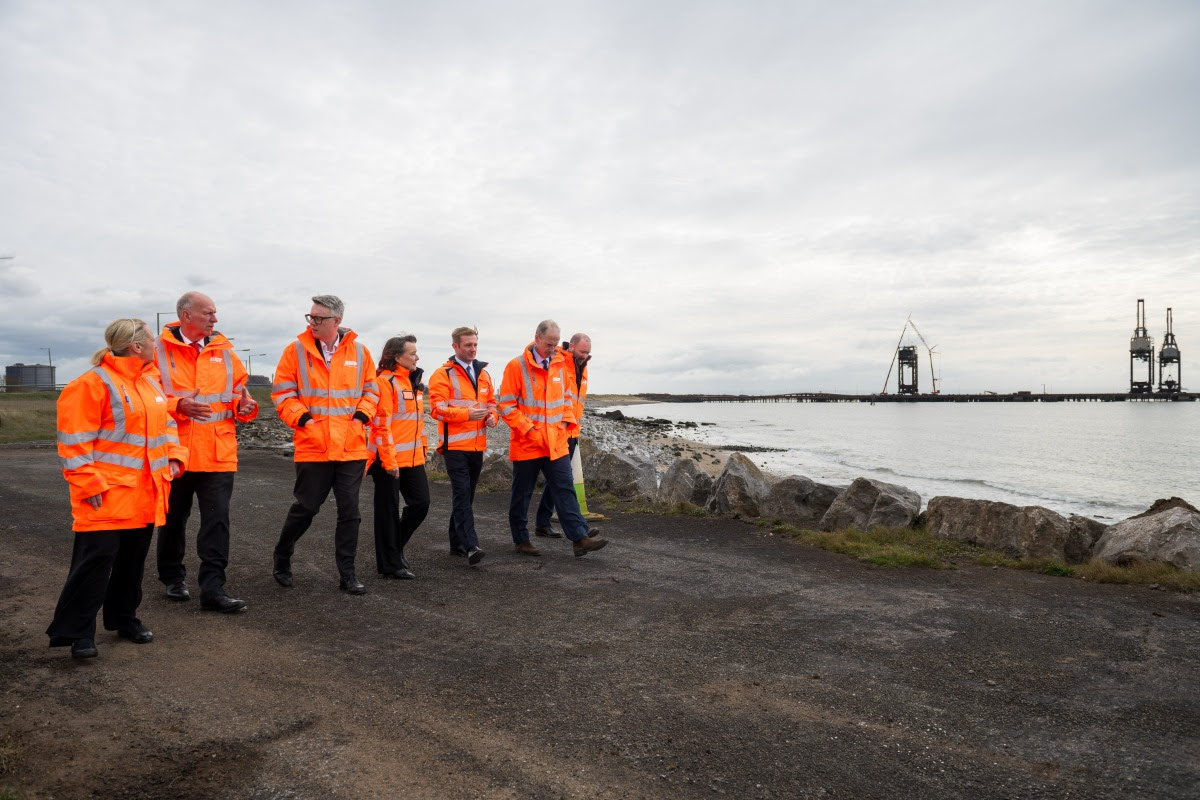
New government-backed deal with ABP reinforces Port Talbot’s central role in Celtic Sea wind plans
PORT TALBOT has been firmly established as the “cornerstone” of the UK’s floating offshore wind ambitions in the Celtic Sea, following a major agreement between the UK Government and Associated British Ports.
The deal confirms government support for the development of large-scale port infrastructure at Port Talbot, enabling manufacturing, assembly and deployment of floating wind turbines for gigawatt-scale projects.
The announcement strengthens Port Talbot’s position as the primary industrial hub for the emerging sector.
Henrik L. Pedersen, Chief Executive of Associated British Ports, said the development would “establish the port as a cornerstone of the Celtic Sea floating offshore wind industry.”
Clear role for Port Talbot
The agreement, subject to final regulatory approval, will support the delivery of major offshore wind projects awarded through the latest Celtic Sea leasing round.
Government ministers visiting the site described the development as a key step in building the UK’s clean energy future.
Energy Secretary Ed Miliband said the project would help Wales “storm ahead in floating offshore wind,” supporting thousands of jobs and driving economic growth.
Secretary of State for Wales Jo Stevens added that the investment would “further cement Port Talbot as a hub of the industries of the future.”
Milford Haven still waiting for detail
The latest announcement comes just days after questions were raised about Milford Haven’s role within the wider Celtic Freeport.
While Port Talbot’s position as a manufacturing and assembly hub is now clearly defined, there has still been no detailed breakdown of what activity will be based in Pembrokeshire.
Industry figures continue to point to Milford Haven’s strengths in operations, maintenance, logistics and servicing of offshore wind projects.
However, no formal commitments have yet been made.

Industry backing grows
Developers involved in Celtic Sea wind projects welcomed the progress at Port Talbot, describing it as essential infrastructure for delivering future schemes.
Ocean Winds said strengthening port infrastructure was “essential” to ensuring regional ports can support the rollout of offshore wind.
The Crown Estate also described the move as a key step towards unlocking the economic potential of the Celtic Sea, which could create thousands of jobs across Wales and beyond.
Growing pressure for answers
With Port Talbot now firmly positioned at the centre of construction and deployment, attention is likely to turn to how other ports—including Milford Haven—fit into the wider strategy.
For Pembrokeshire, the question remains unchanged:
As billions of pounds flow into the Celtic Sea over the coming decade, will Milford Haven secure a defined share of that investment—or continue to wait for clarity?
Pictured above:
From left to right: Cabinet Secretary for Economy, Energy and Planning, Rebecca Evans; David Rees MS for Aberavon; Minister for Energy Consumers, Martin McCluskey; Secretary of State Jo Stevens; Ashley Curnow, Divisional Port Manager (ABP); Julian Walker, Chief Commercial Officer and Regional Director (ABP), Mike Goddard, Head of Programme, Future Port Talbot (ABP)



Crime11 hours ago
Teen jailed after starting fire while others slept
Fire set in shared home left sleeping residents at risk and caused £130,000 damage A TEENAGER who started a fire...


Health16 hours ago
GP crisis driving NHS pressure in Wales, Senedd report warns
Falling GP numbers and funding gaps blamed for worsening hospital delays THE NHS crisis highlighted earlier this week is being...


News1 day ago
Reform reveals west Wales candidates for Senedd battle
Monkton councillor tops Pembrokeshire list as party confirms Carmarthenshire names and includes Haverfordwest councillor in unwinnable Swansea spot REFORM UK...


Health2 days ago
Clash over Withybush Hospital services as Paul Davies challenges First Minister
A HEATED exchange in the Senedd has laid bare growing tensions over the future of hospital services in west Wales....


Crime2 days ago
Police stop car in Pennar as three arrested in drugs investigation
Suspected drug driver report leads to major police response and multiple arrests DRAMATIC scenes were reported in Pennar on Monday...


Business3 days ago
New pilot vessel Llanion arrives at Milford Haven
State-of-the-art 22-metre craft marks reset after £3.6m pilot boat controversy THE PORT OF MILFORD HAVEN has taken delivery of a...


Community3 days ago
Sycamore Gap legacy tree to take root in Pembrokeshire landscapes
A SAPLING grown from the famous Sycamore Gap tree is set to become part of Wales’ protected landscapes — with...


Business4 days ago
Could Primark be coming to Haverfordwest? Major retailer in talks for former Wilko site
Council confirms advanced discussions as speculation grows over high street boost HAVERFORDWEST could soon see a major high street revival,...


Business4 days ago
Rail investment ‘could unlock 40,000 jobs and £11bn for Wales’ says new report
RAILWAY stations across Wales could help unlock around 40,000 jobs and more than £11 billion for the economy by 2036,...


Local Government4 days ago
Milford Haven set for £200m investment with schools, leisure centre and rail upgrade
Council outlines major plans for town with backing from Welsh Government MILFORD HAVEN is set for a major transformation with...
-

 Crime7 days ago
Pembroke man remanded in custody over knife threat, assault and damage allegations
-

 Crime6 days ago
Broad Haven man remanded in custody over sexual harm prevention order breach
-

 Crime7 days ago
Publican jailed for six years for supplying cocaine and cannabis
-

 Business3 days ago
Taxi fare shock in Milford Haven as drivers switch to meters
-
Business4 days ago
Could Primark be coming to Haverfordwest? Major retailer in talks for former Wilko site
-

 News7 days ago
Pembrokeshire’s Muslims gather to celebrate Eid al-Fitr as Ramadan ends
-

 Crime7 days ago
Carmarthen man denies coercive control allegations
-

 Education7 days ago
Prendergast School achieves gold award for Armed Forces support