


News
Truss unveils plan to cap domestic gas and electricity bills at £2500 per year from October


ON THURSDAY morning, September 8, the Prime Minister unveiled her big idea to help UK families cope with spiralling energy costs over the next two years.
Mrs Truss said domestic gas and electricity bills in the UK will be capped at £2500 per year from October in a statement to the House of Commons.
The announcement means that families will only pay twice as much for their energy than they did last year.
The price cap is around £1,000 less than that already announced.
It’s still about £500 more than at present.

As well as households, businesses are also expected to receive some help. Many firms are currently facing even sharper rises than households, and many fixed-rate deals for business expire this October, exposing thousands of firms to full costs that could rise by four or five times or more.
She did not provide details of relief for businesses, apart from a brief mention that a similar measure would provide for six months of protection and targeted support for businesses most at risk.
Otherwise, Liz Truss kicked support for business into the long grass for cutting by Jacob Rees Mogg.
She said she would “not give in to the other side” on windfall taxes on energy firms as “that would undermine the national interest by disincentivising energy companies we need to invest in this country.

“We are doing important business to help people and businesses get through this winter and winter whilst helping Britain secure its long-term energy supplies.
“There will be as cost to this intervention, but we are facing a global energy crisis.”
Preseli Pembrokeshire MP Stephen Crabb praised the PM and said to the House: “Doesn’t this demonstrate Mr Speaker that Conservative Governments do not stand-by when help is needed.”

Shock data released this week shows that 355,000 companies with a turnover higher than £1m are designated as high energy users – industries such as steel, glass, concrete, and paper production.
Of those, an estimated 75,972 are at risk of insolvency, and 26,720 could fail because of energy costs.
That’s in addition to the 26,000 insolvencies already predicted this year.
Without a large-scale support package from the government, more businesses will fail than during the pandemic and any other recession.
A business turning over a million pounds two years ago would have spent around 8% of that on energy costs and made profits of around £90,000.
If the cost of energy doubles to 16%, that instantly wipes out profitability, and they’re straight into a scenario where it threatens the viability of the business within a year.
Beyond the large, energy-intensive companies, smaller companies with turnover under £1m were also at risk of failure, data analytics firm Red Flag Alert said on Tuesday (Sept 6).
In Pembrokeshire, some firms have already closed their doors – one example is the popular Haven Brasserie in Nolton Haven, which said it would shut for “reasons of economic uncertainty”.
The hospitality sector, which is a huge part of the local economy, is facing a triple threat of increasing energy bills, higher supply and staffing costs, and a fall-off in consumer spending, squeezed by inflation.
Red Flag Alert calculates businesses overall will need £100bn a year in support to tackle the rise in energy bills.
The government is already under pressure over how it will finance a promised package of support for households while sticking to promises to cut taxes.
Responding to the PM’s announcement, opposition leader Keir Starmer said the argument against a windfall tax was nonsense and that energy companies’ own announcements showed investment would not be deterred.
He said the PM was focused on protecting the excess profits of energy companies who reaped their unplanned benefit from Russian aggression. At the same time, ordinary families would end up repaying the money she’d borrowed years ahead through their bills.
Keir Starmer said that strategy was a tax on families instead of hitting big corporations who had failed to invest money in energy security and infrastructure.









PLANS for a new £100 million school in Milford Haven have been unveiled, but the project has not yet secured full approval and remains subject to further funding decisions.
Pembrokeshire County Council this week released details of the proposed development, alongside a professionally produced video featuring First Minister Eluned Morgan, senior council figures and school leaders outlining the vision for a modern, state-of-the-art school.
The announcement comes just seven weeks before the Senedd election.
The proposed scheme would see the development of a new, purpose-built school designed to provide modern learning environments for pupils across Milford Haven and the surrounding area. Plans include specialist teaching facilities, improved accessibility throughout the site, and enhanced outdoor learning and play areas.
Council officials say the project will also place a strong emphasis on sustainability, incorporating energy-efficient systems and modern building standards aimed at reducing long-term environmental impact and running costs.

Outline stage only
Despite the high-profile launch, the project is currently at Strategic Outline Case (SOC) stage — an early stage in the public sector approval process.
SOC approval means the scheme has been accepted in principle, but key elements — including final costs, detailed design and overall value for money — have not yet been fully assessed.
Crucially, no final funding commitment has yet been made.
Before the project can proceed to construction, it must pass through the full business case (FBC) process. This stage requires detailed financial modelling, technical planning and formal sign-off from funding bodies, including the Welsh Government.
Only if that process is successfully completed will funding be formally approved and delivery authorised.
Political and funding context
Major school developments in Wales are typically delivered through joint funding arrangements between local authorities and the Welsh Government, often under long-term investment programmes aimed at modernising the education estate.
While both council leaders and Welsh Government representatives have expressed support for the Milford Haven project, schemes at SOC stage can still be subject to revision, delay or, in some cases, may not proceed if funding or value-for-money criteria are not met.

Large infrastructure announcements are often made at this stage to outline ambition and begin public engagement, ahead of final decisions on funding and delivery.
Long-running campaign
Cllr Guy Woodham, Cabinet Member for Education, said he had been working towards securing a new school for several years.
He said: “I have been Cabinet Member for Education since 2019 and I have been fighting for a new school for Milford all that time.
“This project represents a major investment in our children’s future and will provide a safe, modern and inclusive environment where pupils can thrive.”
The Welsh Government has also welcomed the plans, describing them as part of its wider programme to improve school facilities across Wales.
Community involvement
The council has confirmed that the next phase of the project will involve consultation and engagement with pupils, staff, parents and local residents.
This process is expected to help shape the detailed design of the school before a full business case is submitted.
Not yet a confirmed build
While the plans have been presented as a significant step forward for education in Milford Haven, the project remains a proposal rather than a confirmed construction scheme.
At this stage, timelines for delivery have not been finalised, and progression will depend on the outcome of the business case process and the availability of funding.
For now, the new school remains an ambition backed in principle — but not yet a guaranteed build.
Cover image:
Delighted with announcement: First Minister, Eluned Morgan MS
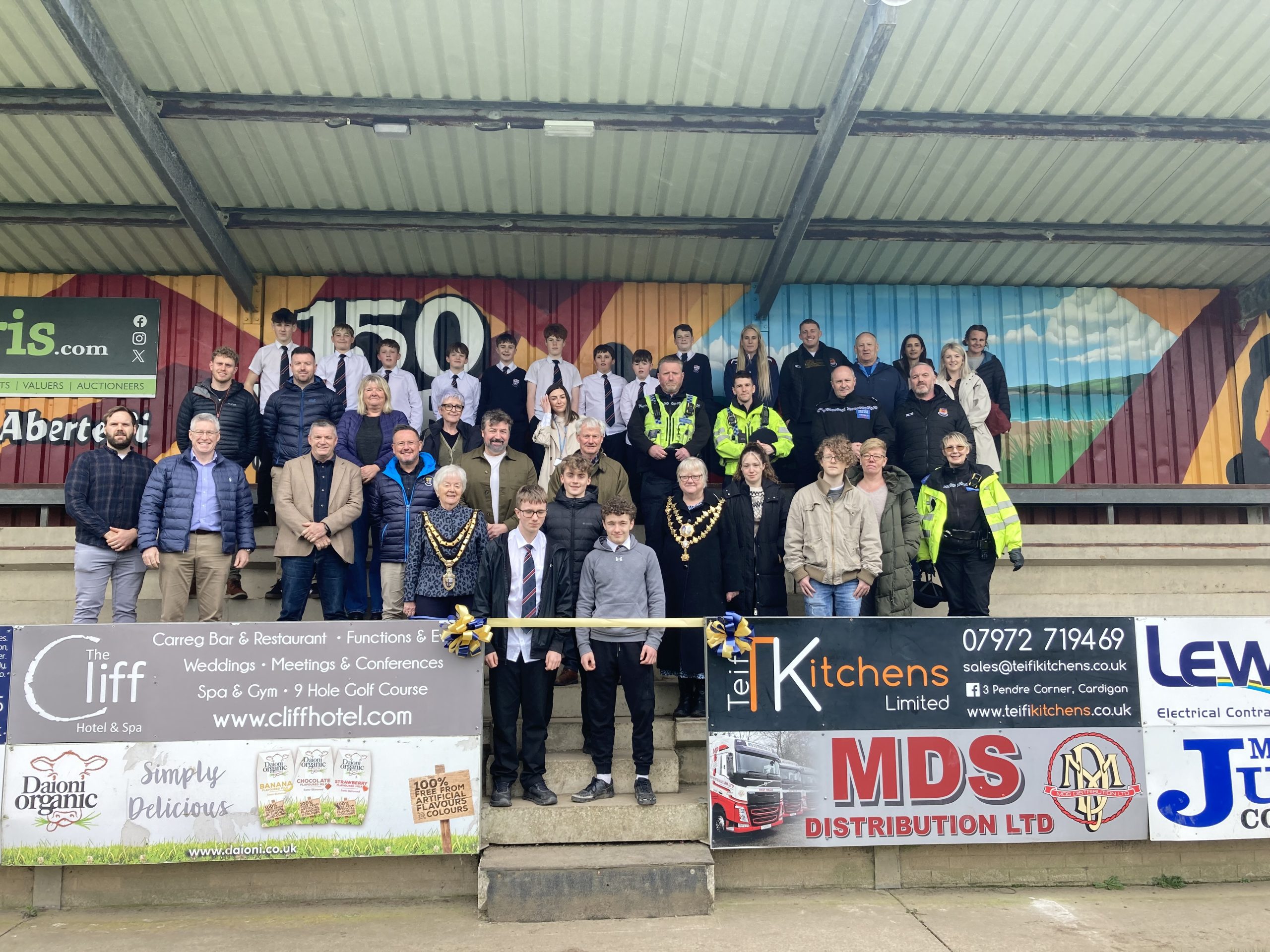
CEREDIGION YOUTH SERVICE has strengthened its early intervention and prevention work across the county through the Home Office-funded Bridges and Safe Spaces (BASS) programme.
Delivered in partnership with the Dyfed-Powys Office of the Police and Crime Commissioner’s Hotspot Action Fund, the initiative is helping youth workers provide trusted adult support, positive activities, and a visible presence in key hotspot areas.
A standout success has been a youth-led graffiti project at Cardigan RFC, aimed at reducing anti-social behaviour by giving young people a sense of ownership over public spaces. Working alongside local artists and youth workers, participants transformed the rugby club stand into a vibrant mural, fostering pride while discouraging vandalism.

A spokesperson for Cardigan RFC said: “The graffiti project has shown the value of a community-based approach. Working with the Youth Service has helped us build stronger relationships with local young people and better understand the issues that matter to them. The transformation of the stand has brought new energy and pride to the club, creating a positive connection between young people and the wider rugby community. We are extremely grateful for their hard work and support.”
Across Aberystwyth, Lampeter and Cardigan, the Youth Service delivered 300 hours of outreach and detached youth work. This included expanded youth club provision and targeted sessions such as free gym access, wellbeing programmes and intergenerational activities.

These initiatives are designed to provide safe, supportive alternatives during key periods of vulnerability, particularly after school and in the evenings.
The BASS programme is also expanding its preventative reach through partnerships with Promo Cymru, developing digital engagement services, and with EYST to strengthen conversations around inclusion and community cohesion. Both partnerships support the Youth Service’s commitment to anti-racist, trauma-informed and bilingual practice.
Funding has also supported Saturday sessions at Depot, Area 43’s youth café in Cardigan, which welcomed more than 10,000 young people in 2025. Operations Manager Ruth Pilcher said the funding has been vital in sustaining the café’s busiest day, highlighting the importance of safe spaces, diversionary activities and needs-led support.
Gwenllian Morris, Team Manager for Community Youth Work and Prevention, said: “This project has strengthened our partnership with Cardigan RFC and Ysgol Uwchradd Aberteifi, giving young people a meaningful role in shaping a space they use every day. By bringing the school, the club and the Youth Service together, we have helped young people develop new skills, build relationships with trusted adults and contribute something lasting to their community.
“The mural celebrates 150 years of Cardigan RFC, but it also reflects the creativity, pride and teamwork of the young people involved. We are proud to have delivered this through the Dyfed-Powys Hotspot Fund, which has been vital in expanding preventative youth work across Ceredigion.”
Councillor Alun Williams, Deputy Leader and Cabinet Member for Through Age and Wellbeing, added: “This project highlights the real impact of prevention-focused youth work. By giving young people support, creativity and a sense of belonging, we reduce the risk of anti-social behaviour and strengthen communities.
“The partnership between the Youth Service, Cardigan RFC and Ysgol Uwchradd Aberteifi shows how local organisations can work together to give young people positive opportunities and a genuine voice. Ceredigion is proud to champion preventative services like this as part of our long-term commitment to community wellbeing.”
For more information about the Bridges and Safe Spaces programme, contact [email protected] or follow Gwasanaeth Ieuenctid Ceredigion Youth Service on social media.

THE WELSH GOVERNMENT has confirmed £3 million in funding over the next three financial years to continue the Welsh Sheep Genetics Programme (WSGP), helping Welsh sheep farmers improve efficiency, productivity and environmental performance.
From April 2026, Hybu Cig Cymru – Meat Promotion Wales (HCC) will lead Phase 2 of the programme, marking a significant next step in supporting farmers to make smarter, evidence-based breeding decisions.
The new phase will provide transition support for existing participants while also opening the programme to new flocks. Farmers will receive practical, technical and financial support to make use of Genomic Estimated Breeding Values, advanced genetic tools designed to help them make better-informed decisions at farm level. The data collected will also strengthen industry benchmarking and support longer-term business planning.
Phase 2 will also include the development of robust key performance indicators, tailored farm-level action plans, and an ambitious portfolio of research projects aimed at driving innovation across the sector.
The programme’s objectives are closely aligned with the Sustainable Farming Scheme, which launched on January 1, 2026, as well as HCC’s Vision 2030, reflecting a shared commitment to a productive, sustainable and competitive Welsh red meat industry.
Phase 1 of the WSGP, delivered by Farming Connect, comes to an end on March 31, 2026. Since launching in 2023, the programme has achieved significant progress, including introducing genomics into the sheep sector for the first time anywhere in the world.
It has also generated 70,000 genotypes across Tier 1 and Tier 2 flocks on the AHDB-Signet database since 2023, the highest number recorded there, while developing two major research strands focused on breeding for worm resistance and reduced methane emissions.
The programme has worked in close partnership with leading specialists, including Innovis and AHDB-Signet, and has delivered measurable genetic gains and improvements in key performance traits across participating flocks.
The investment underlines the Welsh Government’s commitment to reducing greenhouse gas emissions while supporting the production of high-quality, sustainable PGI Welsh Lamb.
Deputy First Minister for Climate Change and Rural Affairs, Huw Irranca-Davies, said: “This funding demonstrates our commitment to supporting farmers to build profitable, resilient businesses while delivering on our climate ambitions. The Welsh Sheep Genetics Programme shows what is possible when cutting-edge science meets the proud tradition of Welsh livestock farming. By helping farmers breed healthier, more productive flocks with a lower environmental footprint, we are strengthening food security and safeguarding our rural economy for the long term.”
José Peralta, Chief Executive of Hybu Cig Cymru, said: “The progress achieved to date reflects the commitment of farmers across Wales, the work of the Farming Connect team, and the continued financial support of the Welsh Government. Together, these provide a strong platform for the next phase.
“This next step directly supports a core priority in our new strategic plan: to develop and lead the implementation of initiatives that improve economic and environmental sustainability. We look forward to working closely with farmers to ensure they have the tools, insights and support needed to thrive in the years ahead.”

I can also turn this into a Herald-style news story if you want.



Education3 minutes ago
Milford Haven school plans unveiled but funding not yet secured
PLANS for a new £100 million school in Milford Haven have been unveiled, but the project has not yet secured...


News47 minutes ago
Council unveils plans for new state-of-the-art secondary school in Milford Haven
PEMBROKESHIRE COUNTY COUNCIL has revealed plans for a new state-of-the-art school in Milford Haven, promising modern, inspiring learning spaces for...


Health4 hours ago
NHS waiting list falls — but cancer delays and diagnostic backlog worsen
Record progress claimed by Welsh Government as critics warn key targets are still being missed THE NHS in Wales has...


Crime1 day ago
Rapist jailed after ‘abhorrent’ attacks on woman and children
Haverfordwest man told police “women won’t have sex without force” A HAVERFORDWEST man who raped a woman and a young...


News1 day ago
Reform secures first Pembrokeshire councillor in Hakin by-election win
Late Reform candidate takes seat as independent surge and Labour withdrawal shape contest REFORM UK candidate Scott Thorley has won...


News2 days ago
Scott Thorley elected as Pembrokeshire’s first Reform councillor
REFORM UK candidate Scott Thorley has won the Hakin by-election after securing 179 votes. The full result is as follows:...


News2 days ago
Police confirm man has died after being recovered from River Cleddau
Major emergency response in town centre after concerns raised for man in water A MAN has died after being recovered...


Community2 days ago
Davies and Kurtz urge groups to seek employability funding
Community organisations in Pembrokeshire encouraged to apply for new grants supporting skills and job access LOCAL Senedd Members Samuel Kurtz...


News2 days ago
Emergency services flood Haverfordwest after reports of person in river
Town centre sealed off as multi-agency response continues A MAJOR emergency response is underway in the centre of Haverfordwest after...


News2 days ago
Detectives receive surge of new information in bid to identify man found at Powys reservoir
Public response follows release of facial image as officers pursue fresh lines of enquiry DETECTIVES investigating the identity of a...
-

 Health6 days ago
Welsh Ambulance Service to host bi-monthly Board meeting
-

 News5 days ago
Rayner and Lammy visit Wales to discuss justice and community safety
-

 News4 days ago
Fishguard linked to allegations in Many Tears Animal Rescue investigation
-
News2 days ago
Emergency services flood Haverfordwest after reports of person in river
-

 Charity7 days ago
Many Tears Animal Rescue visited by inspectors as police attend in support role
-
 Local Government5 days ago
Investigation confirmed after inspectors visit Many Tears Animal Rescue
-

 Farming6 days ago
Plea to remove decades old ‘unviable’ planning conditions from property
-

 Crime6 days ago
Dangerous driver sentenced following a police chase through Carmarthenshire streets