


News
Unpaid carers could swing election in Mid & South Pembs, says charity


UNPAID carers have the power to swing 185 constituencies at the General Election, charity Carers Trust warns
Analysis from UK charity Carers Trust shows there are enough unpaid carers in 185 constituencies to potentially swing each of those seats at this week’s General Election, including in Mid and South Pembrokeshire.
There are 185 seats in England and Wales where the number of carers is higher than the current MP’s majority. They include many seats held by key figures in all parties. Amon them are the Conservatives’ former leader Iain Duncan Smith and Justice Secretary Alex Chalk, Labour’s Shadow Chancellor Rachel Reeves and Deputy Leader Angela Rayner, and Lib Dems Daisy Cooper and Tim Farron.
In the new Mid & South Pembrokeshire constituency there are 10,222 carers and Stephen Crabb’s majority at the last election in 2019 was 8621, although remember at the last election we had the differently configured seat of Preseli Pembrokeshire.
A total of 96 constituencies currently held by the Conservatives could be swung by carer votes. This includes Chingford and Woodford Green where Iain Duncan Smith has a 1,604 majority in a seat with 8,225 carers. Alex Chalk’s 1,421 majority in Cheltenham could also face a threat from 6,871 carers.

In all, 83 Labour-held constituencies could see their majority overturned by carer votes. Angela Rayner has a 4,689 vote majority in Ashton-under-Lyne, a constituency of 8,517 carers. Meanwhile, Rachel Reeves is contesting the new seat of Leeds West and Pudsey which has 7,783 carers and an estimated 2019 majority of 2,963.
Carers Trust has warned that, although there are an estimated seven million unpaid carers in the UK, they have been largely ignored by most political parties during the election campaign. Many carers are looking after ill or disabled family and friends because of the crisis facing social care. Yet the social care system has also been largely absent from election debates so far. If parties are serious about tackling the social care crisis, they will need support from unpaid carers. In return, those carers need more support themselves.
Dominic Carter, Carers Trust’s Director of Policy and Public Affairs, said: “Many carers have been plunged into pverty because of their caring role and are picking up the pieces left by a social care system that’s been starved of investment. These figures show that, although carers have been largely ignored this election, they have the power to swing huge numbers of seats across the country on July 4.
“At Carers Trust we are calling on all parties to make sure carers are no longer pushed to breaking point and are properly supported, including overhauling Carer’s Allowance – the lowest benefit of its kind. It’s not too late for parliamentary candidates to start listening to those calls. If they don’t, they could be punished at the ballot box.”

The largest majority under threat from carer power is Blackpool North and Fleetwood, where the Conservatives’ 10,119 majority for Paul Maynard could be wiped out by 10,233 carers. Seats with majorities of over 8,500 like Brecon, Radnor and Cwm Tawe, Harrow East, Enfield North and Pontypridd are also at risk if carers vote against the incumbent.
Elsewhere, carer votes could also make the difference in marginals like Burnley, Leigh & Atherton and Wimbledon.
More than 1.5 million people in England and Wales provide at least 50 hours of care a week, with huge implications for their finances, health and future prospects. A survey by Carers Trust last year found just 55% of carers say they get the support they need, while 41% said the time they spent caring has increased. Despite this, there has not been a UK Government plan for carers since 2020 and the last cross-government Carers Strategy expired six years ago.

Carer power: The 10 biggest majorities at risk from carer votes
Seat
2019 majority
Number of carers
Incumbent MP
Party
Blackpool North and Fleetwood
10119
10233
Paul Maynard
Conservative
Brecon, Radnor and Cwm Tawe
9091
9677
Fay Jones (Brecon and Radnorshire)
Conservative
Harrow East
8987
9219
Bob Blackman
Conservative
Enfield North
8853
9258
Feryal Clark
Labour
Pontypridd
8798
9944
Alex Davies-Jones
Labour
Corby and East Northamptonshire
8676
8895
Tom Pursglove (Corby)
Conservative
Mid and South Pembrokeshire
8621
10222
Stephen Crabb (Preseli Pembrokeshire
Conservative
Taunton and Wellington
8536
8763
Rebecca Pow (Taunton Deane)
Conservative
South Ribble
8515
8664
Katherine Fletcher
Conservative
Neath and Swansea East
8451
10961
Christina Rees (Neath)
Labour


Dealer who claimed £160,000 profits was later calling police for protection as threats escalated over money he owed to his suppliers
A MILFORD HAVEN drug dealer who bragged he had “the best coke out there” and claimed to have made up to £160,000 in just four months has been jailed for six years.
But behind the image of a confident, high-earning operator, the reality was starkly different — a man in debt, under threat, and repeatedly calling police for protection as his world closed in.

The 35-year-old defendant admitted multiple offences relating to the supply of cocaine and cannabis when he appeared before Swansea Crown Court.
The court heard he played a significant role in the supply of Class A and Class B drugs, purchasing large quantities — including claims he was buying cocaine by the kilogram — and maintaining contact with upstream suppliers.
In messages shown to the court, he boasted about his profits, claiming to have made £38,000 and suggesting that far larger sums were within reach. He also claimed to have earned £160,000 in just four months and said he had bought two houses.
He told customers he had “the best coke out there” and responded aggressively to complaints, stating: “Out of £30,000 worth, you’re the only one to complain,” before adding: “Bad mouthing me is a bad idea you little slag.”

Violence and intimidation
The court was also shown chilling footage of a confrontation at a property on the Mount Estate, where the defendant was heard directing violence over a debt.
In the video, he shouted: “I got boys, yeah, I got boys,” before telling others to “kick his head in” as the attack unfolded inside the victim’s home.
Witnesses described him as having become a “kingpin” in Milford Haven’s drug scene, operating from The Vibe public house, which they claimed was used as both a legitimate business front and a base linked to drug dealing.

Fear behind the façade
Yet the court heard that behind the bravado, the defendant was living in fear.
He had accumulated drug debts estimated at between £18,000 and £26,000 and was being threatened by those higher up the supply chain. His partner reported people turning up at their home, with threats including claims it would be bombed or burned down.
The Herald attended his home address on multiple occasions to report on police activity after he called officers for protection.

In a direct call to this newspaper during the period, he said: “There are threats to my life — people want me dead, dead. I don’t want this in the paper. It’s over money… hundreds of thousands of pounds.”
Documents reveal further pressure
The Herald can also reveal that the defendant was served with a statutory demand in late 2025 over an alleged unpaid debt relating to stock, fixtures and fittings following his takeover of The Vibe public house in March 2024.
Documents seen by this newspaper indicate the financial pressures he was under extended beyond drug debts.
National attention
The case has already drawn national interest, with Channel 4 making a documentary featuring the defendant after interviewing local people in Milford Haven over recent months.
‘Significant role’ in drug trade
Police arrested the defendant on January 5 last year on suspicion of being concerned in the supply of Class A drugs. A search of an address on Priory Road uncovered 18 grams of cannabis, while a separate incident involving a vehicle led to the discovery of 73 grams of cocaine and cannabis.
Prosecutors said he was actively involved in the supply of drugs and purchasing large quantities, describing him as a key player in the local trade.
He has 57 previous convictions, mostly for theft-related offences.
‘Only a custodial sentence’
Defending, Mr Ibrihim described his client’s background as a “tale of woe,” telling the court his father was addicted to heroin and his mother struggled with alcohol. His younger sister died in 2022.
The court heard he had gone “off the rails” in his late teens and that his drug dealing was linked to debts, including those connected to his father. It was also said that many of his claims about wealth were exaggerated and amounted to “bravado”.
Sentencing, the judge said: “The seriousness of this offending means that only an immediate custodial sentence is appropriate.
“You played a significant role in drug dealing. What is clear is that you were dealing with a lot of cocaine.
“I have no doubt that some of what you did was due to pressure, but some of it was for your own gain.”
The judge added that despite the defendant’s claims of wealth, “you haven’t got hardly anything left”.
For the supply of cocaine, he was sentenced to six years in prison, with a concurrent sentence of 30 months for supplying cannabis.
He will serve at least half the sentence in custody before being eligible for release.
A victim surcharge of £228 was also imposed.
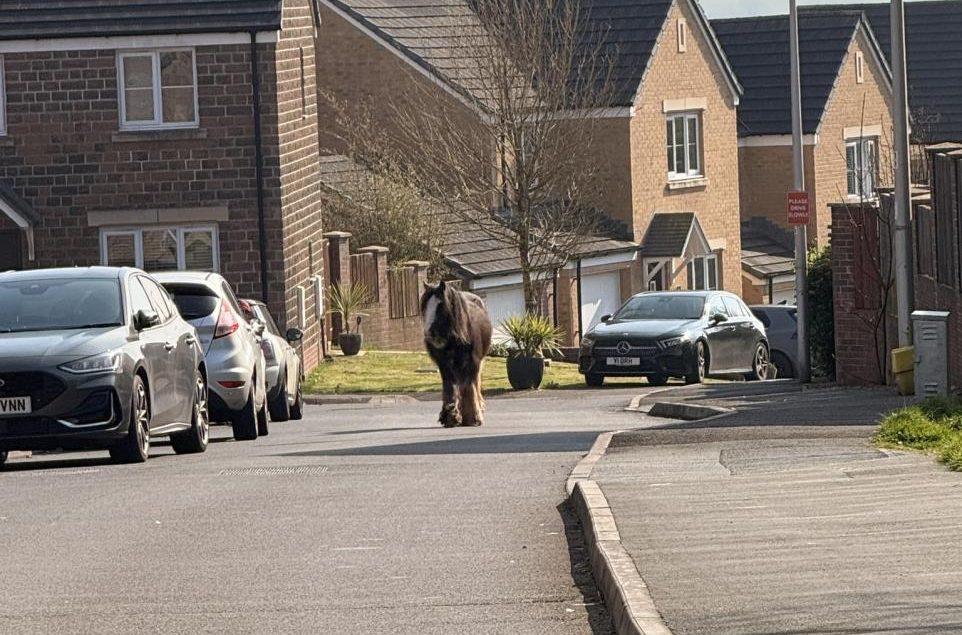
Animal seen galloping through residential streets and towards main road
POLICE are reportedly tracking a loose horse which strayed into a residential area of Pembroke.
The animal was first spotted in Gatehouse View before making its way onto a nearby main road.
A post on the Pembroke and Pembroke Dock Citizens’ Forum said the horse had left Gatehouse View and was seen heading towards the road by Pembroke Leisure Centre.
The resident wrote: “Anyone recognise it? Police following it.”
The horse was later reported to be galloping down Buttermilk Lane in the direction of Martha’s.
Stray horses are not uncommon in the area. In January, several animals were reported loose around Pembroke and along the A477, particularly near Buttermilk Close and the Cleddau Bridge.
Those incidents created a hazard for motorists, prompting Pembrokeshire County Council to step in and return the animals. Drivers were advised to take extra care and avoid startling them.

Reliance on US interceptors leaves gaps as Iran’s reach grows
BRITAIN would struggle to defend itself against a long-range ballistic missile attack and would instead rely heavily on American systems based in Eastern Europe and at sea — with no guarantee of success.
That is the stark reality emerging after Iran’s attempted strike on a UK–US base at Diego Garcia on Saturday (March 21), a move that caught many world leaders off guard and marked a significant escalation in capability.

Concerns are further heightened by Iran’s development of larger space launch vehicles, including the Simorgh, Zuljanah, Ghaem-100 and Qased systems, which on paper demonstrate ranges of between 2,200 km and up to 6,000 km, with payload capacities of up to 1,000 kg. While these rockets are officially designed to place satellites into orbit rather than deliver warheads, they use the same multi-stage technology and propulsion systems found in long-range ballistic missiles. Defence analysts have long warned that such programmes provide a clear pathway to intercontinental strike capability, raising the prospect that parts of Europe — and potentially even the UK — could fall within reach if these technologies are adapted for military use.
No UK shield over Britain
The UK has no dedicated system to shoot down long-range ballistic missiles over its own territory.
While RAF Fylingdales provides early warning and tracking, it cannot intercept incoming threats. Britain’s air defence network — including RAF jets and ground systems — is designed for aircraft, drones and cruise missiles, not high-speed ballistic weapons.
In simple terms, if a missile were heading toward a target such as Milford Haven’s energy facilities, there is no British-operated system that could reliably stop it at the last moment.
America would have to act
Instead, any interception attempt would fall to the United States.
Key assets include:
- Aegis Ashore missile defence bases in Romania and Poland
- US Navy warships equipped with SM-3 interceptors
- Wider NATO tracking and coordination systems
These systems are capable of striking a missile in space during its midcourse phase, long before it reaches the UK.

But there is a crucial limitation: they can only engage if the missile passes within range of those systems.
If the trajectory falls outside that envelope — or if no US ship is positioned correctly — there may be no interception at all.
A probability, not protection
Even when an intercept is attempted, success is far from certain.

Testing data for the SM-3 system suggests success rates of roughly 50 to 80 per cent per engagement, depending on conditions. In practice, multiple interceptors are often fired at a single target to improve the odds.
That still leaves a significant margin for failure.
In a real-world scenario involving countermeasures, technical faults or multiple missiles, the chances of at least one getting through rise sharply.
Gaps in coverage
The NATO missile defence network is not a continuous shield.
It is a patchwork of coverage zones tied to specific systems:
- Romania and Poland provide fixed land-based interception capability
- US warships offer flexible but limited coverage depending on deployment
There is no permanent protective umbrella over the UK itself.
If a missile does not pass through one of those defended zones, Britain would effectively be relying on luck and geometry.
Deterrence, not defence
Ultimately, the UK’s primary protection is not interception — it is deterrence.
Any successful strike on British soil would almost certainly trigger a major NATO response, making such an attack extraordinarily risky for any adversary.
But deterrence does not equal defence.
A growing concern
Iran’s attempted long-range strike on Diego Garcia has shifted the debate sharply.
The use of a missile capable of travelling thousands of kilometres surprised many Western leaders, who had not expected Tehran to demonstrate that level of reach in the current crisis. Although one missile failed and another was intercepted, the incident has raised fresh questions about how far Iran’s capabilities have advanced.
For years, the idea of a missile threat to Europe — let alone Britain — was largely theoretical. Now, defence analysts are treating it as a credible future risk, even if capability remains limited today.
The bottom line
The UK can detect a missile, track it, and coordinate a response — but when it comes to actually stopping it, the country would be dependent on American systems operating at distance, with no certainty of success.
If a missile ever did get through, there would be little standing between it and its target.
And that is the uncomfortable truth behind the headlines.



Entertainment18 hours ago
Tenby steams up in spectacular style as crowds flock to festival
Colourful parade, towering creations and Victorian flair bring town centre to life TENBY was transformed into a vibrant Victorian fantasy...


Crime2 days ago
Publican jailed for six years for supplying cocaine and cannabis
Milford Haven man sentenced at Swansea Crown Court following drug dealing operation A MILFORD HAVEN publican has been jailed for...


Local Government2 days ago
Poverty summit highlights support efforts across Pembrokeshire
A SUMMIT bringing together key organisations from across Pembrokeshire has highlighted both the scale of local poverty and the work...


Education3 days ago
Milford Haven school plans unveiled but funding not yet secured
PLANS for a new £100 million school in Milford Haven have been unveiled, but the project has not yet secured...


News3 days ago
Council unveils plans for new state-of-the-art secondary school in Milford Haven
PEMBROKESHIRE COUNTY COUNCIL has revealed plans for a new state-of-the-art school in Milford Haven, promising modern, inspiring learning spaces for...


Health3 days ago
NHS waiting list falls — but cancer delays and diagnostic backlog worsen
Record progress claimed by Welsh Government as critics warn key targets are still being missed THE NHS in Wales has...


Crime4 days ago
Rapist jailed after ‘abhorrent’ attacks on woman and children
Haverfordwest man told police “women won’t have sex without force” A HAVERFORDWEST man who raped a woman and a young...


News4 days ago
Reform secures first Pembrokeshire councillor in Hakin by-election win
Late Reform candidate takes seat as independent surge and Labour withdrawal shape contest REFORM UK candidate Scott Thorley has won...


News4 days ago
Scott Thorley elected as Pembrokeshire’s first Reform councillor
REFORM UK candidate Scott Thorley has won the Hakin by-election after securing 179 votes. The full result is as follows:...


News5 days ago
Police confirm man has died after being recovered from River Cleddau
Major emergency response in town centre after concerns raised for man in water A MAN has died after being recovered...
-

 News7 days ago
Fishguard linked to allegations in Many Tears Animal Rescue investigation
-

 News5 days ago
Emergency services flood Haverfordwest after reports of person in river
-

 Crime4 days ago
Mother given community order after admitting child cruelty offence
-
Health3 days ago
NHS waiting list falls — but cancer delays and diagnostic backlog worsen
-

 Crime6 days ago
Man cleared of sexual assault allegation after magistrates rule no case to answer
-

 News5 days ago
Senedd votes to ban Greyhound racing in Wales to protect animal welfare
-

 News5 days ago
Senedd vote to ban greyhound racing hailed as ‘landmark moment’ by charities
-

 international news7 days ago
UK considers military options as pressure grows to secure Strait of Hormuz