


Community
Plans to redevelop Brawdy for landmark radar initiative a step closer


The Ministry of Defence has released a second press release regarding plans to redevelop Cawdor Barracks in Pembrokeshire, Wales, to host a groundbreaking radar initiative.
The reannouncement gives a chance for the new Defence Secretary John Healey to express his support for the project, and also announces two community outreach events designed to allow officials to discuss the proposals with local residents.
Known as the Deep Space Advanced Radar Capability (DARC), the initiative, which was first announced last year, aims, according to the Government, to secure long-term employment and enhance the protection of essential satellite communication and navigation networks. DARC will establish a network of ground-based radars across Australia, the United Kingdom, and the United States, enhancing the AUKUS nations’ capacity to detect, track, and identify objects in deep space up to approximately 36,000km from Earth.
This capability will significantly benefit these nations’ land, air, and maritime forces, protect critical infrastructure, and support domestic construction and space industries. DARC will play a crucial role in bolstering AUKUS nations’ ability to ensure safety and security in the Indo-Pacific region and globally.
Defence Secretary John Healey commented: “The proposed redevelopment of Cawdor Barracks secures jobs at home and enhances our defence capabilities for the future. Space plays a crucial role in our daily lives, utilised by everything from our mobile phones to banking services. It also supports UK Defence in conducting vital tasks such as military operations, navigation, and intelligence gathering. This new radar programme will enhance our awareness of deep space and protect our space assets alongside our closest partners.”

The former RAF Brawdy base, currently known as Cawdor Barracks, has a rich history of supporting the UK’s Military, as both a Royal Air Force flying station and a Royal Navy base.
Currently home to the 14 Signal Regiment, the Ministry of Defence announced in 2016 that the barracks would close no earlier than 2028. The site’s redevelopment for DARC would ensure it remains operational, with up to 100 personnel permanently stationed to operate and maintain the radar capability.
Secretary of State for Wales, Jo Stevens, added: “The proposed redevelopment of Cawdor Barracks will secure jobs in the area while protecting our national security. This is an important project for Pembrokeshire, and the government is committed to working with the local community to ensure its success.”

The Ministry of Defence is dedicated to completing all necessary planning and environmental processes to gain consent for the site’s redevelopment and its safe operation. A comprehensive Environmental Impact Assessment, including a Landscape and Visual Impact Assessment, is underway to support a planning application to Pembrokeshire County Council. The Council’s approval will be conditional on DARC meeting all required safety standards.

Safety processes will ensure that DARC complies with international environmental and health standards set by the International Commission on Non-Ionizing Radiation Protection (ICNIRP) and the World Health Organisation. This is standard practice for all MOD installations.
Community engagement will be integral to developing proposals for DARC, with two public information events scheduled before the statutory consultation period required by Pembrokeshire County Council. Members of the MOD DARC programme team will attend these events to discuss proposals, answer questions, and gather local community feedback.
Local opposition to the plans
In June, a public meeting at Solva Memorial Hall was ‘packed to the rafters’ last night as hundreds of concerned residents gathered to discuss the dangers posed by the proposed Deep Space Advanced Radar Capability (DARC) project at Cawdor Barracks in Pembrokeshire. Campaigners are urging local communities to lobby all general election candidates against a project they successfully opposed decades ago.

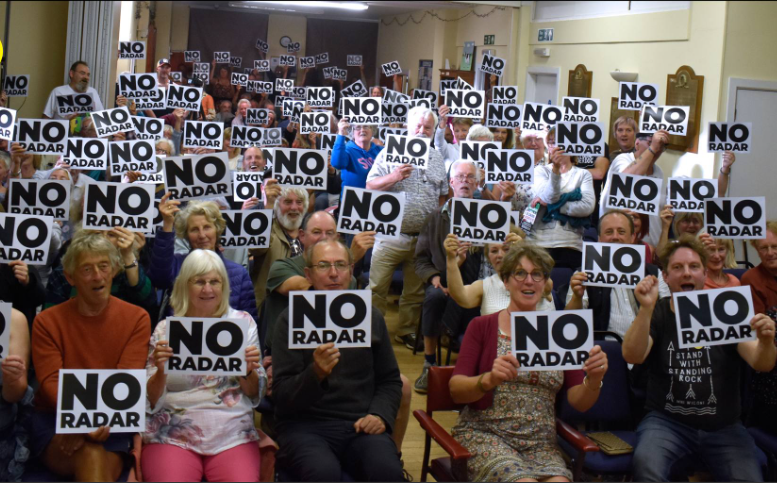
Following the digital launch of the campaign group PARC Against DARC, which aims to halt the UK/US military’s plan to establish a 27-dish high-power radar station, a public meeting in Solva saw a substantial turnout. Organisers reported that the hall was filled with residents ready to challenge the radar initiative.
Speakers at the event reiterated key arguments against DARC, pointing to a similar campaign in the 1990s that forced then-Prime Minister Margaret Thatcher to cancel a related project. The meeting featured a campaign video and presentations that highlighted the community’s readiness to oppose the radar station.
Emma Bowen, general manager of the Retreats Group of local hotels, spoke about the potential negative impact on tourism:
“As an accommodation provider set in the UK’s only coastal national park, we rely on tourists who come to enjoy the coast path, beaches, history, and culture. If you were looking for a holiday location, would you choose somewhere next to 27 enormous radar structures? If DARC goes ahead, it would jeopardise our business, putting 75 jobs at risk and affecting over 40 suppliers and contractors.”
Two short films presented at the meeting, created by leading scientists in non-ionising radiation, outlined severe health risks associated with radar installations. Dr. M. Peleg’s study on Israel’s Iron Dome radar revealed a significant increase in cancer cases among soldiers stationed near the radars. The same type of non-ionising radiation expected from the DARC installation has been linked to haemolymphatic cancers.
One Israeli soldier described the effects: “When you’re near a radar, you literally feel your body boiling from the inside out… like being in a microwave. Israeli soldiers have nicknamed the Iron Dome ‘the toaster’ due to its harmful effects.”
Dylan Lewis-Rowlands, CND Cymru’s secretary, expressed concerns over military escalation: “CND Cymru supports PARC against DARC. We oppose the militarisation of space and Cymru. The DARC initiative is part of the AUKUS alliance’s military ambitions. Our campaign prioritises the needs of Pembrokeshire and Wales over US military interests.”
Michial Davies of the South and West Wales Wildlife Trust discussed the potential harm to Manx Shearwaters and other wildlife: “Lights and Manx shearwaters don’t mix. Brawdy is visible from Skomer, the most important site for these seabirds. DARC will exacerbate the problem, leading to more bird deaths.”
On Thusday (Aug 8) Local campaigner Jim Scott urged attendees to take action: “The MOD acts as if this project will easily pass through local councils, but this is far from a ‘done deal’. We need to ensure our elected County Councillors reject this carcinogenic, military monstrosity. Email the General Election Candidates and make our voices heard.”
Before concluding, attendees replicated an iconic photograph from a previous campaign, holding up NO RADAR placards, symbolising their unified stance against the DARC project.
PARC Against DARC launched a just few weeks ago and already boasts a petition nearing its next target of 15,000 signatures. The public launch meeting was the biggest in Solva’s history.”
With this huge level of public support behind them, campaigners told us; “We are extremely confident that public pressure will put a halt to these ill thought out military proposals.”
Adding: “The MOD’s own scoping report admits that the project would mean 100 heavy lorry trips per day up our coast road and through Newgale itself. That would mean 200 lorry trips per day including the return journey!”
“We know the people of Pembrokeshire wont go along with this, but in any case the road infrastructure simply does not exist for this level of project.”
“As a campaign we have every confidence that this military monstrosity will never see the light of day. We repeat our call for our local MP and MS’s to declare their personal position on this. The issue is likely to be a big vote-loser in the 2026 Senedd elections with some major parties such as Plaid Cymru and the Welsh Greens already having come out staunchly against DARC.
This is no good for Pembrokeshire, this is no good for anywhere. Local Politicians need to get on the right side of this before they are publicly forced to, not afterwards!”
About DARC
Space is crucial for the nation and plays a critical role in our daily lives. Space services, including those delivered by satellites, underpin many aspects of modern life, from enabling navigation, monitoring the climate, forecasting the weather, supporting our emergency services, supporting our Critical National Infrastructure and protecting the public. Understanding what is in space is crucial for the UK’s interests, especially as space becomes more congested with satellites and debris.
The proposed redevelopment of Cawdor Barracks (former RAF Brawdy) for the DARC programme would help to protect our present and future prosperity and national security. By enhancing our awareness and understanding of what is happening in space, we can continue to ensure it remains safe, sustainable and accessible to all.
The MOD announced in 2016 that Cawdor Barracks, home to 14 Signal Regiment (Electronic Warfare), would close and this is currently planned to take place no earlier than 2028. The development of the site for DARC helps keep the site open, with a permanent presence of up to 100 personnel to operate DARC.
The proposals
The MOD says it is committed to undertaking all necessary planning and environmental processes required to gain planning consent for the proposed site and for its safe operation. A comprehensive Environmental Impact Assessment (including a Landscape and Visual Impact Assessment) is underway in support of our planning application to Pembrokeshire County Council and their granting of planning permission is conditional on DARC meeting all the required safety standards.
In particular, the MOD safety processes will ensure that DARC meets international environmental and health standards as set by the International Commission on Non-Ionizing Radiation Protection (ICNIRP) and the World Health Organisation, and this is standard practice for all MOD installations.
Public engagement
There will be two public information events before the statutory consultation period that is required by Pembrokeshire County Council. Members of the DARC programme team will attend these events to discuss the proposals, answer any questions and hear local community views.
Public information events will be hosted over the period 13-14 September 2024:
Friday, 13 September 2024
4pm-7pm
Solva Memorial Hall
39 High St
Solva
Haverfordwest
SA62 6TE
Saturday, 14 September 2024
10am-2pm
St David’s City Hall
High St
St Davids
Haverfordwest
SA62 6SD


SAMUEL Kurtz MS has welcomed more than £4.3 million in National Lottery funding awarded to community projects across Carmarthen West and South Pembrokeshire since 2021.
Figures released by The National Lottery Community Fund show that £4,318,484 has been distributed through 122 grants in the constituency since the 2021/22 financial year, the same year Mr Kurtz was elected.
The funding has supported a wide range of grassroots charities, voluntary organisations and community groups through programmes including National Lottery Awards for All, offering grants of up to £20,000, and People and Places, which provides larger awards of up to £500,000.
Projects backed locally include mental health support for young people, environmental and sustainability initiatives, community workshops, outdoor wellbeing activities, support for vulnerable adults, and programmes aimed at building skills and confidence.
Among the organisations to benefit is Pembrokeshire Coast National Park Authority, which received £343,584 for its Routes to Discovery project, helping improve mental and physical wellbeing through accessible outdoor activities.

St Davids Diocesan Council for Social Responsibility was awarded £398,078 to deliver its Plant Dewi: Strengthening our Communities initiative, supporting families and local groups.
Other recipients include The VC Gallery, Redberth Croft CIC, The Tenby Project CIC and Neptune’s Army of Rubbish Cleaners, with funding supporting projects ranging from food initiatives and nature-based wellbeing to volunteering and environmental action.
Mr Kurtz said: “Community groups and charities across Carmarthen West and South Pembrokeshire do incredible work supporting people and strengthening local communities.
“It is fantastic to see more than £4.3 million of National Lottery funding invested in projects that are improving wellbeing, tackling isolation and creating opportunities for people of all ages during my time in office.

“The voluntary sector plays a vital role in our area, and this funding is helping organisations deliver projects that bring people together and make a real difference to people’s lives.”
The National Lottery Community Fund is the largest funder of community activity in Wales, supporting initiatives that bring communities together, promote environmental sustainability, help children and young people thrive, and improve health and wellbeing.
Organisations across Wales can apply for funding through the Awards for All and People and Places programmes to support projects that matter most to their communities.

Further information is available on The National Lottery Community Fund website.
Tributes pour in for former Neyland officer remembered as a “true gentleman” and “local legend”
A FORMER Neyland police officer remembered as a “true gentleman” and “local legend” has died at the age of 83, prompting an outpouring of tributes from across Pembrokeshire.
Louis Knight, of Neyland Hill, Neyland, passed away peacefully at Withybush Hospital, Haverfordwest on Thursday (Mar 5).
Mr Knight, who served as a police officer in the area for many years, was a familiar and respected figure in Neyland and beyond. In the hours following the announcement of his death, hundreds of messages flooded social media, painting a picture of a man whose impact stretched far beyond his time in uniform.
Many described him simply as “one of the best,” while others called him “a proper local legend” and “a tremendous police officer.”
One resident wrote: “A face and name I will never forget from my youth.”
Another said: “He was a tremendous police officer… a kick up the backside and a word was enough. It stayed with you.”
Others remembered his warmth and humour away from policing.
“He always had a story to tell on the way home in the taxi,” one tribute read, while another added: “Every time you asked him how he was, the answer was always ‘bloody marvellous.’”
Many spoke of his kindness and the time he gave to people.

“Louis was one of the most kindest gentlemen around. Always made time to chat,” one message said.
Another added: “Neyland won’t be the same again.”
While some reflected fondly on a different era of policing, what came through most strongly was the respect Mr Knight earned within his community — something repeatedly highlighted in tributes from those who knew him as children, neighbours, and later as adults.
Mr Knight was the beloved husband of the late Angela, devoted father of Andrew and Alison, and adored father-in-law of Frank. He was also a loving grandfather to Michelle and Laura, and a cherished brother of Jennifer, Charles and Richard.
His family said he was loved dearly and will be greatly missed by all who knew him.
The funeral service will take place on Wednesday (Apr 1) at 11:30am at Parc Gwyn Crematorium, Narberth.
Family flowers only. Donations in memory of Louis, if desired, are for Ward 8 at Withybush Hospital and may be sent directly to the ward at SA61 2PZ.
All enquiries to Tom Newing & Sons Ltd, Funeral Directors, Dartmouth Street, Milford Haven (01646 693180).
Photo caption:
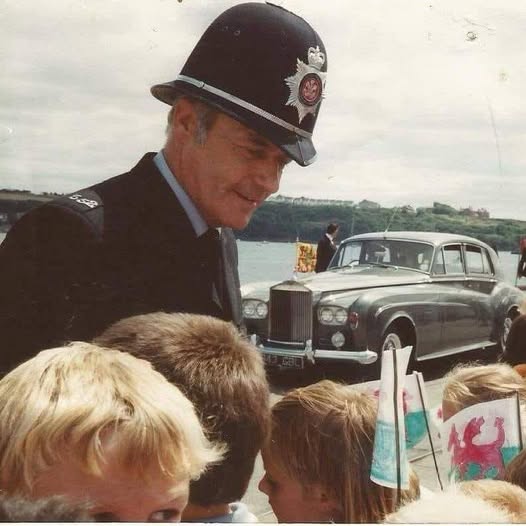
PC Louis Knight pictured during a Royal Visit, engaging with local children — a familiar sight in Neyland for many years (Pic: Supplied).
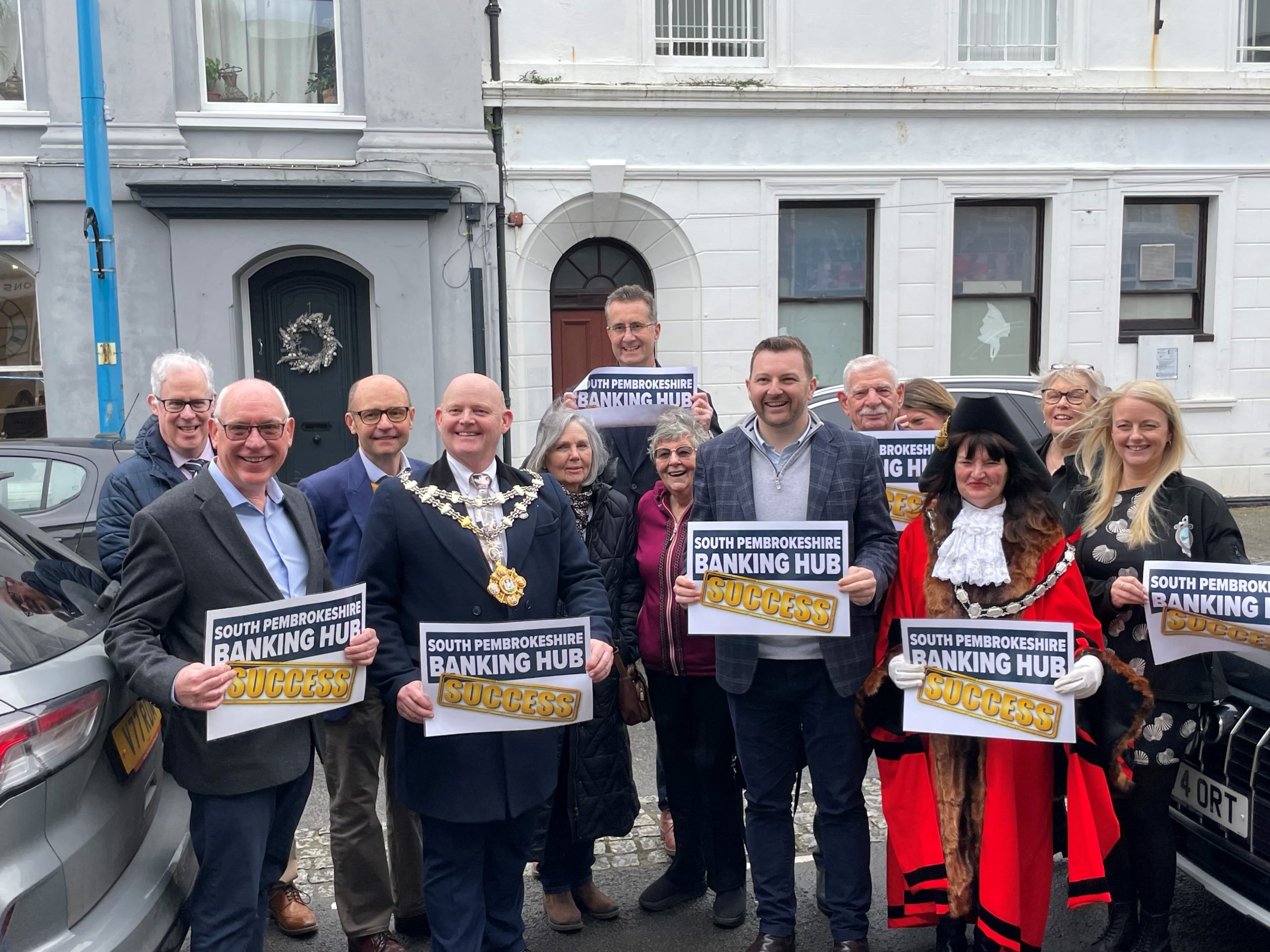
PLANS to deliver a new Banking Hub in Pembroke Dock are moving forward, following a key meeting between local representatives and Cash Access UK.
Samuel Kurtz MS met with Cash Access UK Regional Manager Debbie Crow on Wednesday (Mar 19), alongside community representatives, to discuss the next steps after confirmation last week that the campaign for a hub had been successful.
The new facility is expected to be up and running within 12 weeks, providing vital access to banking services for residents, businesses and community groups across Pembroke Dock and the wider South Pembrokeshire area.

Banking Hubs offer a shared space where customers can carry out everyday transactions such as cash withdrawals and deposits, as well as access face-to-face support from individual banks on designated days.
The development follows the closure of the last bank branch in Pembroke Dock, which had raised concerns about access to essential financial services in the area. Samuel Kurtz has been working with LINK, local businesses and community groups to secure the new hub.
Discussions at the meeting focused on identifying a suitable location and ensuring the service meets the needs of those who continue to rely heavily on cash.
Following strong public interest in the project, Mr Kurtz has confirmed he will hold a series of drop-in sessions in Pembroke and Pembroke Dock to update residents and answer questions.
Samuel Kurtz MS said: “Last week’s news that the campaign for a Banking Hub in Pembroke Dock had been successful was incredibly welcome for our community.
“Access to cash and face-to-face banking services remains vital for many residents, charities and local businesses across the area. I have already been inundated with questions from people wanting to know what happens next.
“That’s why I will be holding drop-in sessions in both Pembroke and Pembroke Dock so residents and businesses can come along, ask questions and hear the latest updates.
“I was pleased to meet with Cash Access UK’s Regional Manager to discuss the next steps, and I will continue working closely with local stakeholders to help ensure the hub is delivered as quickly as possible.”
Further details about the drop-in sessions are expected to be announced shortly.




Local Government58 minutes ago
Poverty summit highlights support efforts across Pembrokeshire
A SUMMIT bringing together key organisations from across Pembrokeshire has highlighted both the scale of local poverty and the work...


Education22 hours ago
Milford Haven school plans unveiled but funding not yet secured
PLANS for a new £100 million school in Milford Haven have been unveiled, but the project has not yet secured...


News23 hours ago
Council unveils plans for new state-of-the-art secondary school in Milford Haven
PEMBROKESHIRE COUNTY COUNCIL has revealed plans for a new state-of-the-art school in Milford Haven, promising modern, inspiring learning spaces for...


Health1 day ago
NHS waiting list falls — but cancer delays and diagnostic backlog worsen
Record progress claimed by Welsh Government as critics warn key targets are still being missed THE NHS in Wales has...


Crime2 days ago
Rapist jailed after ‘abhorrent’ attacks on woman and children
Haverfordwest man told police “women won’t have sex without force” A HAVERFORDWEST man who raped a woman and a young...


News2 days ago
Reform secures first Pembrokeshire councillor in Hakin by-election win
Late Reform candidate takes seat as independent surge and Labour withdrawal shape contest REFORM UK candidate Scott Thorley has won...


News3 days ago
Scott Thorley elected as Pembrokeshire’s first Reform councillor
REFORM UK candidate Scott Thorley has won the Hakin by-election after securing 179 votes. The full result is as follows:...


News3 days ago
Police confirm man has died after being recovered from River Cleddau
Major emergency response in town centre after concerns raised for man in water A MAN has died after being recovered...


Community3 days ago
Davies and Kurtz urge groups to seek employability funding
Community organisations in Pembrokeshire encouraged to apply for new grants supporting skills and job access LOCAL Senedd Members Samuel Kurtz...


News3 days ago
Emergency services flood Haverfordwest after reports of person in river
Town centre sealed off as multi-agency response continues A MAJOR emergency response is underway in the centre of Haverfordwest after...
-

 News6 days ago
Rayner and Lammy visit Wales to discuss justice and community safety
-

 News5 days ago
Fishguard linked to allegations in Many Tears Animal Rescue investigation
-
News3 days ago
Emergency services flood Haverfordwest after reports of person in river
-
 Local Government6 days ago
Investigation confirmed after inspectors visit Many Tears Animal Rescue
-

 international news7 days ago
UK urges allies to keep pressure on Russia despite US easing oil sanctions
-
 Community7 days ago
Community football club raises £1,000 for Withybush Hospital
-

 Business6 days ago
Tesco B&Q Haverfordwest click and collect pod approved
-

 Crime2 days ago
Mother given community order after admitting child cruelty offence