


Business
Clampdown on construction industry’s poor health record


 HEALTH as well as safety’ will be the message as poor standards and unsafe work on building sites in Wales are targeted as part of a nationwide drive aimed at reducing ill health, death and injury in the industry. From Tuesday (Sep 23), HSE Inspectors will ensure highrisk activities particularly those affecting the health of workers, are being properly managed. These include working with harmful dusts such as silica and asbestos, and other hazardous substances.
During the month long initiative, the Health and Safety Executive (HSE) will carry out unannounced visits to sites where refurbishment projects or repair works are underway across Wales. If unacceptable standards are found, Inspectors will take immediate enforcement action, including halting when necessary any potentially dangerous activities. HSE is urging industry to ‘think health’ as an estimated 4,000 people working in construction in Wales last year were suffering from ill-health caused by their work. Paul Harvey, HSE Principal Inspector of Construction, said: “Industry has made much progress in reducing the number of people killed and injured in its activities, but for every fatal accident, approximately 100 construction workers die from a work-related cancer.
A shorter inspection initiative focusing on health risks for construction workers in June saw enforcement action taken at one in six of hundreds of sites visited. Time and again we find smaller contractors working on refurbishment and repair work failing to protect their workers through a lack of awareness and poor control of risks. This isn’t acceptable – it costs lives, and we will take strong and robust action where we find poor practice and risky behaviour. Through campaigns like this we aim to ensure contractors take all risks to their workers seriously, and not just focus on immediate safety implications. They need to put in place practical measures to keep workers both safe and well.”


SWANSEA city centre loses one of its best-known stores today as Marks & Spencer closes its Oxford Street branch for the final time.
The shop, which opened in 1957, has been part of Swansea’s post-war retail story for 69 years and was regarded by many shoppers as one of the city centre’s anchor stores.
The closure affects around 92 staff and leaves a major gap on one of Swansea’s most prominent shopping streets.
M&S said the decision formed part of its wider plan to reshape its store estate and invest in locations that better meet customer needs. The company has said the Swansea store had suffered a sustained decline in sales and that the ageing building would require significant investment.
End of an era
For generations of Swansea shoppers, M&S was more than a shop. It was a meeting point, a reliable food hall, a place for school uniforms, work clothes, Christmas shopping and weekly routines.

Its closure will be seen as another serious blow to traditional city centre retail, following years of changing shopping habits, online competition, out-of-town retail parks and pressure on large high street stores.
Although M&S says it remains committed to serving Swansea customers through nearby stores and online, the loss of the Oxford Street branch means many city centre shoppers — particularly older residents and those relying on buses — will no longer have easy access to a full-line M&S in the heart of the city.
Impact on Swansea
The decision has caused concern about footfall, empty retail units and confidence in Swansea’s main shopping area.
Council leaders had hoped to keep M&S in the city centre and have described the closure as deeply disappointing. The authority is continuing regeneration work in Swansea, including investment around the arena, the city centre and former department store sites, but the loss of M&S is a symbolic setback.

The question now is what happens next to the large Oxford Street building — and whether Swansea can attract a replacement capable of bringing shoppers back into the city centre.
Pic: M&S on Oxford Street, Swansea, closes today after 69 years.


PLANS to diversify a National Trust campsite on the Pembrokeshire coast, with seasonal siting for campervans and ‘landpods’ are expected to be approved by the national park.
In an application recommended for delegated approval at the June meeting of Pembrokeshire Coast National Park’s development management committee, the National Trust seeks permission for a change of use of land for camping, the seasonal siting of five ‘landpods’ and 20 campervans and associated works at Gupton Farm, near Freshwater West.
The application is before the committee rather than being decided by planning officers as it is an application recommended for approval which is a departure from the adopted Local Development Plan 2.
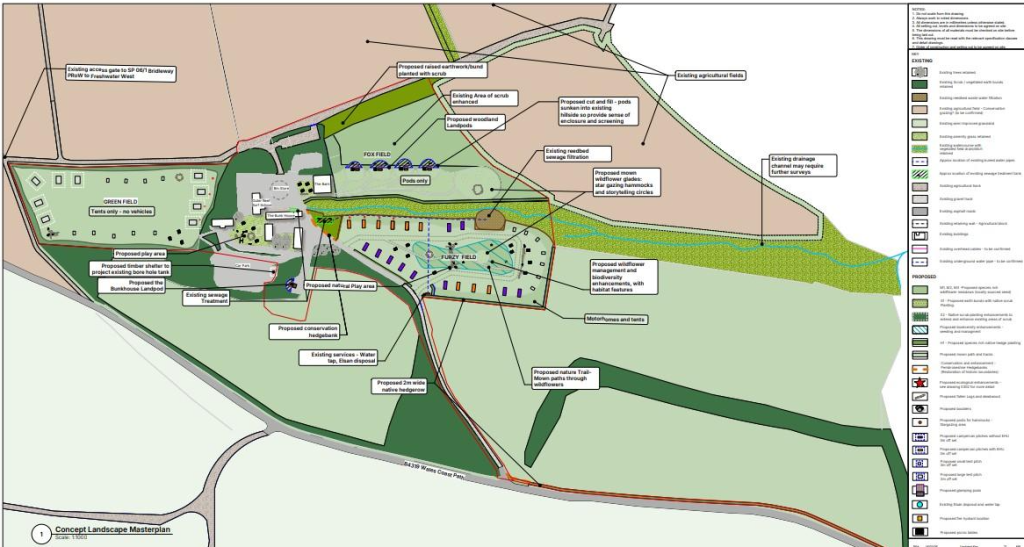
An officer report recommending approval says the site currently operates as an established seasonal campsite under a National Trust exemption certificate.
“The existing campsite has operated for approximately 10 years and currently accommodates seasonal tent camping and a limited number of campervan pitches utilising existing site infrastructure including shower and toilet facilities, sewage treatment infrastructure, access tracks and parking areas.
“The proposal seeks to formalise and diversify the existing operation by allowing greater flexibility in accommodation type and pitch management whilst maintaining the existing overall site capacity of a maximum of 100 people and 50 pitches per night.”
It adds: “The submitted information confirms that the proposal does not seek to increase overall occupancy levels at the site but instead proposes a redistribution of accommodation types through increased campervan provision and the introduction of seasonal landpods. The landpods are proposed as free-standing seasonal structures with no permanent drainage or utility connections and would be removed from the site during December, January and February.”
It says that, while the scheme represents a departure from planning policy “due to the sensitive coastal landscape location,” officers consider “that the seasonal nature of the proposal, the established exempted camping use, the absence of any increase in overall site capacity, the landscape-led design approach and the significant biodiversity and visitor management benefits weigh in favour of the proposal”.
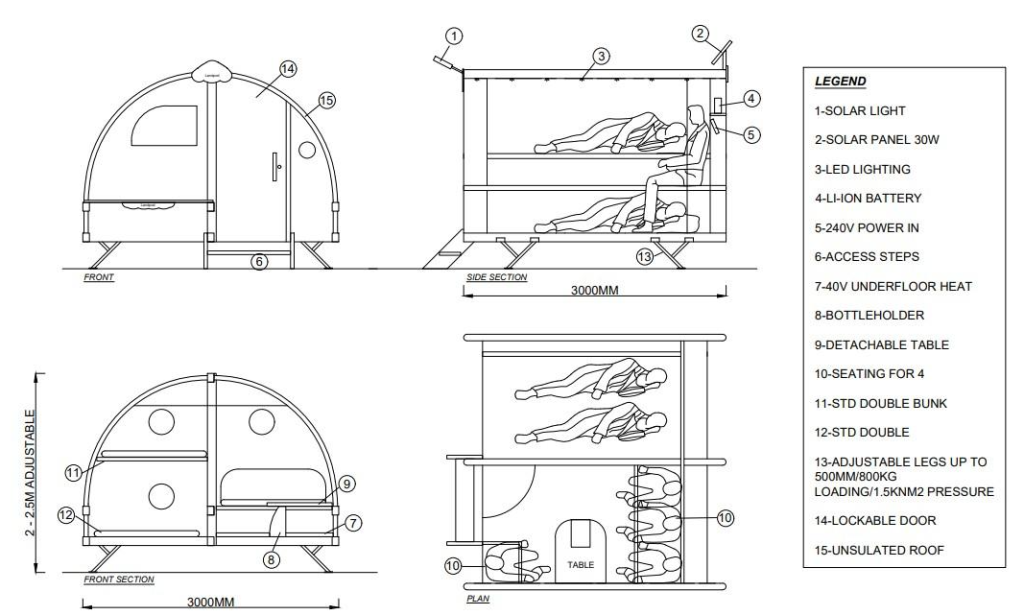
The report adds an original pre-application proposal conflicted in part [with policies] “due to the scale and sensitivity of the site location,” officers advising there could be scope to support “a reduced-scale, clearly seasonal proposal where robust landscape mitigation, ecological enhancement and visitor management justification could be demonstrated”.
It said the submitted application sought to address those concerns; the scheme which incorporates “significant landscape and biodiversity enhancement measures” is “specifically designed as a seasonal and reversible form of development, with the Landpods removed from the site outside the operational season and stored within an existing onsite barn”.
The report later says: “On balance, it is considered that the proposal would not result in unacceptable harm to the special qualities of the National Park and that the material considerations in favour of the proposal outweigh the identified policy tensions in this instance. The principle of the development is therefore considered acceptable subject to appropriate planning conditions.”
It is recommended to delegate conditional approval to officers following the end of a public advertisement period for a policy departure.


A CALL to turn part of Haverfordwest’s former courthouse in the town centre to a theatre is expected to be approved by county planners next week.
At the June meeting of Pembrokeshire County Council’s planning committee, members are recommended to approve an application by Mr N Heywood for a change of use of part of the building from a former court room, Shire Hall, High Street, Haverfordwest, to a theatre.
Built in 1835 to the design of local architect, William Owen, the Shire Hall is a listed Grade-II*-listed building, described by CADW as one of the finest of its type in Wales.
According to Haverfordwest Civic Society the court has seen many major trials, its first being that of Rebecca Rioters on several occasions between 1840 and 1844.
When the law courts were relocated to Hawthorn Rise, Haverfordwest, Pembrokeshire County Council awarded a developer a 999-year lease on a peppercorn rent.
The building housed a couple of restaurants on its upper floors in the early 2000s, with the last of these believed to have closed around 2010.
According to the application, the theatre would: “Bring the vacant building back into a meaningful use, resulting in the preservation of the Grade-II*-Listed Building, and contributing to the enhancement and regeneration of the town centre of Haverfordwest.”
The application states that there would be no change to the exterior of Shire Hall but there would be some internal works.
A related listed building consent application has also been submitted to planners.
The applicant’s agent, Ian Bartlett Planning and Architectural Services, has confirmed the theatre’s opening hours as between 10am and 11pm.
Haverfordwest Town Council supported the scheme in principle but had called for it to be decided by committee, raising concerns in part at a lack of detail in the initial application and concerns about potential harm to the historic building, with Haverfordwest Civic Society taking a similar stance, with members “anxious that any new use should respect and conserve the integrity of the historic courtroom interior, which remains substantially intact, including the judges’ bench, dock, witness box, public benches and associated fittings”.
The application is for committee consideration rather than delegated powers to planning officers following a request by the local member.

An officer report recommending approval says: “As a former courtroom, this use would historically have been characterised by the public assembling within the area via a formalised gathering.
“The proposed use as a theatre would remain broadly compatible with the historic function of the courtroom as a place used for public congregation.
“The proposed use as a theatre would introduce audience-based occupation and periods of intensified use, however, this is not considered inherently dissimilar to the building’s historic use, with any internal alterations subject to the listed building consent application which is currently under consideration.
“In addition, bringing the building into use is likely to contribute positively to the preservation and maintenance of the historic building.”



Crime16 hours ago
Haverfordwest sex offender jailed over child abuse material
Registered offender used library computers to hide social media accounts A HAVERFORDWEST sex offender who used public library computers to...


Local Government17 hours ago
Milford Haven school redevelopment moves a major step closer
£141.6m scheme could transform education in the town A MAJOR step forward has been taken in the long-awaited Milford Haven...


Crime18 hours ago
Castlemorris man spared jail after knife confrontation over council tax debt
A CASTLEMORRIS man has avoided immediate custody after threatening enforcement officers with a knife during an early-morning visit over unpaid...


News2 days ago
Lifeboats and helicopter join search for missing person off Broad Haven
SEARCH teams carried out a major operation at Broad Haven after reports of a missing person. Little and Broad Haven...


News2 days ago
Multi-agency rescue after child falls on rocks while coasteering
Child airlift requested after four-metre fall near Lydstep A CHILD was rescued from rocks near Lydstep after falling around four...


News2 days ago
Police investigate ‘arson’ after vehicle fire spreads to property in Pembroke
A VEHICLE is believed to have been deliberately set alight during an alleged arson in Pembroke in the early hours...


News2 days ago
Four rescued after dinghy deflates off Pendine
FOUR people were rescued off Pendine on Wednesday evening after Tenby’s all-weather lifeboat was launched to reports of an inflatable...


News2 days ago
Hundreds attend major Diocese of St Davids gathering
Churches across West Wales urged to take message of faith back into their communities HUNDREDS of people gathered at Carmarthenshire...

News2 days ago
Vehicle destroyed in early morning fire in Pembroke
POLICE are investigating after a vehicle was destroyed in an early morning fire in Pembroke. The incident happened in the...


Climate4 days ago
Pembrokeshire named among Wales’ green economy hotspots
New analysis says the county’s net zero sector supports 1,600 jobs and accounts for 5.3% of local economic output PEMBROKESHIRE...
-

 Health3 days ago
Paul Davies warns health board over Withybush and Bronglais services
-
 Crime4 days ago
Police tip-off leads to drink-drive ban for Pembrokeshire pensioner
-

 Crime4 days ago
Steynton motorist banned after drink-drive collision
-
Crime2 days ago
Carmarthenshire man sent to Crown accused of 33 historic sexual offences
-

 Crime4 days ago
Warrant issued for man accused of taking wild goldfinches
-
 Crime4 days ago
Dock man given suspended prison sentence for third drink-drive offence
-

 Crime4 days ago
Dock motorist fined £1,600 after four speeding offences
-

 Business6 days ago
Plaid energy policy challenged by Labour after Adam Price interview
police dog selection criteria
January 5, 2026 at 7:59 pm
I appreciate the balanced perspective you provided here.