


Business
Better indoor mobile signal could boost Welsh economy


Wales could benefit from £3bn growth annually if indoor mobile dead zones were eliminated, survey finds.
RESEARCH from Freshwave, a connectivity infrastructure provider, highlights how improving indoor mobile coverage could significantly enhance productivity across Wales. According to the 2025 Freshwave Mobile Connectivity ROI Index, poor indoor mobile signal currently costs Welsh organisations an estimated £4bn every year, with businesses, hospitals, and public buildings suffering from inefficiencies caused by mobile blackspots.

The index reveals that 82% of Welsh organisations experience daily connectivity issues, which have a direct impact on both employee productivity and customer satisfaction. Survey respondents believe that resolving these connectivity problems could lead to a substantial 2.1% increase in Wales’ GDP—surpassing the UK-wide average of 1.6%.
In light of these findings, the Welsh Government’s Digital Strategy for Wales aims to use technology to improve lives and enhance productivity across the nation. This is particularly timely, as Chancellor Rachel Reeves has made economic productivity a key priority amid discussions of avoiding further tax increases.
Impact on Welsh businesses and public sector
Organisations with more than 100 employees are reporting that indoor mobile connectivity problems cost them an average of £143m annually, which translates to a collective £4bn loss across the Welsh economy. Respondents believe that improving mobile coverage—whether through 4G or 5G—would address these productivity barriers and contribute to significant efficiency gains. Many also anticipate higher budgets for mobile connectivity improvements, with 68% planning to increase their investments over the next two years.

CEO comments on the need for action
Simon Frumkin, CEO of Freshwave, explained: “The Welsh economy simply cannot afford to lose billions every year. Investments in digital infrastructure over the past decade have set the stage for progress. Now, we need to ensure that seamless mobile connectivity is available where it’s needed most. This could result in a £3bn boost to Welsh organisations.”
Frumkin added, “By working alongside mobile network operators, we can unlock the full economic potential of 4G and 5G connectivity, driving innovation and efficiency across all sectors.”
National context: Public sector hit hardest
Across the UK, the public sector is the most affected by indoor mobile connectivity issues, with losses of £46bn annually and missed opportunities worth £33bn. The professional and financial services sector also faces significant losses, amounting to £24bn annually, with potential gains of £17bn.
Notes to Editors
Research methodology: A survey of 900 senior IT decision-makers from medium and large organisations across the UK was conducted in December 2024. Participants represented sectors including government, healthcare, professional services, and more, with all respondents from organisations with over 100 employees and revenues exceeding £50 million.
About Freshwave: Freshwave is a connectivity infrastructure provider that simplifies digital infrastructure. Backed by DigitalBridge, Freshwave collaborates with mobile operators, governments, and real estate providers to ensure reliable connectivity across the UK. Visit www.freshwavegroup.com for more information.




PLANS for a new showroom for a Pembrokeshire car dealership which has recently acquired a new Isuzu vehicle franchise, have been given the go-ahead.
In an application to Pembrokeshire County Council, Gareth Hughes Motors of 25 Burton Road, Sardis, through agent Hayston Developments & Planning Ltd, sought permission to replace a temporary canopy with fixed permanent mini-showroom.

A supporting statement said: “Gareth Hughes Motors is a family run enterprise, established in 1982. In order for the business to respond to the latest technological advancements, especially those related to the transition to hybrid and electric vehicles, additional space and different resources will be required.
“Approval of this application will assist in the delivery of these required resources, associated staff training and recruitment for the servicing of electric vehicles will also lead to the retention and provision of skilled employment.”
It says the extension will be designed to allow sufficient space to display Isuzu vehicles, an additional motor franchise recently acquired by the dealership, with no changes proposed to the existing access from the C3007 as the mini-showroom would take place to the rear of the site and replace an existing canopy structure.
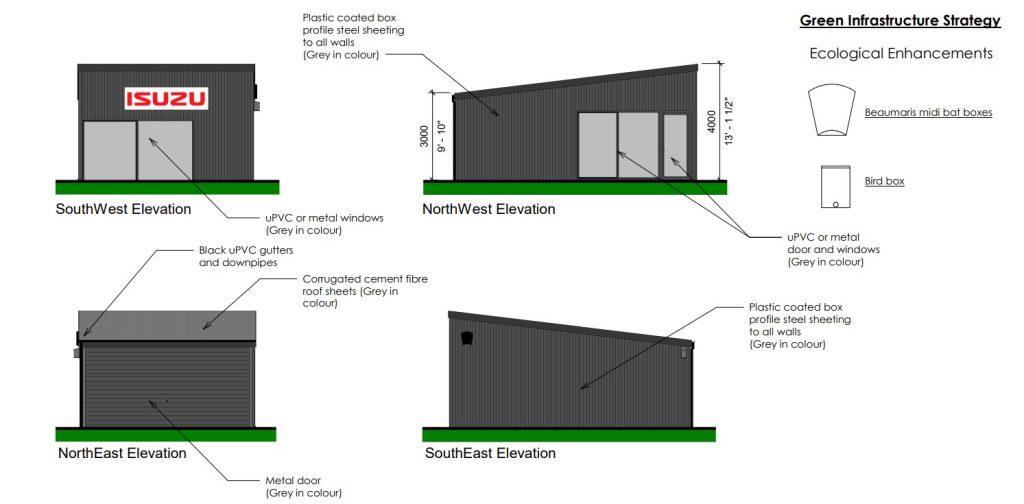
It added: “The environmental impacts from the proposal are minimal as the replacement structure takes place on a concreted/bitumac surface which is currently used for the parking of cars. In addition, the design and use of materials complements that of the current showroom and repair shop and by the addition of a bird and bat box on the south-east of the proposed extension.
“The proposed new mini-showroom will accommodate a maximum of two vehicles and would take place to the rear/side of the site and would be constructed in materials which complement those of the existing showroom and service bays.
“Although Gareth Hughes Motors is located within a group of residential properties it is considered that there will be no significant negative impacts on those neighbouring properties because of their distance from the application site, the orientation of the buildings.
“The securing of an additional franchise at this Sardis site will both help secure the future of the existing staff and create opportunities for additional employment in the motor trade.”
The application was conditionally approved by county planners.

PLANS for what could have been the third store in the country for Welsh cheesecake business The Cheesecake Guy Ltd at Saundersfoot’s Coal Building interpretation centre have been withdrawn.
In an application to Pembrokeshire Coast National Park, Craig Taylor of Merthyr Tydfil-based The Cheesecake Guy Ltd sought a change of use of part of Saundersfoot’s Cambrian Terrace Coal Building interpretation centre to create a small retail unit.
On its website, The Cheesecake Guy says of its business and products: “Established in 2019, The Cheesecake Guy is all about delivering indulgent, handcrafted cheesecake desserts with a twist. While we offer a range of sweet treats, our specialty — and customer favourite — is the signature cheesecake jar.
“Made with quality ingredients and packed with rich, creamy layers, our jars are the perfect dessert for any occasion. Whether you’re treating yourself or sharing with others, The Cheesecake Guy brings a spoonful of happiness to every bite.”
While no supporting statement was published for the Saundersfoot proposal, the application said the scheme, if approved, would employ two full-time members of staff, operating 10am-6pm Mon-Sat, and 10-5 on Sundays and bank holidays.
Of the scheme itself it said it would involve “retail sales of pre-prepared desserts and merchandise,” adding there will be “no on-site manufacturing or heavy processing,” with “equipment limited to display fridges and freezers”.
If approved, the Saundersfoot site would have been the third outlet for The Cheesecake Guy, with sites in Merthyr, and, more recently, Newport Market.
For its Newport site, The Cheesecake Guy says: “We specialise in creating a wide variety of cheesecake desserts that cater to all tastes. Our menu features popular favourites that have won the hearts of many, alongside exciting new creations designed to keep your taste buds satisfied.
“Whether you’re a classic cheesecake lover or an adventurous foodie, we promise a cheesecake experience like no other. Each cheesecake is made with the utmost care, ensuring a rich, creamy texture and a burst of flavour in every slice (or jar!).”
Since the application was submitted, Saundersfoot Community Council objected “on the basis that the harbour is diluting the original intention of this area, which was designed to be an educational section of the development”.
The application is now, as of June 19, marked as withdrawn.

AN AMENDED scheme for a children’s care home on the edge of Fishguard has been approved after a previous call was refused.
In an application to Pembrokeshire County Council, Martin Leahy of Ty Caredig Ltd sought a certificate of lawfulness permission for the use of a dwellinghouse to a residential care home for up to two children at Bryn Delyn, Y Fraich, Fishguard.
Last November, a similar call to allow Bryn Delyn to be used as a children’s home, which raised fears from local objectors the scheme was being ‘rubber stamped’ by the council, was refused.
In that application to the council, Cardiff-based Ty Caredig Ltd sought permission for a Certificate of Lawfulness on the basis the use was not materially different from the property’s existing lawful use.
Residents had accused the council of “pushing through a highly controversial children’s home application behind closed doors”.
A supporting statement for that scheme, with many redacted parts, said the four-bed property had a lawful use as a dwelling house; saying the use as a care home did not require planning permission through a change of use.
However, planners said the use of the dwelling as a care home “would represent a material change of use requiring the benefit of planning permission”.
Since then, amendment to the scheme, for a lawful change of use was submitted, a supporting statement saying Ty Caredig Ltd operates homes throughout Wales that provide specialist care for children, the latest scheme “seeks formal confirmation that the proposed use of Bryn Delyn as a children’s care home for up to two children (plus care staff) would not require planning permission”.
Fishguard Town Council objected, on the grounds of highway safety and parking issues.
It also raised points of “apparent discrepancies between the planning application and the information available on the website,” but stressed it did support provision of suitable accommodation for vulnerable young people and children “with the correct infrastructure in place”.
Local county councillor Cllr Par Davies has said the scheme has her “full support,” as did the certificate call, adding: “Rumours abound regarding this application with objections concerning the usage of the property as a care home for young people. The application states that only two young people would be cared for in the property.
“This type of property is needed as we often talk as councillors for the need for Pembrokeshire children in care to remain in Pembrokeshire instead of the alternative of moving them to other areas in the country and this application fulfils that need.”

The application was approved by planners, the approval stating “Based on the information submitted and on the balance of probability it is considered that the use of the property as a residential care home for up to two children would not result in a material change of use from the lawful use of the property as a dwellinghouse and as a result a certificate of lawfulness for a proposed use should be granted.”



Community4 hours ago
The gentle giant behind the tattoos
Pembrokeshire security worker Josh Davies praised for professionalism, kindness and proving first impressions can be wrong JOSH Davies is hard...


Charity1 day ago
Toy Story fans fill charity toy box at Haverfordwest cinema
Donations pour in for SNAP Specialist Play as families embrace Toy Story 5 launch A TOY STORY-themed charity appeal at...


Community1 day ago
Lord Rhys emerges from the mist in St Davids
Giant puppet begins historic journey marking 850 years since the first Eisteddfod MIST swirled around St Davids Cathedral on Friday...


News2 days ago
Tragic tribute paid to Haverfordwest man after A4075 collision
FAMILY REMEMBERS “KIND AND LOVING” CALLUM HANSON THE FAMILY of a 22-year-old man from Haverfordwest who died following a road...


News3 days ago
Motorcyclist, 22, dies in A4075 crash in Pembrokeshire
A 22-year-old woman remains in hospital after two-vehicle collision A MOTORCYCLIST has died following a serious two-vehicle crash on the...

Community3 days ago
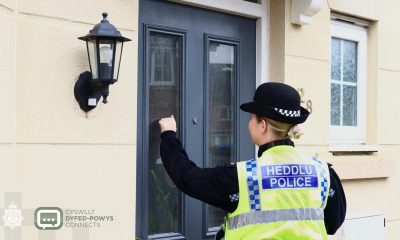
Why police will be visiting every home in Pembrokeshire
New operation aims to knock on more than 257,000 doors across Dyfed-Powys over the next three years DYFED-POWYS POLICE has...


Crime3 days ago
Prisons at breaking point: MPs warn Wales is paying the price of a failing system
Frozen healthcare budgets, overcrowded jails, homelessness on release and mounting pressure on staff are undermining rehabilitation across Wales, according to...


News4 days ago
Brexit at 10: How Britain was sold a dream that cost us dearly
A decade after the referendum, the promised benefits remain hard to find while the economic costs are increasingly difficult to...


Crime4 days ago
Worcestershire man jailed after violent attack on woman in Tenby
Defendant was already serving a suspended sentence when serious assault took place A WORCESTERSHIRE man has been jailed for more...


Climate4 days ago
Offshore wind ‘could bring new generation of jobs to Milford Haven’
Pembrokeshire ports and Celtic Sea projects placed at centre of Wales’ green energy ambitions MILFORD HAVEN and Pembroke Dock could...
-

 Crime3 days ago
Milford Haven man jailed for breaching domestic violence protection order
-

 Local Government5 days ago
Security privately arranged by Mayor at Beating of the Bounds
-

 News3 days ago
Crash on Freeman’s Way causes school-run chaos across Haverfordwest
-

 Crime5 days ago
Man wanted by court after failing to attend hearing over alleged shop thefts
-
 Crime5 days ago
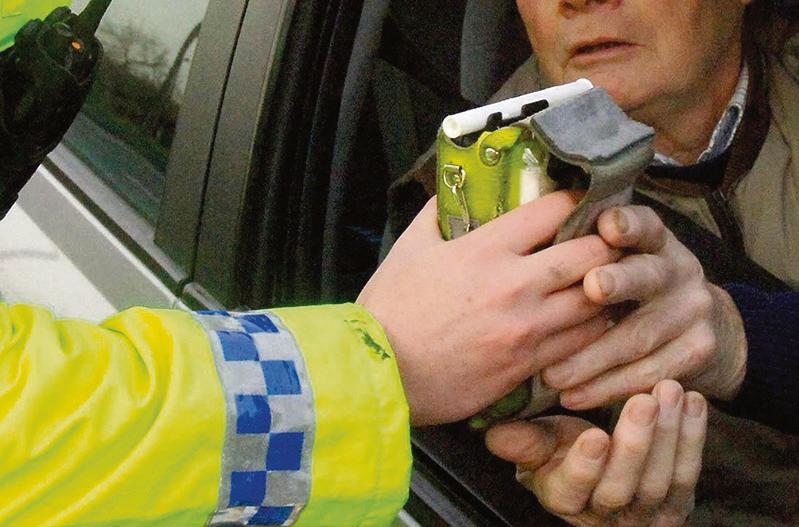
Man banned from roads after drink-driving offence
-

 Crime5 days ago
Man jailed after admitting strangulation and assaults
-

 Crime5 days ago
Drug trafficker must repay £33,000 after court rules he made nearly £500,000
-

 Crime5 days ago
Man sentenced over stalking campaign and lock knife offence