


Local Government
A decade of mismanagement in the Pembroke Dock grants scandal exposed


How PCC commissioned fresh legal advice in late 2023 but kept its existence concealed until councillors forced its release — resulting in a redacted report confirming the evidential threshold for fraud was met, but concluding PCC could not prosecute because of its own internal failings.
A DECADE of confusion, missing evidence, redactions and internal failures has been laid bare in the long-running scandal surrounding the Pembroke Dock Commercial Property Grant Scheme – a case Pembrokeshire County Council quietly revisited in 2023 before burying most of the crucial legal advice until their hand was forced.
The legal advice has been released by the authority, but is heavily redacted.
The Herald can reveal that council officers sought fresh legal advice in December 2023, nearly ten years after the original investigation, following efforts to determine once and for all whether the authority could pursue a prosecution over alleged irregularities in grant-funded renovation work in Pembroke Dock.
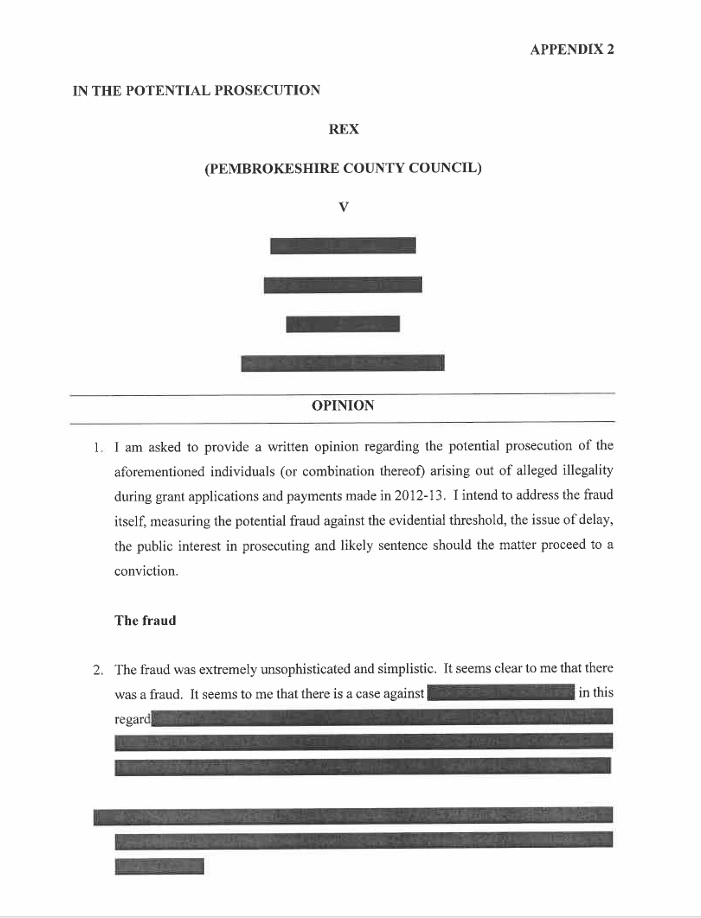
That advice, written by barrister Lee Reynolds of Apex Chambers, was only published in heavily redacted form (After Cllrs Mike Stoddart and Jacob Williams argued that it would not be in the public interest for the whole of the report to be considered in private). Despite confirming that the evidential threshold for fraud had been met, Reynolds advised in the strongest possible terms that Pembrokeshire County Council must not prosecute – because its own officers’ conduct, document handling and procedural failures would undermine any case in court.
Advice confirms fraud – but PCC “cannot prosecute”
The visible sections of Reynolds’ opinion are stark. He describes the fraud under investigation as “clear”, “unsophisticated” and “supported by evidence”. He states plainly that the evidential test for prosecution is met.

But he concludes that PCC cannot be the prosecuting authority because of severe concerns about the authority’s own internal processes. He warns that allegations of “complicity (at worst) or gross incompetence (at best)” by individuals within the Council would fatally compromise any case brought by PCC.
The majority of the written advice – including the detailed factual background and key evidence against the suspects – remains entirely blacked out.
Police and CPS raised identical concerns years earlier
The Herald has reviewed a Dyfed-Powys Police letter summarising Crown Prosecution Service findings from the original 2014–2016 referral. It highlights:
- Missing evidence, including a caseworker’s computer hard drive that vanished before reaching police.
- Concerns about document integrity after public allegations that papers in a council store room may have been interfered with.
- Unreliable or conflicting statements from officers who administered the scheme.
- Inadequate training and inconsistent handling of claims.
- Failure to follow proper processes when approving invoices or carrying out on-site checks.
The CPS concluded there was no realistic prospect of conviction – not because fraud had not occurred, but because PCC’s own internal failings had contaminated the evidence. Reynolds’ 2023 opinion echoes those concerns almost word for word.

A scandal without accountability
After a decade of investigations, repayments, police enquiries, CPS reviews, council motions and now a second round of legal advice, the Pembroke Dock grant scandal ends not with prosecutions, but with more redactions, missing evidence and unanswered questions.
- Despite a barrister confirming the evidential test for fraud was met – no one will ever face trial.
- Despite WEFO raising serious concerns – no officer has been held publicly accountable.
- Despite repeated calls from councillors for transparency – large parts of the file remain secret.
The Council has formally closed the matter. The final question remains: what else is still buried?
One name that will be familiar to long-time readers is that of Gwyn Evans, the Council’s then European Manager, who oversaw elements of the grant scheme. Concerns about Mr Evans’ role were raised publicly as far back as 2014, when Audit Committee papers and subsequent reporting highlighted that he had been interviewed during the police investigation and that questions had been raised about the accuracy of a report he produced relating to the 29 Dimond Street project. While the new barrister’s opinion does not reveal names, the pattern of redactions and the references to officers interviewed as witnesses or potential defendants strongly suggest that figures involved in those earlier controversies – including Mr Evans – feature within the censored sections of the 2023 legal advice.


In January 2024, the issue briefly resurfaced when a meeting described on the agenda as a “review” was repeatedly referred to by senior officers as an “investigation” into the scheme. Reporting at the time highlighted that senior figures – including Finance Director Mark Lewis, Development Director Dr Steven Jones, European Manager Gwyn Evans, and Head of Internal Audit Jonathan Haswell – addressed councillors on the controversy.
The public gallery was packed. In a marked departure from the secrecy that characterised the 2014 era, Monitoring Officer Lawrence Harding announced that all councillors would be given confidential access to grant documentation. But the promise was short-lived: the material councillors eventually received was heavily restricted, with key documents withheld and others made available only under supervision.
Behind the scenes, as we now know, the Council had already commissioned the 2023 Reynolds advice – yet no mention of it was made during that meeting. Councillors were not told that a fresh legal opinion existed, nor that it confirmed the evidential test for fraud had been met. Instead, the authority continued to present the matter as an internal housekeeping exercise, even as redactions were being prepared for eventual publication nearly two years later.
What PCC still hides
Black bars in the Reynolds opinion almost certainly conceal:
- The detailed narrative of the alleged fraud
- WEFO audit evidence
- Internal emails and correspondence
- Officer decision-making and supervisory failures
- Lost or mishandled evidence
- Conflicting staff statements
- Senior officer involvement in grant approvals
- Potential conflicts of interest
TIMELINE: 2013–2025

2013–14 — Concerns first raised about grant payments in Pembroke Dock
2014 — PCC refuses councillors access to key documents; police investigation begins
2015–16 — CPS rules no prosecution possible due to evidential contamination
2017–22 — WEFO oversight continues; internal reviews carried out
Dec 2023 — PCC quietly commissions fresh barrister’s advice
2024 — Redactions prepared behind closed doors
Late 2025 — Heavily censored advice finally published
2025 — Case closed: no prosecutions, no accountability
TWELVE YEARS OF WARNINGS – NOTHING HAS CHANGED

December 2013
Cllr Mike Stoddart told Cabinet that grants were being paid for building works “which had never materialised” and accused the authority of hiding the truth behind blacked-out documents. Then council leader Jamie Adams responded by attacking Cllr Stoddart’s former career in the building trade rather than addressing the allegations. When challenged Cllr Adams was unable to substantiate these allegations. The meeting descended into shouting.

Private Eye’s Rotten Boroughs column covered the row days later, mocking the council’s claim that a grant-funded roof had magically been made to look authentically “aged” with a mix of new and recycled slate, and highlighting phantom works the council later insisted had been paid for privately by developer Cathal McCosker.
2023–2025
A barrister confirms the evidential test for fraud is met.
The same advice is heavily redacted.
No one will ever be prosecuted.
Twelve years, two police referrals, multiple audits and a CPS review later – many will say that the culture of secrecy and deflection remains untouched.
Here is the final, press-ready companion piece – written in the same house style, legally cautious where it needs to be, but still devastating. It can run alongside your main article or as a separate “How We Exposed It” box/feature.
How The Herald uncovered Pembroke Dock’s longest-running scandal
Long before The Pembrokeshire Herald existed, our predecessor title Pembrokeshire’s Best first put developer Cathal McCosker on the front page – dubbing him the “Baron of the Bedsits”.
What started as a series of curious planning applications and suspiciously generous grants turned into one of Welsh local government’s most enduring scandals. Over more than a decade, Herald journalists – together with dogged whistleblowers inside and outside County Hall – pieced together a picture that officials worked hard to keep hidden.
Among the discoveries that never quite made it into the official narrative:
- A senior council officer caught altering the public minutes of a key meeting.
- Evidence that then-Chief Executive Bryn Parry-Jones personally intervened to block disciplinary action against at least one member of staff linked to the grant scheme.
- A furious confrontation in which Mr Parry-Jones reportedly threatened to hire private investigators to find out who was talking to this newspaper. (County Hall’s walls, it turned out, were very thin indeed.)
- A former NatWest bank on Meyrick Street converted into ten bedsits – despite planning permission having been granted for just four flats. The extra six appeared only after a retrospective application was quietly nodded through.
- Within days of the council reporting the alleged fraud to the police the developer Cathal McCosker offered to pay back all the £180,000 in grants he had received on the four completed properties and to forgo the £120,000 due on the nearly complete project at No 1 Dimond Street even though the dossier handed to the police only concerned £60,000 in contested payments. Mr McCosker’s offer was on condition that this “would be the end of the matter”
- A Dimond Street butcher’s shop (No 25) that supposedly received grant-funded renovation work before the purchaser even owned the building.
- The developer was allowed to omit the work to fireproof the ceiling between the former butcher’s shop and the flat above
- Housing Benefit payments for tenants routed to an Irish bank account that never appeared in the relevant company filings.
- Tenants left without electricity or water despite tenancy agreements promising “all bills included”.
- The disappearance – never satisfactorily explained – of a laptop and hard drive containing crucial grant records.
- Repeated attempts by senior officers and members of the ruling Independent Political Group to delay, deflect or shut down scrutiny, even after the money trail had become impossible to ignore.
The collapse of confidence in the Commercial Property Grant Scheme fed directly into the wider crisis that eventually ended Bryn Parry-Jones’s controversial tenure at County Hall.
When we sat down with Cllr Mike Stoddart – the one elected member who refused to let the matter die – and compared his files with ours, the conclusion was the same.
It was, in the end, a very simple fraud with very few moving parts.
And twelve years later, despite police investigations, CPS reviews, WEFO audits and now a barrister confirming the evidential test for fraud was met, nobody has ever been prosecuted – and most of the paperwork is still blacked out.
That is the real scandal.












PEMBROKESHIRE COUNTY COUNCIL has paid tribute to long-serving Pembroke Dock Market councillor Brian Hall, following his death.
Cllr Hall first joined the authority after winning a by-election in 1996 and went on to serve his community for nearly 30 years.
During his time on the council, he represented the authority on a wide range of bodies, including the RWE Npower Pembroke Power Station and Valero Liaison Committee, Mid and West Wales Fire and Rescue Service, and the Swansea Bay City Region Joint Scrutiny Committee.
He was also an active member of several scrutiny committees and the Planning Committee.
Cllr Hall previously served on the Cabinet from its creation in 2002 until March 2007. Between 2012 and 2022, he also chaired several Overview and Scrutiny Committees, including those covering environment, services and corporate matters.
Council Leader Cllr Jon Harvey said: “We were all very sad to hear of Cllr Brian Hall’s death.
“I pass on the condolences of everyone at the council to his family and many friends.
“Brian was a council stalwart and had been working for, and demanding better, for his constituents for nearly 30 years.
“His enthusiasm for his home patch was unmatched and there was little of Pembroke Dock’s history that he could not tell you about.

“The loss of Brian from the chamber will be felt by all members of council across the board.”
Independent Group Leader Cllr Anji Tinley also paid tribute, saying: “The loss of Cllr Hall profoundly saddens us.
“He was a well-respected figure known for his dedication and commitment to local governance and his community.

“His legacy will live on in the lives he touched, and we will dearly miss him.
“Our thoughts are with his family and friends during this difficult time.”
ASB AMONG KEY PRIORITIES
A HAVERFORDWEST councillor has raised concerns about a sudden increase in anti-social behaviour in the town centre during a meeting with local police.
Cllr Thomas Tudor, county councillor for the Castle Ward, met with Sgt Andrew Williams from the local Neighbourhood Policing and Prevention Team on Thursday (Apr 23).
Cllr Tudor said the meeting had been “very beneficial and informative” and gave him the opportunity to pass on concerns from residents and businesses about policing issues in Haverfordwest.
Sgt Williams’ role includes overseeing neighbourhood policing priorities, including anti-social behaviour, road safety, business engagement, shoplifting prevention, and tackling the illegal use of e-scooters and electric bikes.
Cllr Tudor said he had raised both his own concerns and those of constituents about issues affecting the town, including what he described as a sudden escalation of anti-social behaviour in the centre of Haverfordwest.
The current policing priorities for the Haverfordwest section, which also includes the Fishguard and St Davids areas, are tackling anti-social behaviour in the community, increasing high-visibility patrols and business interaction to reduce shoplifting, and dealing with the illegal use of e-scooters and electric bikes.
Cllr Tudor thanked Dyfed-Powys Police, the Haverfordwest, Fishguard and St Davids policing teams, and Pembrokeshire County Council following the meeting.

A NEW mayor for Milford Haven is set to be elected next week as councillors gather for a full council meeting on Monday (Apr 27).
The meeting will take place at the Sea Cadets and Royal Marines Cadets Unit at Havens Head Business Park from 6:00pm.
Councillors are expected to elect both the town mayor and deputy mayor for the 2026–2027 civic year.
Three councillors have put themselves forward for the position of deputy mayor — Councillor K. Gray, Councillor N. Harteveld, and Councillor C. Stevens.
The meeting will also include public questions, updates from the current mayor, reports on community activities, and feedback from councillors who sit on outside bodies.
Planning matters will be noted for information, while several local organisations are set to be considered for financial support.
These include Milford Haven Men’s Shed, Milford Haven Business Circle, Milford Haven Pickleball Club, and The Rotary Club of Milford Haven.
Members of the public can attend, with remote access available on request under Welsh local government rules.



Local Government4 hours ago
Council pays tribute to long-serving councillor Brian Hall
PEMBROKESHIRE COUNTY COUNCIL has paid tribute to long-serving Pembroke Dock Market councillor Brian Hall, following his death. Cllr Hall first...


Sport24 hours ago
Bluebirds reach European play-off final after penalty drama in Barry
Haverfordwest County beat Barry Town United 3-1 on spot-kicks after 1-1 draw at Jenner Park HAVERFORDWEST COUNTY are one win...


News2 days ago
Barley Saturday brings bumper crowds to Cardigan
CROWDS lined the streets of Cardigan on Saturday (Apr 25) as Barley Saturday once again brought the town centre to...


Community2 days ago
Freshwater West memorial honours crews lost in wartime tragedy
VETERANS, standard bearers and civic representatives gathered at Freshwater West on Saturday (Apr 25) for a moving service of remembrance...


News2 days ago
Haverfordwest Hemp hustings to explore role in Wales’ future economy
Debate at Haverhub to link agriculture, sustainability and Senedd election issues A UNIQUE political and environmental debate is set to...


News3 days ago
Parties use postcode-targeted social media adverts in Senedd campaign
LABOUR has spent more than twice as much as any other Welsh political party on Facebook and Instagram advertising in...

News3 days ago
Pressure builds as Labour ducks farming hustings
NOT one of Labour’s seven list candidates for the Ceredigion Penfro seat turned up for farming hustings in either Pembrokeshire...


News4 days ago
Kemi Badenoch warns over loss of industry during Valero visit
Conservative leader says Wales cannot afford to lose more strategic jobs as she attacks Reform and backs Darren Millar KEMI...


News4 days ago
Waiting lists fall for ninth month — but cancer, A&E and ambulance pressures grow
Labour points to “real progress” on treatment backlogs as surgeons and Conservatives warn the next Welsh Government still faces a...

Crime4 days ago
Man on trial over historic sex offence allegations
Pembroke Dock defendant faces charges spanning from 1984 to 2008 A MAN from Pembroke Dock is standing trial at Swansea...
-

 Crime6 days ago
Milford man admits TV piracy offences linked to estimated £6m losses
-

 Local Government4 days ago
Unresolved building control record leaves buyer’s cottage unregistered
-

 News6 days ago
Paul Dowson defends controversial record in Herald election interview
-
Crime4 days ago
Man on trial over historic sex offence allegations
-
News4 days ago
Waiting lists fall for ninth month — but cancer, A&E and ambulance pressures grow
-

 News6 days ago
Sandra Jervis warns Withybush is being stripped back by stealth
-

 Charity7 days ago
Wales Air Ambulance appeals for support as aviation fuel costs soar
-

 Crime5 days ago
Keeston driver to face trial over A40 driving allegation