


Finance
£32.5m boost to help disabled people and those with health conditions into work

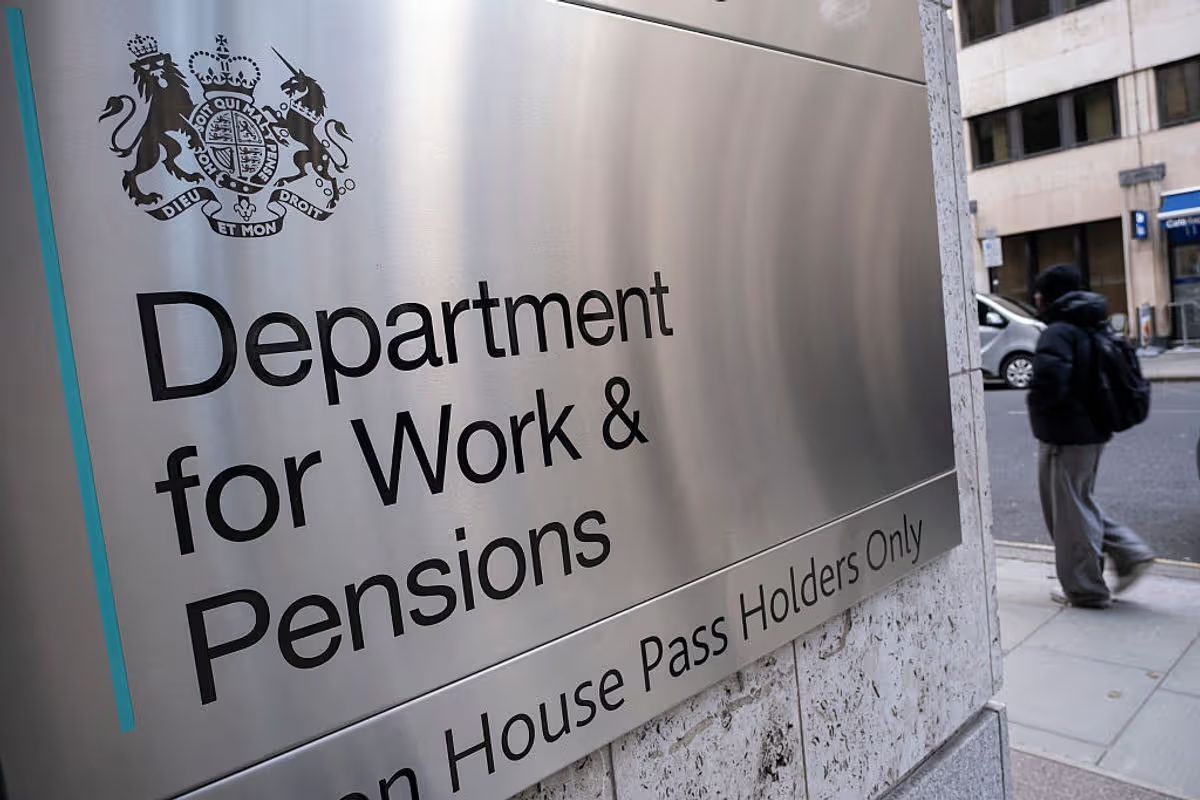
MORE than 9,000 people across South East Wales are to receive tailored employment support under a £32.5m expansion of the UK Government’s Connect to Work programme.
The funding will support around 9,100 disabled people, people with health conditions, and those facing complex barriers to employment, helping them move into work or closer to the labour market by 2030.
The Department for Work and Pensions said the programme replaces a “one-size-fits-all” approach with intensive, personalised help built around each individual.
Support will be delivered by specialist employment advisers, who will meet people in accessible community settings, including GP surgeries, cafés, parks and community hubs.
The help available will include matching people with suitable jobs, CV writing, interview preparation, direct work with local employers, and continued support once someone has started a role.

Work and Pensions Secretary Pat McFadden said: “For too long, disabled people and those with health conditions in South East Wales and across the country were written off and denied the chance to work. This Government is changing that.
“Connect to Work is built on a simple belief: that with the right support, built around the individual, people can and do get into work.
“Today’s figures prove it. Thousands of people are now closer to working, earning and building better lives, and with South East Wales set to launch its support offer, this is just the beginning.”
The announcement comes as the first official statistics for Connect to Work show that 14,000 people across England and Wales have already received personalised support through the programme.

The DWP said 2.8 million people are currently out of work due to ill-health, and that Connect to Work forms part of a wider £3.5bn employment support package.
Councillor Peter Bradbury, Cardiff Council’s Cabinet Member for Employment and Inclusive Growth, said: “We are delighted that Connect to Work is being introduced across the South East Wales region; this is a significant opportunity to support our residents into sustainable employment while strengthening our local communities and economy.
“Delivery will commence shortly across the region, with further details, including start dates, available on the Cardiff Council website.”

The South East Wales funding follows earlier announcements for Connect to Work in South West Wales, Mid Wales and North Wales.


AT LEAST 1.5 million people were taken to court over unpaid council tax last year, according to a new investigation by the GMB union.
The union said the figures showed a council tax system “completely broken”, with cash-strapped local authorities forced to pursue residents through the courts to recover unpaid bills.
The findings, released ahead of GMB’s annual congress in Blackpool on Tuesday (Jun 9), were based on Freedom of Information requests sent to all council tax-collecting local authorities in Britain.
Almost 200 councils replied within the statutory deadline.
The responses showed that 1,430,726 people were summoned to court in the financial year 2024/25. However, because many councils did not respond, GMB said the true figure was likely to be far higher.
The investigation also found that at least 4,593,838 council tax accounts were in arrears, while debt management proceedings had been launched against 3,231,480 accounts.
In total, at least £4.6bn is owed to councils in unpaid council tax.
In Wales, the figures showed £110,884,885 was owed, with 31,452 accounts in arrears, 14,792 facing debt management proceedings, and 34,437 people taken to court during 2024/25.
Broken system
Rachel Harrison, GMB National Secretary, said: “These horrifying figures show our council tax system is completely broken.
“Not only is the banding system woefully out of date, but forcing cash-strapped councils to pursue one and a half million people through the courts just to make ends meet can’t be the right way to do business.
“Austerity left deep scars on all our public services, which will last a generation or more.
“Meanwhile the lack of authority funding often means low pay for the people we rely on to look after our loved ones, to take our rubbish, to keep our towns and cities running.

“To fix all this, we need more guaranteed central government funding, progress on council tax reform so the richest pay their share, and changes to business rates so that authorities get more to regenerate our high streets.”
The highest regional total was recorded in Scotland, where £989m was owed and 245,294 people were taken to court.
London councils reported £625m owed, with 258,732 court summonses issued, while the West Midlands recorded 239,116 court cases and £490m in unpaid council tax.

A UK GOVERNMENT review into access to face-to-face banking services has begun, with communities, businesses and organisations being urged to submit evidence.
The independent review, chaired by former Which? director and former FCA board member Richard Lloyd OBE, will examine the impact of changes to in-person banking services across the UK.
It will look at whether branch closures and reduced access to banking services are causing harm to consumers, communities and businesses, particularly those who rely on face-to-face support.
The Call for Evidence opened today, Monday (Jun 8), and will run for six weeks, closing on July 20.
The evidence gathered will help shape recommendations to the UK Government, with final recommendations expected in October 2026.
Economic Secretary to the Treasury, Rachel Blake said: “Banking services matter to communities and businesses across the UK – and that includes face-to-face services.
“Whether you are responding as an individual or a business, your experience could shape the recommendations this review makes to Government.
“Where evidence shows people are being left behind, we will act – including through legislation if necessary.”
Richard Lloyd OBE said banking was “an essential service” needed by consumers, communities and businesses.
He said the review wanted to gather “the best possible up-to-date evidence” on the challenges faced by those who need in-person banking.
The review follows concerns across the UK about the loss of local bank branches, leaving many customers dependent on online services, telephone banking or limited alternatives.
The Treasury said the Government would act quickly where evidence showed intervention was needed to protect access to banking services.

Responses should be submitted by July 20 through the online Smart Survey on the review’s GOV.UK page. Those unable to use the survey can email [email protected].

PEMBROKESHIRE workers are among the higher earners in Wales, according to new research analysing full-time weekly pay across the country.
The study by CV Maker, using Office for National Statistics data from April 2025, placed Pembrokeshire eighth out of Wales’ 22 local authority areas for median gross weekly earnings.
Full-time workers in Pembrokeshire earn an average of £711.30 per week, putting the county slightly above the Welsh average of £704.
The figure also places Pembrokeshire ahead of Swansea, Ceredigion, Carmarthenshire, Powys and Gwynedd.
By comparison, Monmouthshire was named the highest-paid area in Wales, with full-time workers earning an average of £773.50 per week. Merthyr Tydfil recorded the lowest figure, at £619.20 per week.
That means the gap between the highest and lowest-paid areas in Wales is £154.30 per week, equivalent to more than £8,000 a year.
Pembrokeshire’s average weekly earnings are £7.30 above the Welsh average, but £62.20 below Monmouthshire.
The figures also show a marked difference between Pembrokeshire and neighbouring Carmarthenshire, where full-time workers earn an average of £657.70 per week. That puts Pembrokeshire workers £53.60 per week better off on average, or around £2,787 a year.
Ceredigion sits closer to Pembrokeshire, with average weekly earnings of £675.70 — £35.60 lower than Pembrokeshire.
The research ranked the ten highest-paid areas in Wales as Monmouthshire, Newport, Flintshire, Cardiff, Bridgend, Wrexham, Neath Port Talbot, Pembrokeshire, Swansea and the Isle of Anglesey.
Nicky Klaasse, CEO at CV Maker, said: “These figures highlight the significant wage disparities across different regions in Wales.
“While the national average weekly earnings sit at £704, there’s a notable £154 gap between the highest and lowest-paying areas.

“For job seekers in Wales, this data provides valuable insights into where the highest earning potential might be found.”
The company said the figures were based on ONS median gross weekly earnings for full-time employees, ranked by local authority.



News12 minutes ago
Childcare row erupts as Plaid faces questions over costs and delivery
Opposition parties clash over flagship pledge as Senedd debate exposes growing divisions PLAID CYMRU’S flagship promise to create what it...


Crime15 hours ago
Farmers fined in bovine TB scandal face fresh court action
Hartt family members listed at Haverfordwest Magistrates’ Court over unpaid penalties linked to major cattle prosecution TWO PEMBROKESHIRE farmers convicted...


Crime19 hours ago
Pembrokeshire child killer stabbed to death in prison cell, murder trial hears
Kyle Bevan, jailed for the murder of Haverfordwest toddler Lola James, was allegedly stabbed 25 times and left ‘as if...


News1 day ago
Pendine cliff fall victim recovering after major emergency response
A 22-YEAR-OLD man who suffered serious injuries after falling from cliffs overlooking Pendine Beach is recovering well following emergency surgery....


Community1 day ago
Commissioner launches free course to help tackle ageism in Wales
A NEW free learning course has been launched to help people across Wales recognise and challenge ageism. The Older People’s...


News2 days ago
First Minister challenged over jobs for student nurses
REFORM WALES has accused the First Minister of failing to guarantee jobs for student nurses in Wales, despite continuing pressure...

Crime2 days ago
Knife blankets call as school staff face rising violence fears
GMB says protective equipment should be considered where risk assessments show staff could face blades SCHOOL staff should be given...


News2 days ago
Claire Archibald secures review of Milford Haven train times
RURAL TRANSPORT CONCERNS RAISED WITH TFW CLAIRE ARCHIBALD MS has secured a review of train times between Milford Haven and...


Crime2 days ago
PCC review calls for stronger youth crime prevention work
REPORT MAKES 13 RECOMMENDATIONS A REVIEW into crime and anti-social behaviour services for young adults has called for stronger prevention...


Crime2 days ago
Families condemn failed appeal by paddleboard boss jailed over Haverfordwest tragedy
RELATIVES SAY LATEST COURT BID HAS REOPENED PAIN AFTER FOUR DEATHS ON WESTERN CLEDDAU THE FAMILIES of victims of the...
-
Crime6 days ago
Paddleboard company owner loses bid to cut sentence over Haverfordwest tragedy
-

 Crime5 days ago
Milford Haven man admits harassment and assault
-

 News5 days ago
Community appeal for privacy after serious emergency in Pendine
-

 Community3 days ago
Forgotten wartime archive found in Pembroke Dock attic after 80 years
-

 Crime3 days ago
Sex offender in senior role at Tenby family hotel
-
Crime2 days ago
Families condemn failed appeal by paddleboard boss jailed over Haverfordwest tragedy
-

 Business5 days ago
Call for gym and Padel courts at Kiln Park Farm unanimously backed
-

 Community5 days ago
Founders Day hailed a success despite rising costs and extra security