


News
Delyth Evans: Business and young people a priority

As part of a series of interviews with local parliamentary candidates standing at the general election in May, Deputy Editor Jon Coles spoke to
Delyth Evans, Labour candidate for South Pembrokeshire and West Carmarthenshire.
42 DIMOND STREET at 2pm, Pembroke Dock was the appointment. And I was late. Having abandoned the idea of Fish Week, the  council had instead elected to host the International Festival of Road Works across Pembrokeshire.
Through the door of the campaign office, which used to be a shop, and there are some bare tables a few chairs and Delyth Evans on the phone trying to find out where I am. Quick introductions and apologies are in order. Time is a precious commodity for an election candidate and she has places to be.
The purpose of the interview is to find out more about the person who wants to unseat incumbent Conservative Simon Hart. Bearing in mind the time constraints, we move briskly to business.
“I was brought up in Carmarthenshire.” Delyth opens: “I was a journalist who worked for the BBC and HTV for ten years. When I felt I could no longer be politically neutral in my job, I left to join the Labour Party. I was very lucky to work for John Smith when he was Labour leader. I was John’s speechwriter for two years, he was a very good man, who died very suddenly. I left politics before returning to sit in the Welsh Assembly during its first term. I had very young children and it was tough combining a political career with being a parent. After the Assembly, I worked for a charity focussing on helping women from difficult backgrounds access employment and other services.”

The challenges facing a candidate – any candidate – in the current climate are well-known and we asked Delyth Evans her view about them: “The main challenge is that people think politicians are the same. There is a cynicism about politics and disengagement by the electorate. The biggest challenge for politicians is dispelling the notion that we are all the same. Someone said to me recently that politicians never seem to have had any work experience outside politics. I would say that I certainly have a lot of work experience and a broader life experience upon which to draw.”
Looking at Carmarthenshire West and South Pembrokeshire, Delyth was clear as to the task that would face a new member: “For this constituency, the major challenge is the regional economy. I am convinced that what is needed is a government that is prepared to intervene to help businesses. The market alone, which is the current government’s approach, cannot and will not work. There are different choices the government could make that would make a positive difference to their lives.”
On local businesses and issues that affect them Delyth Evans had spoken with them about their priorities: “I spend a lot of time talking to local businesses and try to find out what local businesses need from government to help them grow. As an MP, my role will be to support and help businesses get the best deal from government.”
On the European issue, Delyth is eager to make a clear statement about the importance of Europe to local businesses: “Europe – and our future trading relationship with Europe – is often raised with me. Businesses are clear about the importance of European markets to them. The Tories are, in my view, playing fast and loose on the issue. Businesses need certainty and, for their own reasons, the Conservatives are creating uncertainty.”
On her personal priorities, she expresses a similarly clear viewpoint: “Young people are a priority. It’s about helping them find opportunities in their own areas without moving away. It’s about things like apprenticeships, training, housing – on which Labour has very good proposals: it is important that young people’s voices are heard and that they are engaged in the political process and on political issues. One of the things I am very keen on is to get young people to vote and to participate. It is not just about getting them to vote for me, but to vote.”
On the thorny issue of voting, the measure of the challenge is not lost on her: “Most of the people I speak to tell me they haven’t made up their mind about how they are going to vote. An awful lot of people have an open mind and are waiting to be persuaded. My job, if you like, is to persuade them to vote for me. I’ve been the Labour candidate here for over a year. It has become a lot easier to engage with people on the issues as the election has drawn nearer. People are now focussed on May’s election.”
As for what would come after a possible Labour victory, she told The Herald: “The main challenge a Labour government would face would be how to get real growth back into the economy. Austerity is making harder for new businesses to succeed and for the economy to grow. That is why we cannot afford another five years of a Conservative government. In Carmarthen West and South Pembrokeshire the focus needs to be on encouraging high skilled jobs in new technologies. Labour is talking about creating a regional investment bank to support new businesses. For young people it is very much getting those apprenticeships and training opportunities. Labour is looking at vocational training equivalent to A Level and beyond. It is vital the building blocks are in place to help us capitalise on economic growth and be ready for the future.”

The difficult ground in the constituency was not shirked: “The issues that come up most often are jobs and health. That’s what comes up on the doorstep. People do not like it when English politicians, like David Cameron, run down the NHS and the NHS in Wales. Any other party in power in Wales would have had to make similar, if not the same, decisions about the health service in Wales as those decisions were based on clinical guidance. I agree with the idea that part of the problem is the failure of the Health Board to communicate properly about its strategy. I spoke with Bernadine Rees, the Chair of the Health Board this morning, and we discussed that point. I know that the Board is currently holding a series of public engagement events across the area and that the feedback being generated from those is being taken on board in terms of how the Board can better communicate. There was always going to be huge opposition to services being moved and I completely understand that. What we need to know now is that there will not be continuous revolution; that Withybush’s future is secure; that the right model is in place for the future. There is a job to be done to reassure people about that.”
Read part two of this interview in next week’s edition of The Herald.


POLICE in Haverfordwest, Fishguard and St Davids are reminding residents that privately owned e-scooters cannot legally be used on roads, pavements or other public spaces.
E-scooters are treated as motor vehicles under road traffic law. This means riders would need to meet the same legal requirements as other motorists, including having a valid licence, insurance and tax.
However, because privately owned e-scooters cannot currently be insured for use on public roads, they cannot legally be ridden in public places. They may only be used on private land, with the permission of the landowner.
Anyone caught riding an e-scooter illegally could face a fixed penalty notice, including a £300 fine and six penalty points for riding without insurance. Riders may also face a fine of up to £100 and three to six penalty points for riding without the correct licence.
Police say riders may also be committing further offences if they are caught riding on pavements, using a mobile phone while riding, going through red lights, or riding while under the influence of alcohol or drugs.
The penalties for drink or drug riding are treated in the same way as if a person was driving a car, and could include a court-imposed fine, a driving ban or imprisonment.
Officers are urging parents and young people to understand the rules before buying or using an e-scooter.

Ministers say health boards and councils must act now to ease pressure on hospitals, ambulances and social care before winter
THE WELSH GOVERNMENT has told NHS Wales and social care partners to start planning earlier for winter, after a difficult year for emergency care and recent heatwave pressure on ambulance services.
Health and Care Minister Mabon ap Gwynfor said the aim was to make ambulance, emergency department and hospital services safer and more resilient during the colder months, while also recognising that pressure on the NHS is no longer confined to winter.
The announcement will be closely watched in west Wales, where Hywel Dda University Health Board runs Withybush, Glangwili, Bronglais and Prince Philip hospitals.
Latest published figures show Hywel Dda performing better than the Wales average on emergency department waits in May, with 66.5% of patients admitted, transferred or discharged within four hours and 9.9% waiting more than 12 hours. However, the health board remains well short of the Welsh Government’s 95% four-hour target, and therapy waiting times in Hywel Dda were worse than the Wales average.
Across Wales, 64.4% of patients attending emergency departments in May spent less than four hours there, while 11,066 patients waited 12 hours or more. Official figures also showed more than 1,300 “pathway of care” delays on the day data was collected, meaning patients were clinically ready to leave hospital but were still waiting for the right care, support or accommodation.
The Welsh Government says this year’s winter plan will focus on five key areas: preventing illness through improved vaccination uptake, keeping more people well at home, freeing up hospital beds through better infection control and earlier discharge, helping patients leave hospital safely when they are ready, and keeping services running under pressure while supporting staff.
An expansion of the RSV vaccine to people aged over 65 who are clinically at risk will begin in September. Ministers also want stronger uptake of vaccination among people at greatest risk, NHS and care staff, and children.
A new communications campaign is also being developed to help people understand where to go for care, so that emergency departments and ambulances are preserved for those with the most serious needs.
Mr ap Gwynfor said: “Our fantastic NHS and social care staff worked incredibly hard last winter, and we are being clear with health boards and partners more needs to be done.
“Last winter was tough. Too many people waited too long for the care they needed, and that’s not good enough. Early planning and action are key, and I’ve also asked officials to begin planning now so we’re better prepared for the winters ahead.
“I am also clear that this is not just a winter challenge. The recent period of extreme heat is a clear reminder that pressures and risk can arise at any time of year.
“Our ambition is simple: safe services all year round that protect ambulance and hospital capacity for those who really need them, ensuring people get the right care, in the right place, at the right time.”

The statement follows renewed concern from emergency medicine doctors about long waits and so-called corridor care. The Royal College of Emergency Medicine has warned that poor patient flow, delayed discharges and a lack of inpatient beds are leaving too many patients stuck in emergency departments for long periods.
The British Medical Association in Wales has also called for clearer recording and reporting of corridor care, arguing that without better data it is harder to understand the scale of the problem and hold decision-makers to account.
There was a further warning last week when the Welsh Ambulance Service declared a critical incident during the extreme heat. The service said 999 call volumes had risen by 31% compared with two weeks earlier, with around 400 additional emergency calls a day. The critical incident was later stood down, but ambulance chiefs said demand remained high.
The political test for the Plaid-led Welsh Government will be whether early planning can translate into visible improvements by winter. Health boards and councils will be expected to work together more closely, but many of the problems ministers are trying to solve depend on social care capacity, staffing, available beds and community services.
For patients and families in Pembrokeshire, Carmarthenshire and Ceredigion, the key question will be whether the plan leads to shorter ambulance waits, fewer long delays in A&E, and quicker support for people well enough to return home from hospital.

CHEMICAL science contributed £1.9bn to the Welsh economy in 2023, according to a new report which warns that skills shortages and pressure on universities could put future growth at risk.
The Royal Society of Chemistry says the sector is one of Wales’ most productive, generating £99,500 in Gross Value Added per worker. That compares with £73,300 per worker across the wider UK workforce and places Wales among the strongest-performing parts of the UK for chemistry-related economic output.
The findings are contained in The Contribution of Chemistry, a report commissioned by the Royal Society of Chemistry and carried out by Metro Dynamics. It examines the role of chemistry in economic activity, workforce development, research, innovation and regional growth.
The report says chemistry is often “hidden” within wider economic statistics, despite being embedded across major industries such as clean energy, advanced materials, healthcare, food and drink, construction, agriculture and manufacturing.
Across the UK, nearly half of chemistry-using professionals work in government priority growth sectors, compared with just over a quarter of the wider workforce. The RSC says this shows how important chemistry is to industrial strategy, local prosperity and high-value employment.
However, the report also warns that the skills pipeline is under pressure. Universities are described as playing a critical role in supplying graduates, supporting businesses and helping research move into commercial use. The RSC says funding pressures in higher education could make it harder for Wales and the wider UK to maintain access to the talent and facilities needed for future growth.
Helen Pain, Chief Executive of the Royal Society of Chemistry, said the figures showed the “enormous significance” of the sector.
She said: “With chemistry injecting nearly £2bn in GVA contribution to the Welsh economy, our report underlines the enormous significance of our sector to both Wales and the UK.
“As more and more universities across the country face funding cuts, it’s more important than ever that both the Welsh and the UK governments recognise how central chemistry is to the economy within wider innovation and skills strategies and ensure opportunities to study chemistry do not fall away.”
The report also highlights the value of chemistry graduates to the labour market, saying 83% go into high-skilled roles. It says maintaining that pipeline will depend on stronger links between schools, colleges, universities, technical training and employers.
For Wales, the issue is not only about university departments, but also about the businesses and local economies that depend on chemistry skills. The report argues that sectors relying on chemical science can be affected if there are shortages in skilled workers, research capacity, laboratory space or scale-up support.
The Royal Society of Chemistry is calling on local, devolved and UK governments to make chemistry a core part of economic, science, industrial, innovation and skills strategies. It also wants reforms to higher education and research funding to recognise the cost and importance of chemistry teaching and research, including the need for laboratories, equipment, specialist staff and consumables.

The report says chemical sciences GVA across the UK grew by 18% between 2019 and 2023, but warns that growth could be held back without better access to lab space, pilot facilities and support for businesses trying to scale up new products and technologies.
Ms Pain added: “Chemistry is critical to many local growth ambitions, straddling sectors ranging from clean energy and advanced materials to healthcare and manufacturing.
“A sustainable chemicals and materials sector is vital for national resilience and local growth, providing both the everyday products we need and vital supply chains for many more economic sectors.”
Fiona Tuck, Director at Metro Dynamics, said the report showed why leaders needed to look beyond traditional sector labels when planning for growth.
She said: “Now more than ever, leaders need to understand what really underpins growth in places. Too often, the capabilities that matter most are not the easiest to count.
“Chemistry shows why this matters: it is woven through our research base, industrial supply chains and priority sectors, but its contribution can be hidden when we look only through traditional sector lenses, or at technology alone.”
Dr Alexander Reip, Chair of Enterprise Oxfordshire, trustee of the Royal Society of Chemistry and a member of the project steering group, said chemistry should be treated as essential economic infrastructure.
He said: “Chemistry’s contribution to the UK economy is substantial, and this report finally puts hard numbers to what many in the sector have long understood.
“Chemistry-intensive activity runs through the industrial base of communities across the UK, underpinning jobs, supply chains and innovation capacity in ways that rarely get the visibility they deserve.”
He added that local and devolved governments needed to support the education pathways, laboratory facilities and commercialisation support that allow research to become real economic activity.
The report says supporting chemistry-based businesses at the scale-up stage is particularly important, because promising innovations can fail to reach commercial success without the right facilities, finance and skilled workforce.
The Royal Society of Chemistry says the sector has a major role to play in future challenges including clean energy, healthcare, environmental protection, secure food and water supplies, and resilient manufacturing.
The full report can be found on the Royal Society of Chemistry website.



Health40 minutes ago
Wales begins early NHS winter planning after long waits and ambulance pressure
Ministers say health boards and councils must act now to ease pressure on hospitals, ambulances and social care before winter...


Crime1 day ago
Judge calls pensioner a ‘dirty old man’ as he avoids jail for exposing himself to women
Judge says 75-year-old Stewart Laugharne behaved ‘disgracefully’ as he avoids jail but is ordered to sign sex offenders register A...
Health1 day ago
Stroke services consultation reaches halfway point as public urged to have say
HYWEL DDA University Health Board is urging people to take part in its consultation on the future of stroke services,...


Business1 day ago
Welsh firms eye share of £5bn defence drone boom
WELSH defence and aerospace firms could be in line for a share of billions of pounds in new military spending...


Community3 days ago
Thousands line Cardigan streets for Lord Rhys homecoming parade
THOUSANDS of people lined the streets and quayside in Cardigan on Saturday as the town marked 850 years since Lord...


Crime4 days ago
Dyfed-Powys Police rated only ‘Adequate’ in organised crime inspection
A WATCHDOG has rated Dyfed-Powys Police only “Adequate” in its response to serious and organised crime, despite praise for the...


News4 days ago
Two taken to hospital after aircraft ditches in Cardigan Bay
Coastguard helicopter spotted two casualties after light aircraft came down off west Wales coast TWO people were taken to hospital...


Sport5 days ago
Long Course Weekend gets underway in Tenby as thousands head for county
Three days of swimming, cycling and running begin with The Wales Swim at North Beach THOUSANDS of athletes and supporters...


Climate5 days ago
Welsh waters, Westminster profits: Crown Estate row reignited in Wales
PLAID CYMRU has renewed calls for the Crown Estate to be devolved to Wales after figures showed income linked to...

News5 days ago
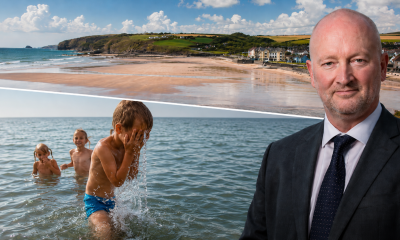
Reform MS: ‘I felt like shouting get out of the water’
Paul Marr says children playing in streams at Pembrokeshire beaches deserve better protection from pollution risks REFORM UK MS Paul...
-

 Crime6 days ago
Police appeal after reported rape at Young Farmers rally
-
Crime4 days ago
Dyfed-Powys Police rated only ‘Adequate’ in organised crime inspection
-

 News2 days ago
Biker dies and woman seriously injured in Black Mountain crash
-

 Entertainment5 days ago
Torch cuts children’s cinema tickets to £5.25 for summer
-

 Farming6 days ago
Farmers urged to protect themselves as heatwave brings health risks
-

 Farming6 days ago
Rural Wales ‘left out’ of net zero debate, warns carbon entrepreneur
-
News5 days ago
Reform MS: ‘I felt like shouting get out of the water’
-
Climate5 days ago
Welsh waters, Westminster profits: Crown Estate row reignited in Wales