


News
Presiding Officer rules Welsh Government legislation ‘outside powers’


CONTROVERSY over Labour and Plaid Cymru’s plan to ram through Senedd reform continued this week.
The Senedd’s Presiding Officer, Elin Jones, announced plans to compel political parties to rig the closed candidates lists that underpin the parties’ wish to stitch up Welsh elections were outside the Welsh Parliament’s powers.
The Labour/Plaid proposals provide that if a political party puts forward a list of two or more candidates in a Senedd constituency, they must ensure that:
- At least 50% of their candidates are women (known as the ‘minimum threshold’), and
- A woman must immediately follow all candidates who are not women unless they are last on the list (known as the ‘vertical placement criteria’).
The Bill proposes introducing rules at the constituency level and across all constituencies represented by a political party.
Suppose a political party puts forward candidates in two or more constituencies. In that case, the Bill forces it to ensure that the first or only candidate on at least half the lists submitted by a party must be a woman (known as the ‘horizontal placement criteria’).

The proposed legislation sidesteps a row on transgender women by ignoring the issue altogether. Instead, it appears to allow self-declaration.
As part of the nomination process, candidates must state whether they are women. This statement will be used to enforce the quotas. Constituency Returning Officers (CROs) will take these statements at ‘face value’, meaning that they will not investigate whether the information provided by a candidate is correct. That would mean a candidate declaring themselves a woman IS a woman.
It is an effort to sidestep the provisions of the Government of Wales Act (2006), which reserves legislation about gender recognition to Westminster.
On such shallow semantic games is Welsh democracy advanced.

However, on Monday (March 11), Llywydd Elin Jones said the Labour/Plaid legislation crossed the line into powers reserved to Westminster on a separate basis.
As with every Bill, the Llywydd must assess whether the Senedd has the power to make that law (this is known as legislative competence).
The Wales Act 2017 allows the Senedd to legislate on matters not reserved to the UK Parliament. A provision in a Senedd Bill cannot modify the law on reserved matters.

Ms Jones said: “In my view, the provisions of the Senedd Cymru (Electoral Candidate Lists) Bill, introduced on March 11, 2024, would not be within the legislative competence of the Senedd because the Bill:
a. relates to the reserved matters of equal opportunities; and
b. modifies the law on reserved matters, namely the Equality Act 2010.
In other words, the Bill proposes a law in an area of legislation controlled by Westminster.
The Llywydd’s view on legislative competence does not affect whether or not a Bill can be introduced.
It is the first time the Llywydd has stated that she considers proposed Welsh Government legislation wholly outside the Senedd’s legislative competence.
That is despite the Member in charge of the Bill, the Minister for Social Justice and Chief Whip, Jane Hutt MS, stating in an explanatory memorandum: “In my view, the provisions of the Senedd Cymru (Electoral Candidate Lists) Bill, introduced by me on March 11, 2024, would be within the legislative competence of Senedd Cymru.”
The Bill could still be passed, but the UK government’s attorney general or the Welsh government’s counsel general may challenge it in the Supreme Court.
The latter is unlikely. The former would be certain.
It is not as though Mark Drakeford’s Cabinet are unaware of the risk. It chose to separate gender quotas from the rest of its plans to increase the size of the Senedd and rig Wales’s electoral system precisely because the gender quota scheme is legislatively dubious. If it had the courage of its convictions, it would have included them in the rest of the Bill.
Picking an argument with the Westminster Government would be on brand for Welsh Labour only as long as a Conservative Government remains in power.
As an example of seeking a distraction from its failures, a row on a constitutional issue would be ideal for the Labour Party in Wales to stir up national feeling and hostility to the Conservatives (i.e. “the English”).
Nevertheless, a potential UK Labour Government is unlikely to hand a Cardiff Cabinet everything (or much of anything) on its shopping list. It is unlikely to regard reworking the UK’s complex equalities legislation as a high priority when bread-and-butter issues dominate political discourse.
Darren Millar MS, Welsh Conservative Shadow Minister for the Constitution, said: “There are huge question-marks over the legitimacy of this legislation and whether the Senedd has the competency to legislate in this area.
“Regardless of the answers to those questions, the Welsh Conservatives will oppose this Bill.
“We believe that candidates should be chosen and elected to our national parliament based on merit, not because of their self-identified gender, biological sex, sexuality, race, religion or disability.
“While we all want to see greater diversity in our politics, we will always reject any system which seeks to pit one aspect of diversity over another.”


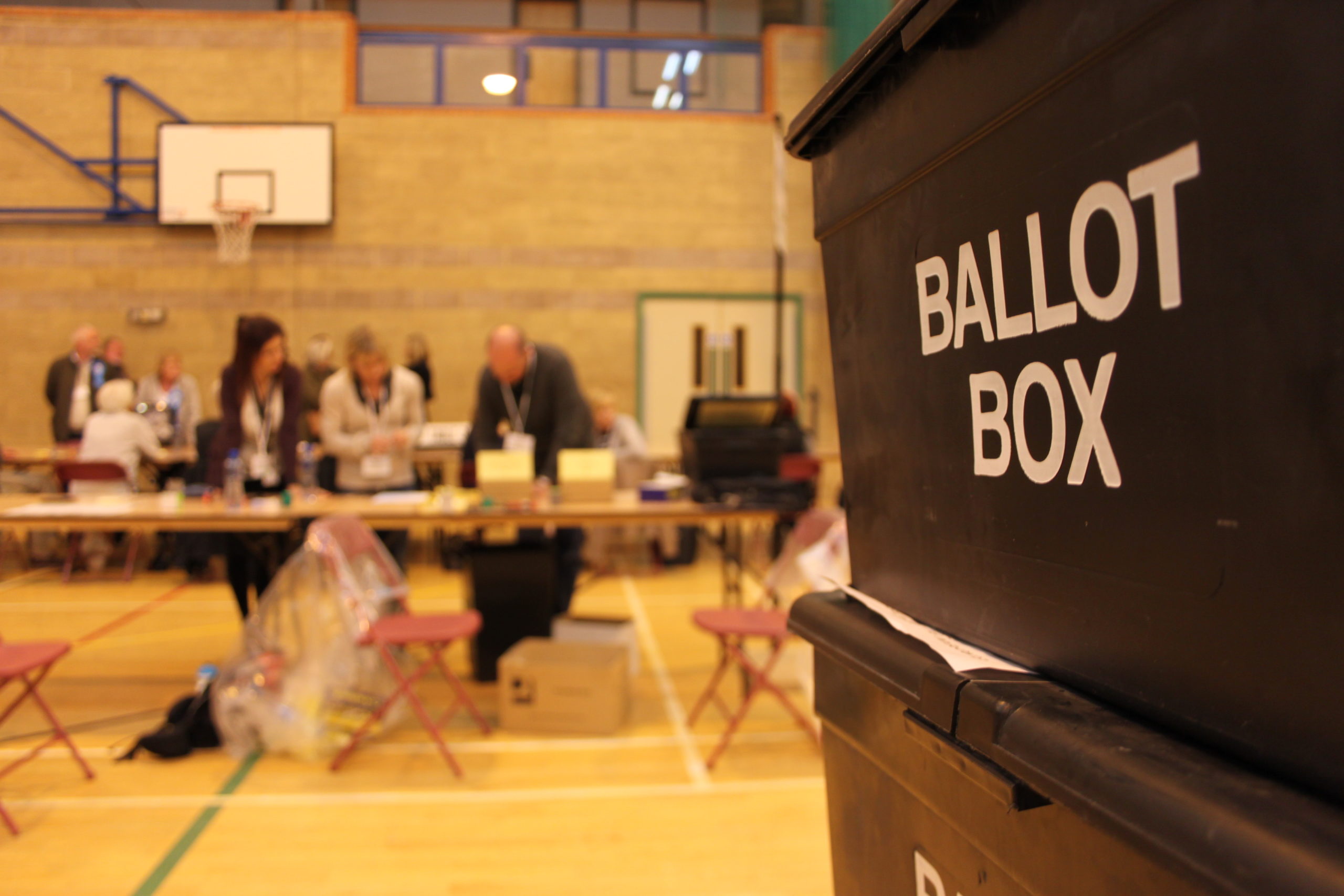
Campaign leaders criss-cross country in last-minute battle for crucial votes
WALES heads to the polls tomorrow (Thursday, May 7) after a frenetic final day of campaigning that saw party leaders, candidates and activists make one last push to win over undecided voters in what is being described as the most unpredictable Senedd election in modern Welsh history.
With polling stations due to open at 7:00am, parties spent Wednesday targeting key battleground constituencies across the country, including the new Ceredigion Penfro seat, amid growing expectations of a fragmented Senedd and a dramatic shake-up in Welsh politics.
The election is the first to be held under Wales’ new expanded Senedd system, with 96 Members of the Senedd being elected across 16 large constituencies using a proportional closed-list voting system.
Reform UK appeared to finish the campaign with significant momentum following a major rally on Tuesday attended by party leader Nigel Farage. The event drew large crowds and considerable online attention as Reform attempted to convert strong polling figures into seats in Cardiff Bay for the first time.
Farage used the rally to attack both Labour and Plaid Cymru, while positioning Reform as the party of “change” for disillusioned voters. Reform campaigners have focused heavily on immigration, cost of living pressures and opposition to what they describe as “wasteful government spending.”

Plaid Cymru leader Rhun ap Iorwerth spent the final day presenting his party as the main alternative to both Labour and Reform UK, insisting Plaid could “build a fairer Wales” while warning against what he described as “divisive politics.”
Labour figures, including First Minister Eluned Morgan and deputy leader Huw Irranca-Davies, urged voters not to “take risks” with public services, arguing only Welsh Labour could protect the NHS and local councils during a period of economic uncertainty.
Labour activists were heavily focused on turnout operations in traditional strongholds, amid polling suggesting the party could lose ground after decades as the dominant force in Welsh politics.
The Conservatives attempted to rally core voters with warnings about both Labour and Reform, while also focusing on farming, the rural economy and healthcare waiting lists.

In west Wales, Conservative candidates Paul Davies and Sam Kurtz spent the day meeting voters and carrying out final campaign visits across Pembrokeshire and Ceredigion, arguing their experience and local knowledge would be important under the new electoral system.
The Liberal Democrats and Green Party also maintained visible campaigns in several areas, hoping tactical voting and the proportional voting system could help them secure representation.
Across Wales, campaign teams handed out leaflets outside transport hubs, supermarkets and town centres, while social media campaigning intensified throughout the day.

Political analysts believe turnout could prove decisive, particularly because the new voting system means relatively small shifts in support could determine the allocation of the fifth and sixth seats in many constituencies.
The campaign has been dominated by debates over the NHS, farming, the economy, transport, tourism and the rising cost of living, alongside concerns about the future direction of Welsh devolution.
Polling stations open across Wales from 7:00am until 10:00pm on Thursday, with counting due to begin on Friday morning.
The Herald will provide live election coverage online throughout polling day and count day, including updates from count centres, candidate interviews and reaction as results emerge from across west Wales and the rest of the country.

Final poll suggests Welsh politics could be on the brink of a major realignment
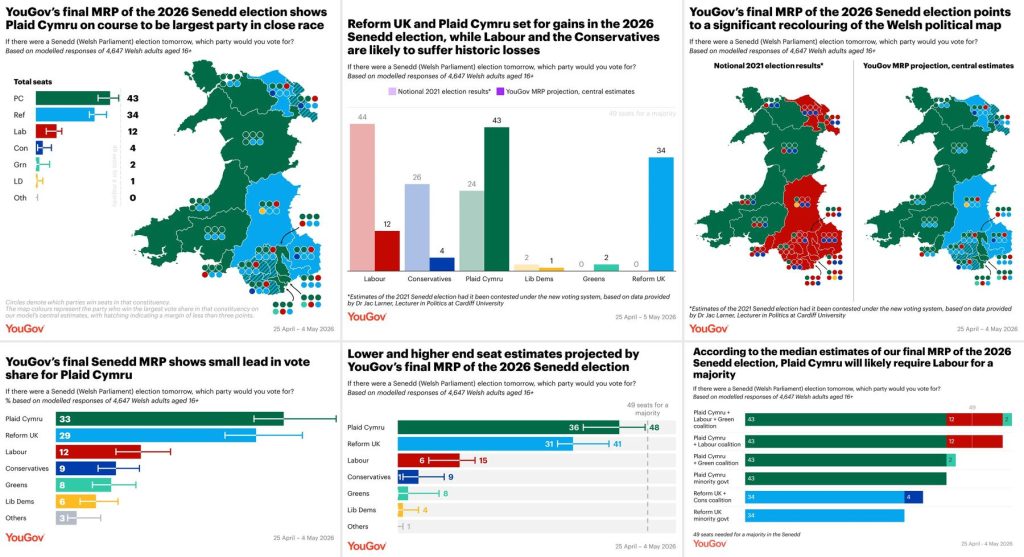
PLAID CYMRU is on course to become the largest party in the Senedd, according to the final YouGov MRP projection for ITV Cymru Wales before polling day.
The model suggests Labour’s century-long dominance of Welsh elections could be coming to an end, with Plaid projected to win 43 seats in the newly expanded 96-member Senedd.
Reform UK is forecast to finish second on 34 seats, while Labour is projected to fall to just 12.
The poll, based on responses from more than 4,600 adults between April 25 and May 4, puts Plaid Cymru on 33% of the vote, ahead of Reform UK on 29%. Labour is on 12%, the Conservatives on 9%, the Greens on 8% and the Liberal Democrats on 6%.

Labour facing major losses
The projection points to a dramatic collapse in Labour support across Wales.
YouGov’s central estimate would represent a notional loss of 32 seats for Labour compared with the 2021 result under the new electoral system.
It would also be Labour’s worst result at any major Welsh election since 1906.
The model suggests Labour may fail to top the poll in any of the 16 new Senedd constituencies, and could return no members at all in four of them.
In west Wales, Labour’s support is projected to have fallen into single figures in some areas.

First Minister Eluned Morgan, who leads Labour’s list in Ceredigion Penfro, could also be at risk if the projection proves accurate.
Reform surge
Reform UK is projected to make major gains, rising from just 1% of the vote in 2021 to 29% in the final pre-election model.
The party’s support appears to be spread widely across Wales, though it is weaker in Cardiff and strongest in parts of the south Wales valleys.

One of the most striking projections is in Pontypridd Cynon Merthyr, which includes the Merthyr Tydfil area where Keir Hardie was elected as Wales’s first Labour MP in 1900.
There, YouGov’s central estimate puts Reform UK narrowly ahead on 34%, Plaid Cymru on 33%, and Labour on 14%.
Smaller parties
The Conservatives are projected to win just four seats, which would be their weakest devolved election result.
That would leave them one short of the five members needed to form an official political group in the Senedd.
The Greens are forecast to enter the Senedd for the first time, winning two seats in Cardiff.
The Liberal Democrats are projected to win one seat in Brycheiniog Tawe Nedd, keeping Jane Dodds in the Senedd.
No majority expected
No party is projected to win the 49 seats needed for an outright majority.
YouGov’s modelling suggests Plaid Cymru would be best placed to lead the next Welsh Government, but would probably need support from another party.
Plaid and Labour together reach a majority in most of the model’s simulations, while a Plaid-Green arrangement does so far less often.
A Reform-Conservative majority appears unlikely in the projection.
Under the new D’Hondt voting system, small movements in vote share could still make a significant difference, particularly for the final seats in each constituency.
Polling stations open tomorrow, Thursday, May 7.

POLICE are appealing for witnesses after a driver died in a crash on the A44.
Dyfed-Powys Police said the collision happened at around 6:10pm on Tuesday (May 5) on the A44 between Capel Bangor and Goginan, near Aberystwyth
The crash involved a single vehicle, a white Volkswagen Golf, which was travelling eastbound towards Goginan when it left the carriageway.
Sadly, the driver died at the scene. Their next of kin have been informed and are being supported by specialist officers.
Police confirmed there were no other passengers in the vehicle.

Officers are now asking anyone who witnessed the collision, or who may have dashcam footage from the area at the time, to come forward.
Anyone with information is asked to contact Dyfed-Powys Police online, by emailing [email protected], or by calling 101.



News3 hours ago
Plaid Cymru projected to lead Senedd as Labour faces historic collapse
Final poll suggests Welsh politics could be on the brink of a major realignment PLAID CYMRU is on course to...


Community11 hours ago
Rescue bid planned for lambs stranded below Stack Rocks cliffs
Tree surgeon preparing 150ft descent after live firing delayed rescue attempt A MAJOR rescue operation is being planned this afternoon...


News13 hours ago
Bishop’s report reveals major renewal challenge at St Davids Cathedral
Formal Visitation highlights financial, structural, leadership and spiritual pressures at one of Wales’ most important religious sites ST DAVIDS CATHEDRAL...


Crime1 day ago
Farming company fined £19,000 for damaging protected wildlife site
A CARDIGAN farming company has been ordered to pay almost £20,000 after recklessly damaging a Site of Special Scientific Interest....


News1 day ago
Baby in critical condition after Fishguard emergency
Teenagers arrested as police investigate circumstances A BABY remains in hospital in a critical but stable condition after being taken...


Community2 days ago
Tenby phone signal crisis goes national as businesses warn of summer disruption
TRADERS SAY CARD PAYMENTS, TAXIS AND VISITOR SAFETY ARE BEING HIT BY ‘DEAD ZONE’ COVERAGE TENBY’S long-running mobile phone signal...

News2 days ago
Final poll puts Plaid and Reform level ahead of Senedd vote
Labour faces historic setback as new modelling points to a hung Senedd PLAID CYMRU and Reform UK are projected to...


News3 days ago
West Wales coracle fishermen raise alarm over suspected sewage pollution
A CENTURIES-old fishing tradition on the River Towy could be under threat after coracle fishermen reported suspected sewage pollution entering...


Community4 days ago
Scooter rally brings colour and nostalgia to Tenby
TENBY is buzzing with the sights and sounds of classic scooters this Bank Holiday weekend as the Welsh National Scooter...


Entertainment4 days ago
Haverfoodfest returns to Haverfordwest town centre today
HAVERFORDWEST town centre is expected to be busy today as Haverfoodfest 2026 returns for a full day of food, drink,...
-
News1 day ago
Baby in critical condition after Fishguard emergency
-

 News14 hours ago
Former housing officer admits drink-driving in Pembrokeshire retail park
-
 Crime14 hours ago
Job loss threat for convicted Pembrokeshire drug-driver
-
 Crime14 hours ago
Milford motorist disqualified for drug-driving
-

 Crime13 hours ago
Police tip-off leads to driving ban for Milford motorist
-

 Community6 days ago
Dogs removed after welfare concerns at Milford Haven property
-
 Crime13 hours ago
Delivery driver caught twice over legal drink-drive limit
-

 Community10 hours ago
Sixth-former firefighter balances schoolwork with saving lives