
Business
Crypto Investment Networks: The Future of Finance


Introduction: The Rise of Crypto Investment Networks
Crypto investment networks are revolutionizing the way investors interact with digital assets. These networks leverage blockchain technology to facilitate decentralized and transparent investment opportunities, offering an alternative to traditional financial systems. As the crypto market evolves, these networks are becoming increasingly integral, reshaping investment practices and providing new avenues for growth. For those seeking comprehensive investment education and insights, Immediate Zenar offers valuable resources to help navigate this rapidly changing landscape.
Understanding Crypto Investment Networks
Crypto investment networks are platforms that enable users to participate in cryptocurrency and blockchain-based investments. Unlike traditional financial systems, these networks operate on decentralized protocols, eliminating the need for central intermediaries. Key components include decentralized exchanges (DEXs), automated market makers (AMMs), and yield farming platforms.
Participants in these networks can engage in various activities such as trading, staking, and lending. Notable examples include Uniswap, a decentralized exchange that facilitates token swaps, and Compound, a platform that allows users to lend and borrow cryptocurrencies. These networks function through smart contracts, which are self-executing agreements coded on the blockchain, ensuring that transactions are automated and trustless.
The Technology Behind Crypto Investment Networks
Blockchain technology underpins crypto investment networks, offering a decentralized ledger that records all transactions across a distributed network of computers. This technology ensures transparency, as all participants can view the transaction history, and security, as altering the ledger requires consensus from the network.
Smart contracts enhance functionality by automating complex agreements without human intervention. For instance, in yield farming, smart contracts automatically distribute rewards based on predefined rules. Additionally, decentralized finance (DeFi) has integrated with these networks, providing innovative financial products like liquidity pools and synthetic assets, which further diversify investment opportunities.
Benefits of Participating in Crypto Investment Networks
Participation in crypto investment networks offers several advantages:
- Enhanced Transparency and Security: Blockchain’s immutable ledger and cryptographic techniques reduce the risk of fraud and manipulation. Investors can trace transactions and verify the integrity of investments in real-time.
- Access to Diverse Investment Opportunities: These networks provide exposure to a range of assets and financial products not available in traditional finance. Investors can explore new asset classes such as yield farming tokens and decentralized stablecoins, often with lower barriers to entry.
- Community and Collaboration: Crypto investment networks foster a collaborative environment where users can share insights, strategies, and experiences. This collective knowledge enhances decision-making and can lead to more informed investment choices.
Risks and Challenges
While crypto investment networks offer numerous benefits, they also present risks:
- Market Volatility and Speculation: The crypto market is notoriously volatile, with prices subject to rapid fluctuations. This volatility can impact investment stability and lead to significant losses. Investors need to employ risk management strategies and stay informed about market trends.
- Regulatory and Legal Issues: The regulatory landscape for crypto investments is still evolving. Varying regulations across countries can create compliance challenges and affect the operation of investment networks. Future regulations could impose restrictions or require changes to how networks operate.
- Technical Risks: Technical vulnerabilities, such as coding bugs in smart contracts or security breaches, pose risks to investments. Regular audits and security measures are essential to mitigate these risks and protect user assets.
Case Studies: Successful Crypto Investment Networks
Several crypto investment networks have demonstrated significant success:
- Uniswap: As one of the leading decentralized exchanges, Uniswap has enabled users to trade a vast array of tokens with minimal friction. Its automated market maker (AMM) model allows for efficient and transparent trading without relying on traditional order books.
- Compound: Compound has revolutionized lending and borrowing by using smart contracts to manage interest rates and collateral. Users can earn interest on their crypto assets or borrow funds against their holdings, showcasing the potential of decentralized finance.
- Lessons from failure cases, such as the collapse of certain DeFi projects due to security flaws or mismanagement, highlight the importance of robust security practices and due diligence. These experiences underscore the need for continuous improvement and vigilance in the crypto space.
The Future of Crypto Investment Networks
The future of crypto investment networks is marked by several emerging trends:
- Integration with AI and Machine Learning: Advanced algorithms and machine learning models are being integrated into investment strategies to enhance predictive analytics and decision-making. AI can analyze vast amounts of data to identify patterns and optimize investment strategies.
- Advances in Blockchain Technology: Innovations in blockchain technology, such as scalability solutions and new consensus mechanisms, will likely improve the efficiency and performance of crypto investment networks. These advancements can address current limitations and expand the capabilities of decentralized finance.
- Potential Market Transformations: As crypto investment networks grow, they could significantly impact traditional financial systems. The decentralization of financial services and increased accessibility may lead to a shift in how financial products and services are delivered.
How to Get Involved: A Beginner’s Guide
For those interested in participating in crypto investment networks:
- Starting with Crypto Investment Networks: Begin by researching and selecting reputable platforms. Create a wallet, choose an investment strategy, and engage with the community to stay informed about opportunities and risks.
- Resources and Tools: Utilize educational resources such as online courses, webinars, and forums to build your knowledge. Platforms like CoinGecko and DeFi Pulse provide valuable insights into market trends and network performance.
Conclusion: The Path Forward
Crypto investment networks represent a significant shift in the financial landscape, offering new opportunities and challenges. As these networks continue to evolve, they will play a crucial role in shaping the future of finance. By understanding the underlying technology, benefits, risks, and trends, investors can navigate this dynamic space and leverage its potential for growth.


A CALL to convert a former Pembrokeshire farmhouse and guesthouse into housing units has been given the go-ahead by county planners.
In an application to Pembrokeshire County Council, Dan Hildebrand, through agent GMW Design, sought approval for the subdivision of Torbant Farmhouse, Croesgoch, near Haverfordwest, to form four residential units.
A supporting statement through Johnston Planning on behalf of the applicant and agent said: “The property has historically been run as a successful guesthouse for a number of years but has recently come under new ownership. The new owner wishes to maximise the potential of the existing residential floor space through the subdivision of this generous property into four units.”
It added: “Whilst the intention is to utilise the subdivided property for residential purposes due regard is given to the 2022 changes to the use class order which in effect created new residential classes for new development in an effort to control unrestricted holiday uses in sensitive locations.
“As such a ‘free use’ is sought within use classes C3 (use as a sole/main residence), C5 (use as otherwise as a sole/main residence) and C6 (use as a commercial short term let).
“These proposed uses, which are considered to be reasonable and to be fully compliant with current planning policy (especially when one has regard to the existing use) will provide the owner with flexibility in terms of proposed occupation. Ensuring full and meaningful use of the property in the future.”
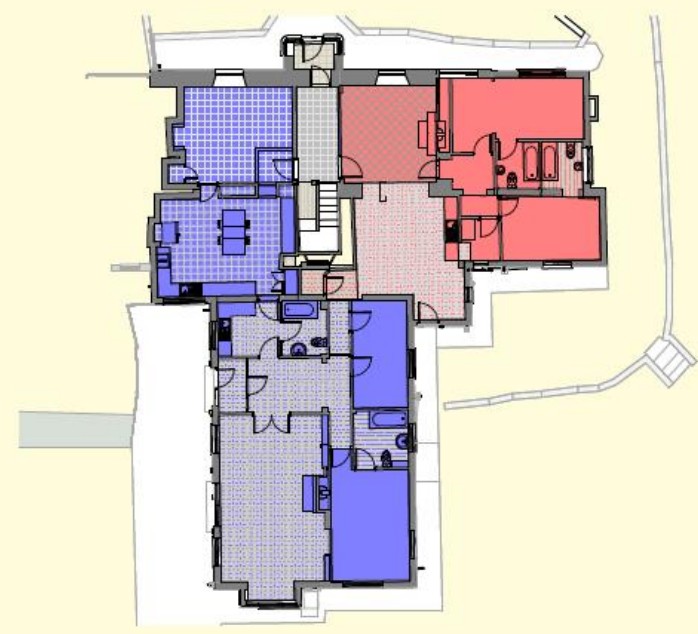
It said the property was once part of Torbant Farm, now been broken up into a number of separate properties, including Torbant Caravan Park immediately to the north.
It added the works to the property “are minimal and will have a negligible impact externally,” adding: “Internally whilst the layout will alter marginally no structural works to the property are proposed.
“In character terms therefore, there will be no discernible physical impact either to the dwelling itself or to the wider locality.”
Six objections to the scheme were received, raising concerns including harm to visual and residential amenity, ecological impact, infrastructure constraints, and claimed inaccuracies in the submitted application, as well as the application overstating available parking space “which would encroach onto shared access areas, causing obstruction and conflict between users”.
An officer report recommending approval said the scheme was amended to move car parking provision within land under the applicant’s control.
It concluded the scheme represented “an efficient use of the existing building stock,” and it “would not result in any external alterations to the host building and would not give rise to unacceptable harm to the character or appearance of the building or its wider rural setting nor the residential amenities of neighbouring occupiers”.
The application was conditionally approved by county planners.

PLANS to convert a former Pembrokeshire town centre social club into council owned social housing have been given the go-ahead.
In an application to Pembrokeshire County Council, the authority itself, through agent KEW Planning, sought a change of use of the former Manchester Club social club, Fulke Street, Milford Haven to seven social rented residential units.
The Manchester Club public house/social club closed in March 2024 due to the cost of operations rising to be more than the monetary value that the club delivered, remaining vacant since this time, and was marketed for sale before an offer from the council was accepted.
The council scheme will provide five one-bed flats, one two-bed, and one studio flat; an amended scheme from discarded initial options which included one for 12 apartments and two studio flats. The scheme revised to restrict proposed alterations to the existing building to a minimum.
The proposal includes the demolition of the single storey garage to the front, and a single-storey extension at the rear, which will allow a communal amenity area.

A supporting statement said: “The vision for this project is to provide social housing to address housing stock shortages and to give a new life to a vacant building in a central location of the town. The property will be rented to mixed aged tenants, with PCC as the corporate landlord.”
An officer report recommending approval said the site had been marketed since 2024 at £170,000, with a £150,000 offer made but was unable to be proceeded with, the price later reduced to £150,000, three offers later received including £140,000 from the council, which was accepted in April 2025.
“For the two years that this property has been marketed the market response to the property has been limited with no viable interest in retaining the building for its existing community facility use,” the report said.
It concluded: “The loss of the former community facility has been robustly justified in accordance [with planning policy], and the scheme would deliver social and economic benefits through the provision of additional housing and the re-use of a vacant building.
“The proposal would enhance the visual appearance of the site, provide an acceptable standard of residential amenity for future occupiers without undue harm to neighbouring properties, and would not give rise to unacceptable impacts in respect of highway safety, drainage, biodiversity or the historic environment.”
The application was conditionally approved.


WALES’ unemployment rate is broadly in line with the UK average, according to the latest labour market figures.
The Welsh Government said figures from the Annual Population Survey showed unemployment among people aged 16 and over in Wales at 4.5%, compared with 4.4% across the UK.
Ministers said Wales’ employment rate was also “relatively close” to its all-time high, but acknowledged that official labour market data should be treated with caution because of continuing concerns over reliability.
The figures come as the newly elected Welsh Government seeks to put productivity at the centre of its economic agenda.
A Welsh Government spokesperson said: “As a newly elected Government we are committed to driving investment, innovation and higher productivity across Wales.
“We have announced a National Productivity Goal to close the gap with the rest of the UK and help unlock the full potential of the Welsh economy.
“By focusing on productivity, we will deliver more jobs, higher pay, stronger businesses and thriving communities.”
The Government says the new goal will help shape the work of its planned Welsh innovation and development agency, including how it supports businesses, develops skills and invests in the wider economy.
However, ministers also said Wales’ labour market appears to be following similar trends to the UK as a whole.
They pointed to ongoing work by the Office for National Statistics to improve the quality of Labour Force Survey data, saying the figures should be read alongside other labour market indicators to get a clearer picture.
The Cabinet Minister for Enterprise, Connectivity and Energy, Adam Price, is seeking a meeting with the ONS to discuss the reliability of labour market data for Wales.


Motorcyclist, 22, dies in A4075 crash
A 22-year-old woman remains in hospital after two-vehicle collision A MOTORCYCLIST has died following a serious two-vehicle crash on the...


Why police will be visiting every home in Pembrokeshire
New operation aims to knock on more than 257,000 doors across Dyfed-Powys over the next three years DYFED-POWYS POLICE has...


Prisons at breaking point: MPs warn Wales is paying the price of a failing system
Frozen healthcare budgets, overcrowded jails, homelessness on release and mounting pressure on staff are undermining rehabilitation across Wales, according to...


Brexit at 10: How Britain was sold a dream that cost us dearly
A decade after the referendum, the promised benefits remain hard to find while the economic costs are increasingly difficult to...


Worcestershire man jailed after violent attack on woman in Tenby
Defendant was already serving a suspended sentence when serious assault took place A WORCESTERSHIRE man has been jailed for more...


Offshore wind ‘could bring new generation of jobs to Milford Haven’
Pembrokeshire ports and Celtic Sea projects placed at centre of Wales’ green energy ambitions MILFORD HAVEN and Pembroke Dock could...


Police officer hailed hero after midnight sea rescue in Milford Haven
PC swam 100 metres offshore to save distressed woman heard calling for help in darkness A DYFED-POWYS POLICE officer has...


Security privately arranged by Mayor at Beating of the Bounds
HAVERFORDWEST TOWN COUNCIL has confirmed that security personnel seen at this year’s Beating of the Bounds were privately arranged and...


Celtic Freeport five-year plan puts Milford Haven at centre of green energy future
Strategy promises investment, skilled jobs and new supply chains, but major barriers remain over grid connections, planning and delivery THE...


Closure of Ysgol Clydau approved after emotional council debate
COUNCILLORS WARNED RURAL COMMUNITIES WILL REMEMBER DECISION PEMBROKESHIRE councillors have voted to close Ysgol Clydau following an emotional debate over...
-

 Community4 days ago
Pembrokeshire Chess Club crowned Welsh champions
-
Local Government2 days ago
Security privately arranged by Mayor at Beating of the Bounds
-

 Crime7 hours ago
Milford Haven man jailed for breaching domestic violence protection order
-

 Education6 days ago
Diocese threatens legal action as Manorbier school closure battle intensifies
-

 Crime2 days ago
Man wanted by court after failing to attend hearing over alleged shop thefts
-

 Local Government6 days ago
Taxi suspended after county-wide licensing checks
-
 Crime2 days ago
Man banned from roads after drink-driving offence
-

 Crime6 days ago
Currys worker denies stealing £2,500 of store stock